
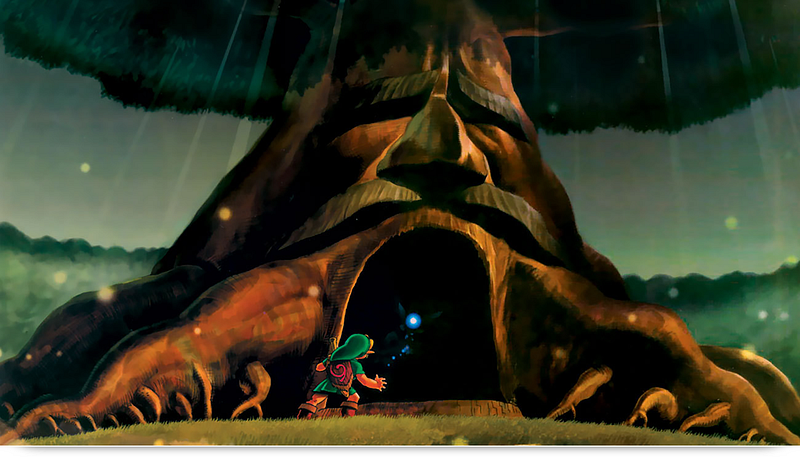
The Zelda That Changed My View of Gaming Forever
Ocarina of Time redefined video games for me
1998. I purchased The Legend of Zelda: Ocarina of Time. And it completely changed my perspective on video games. Prior to playing it, the only single-player games I’d experienced on the Nintendo 64 were Super Mario 64 and Star Fox 64. And, despite having owned several games for the platform, I wasn’t really a completionist (and was certainly never interested in game secrets or Easter eggs).
Early on in Ocarina of Time, there was plenty of dialogue and exposition to establish the world of Hyrule. Honestly, it felt boring initially. But the adventure really took off once it was time for the first dungeon.
Speaking of dungeons; each one featured a new item that was required in order to progress through said dungeon. These items also served the double purpose of opening up new areas in the game as well, allowing you to progress the story. At the time, I thought the experience was both novel and refreshing — I loved every aspect of it.
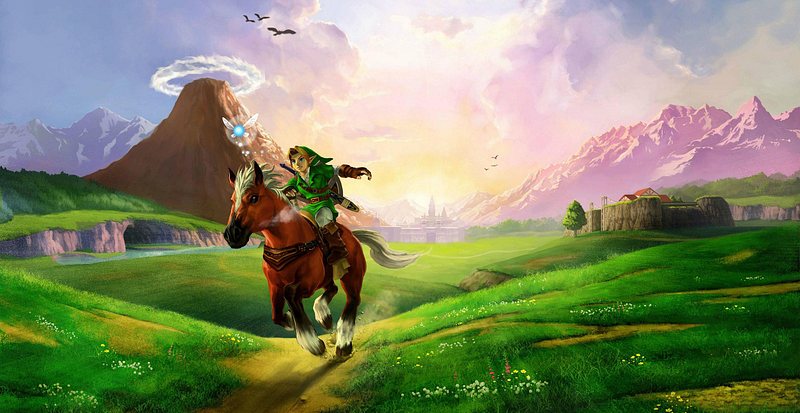
I remember there being surprise around every corner. I’d gotten stuck at Zora’s Domain — I didn’t know how to continue with the story and I couldn’t understand any of the clues. The game was still fun, though, and the side activities were almost as good as the main story activities. I remember swinging an empty bottle around while in Zora’s Domain, which triggered a prompt telling me that I’d caught a fish. I didn’t even know this was possible! The obvious question was: what do I do with the fish in a bottle?
I had no idea what to do with the fish. I knew it had something to do with the big fish in Zora’s Fountain…but what? I accidentally dropped the fish in front of Jabu-Jabu (the huge fish in the fountain), which proceeded to open its mouth, swallowing both the fish and me in one gulp. Here I was in the third dungeon…inside Jabu-Jabu’s belly! It was a brilliant puzzle requiring lateral thinking; I felt stupid that it took me so long to get it.
But this was the beauty of the game. Everything had a purpose, and there were subtle hints every step of the way to nudge you forward. Rarely did the game put you on the spot and pressure you — it was possible to take things at your own pace and explore as you saw fit. You might learn a song that you first thing is meaningless, but you then learn that it’s helpful in some situation later in the game.
Speaking of later in the game: the whole theme and dynamic of the experience changes after the Temple of Time. Seven years have passed, and Link is now a young adult. He’s changed, but so has the world around him. Instead of completing dungeons, you’re now tackling temples. The same general formula applies, though (although now, a new piece of gear will become available after completing each temple).
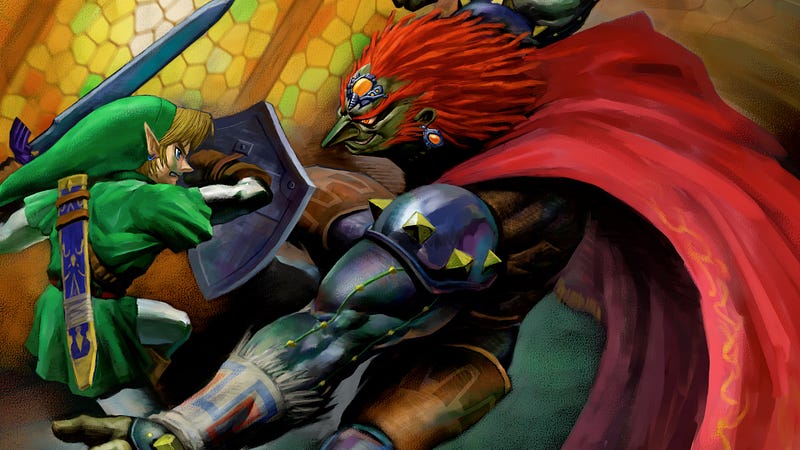
One of the most interesting parts of the game involves a side quest in which Link has to go back-and-forth in time. You pick up an item from the future, go back in time to give it to an NPC, then go back into the future, search for that same NPC, talk to him, and then suddenly the side quest is available. There is a sense in which Ocarina of Time used time itself as a game mechanic — not just in terms of moving from the past to the future and back again, but also the day/night cycle, which was genuinely unique in the late ’90s. NPCs will adopt different behaviors depending on the time of day, as well as whether or not you’re encountering them in the past (young Link) or the future (adult Link). And of course, your trusty ocarina gave you control over the day/night cycle as well, which was useful for certain puzzles.
This was the game that put me into a full completionist mindset. I loved it so much that I finished every little side quest, mini-game, and uncovered every secret. Ocarina of Time, for this reason, has become the standard against which I judge all other video games. And I must admit that with some very rare exceptions, I find that a lot of modern games still don’t quite match up to the experience I had with Ocarina of Time. It’s not that modern games are bad per se, it’s just that Nintendo really hit it out of the park with Ocarina of Time — it was a highly ambitious game in 1998, and it’s still a genuinely great experience in 2020.
What do you think? Did Ocarina of Time change your perspective on gaming? Please feel free to let me know via the comments!