
The Worst Story Ever Told
Why is Original Sin Still a Thing?
So I was at the Vatican. Not strolling through St. Peter’s or the museums, but sitting with my notepad in a Pontifical college meeting room in Vatican City. A Pontifical college is one of the dozen or so hives in Rome that tends a nation’s hand-selected priestly larvae who will emerge from their Roman cocoons and rise through the church’s food chain and over time take on distinguishing colors — purples and reds and white lace tunics and the bling of bishops and cardinals, and a multitude of funny hats.
I’m not here because I know how to party. I have questions about Christianity’s relationship with the Earth that I can’t seem to get answered.
I was interviewing a dozen American seminarians for a piece on the Church and its environmental responsibility. This was at the end of the reign of Pope John Paul II, who’d blow it out his cassock about caring for the Earth while having sausages flown in special from Poland and collaborating with Islamic theocracies to torpedo United Nations family planning programs. Trust me, there hasn’t been much real progress since, Francis or not.
The college was wary of interviews because the Boston Globe had recently unleashed the story of priest sexual abuse and cover-up in the Archdiocese of Boston. (I was asked to remind my subjects that I was not there to talk about sexual molestation.) The college administration probably figured I was friendly, since they knew of my monsignor uncle, and since I am obviously (to a Catholic) named after some A-list virgins. I arrived early for my appointment, was buzzed through the gates and escorted by a priest down a long secluded marble colonnade bordered by palm trees and views of pined Roman hills. Everyone walking around the college halls or depicted in portraits or saint statues was a man except for Mary, a virgin, and I was dressed like one in a modest black skirt and white linen blouse and pearls to hide my true atheist lizard identity.
About 20 minutes into our group chat in a sunny room, it was evident that these seminarians were smart, friendly, thoughtful guys, and that Earth wasn’t on their radar. None had read any of the eco-theologians I mentioned, or seemed curious. I asked, “People in your future parishes are going to be watching you and listening to you. If the Pope says we should protect the planet, how do you see your role in that?” One guy’s comment pretty much characterized the group gestalt: “The environment’s really not our primary job. We can recycle or something but we’re here to help people live with God and get into heaven.”
And isn’t that the problem, I thought. Those things are so separate, and we are so separate from them: the God thing and the Nature thing, the Human and Nature thing, the Heaven and Earth thing, the Spirit and Matter thing, all of which are the same thing. Separation, and the cloaked, wrenching pain of it, is the problem to begin with.
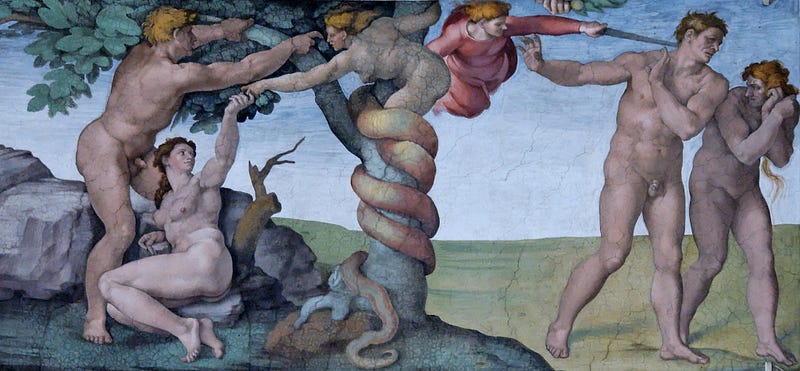
And in Western Christianity, Catholic or Protestant, separation begins in the Beginning, in Original Sin.
Several seminarians had stayed for more detailed conversations. I wrapped up with Jack and Phil. Before the seminary, Jack had graduated from Harvard and Phil had taught physics. I asked them, “OK, knowing what we all know about evolution, why is there still this dogma of Original Sin? The Church accepts evolution; so if we evolved from bacteria all the way to hominids, what was Original Sin and who committed it? And who even knew?”
We sat there for a minute. You could almost hear the tumblers clicking. And then Phil said, “I forget where I read this, but when Man” (they talked about Man a lot) “when Man first was ensouled, and reached consciousness, his first act was a sinful one. He took a stick or a rock in his hand and brought it down on another man and killed him, and that was Original Sin.”
And there was this pause, and Jack turned to Phil and said sheepishly, “Uh, Phil…I think you’re thinking of 2001: A Space Odyssey.” Uncomfortable silence.
Because it doesn’t fit. Not any more, not with what we know, this idea of “the Fall” and “the sin of our first parents” passed along in perpetuity. Whatever the size of your theological shoehorn, not even a physics teacher can stuff the mass of what we know about evolution, emergence, and science, and about other cultures’ beliefs, into Christianity’s tiny glass slipper of Original Sin and salvation.
Put A Lid On It
We were in religion class, Medieval and Reformation Thought, at the end of the grad school semester. A Big 10 Midwest research university, early 2000s. We were a mixed bag from all over, from undergraduates to grad students.
We were wrapping up a survey of different strains of European Protestant reformers. Luther, Calvin, Bullinger, Zwingli, where they differ, where they agree. All of this got laid out on the chalkboard.
I looked at the chalk menu of Protestant denominations and saw “Original Sin” was a major ingredient in each column (minor tweaks aside). I raised my hand and asked how much of the belief in Original Sin has remained consistent up till now.
The professor replied, matter-of-factly, “These views on Original Sin have remained quite consistent,” and turned away.
So I quickly asked, “But why is that? I mean, in the last 500 years we’ve learned that humans evolved on Earth, so there goes any literal reading of Genesis and Adam and Eve and the Fall. Even if you want to say the story is allegorical for how flawed humans are, how do you know that’s nature rather than nurture? A psychologist could say, if you tell somebody every Sunday morning from birth that they’re a spiritual trainwreck,” (the professor’s own shorthand for Augustine’s view) “you usually wind up with a spiritual trainwreck. How do these religions maintain a belief in Original Sin? Why do they do it?”
The professor said offhandedly, “Well, probably because a lot of people believe it.”
“OK, but I’m not talking about people in Kansas,” I cracked. Laughs from the back of the room. (Kansas, not that far away, had just voted to restore public school teaching of Darwin and evolution, after removing the topics from state teaching standards in favor of creationist “alternatives.”)
An undergrad spoke up. Her voice was emotional: “You believe it because it’s your faith!!”
We moved on, my question left dangling in the air. Later that week, when I dropped by the professor’s office to discuss a paper, he reprimanded me. The young woman who had spoken about her faith had complained I was offensive. He grumbled from his office chair, “We’ve got two weeks left in the semester. Can you keep a lid on it for two weeks?” I felt a wobbly rush in the legs. “But this isn’t a bible college — we’re studying this academically,” I said. “I didn’t mean to offend anybody. But Kansas — come on!”
“Two weeks, Maria,” as I left his office.
It’s not like I was treading brave new ground here. I was just another of the nameless folks (and some named) who have believed Original Sin and the salvation market it created was a transformatively bad idea.
Augustine of Hippo, building on Paul, had established Original Sin in the 4th century. Augustine then spent his later years pummeling the British theologian Pelagius for believing that humans could be good without a death on the cross. In a 12th Century theological cagefight, star philosopher Peter Abelard and Cistercian power-abbot Bernard of Clairvaux debated, among other of Abelard’s “heresies,” whether Jesus’ death on the cross was an example of an emptying love for humanity, or, as Bernard insisted, an “objective transaction” needed to redeem us. Abelard’s books were burned. He was silenced for life.
In 2018, Episcopal Bishop John Shelby Spong wrote, “The entire superstructure of Christianity is built on a false premise. We are not fallen sinners, indelibly infected with Original Sin. Rather we are incomplete people, yearning to be made whole.” I would add, “We probably feel so incomplete because we’ve been told for 1700 years that we’re perverted and far from home.”
Why does it even matter that Original Sin is still a thing?
Stories tell us how to live and what to value. It’s a bummer for everybody to base a culture’s cosmology on humans being broken. Other cultures’ creation myths tell of deities dancing the world into being, co-creating with consorts and natural forces. Which sure beats “God made you in paradise, you blew it, you pissed off the Big Guy and ruined it for everyone.” The Western Christian story focuses on original perfection, obedience to one god, and punishment for disobedience. As Joseph Campbell saw it, “It’s a killing story.”
It doesn’t work as allegory, either. Where in the timeline does the allegory stop? Does it shift into literalness just as Jesus shows up, because he needs to suffer physically?
It’s contagious. Original Sin has been called “the red sock in the laundry of Western culture” for how it colors childrearing, psychological health, and law. Here’s US Secretary of State Mike Pompeo in 2019 on why we need religion: “Because man is fallen, we don’t automatically conform ourselves to moral rules…”
The high-stakes focus on achieving eternal salvation for your soul is an alienating agent. For the Jews, “salvation” figured as fulfillment in the tribal, societal sphere. Christianity narrows the attention to your solo relationship with God, and whether you’re checking those boxes toward your salvation.
It’s a poor excuse for evil. Since this God is perfect, evil must come from someone else — humanity and Satan. Many other cultures don’t agree: The Dalai Lama was asked once how Tibetan Buddhism would describe Western ideas of “sin” and “evil.” He answered, “ignorance.” Ignorance is more fixable than evil. No wonder, in his first visits to the West, he was struck by how guilty everyone was.
Meanwhile, Calvin, in his Institutes of Religion, still considered a founding Protestant document, calls Original Sin a “hereditary deformity.” Because of it humans are “so entirely alienated from the righteousness of God that he cannot conceive, desire, or design any thing but what is wicked, distorted, foul, impure, and iniquitous; that his heart is so thoroughly envenomed by sin…that if some men occasionally make a show of goodness, their mind is ever interwoven with hypocrisy and deceit, their soul inwardly bound with the fetters of wickedness.”
Which is what makes Original Sin such a handy sales funnel for Christianity. Here’s the pitch: You suck. You have sucked since before you were born. You need Salvation or you’ll burn eternally. Only Jesus can save you. Only we can bring you to Jesus. Something about love. This offer won’t last long — and neither will you. We need to keep in touch.
Worst of all, the Original Sin concept harms the Earth. Years in the environmental trenches, and earlier years in the tar pits of Catholic schooling, have convinced me that the religion problem caused the environmental one. If our religion tells us we’re so bad we’re locked out from our totally fabulous real home, and Earth’s “valley of tears” is just our waiting room for that eternal paradise, how are we going to treat the Earth?
Like “fuck it, it’s a rental,” that’s how.
Like a coked-up death metal band treats a hotel room the last night on tour.
Or to quote Evangelical Christian and former U.S. Secretary of the Interior James Watt: “We don’t have to protect the environment; the Second Coming is at hand.”
As Lakota Sioux scholar Vine Deloria, Jr. said:
“It is doubtful if Western Christians can change their understanding of creation at this point…Their religion is firmly grounded in their escape from a fallen nature, and it is highly unlikely to suppose at this late date that they can find a reconciliation with nature while maintaining the remainder of their theological understanding of salvation.”
Enough. Let’s live and believe as we are: an intelligent creature, made from Earth, who makes mistakes, and who reconciles them as a member of Earth.
Selected Sources
Abelard, Peter. “Exposition of the Epistle to the Romans” (An Excerpt from the Second Book)/ Trans. And Ed. Eugene Fairweather. Philadelphia, the Westminster Press, 1961.
Abelard, Peter. “Prologue to Sic et Non.” Medieval Sourcebook. Fordham University. www.fordham.edu/halsall/source/1120abelard. html
St. Augustine’s Anti-Pelagian Works. Ed. Philip Schaff. T&T Clark, Edinburgh. 1896. [Full text: https://books.google.com/books?id=pQ2sDgAAQBAJ&pg=PA3&source=gbs_selected_pages&cad=3#v=onepage&q&f=false]
Bernard of Clairvaux. “Letter to Pope Innocent II Concerning Certain Heresies of Peter Abelard.” Life and Teaching of St. Bernard. Ailbe J. Luddy, O. Cist. Dublin: M.H. Gill & Son. 1950
Jean Calvin, The Institutes of the Christian Religion Book the 2nd, Chapter 5. [Full text:
http://www.ntslibrary.com/PDF%20Books/Calvin%20Institutes%20of%20Christian%20Religion.pdf]
Vine Deloria, Jr. God is Red: A Native View of Religion 30th Anniversary Edition. Fulcrum Publishing, Golden, CO. 2003.
John Shelby Spong. Unbelievable: Why Neither Ancient Creeds Nor the Reformation Can Produce a Living Faith Today. Harper Collins, New York. 2018.