
The Worst Side Effect of Narcissistic Abuse
It’s not called toxic as a metaphor…
The worst side effect of narcissistic abuse is that IT KILLS.
Narcissistic abuse serves one purpose for the narcissist:
SURVIVAL.

The disorder operates on the denial of shame: it is an emotional disability.
The emotional part of their brain is stunted to the age of toddler years: they can only see the world in black/white terms: all good or all bad.
To survive, they must be all good.
PERFECT, IN CONTROL, ENTITLED, ADORED BY ALL:
The smartest, most beautiful, most righteous, most important person in the world.
Due to their split thinking, to be anything less than that is to be the most WORTHLESS person in the world.
Which means, to DIE.
Split thinking means things are all good or all bad — there’s no nuance, no in between, no room for anything but perfect superiority or utter inferiority.
This is why they become suicidal in a collapse.
They survive entirely by fantasy and denial.
The narcissistic abuse serves to offload shame: they give it to someone the narcissist has convinced themselves DESERVES IT.
Therefore, the abuse does to the victim what the abuser is protecting themselves from shame doing to them:
IT KILLS THEM.
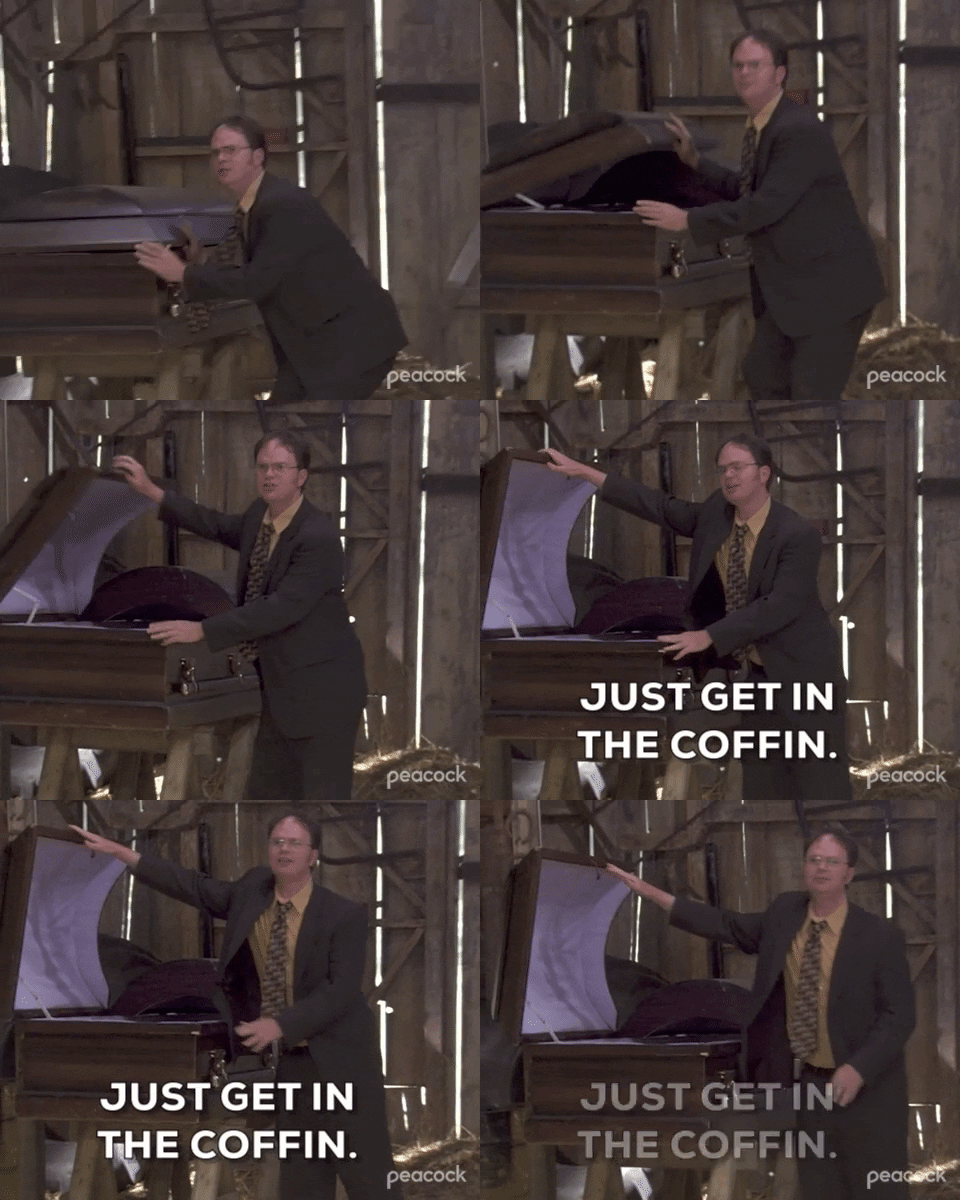
SHAME IS TOXIC AND THE BRAIN CANNOT SURVIVE IT.
It kills in a variety of ways…
1) In a rage, as the narcissist recovers from a collapse and seeks revenge by redirecting blame on the person who made them face their true self, the narcissist will sometimes MURDER in order to feel relief of shame.
In this scenario, the narcissist gets relief by winning, thus restoring their grandiosity.
The victim has made them face an undeniable shame, which plummeted them into a terrifying collapse, and they believe their fantasy will be restored simply by you dying.
Therefore, the source that made them face their shame no longer exists.
And though they know they killed someone, they’re proud.
They believe it was deserved revenge; it makes them feel powerful and grandiose.
It’s even better if they get away with it.
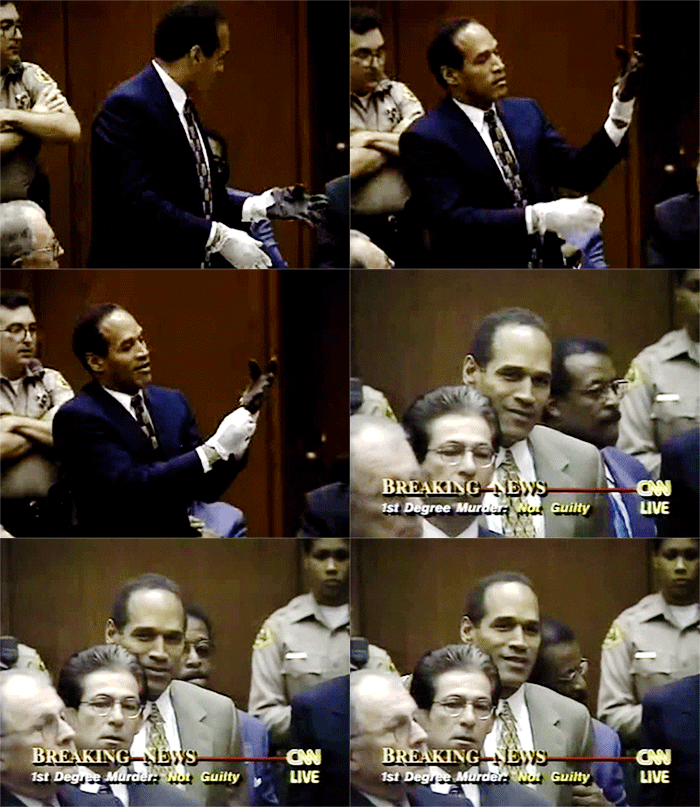
Roughly 40% of murders in the U.S. go unsolved. And some convictions are innocent people.
In the U.S. a rape victim has a higher chance of going to prison for killing their rapist than a rapist does for raping. (.5% conviction rate).
I’ve had several narcissists directly attempt to kill me in a rage. My mother was the first, and it was my worst borderline collapse when she did so.
Borderlines are conditioned to believe abuse is deserved and have high tolerance rates, so when we collapse, it has to be really bad.
After particularly sadistic abuses or attempts on our lives, WE REALLY SNAP.
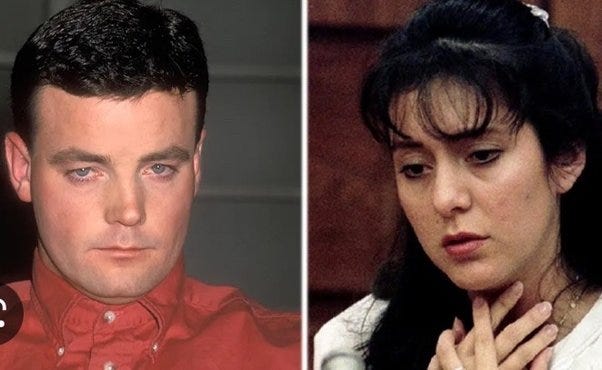
Remember Lorena Bobbitt, the woman who cut off her husband’s penis after he assaulted her one too many times?
The abuser and their obedient scapegoat. A beaten puppy that just keeps running back and being loving, until one day it just bites your testicles off.
I pulled a knife on my mother after she strangled me until I nearly passed out, and in that moment, I was resigned to prison for life: I was absolutely going to kill my mother. Had my dad not intervened, I’d have done it.
After, I was totally shocked: I couldn’t believe I nearly killed my own family, no matter what she’d done.
I wasn’t myself. Nothing in me wants to kill anyone.
So I felt deeply ashamed, reverting back to the borderline baseline: I am unlovable.
But when the narcissist kills, it’s to go back to the narcissist baseline: I am the best in the world.
For a person with empathy, abuse brings shame, but for a person without empathy, abuse brings relief.
After I did that, I was so overcome with shame, I attempted suicide. Which leads to the next point…
2) It kills by driving victims to suicide.
80% of borderlines, who are victims of lifelong narcissistic abuse, attempt or idealize suicide.
Our average life expectancy is 39.
Many victims in marriages, especially with covert narcissists whose abuses they don’t recognize as abuse (because it is either secret or internalized and easily excused), end their marriages in suicide, having no idea why they feel so unloved and miserable.
The narcissist can’t endure the emotional state of shame for more than a couple days of a collapse before they revert to rage and projection, but people with empathy can process shame longer, having more emotional intelligence: they can endure it longer.
But shame and being unloved is TOXIC AND UNSURVIVABLE for ANY human being.
It eventually leads the brain to one conclusion: to identify the self as the predator and to eliminate the predator to end the suffering.
And sometimes, as with my first love as a teenager, and an attempt by my father, the NPD leads them to kill themselves.
NPD affects men at higher rates than women; men resist therapy at higher rates than women, insisting they don’t need it and it’s for emotional people.
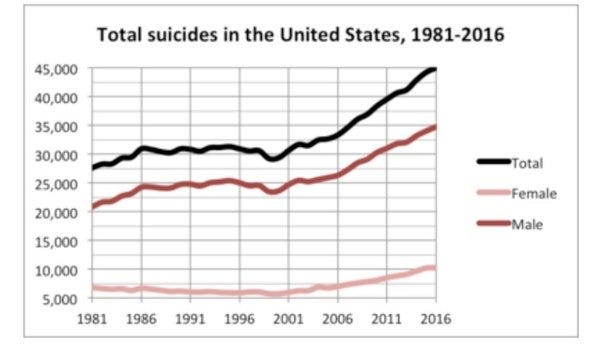
And men kill themselves at 3x the rates of women.
The root we aren’t talking about as a culture in this public health crisis of rising suicides is NPD and ASPD.
My first suicide attempt as a borderline (all cluster b’s have their disorders lifelong, as our narcissist cycle of abuse begins at birth) was at 8 years old.
I attempted to hang myself from a ceiling fan.
I had several times in which I came very close or attempted suicide throughout my life. Whenever I was suicidal, the narcissists in my life — my sister, parents, favorite people enmeshed narcissist friends, or narcissist partners — would increase psychological abuses or initiate sudden discards to push me to suicide.
I was most often told I was crazy and too sensitive.
This is, of course, a narcissist projection. They are the ones too emotional and too sensitive for shame; that’s why they must project it.
To watch you suffer makes them feel better.
They watch you psychologically deteriorate and it makes them feel more sane and intelligent.
It regulates their emotions. It also diminishes anything they may have felt jealous of.
You become physically ugly, you gain or lose weight, you break out in stress acne, you can’t be creative, you can’t be successful, so…
YOU CAN’T BE BETTER THAN THEM IN ANY WAY.
You protect the narcissist’s fantasy by deteriorating.

One favorite person enmeshment I had with a narcissist had several suicides of partners in her past.
She didn’t recognize what she was doing, but when I witnessed her collapses when partners left her, she used to say, “I think everyone I love is going to kill themselves. Why do so many around me kill themselves?”
In collapses, she also confessed to me that she molested her brothers as a child. I soothed her by saying the truth: a child that molests was molested.
She confessed horrific shames in collapse states: it was brutal to watch her face her realities. The pain was severe.
As her FP, I didn’t believe she caused these suicides in any way.
…Then I became very suicidal, and she abused me so shockingly and blatantly.
And then discarded me unexpectedly.
I had a suicide attempt then. Even after the attempt, I couldn’t recognize her NPD for years of no contact.
One day, I finally woke up to it and contacted her exes to confirm I wasn’t crazy.
They all reported really horrific physical, sexual, and emotional abuse, as well as theft of money and cheating, things I had never imagined from her.
I’d been an oblivious flying monkey, and it nearly cost me my life.
3) It kills through illness.
The connection between trauma and the body is far understated in our understanding of health.
There is much research on this, but not much general knowledge in the public.
When your brain has to live with shame, and you do not resolve the trauma, it roots elsewhere in your body.
Everyone I know in narcissistic relationships degenerated health wise, and some DIED.
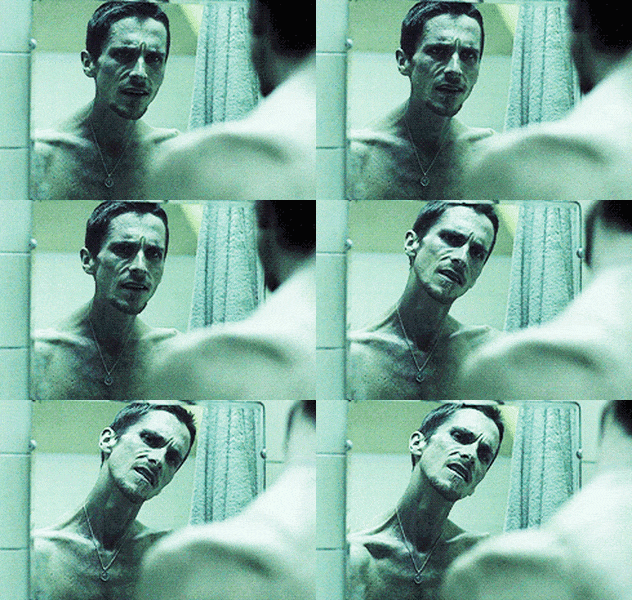
My grandmother was a borderline in a physically and emotionally abusive marriage with an NPD daughter: she died from cancer in her 40s.
I had a former student who knows she was raised by a narcissist, and I’m positive she was an unaware borderline in a marriage with a covert narcissist.
She died from breast cancer in her 20s.
With one of my best friends, I watch her husband covertly abuse her left and right. She thinks he is a saint and blames herself for being “too masculine.”
She mysteriously went partially blind and had to get disability accommodations. She is wholly dependent on him.
I had c-diff that nearly killed me for a year and a half. It’s something usually easily treated with antibiotics that only kills old people.
I had kidney infections; stints of pneumonia for months.
No matter how healthy I ate, I fell into chronic illness when suffering narcissistic abuse.
When you are ill is also exactly when they cheat on you, discard you, or betray you shockingly.
4) It kills through addiction.
The trauma bond cycle of abuse is as strong as a heroin addiction.
Many victims go through physical withdrawals to be discarded.
All cluster b’s are prone to rechanneling and numbing their pain through drugs.
And it takes a lot of us out.
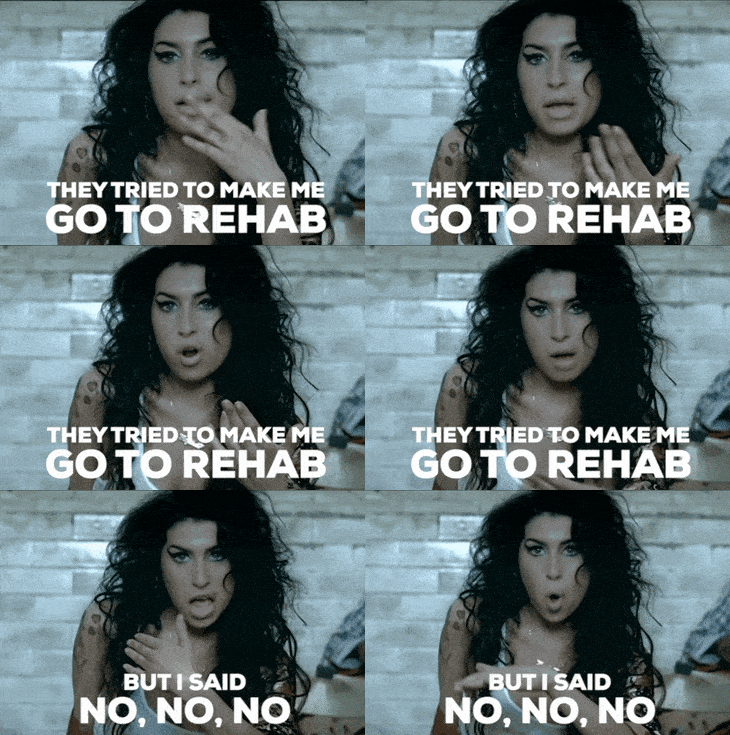
(Famous Borderline 👆🏼)
Especially in a culture that criminalizes drugs rather than treats mental health problems…
5) It kills through greed and power and senseless violence.
Wars are waged by leaders with grandiosity and NPD/ASPD. They choose whole swathes of people as scapegoats.
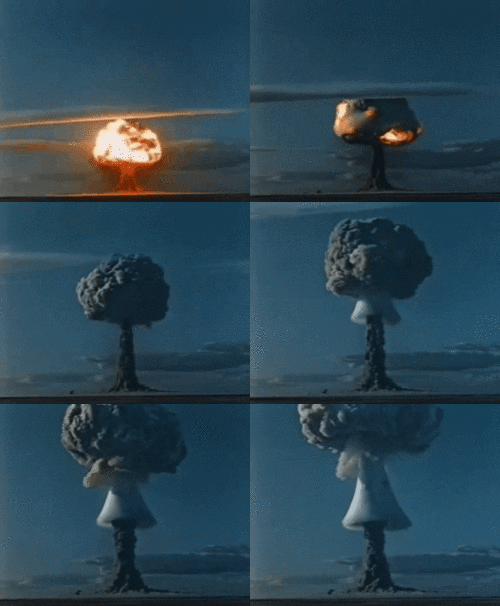
The poor are killed by wealthy policy makers and corporate CEOs with NPD/ASPD.
Genocides are enacted by leaders with NPD/ASPD.
People’s careers and livelihoods are shattered by bosses with NPD/ASPD.
Mass shootings are enacted by people with access to weapons with NPD/ASPD.
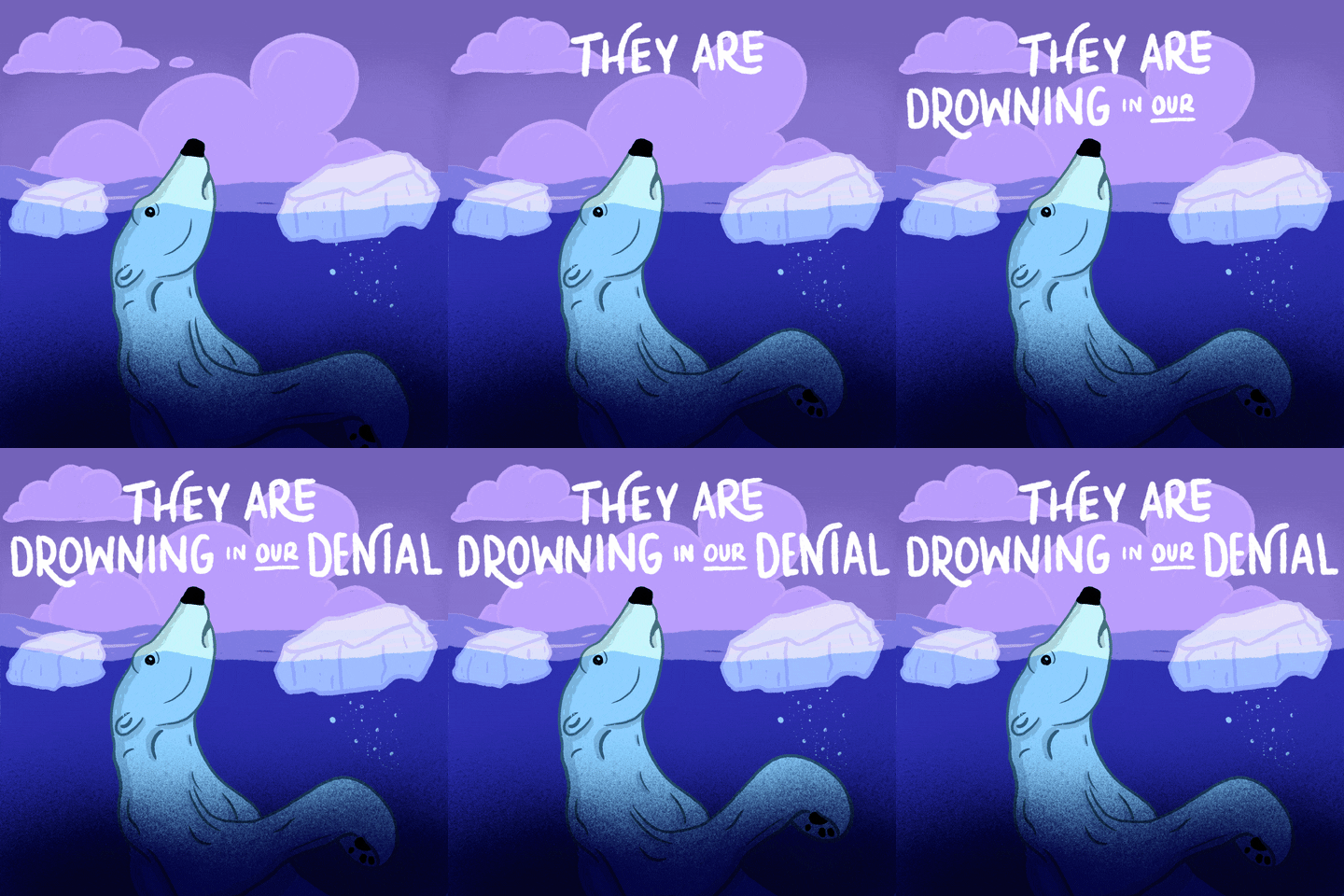
We will all be killed by climate change due to the people with NPD with power.
It kills by serial killers with NPD/ASPD, police with NPD who kill civilians, serial rapists and stalkers with NPD/ASPD who drive victims to suicide.
It spreads in families, and grows with each generation and it kills, it kills, and it kills.
Until we wake up to the narcissist fantasy of their power and take our power back.
Until we recognize that we are a part of a whole.
This is the lesson to learn from NPDs:
An attack on anyone is always an ATTACK ON THE SELF.
This means: We need each other.
We need LOVE AND EMPATHY to SURVIVE AS A SPECIES.
We are a social species that is the top of the food chain not because we are the strongest, but because we work together in large numbers: to leave NPD untreated in our culture is to drive us to collapse, to EXTINCTION.
BUT…
…I think sometimes narcissists may try very hard NOT to kill you.
My favorite person enmeshment with the girl surrounded by suicides spanned nine years of daily, all day long texting, hours of phone calls, and traveling the world.
So, this narcissistic abuse relationship was more intimate to me than any romantic one; therefore, I’ve analyzed and agonized over it.
I very often saw her aware of and agonizing over her behavior.
She is someone who makes me think there could be hope for a treatment or cure for this problem.
She was extraordinarily intelligent, and in extraordinary pain.
I heard her agonize on the phone that she was giving someone the cold shoulder, and she knew that was abusive, but she feared what she would say or do if she didn’t.
She used to always say it scared her how easily she could cut people off.
Once, she was helping me move, and she said something that just wounded me so deeply, and I started to cry.
I looked at her pleadingly and said, “Why do you keep saying things like this? What have I done? I feel like you secretly hate me! Just tell me why!!”
I will never forget that LOOK: her lips trembled.
TERROR.
She breathed slowly, clearly trying to calm herself. Then she looked at me clear eyed and said,
“You are not the first person to give me this feedback on myself. When you ask me the question of what you’ve done for me to say this, I search in my mind, and I can’t find anything. You’re right.“
Her voice quivered, “I think something is wrong with my mental health. All I can tell you is I’m trying to figure it out. And I can’t lose you.”
HONESTY.
I instantly forgave her. Her inner child was so bare and vulnerable.
When she discarded me, the last thing she said to me was, “You drive everyone who loves you away.”
Yes, I’d had many NPD relationships that ended in flames with abusive men, and my relationship to my sister was strained, but she knew better than anyone how much I cried over that.And I’ve always had a lot of friends who didn’t have NPD. I had a lot of love from coworkers and students too.
She was projecting that onto me: her SHAME.
Their accusations are their confessions.
She texted immediately after:
“I AM SO SORRY. I DID NOT MEAN THAT. This is why we can’t be friends anymore. I can’t control myself from saying cruel things to you that are not true. I have to save you from me. You’ve been so important to my life. I hope you will remember me positively.”
I kept thinking of those words, “I have to save you from me…”

I interpreted this as I am unlovable.
Why couldn’t she control herself from saying cruel things to me? What terrible thing had I done???
This person who I loved unconditionally saw nothing redeeming in me to work on our friendship?
Just before that happened, she and I read the last letters of Sylvia Plath, my favorite poet, just before her suicide on the phone out loud. There were 13 letters. We went through one a night for 13 days. We talked about them at length.
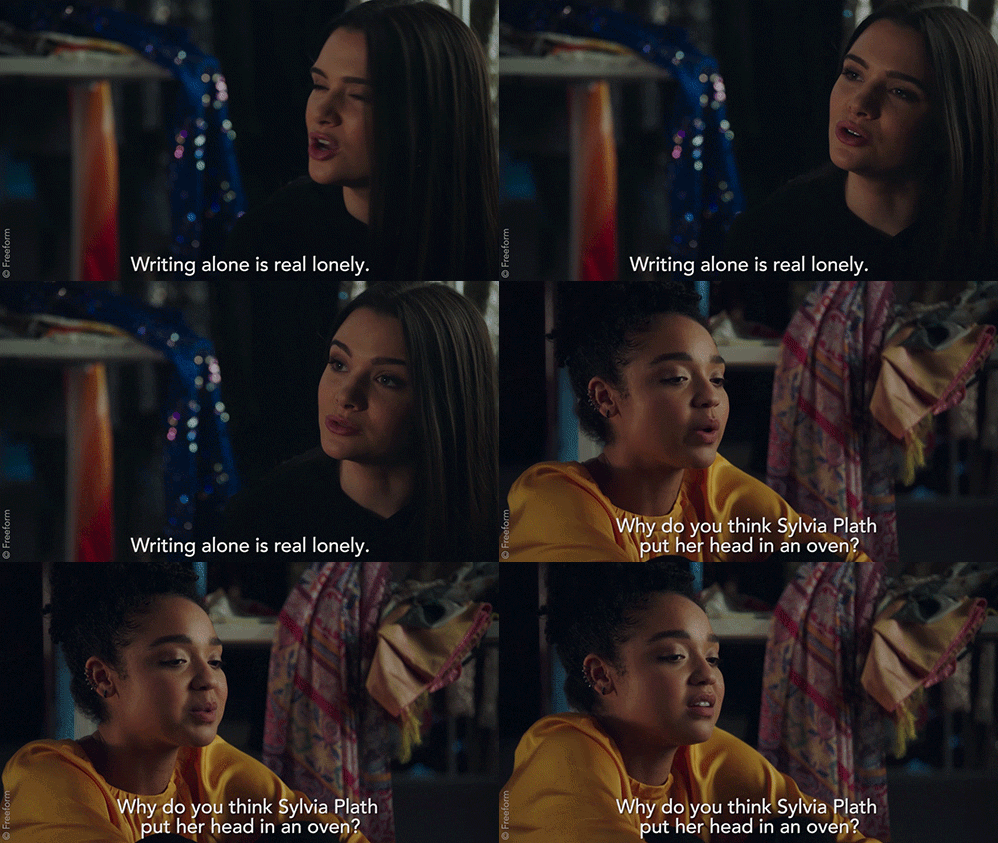
(PS Plath’s husband was a narcissist. Her husband had two wives and a son commit suicide).
When we got to the last letter, just days before her suicide, I was really upset, and I cried.
“I’m just so terrified that I have fought so hard, but someday suicide will take me under.”
She immediately burst into tears.
She was facing her shame.
She said, “I’m so terrified you will too. And it will be my fault.”
When the next suicide attempt did take me under, it was because I’d lost her.
But I do believe she was trying to save us both when she discarded me.
And that it was excruciating for us both.
I see her truths: some very shameful abuses of exes, scamming people of money, cheating on her partners, lying, and many covert abuses I excused from her. That wasn’t even her first discard of me. She’d discarded and hoovered me back, and then she very nearly killed me.
But I truly don’t think she wanted to kill me.
And as far as narcissists go, I believe she tried to tell me the truth of her mental health as far as she understood it.
Do I think all narcissists are trying to save you from themselves when they discard?
Heck no! Most believe they want to kill you QUITE EARNESTLY, and they go right through with trying to without flinching.
They wallow in their denial.
But in her, there were truths said, a glimmer of reflection, a genuine confusion.
In hindsight, it didn’t feel like a discard so much as it felt that she was desperately fleeing from me after shifting into something monstrous that would devour me if she stayed.
She no longer could preserve her mask, so she could only destroy me or abandon me.
She chose abandonment, and it nearly destroyed me anyway.
However, this is not to underestimate their dangerous mental health state: most of them are not as self reflective about the people who’ve loved them, and they regularly dehumanize the people they scapegoat, so they’ll happily smirk as people die or deteriorate without a shred of remorse.
A.M. Champion is the author of She Saints & Holy Profanities (Quarterly West, 2019), The Good Girl is Always a Ghost (Black Lawrence Press, 2018), Book of Levitations (Trembling Pillow Press, 2019), Reluctant Mistress (Gold Wake Press, 2013), and The Dark Length Home (Noctuary Press, 2017). Her work appears in Verse Daily, diode, Tupelo Quarterly, Prairie Schooner, Crab Orchard Review, Salamander, New South, Redivider, PANK Magazine, and elsewhere. She was a 2009 Academy of American Poets Prize recipient, a 2016 Best of the Net winner, and a Barbara Deming Memorial Grant recipient.


