
The World’s Virus
How the response to Coronavirus helps us take stock of technological and moral problems around the World
This article was originally published on Wonk Bridge
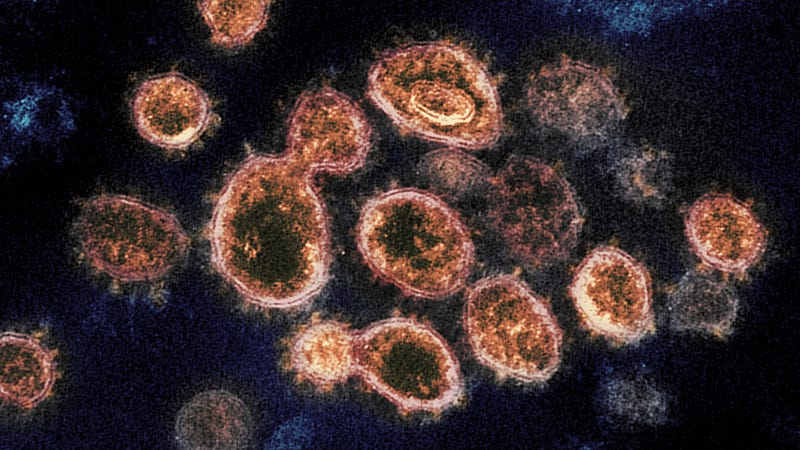
- Whose Virus?
- The States & Their Responses
- What Will Act II of the Coronavirus Look Like?
- The Value of Freedom in Sickness
- For Your Information: Advice on Identifying and Protecting Against COVID-19
Pandemics tend to have an air of moral reckoning about them. That’s not simply because, particularly in the West, we inherit the remains of centuries of religious thinking that interpreted widespread disease and natural disaster as missives from an austere and imperious God. It is because such adverse circumstances tend to give us the measure of ourselves, as individuals and States.
The primary hypothesis that has emerged from the early months of the global Coronavirus outbreak is that, holistically, the East is considerably more technologically advanced than the West. When I say ‘holistic terms’, I refer not only to the pure calibre of technology in use, but the overall degree of moral soundness with which said technology has been deployed, and the social sensibilities that underpin its use.
Given the fact of China’s social credit rating being a perennial guest — if not a host outright — of Western media speculation, this may seem a controversial assertion. It will certainly offend many a-Westernised constitution on the subject, disrupting the way we generally privilege ourselves above our laterally antipodean brothers and sisters.
Whose Virus?
Donald Trump’s obsessive revision of the terms of COVID-19 as the “Chinese Virus” — simultaneously evoking the non-descriptive language beloved of demagogues and (such soft, soft) fascists, and the kind of liberties taken with intensional definitions that we have recently seen make a market unit out of the notion of the ‘friend’ — has drawn much justified ire. It has not, according to Wonk Bridge’s America correspondent Jackson Oliver Webster, been understood correctly as a strategic device, “to trigger the Liberals and determine the subject of the national conversation, in order to distract from what a terrible job the administration is doing of dealing with the outbreak.”
However, there is something for us to consider in Trump’s demarcation of the virus along country lines. In truth, every country to be afflicted with the Corona has its own version of the virus, and it might be revealing if we take a look at what a handful of individual states have done to cope with their own personal COVID-19.
Taiwanese response to outbreak
As Taiwan’s case volume grew, the mood among the public was fearful, but staunch — daily life went on. Given the familiarity multiple East Asian states have with epidemic response protocol (thank you, SARS), the government acted rapidly — with both departing passengers and arriving passengers on commercial airliners being subjected to mandatory temperature checks. In short course, the same custom became observed during restaurant and museum visits; your temperature was first taken, then your hands sanitised, and entry required the wearing of a face-mask.
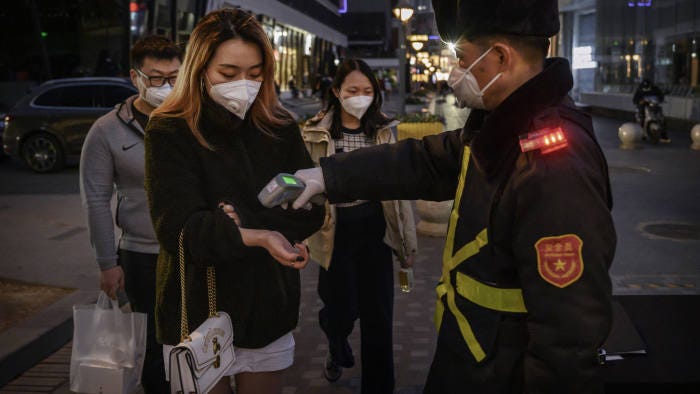
With respect to other virus-friendly customs, Taiwan might be considered the anti-Italy: there are few tactile means of social interaction, with people naturally keeping a polite distance. Public transport systems became masquerade balls. The country’s universal healthcare system was well utilised, and abetted by a live feed of data from tested carriers of COVID being fed to the country’s epidemiology command center. In a move more-or-less common to East Asian states, people were rapidly quarantined and tracked by their cellphone to ensure compliance, with heavy fines for violators.
In a more general (if symbolic) sense, the effectual excellence that differentiates the Taiwanese response from, for instance, that of the United States, can be summed up in a comparison of the profiles of their respective leaders. The only way in which Tsai Ing-wen might be compared to Donald Trump is that she too began her career as an unaffiliated outsider to the party system, boasting a notable track record as an academic. She has embodied not only her government’s seriousness of manner when responding to recent events, but has also epitomised a generally observable pattern in Confucian East Asia of retaining talent in the public sector/civil service. Moreover, her vice-president, Chen Chien-jen, is the former vice president of Academia Sinica, and is, fortuitously for his times, an epidemiologist.
Technologically speaking, Taiwan’s people have — in one of the few unequivocal instances of such a thing as can be observed — benefitted from the surveillance model common to their country and analogously to China (to a greater extent). The free access to what otherwise might be thought private data — particularly movement trackers, and even healthcare information — has enabled a better public response. People are briefed constantly about the virus and hotspots or clusters and what should be done to avoid them.
Moreover, key to Taiwan’s success is that its people come armed with a deep civic education and mindset. They are civic-minded in a way that many in the West would be disposed enough in arrogance to consider servile or lacking in defiant spirit. It is not that their public lacks the will to agitate against authority, as they did against their present premier in late 2018. But that the root of this willingness to comply with advice dispensed from an authority is in the fact that such hatred-on-principle of government as exists in the West is relatively foreign to Eastern cultures. The effect of this willingness to take the word of authority as given is a considerable advantage in the present fight, whatever its other corollaries in differing circumstances.
In Taiwan, the disease’s advance has slowed.
South Korean response to outbreak
South Korea’s response has been functionally identical to Taiwan’s, and almost entirely predicated around the harvesting of large quantities of consumer data in order to track infection hotspots and enable uninfected citizens to avoid them. Perhaps it is unsurprising, given they are the world’s most prodigious exporter of complex electronics, that South Korea has gone further still in the extension of their tech against Coronavirus.
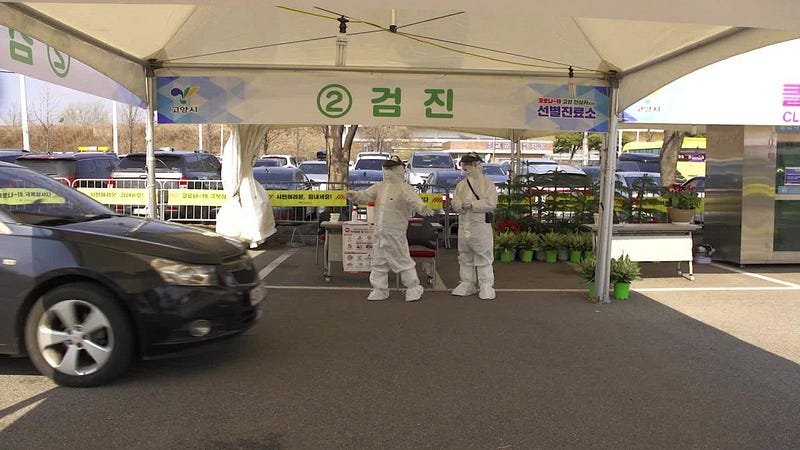
The drive-thru testing centre, few images of which have circulated in Western press outlets, was instituted; the concept itself has become something of a meme, an avatar of the gulf in Corona response between East and West. As in Taiwan, citizens have seen their credit card purchases tracked and paired with information from test centres, with areas visited by infected persons flagged for avoidance. While it is a considerably simpler, though no less decisive, technology, South Korea also commands the second highest intensive-care-beds-per-capita rate in the world.
The most thrilling endorsement of South Korea’s aggressive technological pursuit of public health is in their test count. They have, at the time of publishing, tested well over 200,000 people. This presents as a much greater degree of clinical preparedness than, as we will see, is present in the USA or United Kingdom. However, South Korea’s success so far in mitigating the effects of the Corona is similarly rooted in that civic-mindedness — an observation of counsel, minimal panic-consumption.
In Korea, the disease’s advance has slowed.
Chinese response to outbreak
Coverage of China’s response to Covid-19 was accomplished with some eloquence by Wonk Bridge’s China correspondent nonpareil, Edward Zhang, and can be read here.
Swiss response to outbreak
Moving west, Switzerland has a curiously high number of confirmed cases per capita (pushing 8,000 in a population of 8.5 million). A countrywide ban on gatherings of more than five people has been instantiated, President Ticino has ordered all manufacturing plants to cease operation, and cantons put on their own spending rations.
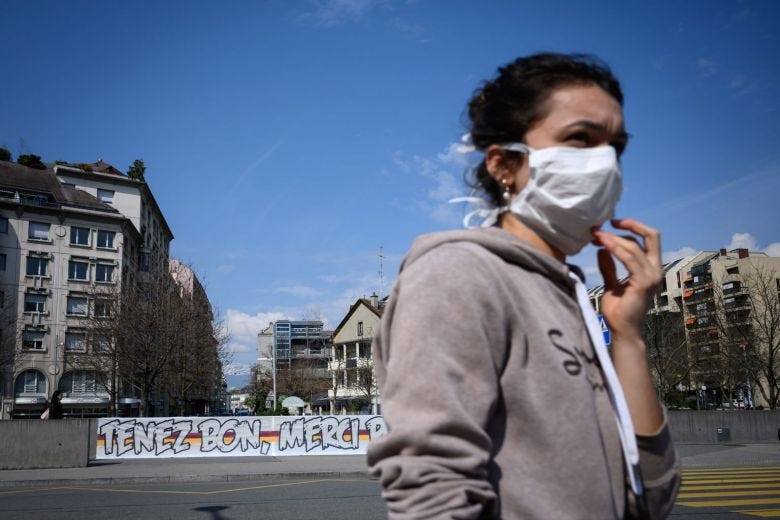
Switzerland’s high number of confirmed cases can be partly attributed to some of Europe’s most assiduous and vanity-free testing. However, it is also accounted for by the fact that its borders presented a particularly game membrane for the virus, shared eagerly as they are with some of Europe’s most prolific Covid-19 all-action areas . What’s more, Ticino dithered in closing them until several thousand cases had been confirmed, in equal parts owing to the economic and symbolic value of the historically ‘open’ mountain republic doing so. The wealth of the Swiss government and the strength of the franc has, however, allowed Switzerland to announce a support fund for the economy worth $65 billion, fully commensurate with the scale of their personal battle.
In Switzerland, the disease’s advance continues to increase exponentially day-by-day.
Germany’s response to outbreak
Germany’s Covid-19 situation has perplexed onlookers in its relative mildness, just as Italy’s situation (which we’ll shortly be inspecting, gloved and scrubbed, of course) has bewildered them in its intensity. In spite of having the world’s fifth-highest number of confirmed cases, Germany has suffered fewer deaths than, for instance, Iran (94% fewer deaths, despite 13% more confirmed cases) and France (84% fewer deaths, despite 37% more confirmed cases). This is probably owing to the curious fact that Germany’s outbreak has been largely localised among its younger population; unlike the Spanish Flu of the early 20th century, young immune systems have proven to deal well with the Corona. Their overall mortality rate from all infections in 0.3%, by far the lowest of the 10 worst-afflicted countries.
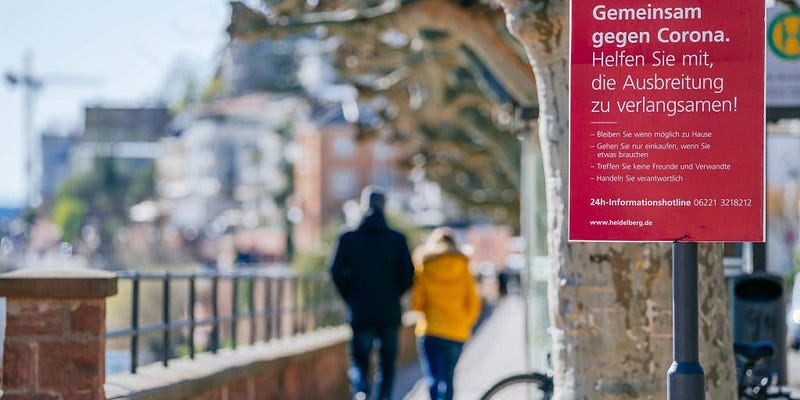
German healthcare specialists mandated professional contact tracing when the first cases of Covid-19 were reported, giving them excellent scope to prepare their clinics, an advantage they have reaped the benefits of. In extending testing (for which the country has a capacity for between 84,000–160,000 per week) to even those with milder symptoms, Germany’s response has been the most similar in Europe to the East Asian states. However, Germany are diagnosing cases at almost three times the rate of France, with 1,347 on March 22nd alone — their Covid-19 story is not yet over.
In Germany, the disease’s advance continues apace though with some suggestion of curve-flattening having begun; mortality rates remain low.
Italy’s response to outbreak
Italy have newly become Europe’s sickman — with 59,138 confirmed cases as of March 23rd, they have more than double that of the next worst-afflicted country on the list, and bear the very real possibility of passing China to claim first-place if the onset of warmer weather and the effects of lockdown do not stay a Covid tide.
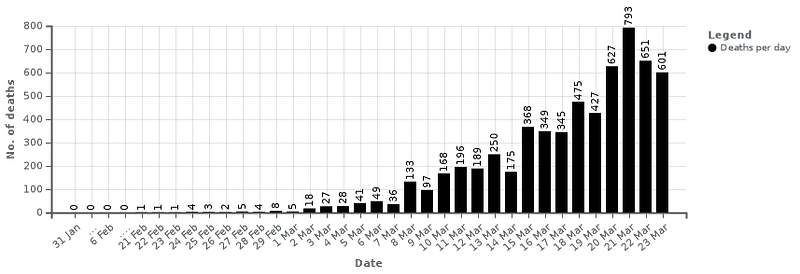
Why exactly Italy has been so pointedly afflicted still fuddles the general mass of experts, though several factors remains clear. In part, it owes to a naturally tactile culture where exchanges of physical affection are ubiquitous. Despite the famed healthiness of the Italian Mediterranean diet and lifestyle, Italy’s high aged population predisposed them to higher numbers of infected and dead. Yet the Italian fatality rate of some 9% cannot be excused on these grounds only — Japan, a country whose average age is even higher than Italy’s, has registered just 41 deaths against Italy’s tally of 5,476.
Italy’s healthcare system was rapidly saturated with severe cases, having been completely without Germany’s grace period (and moreover without its resources and facilities). The answer may in fact lay in the balancing act Italy, like much of the West, sought to entertain — a preservation of civil liberties alongside wariness of advancing disease. Lombardy, the original European Wuhai, was sealed off progressively (a town here, then part of the region, then the whole region) and always behind the virus’ progress. Soberingly, the outbreak is almost exclusively concentrated in the historically well-kept north; a spread to the more impoverished south would put an entirely different dimension of cat among the Piazza Dante’s pigeons.
It is also through an Italian pane of glass that we can most acutely see and forecast the potential economic fallout of the Covid-19 outbreak. They nurse a debt to GDP ratio of above 130%; they are not fiscally in any kind of shape to afford significant loosening to fight the upcoming recession. As Fabrice Grinda has ably observed, the country’s poorly capitalized banks (with their matching inability to extend credit to borrowers) “own about a quarter of the country’s $2.4 trillion debt, linking the fate of the two in a destabilizing way”.
To put the effect of a potential Italian sovereign debt crisis into perspective, its economy (the world’s 10th largest) is something to the effect of ten times the size of Greece, the last patient of a sovereign debt crisis. Any such instability in Italy would prove extremely contagious, with Greece, Portugal, France, Spain, and Belgium all in the immediate buffer zone.
North American response to outbreak
It does not augur well for the American public that, as adjudged by narratological conventions, the USA’s response to Covid-19 has been by far the most ‘interesting’ of almost any country to have suffered it at scale.
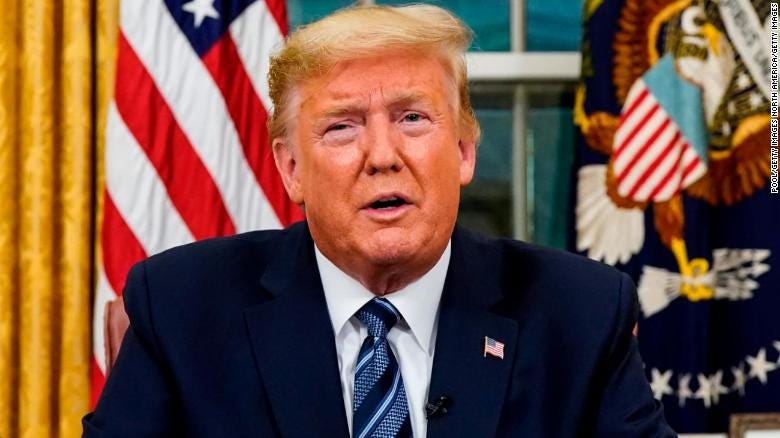
In the United States, hospitalists mobilised to help the country’s healthcare system deal with the outbreak have been instructed by infectious disease and infection control personnel that unless someone has recently returned from China or had contact with someone who had , they do not meet criteria for testing for Covid 19. Nevermind the plentiful evidence that this respiratory virus is prevalent in nearly every country in the world; the USA criteria for testing is based on travel-history only, not symptoms. Even extremely-at-risk personnel — for example, flight attendants working in at-risk areas, including ones with prior health complaints such as asthma — are not being given test priority, afforded unconditional discharge from work, or being given sick-pay where this is not already afforded in employment contracts.
The technological response to Covid-19 in America has largely been used to deny the gravity of the situation or defuse responsibility for the derelict response of the Trump administration. The nation’s most potent technology — its syndicated media — has been used as the instrument of a strategic minsiformation campaign, in which almost all parties have an approximate stake. Trump-friendly outlets have given voice to the chief’s continual denials and deflections of the gravity of the situation as it has developed. On Medium, Aaron Ginn, among other things protege of the libertarian cause-celebre Peter Thiel, posted a more-or-less outright denial of the Covid-19 phenomenon that drew an equivalently unanimous storm of derision for its many inaccuracies, its misuse of data and the mendacity with which it appears to have been assembled.
While Wonk Bridge’s position on Fake News has, from year dot, been unequivocal and forthright, we feel that this piece is an alpha/omega of the form; that in tone and content it epitomises what can be seductive about the philosophies and subjectivist responses to the world allowing certain people — many of them powerful — to justify to themselves the spreading of untruths. From that perspective, we’d like to invite you to read the article, and acquaint yourself with what such a thing looks like.
The left hemisphere of the press have similarly found their replies to the situation proved impotent — the effects of the scorched earth campaign they have waged against the presidency over the last three years have given them no higher gear to call upon during this, Donald Trump’s time of most egregious inaction and dishonour. Those outlets, such as the New York Times, who have committed to honest reporting about the scale of the task facing the States have hamstrung themselves on the use of even the most basic technology — a very comprehensive recent article in that daily on global infection rates and how to flatten the curve was rendered useless when more than one commenter observed that its many graphs had not been calculated properly for increase-in-cases-as-%-of-population.
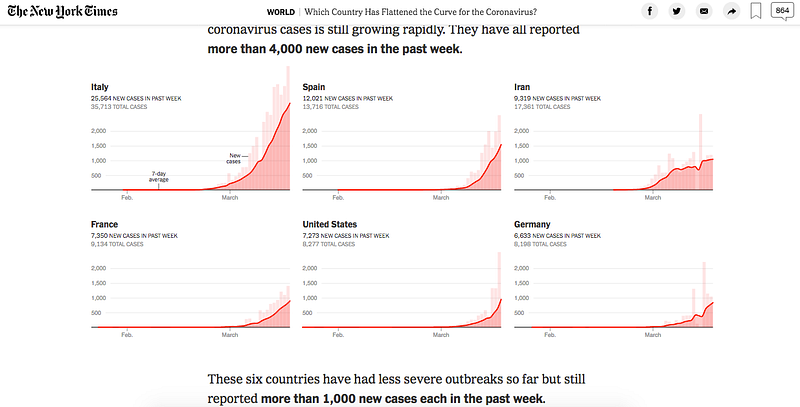
Testing in the United States has been functionally non-existent in comparison to many of the other worst-afflicted countries. As we near the end of March, there is an average of less than 2 medical laboratories offering testing per state. Given that even Germany’s diligence has failed to convince its leading medical professionals that large numbers of cases aren’t going undiagnosed, it is hard to reckon that CDC reporting on the scale of the outbreak is in any way executively trustworthy. Even still, what has been disclosed could offer little confidence to the average American — mere thousands of confirmed cases, with a reporting emphasis still defaulting towards those who’ve visited known action areas, and neglecting close contact transmission. Michael Mina, Assistant Professor of Epidemology at Harvard, suggested that around 100,000 tests per day “might be optimal” for a country of the United States’ scale.
The American response has laid bare the presentism of thought behind its institutions. In October of 2018, Rear Admiral Timothy Ziemer abruptly departed from the National Security Council, with his staff breaking up in the process. This left the NSC in the position of hosting no senior administration official focused solely on global health security; no executive in charge, in other words, for precisely the kind of outbreak the country now faces.
We must at this point reckon Silicon Valley to be almost its own pirate republic, but their response has been striking. Having spent a grace period weighing up the situation, multiple firms have initiated what CNBC has called an “investment blitz” to help tackle Covid-19. Facebook has announced it will offer $100 million in cash grants and ad credits for up to 30,000 eligible small businesses — proof that here the panacea is considered to be more basically competitive entrepreneurial capital. There has been, perhaps surprisingly, not a murmur of coalition between the public and private sectors in the States in order to coordinate efforts against the outbreak.
The United Kingdom’s response to the outbreak
It serves as some indictment too of the UK’s response to Covid-19 that their efforts against it cannot be said to be much less ‘interesting’ than America’s. To say the tigerishness of the British press has been relatively untamed by events would be an understatement — as is the case in the States, the press is Britain’s most effective technology, and has generally proven as much of an opponent of public interest as the general civic response has been an enemy to itself.
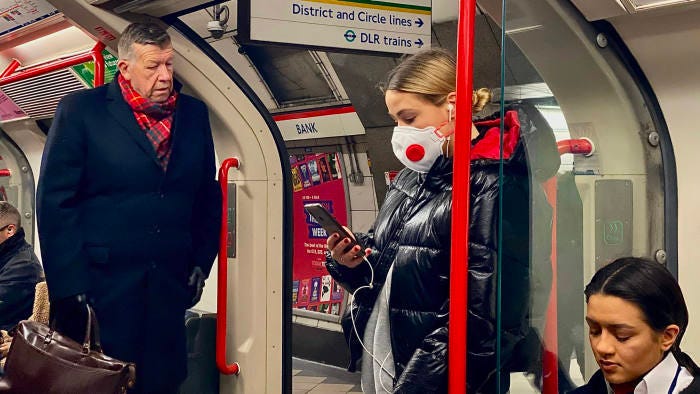
The media outlets with the most potent commentariats have continued to sew political footballs from recent events, helping to encourage sprees of panic buying and reducing trust in the credibility of governmental word. Having said that, Parliament has not covered itself in glory either, with wage relief announced late (and a pittance being reserved for the self-employed), and noted capriciousness of mind over whether pursuit of herd immunity represented the best course of action. This in and of itself does not represent any ludicrous dereliction of sense — indeed, the deadliest waves of Spanish Flu occurred after the relaxation of the initial extreme vigilance around quarantine, with a lack of herd immunity to buffer the subsequent waves of infection.
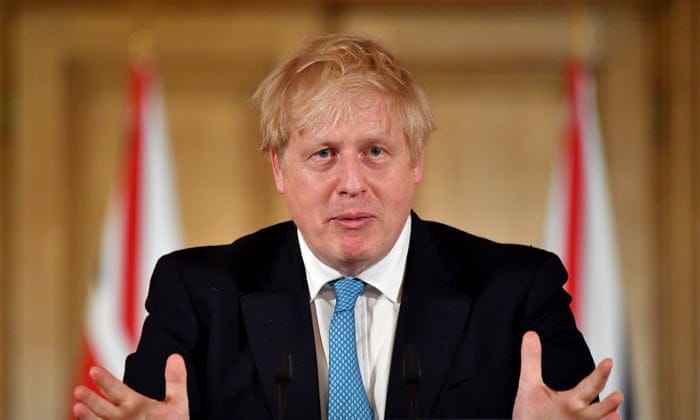
The UK response has been from the very beginning science led, even if the methods used resulted in under-estimations. However, the lack of decision is problematic; it remains to be seen whether or not the lockdown announced by Prime Minister Boris Johnson on the night of the 23rd will stay the tide, or prove as effective in real terms at the corresponding measures taken by Italy.
More problematic is the way in which a cavalier, if not outright neglectful, attitude towards the natural fecundity and strength of the NHS over the last decade has caused the health service to be dreadfully tested. Testing for the virus has been extremely limited, with still no systematised process for making tests available. There has been no suspension of GP handovers, leaving many at-risk patients with complicating health issues without access to doctors as surgeries change hands, and no discrete instructions dispensed to pharmacies to establish prescription continuity. There is the possibility of a ventilator shortage, as all of Britain’s are imported; there is the very real shortage of available medical personnel; and the UK’s intensive-care-beds-per-capita ratio is abysmal, having declined each year out of the last 10.

Where the UK has shown itself to be as troublesome — largely to itself — in dealing with the outbreak is in the fact that, as far as the civic-mindedness of the Taiwanese populace goes, the British public’s is antithetical. On the first fine day of spring on March 21st, custom trumped all good sense as Londoners (the highest single metropolitan concentration of Covid in Europe) flocked to public parks and street markets. Despite repeated pleas not to do so — not met by a firmer hand from Parliament on rationed purchasing at supermarkets — panic buying has continued daily. As a result of this, the UK’s rise in daily confirmed cases has begun to ominously mirror the by-day increases sported by Italy when it was in the first throes of the outbreak.
Where the UK is treading an interesting path is in its grassroots tech circles — the guilds of start-up founders and independent technologists in various areas of (predominantly East) London. Initiatives and virtual hackathons have been launched apace in order to attempt to do for London what KaiOS has sought to do for various underserved markets and produce a greater quantity of apps that will give people greater practical resources to deal with a very real and very intimate threat. Wonk Bridge will be running a piece on this, and specifically on Newspeak House’s Coronavirus Tech Handbook, which has provoked some sensation, in short course.
Much as is the case with Palo Alto and the States, London and the remainder of Britain have acted under differing constitutions of custom. It is highly likely that London’s suffering under the Covid yoke will grow exponentially, and almost certainly will continue to provide the majority of confirmed cases within the country — sanity prevails to a somewhat greater degree in the counties.
What will Act II of the Coronavirus Outbreak Look Like?
Speculation at a time like this is almost guaranteed to make God laugh — but, outlet as we are, speculate we must.
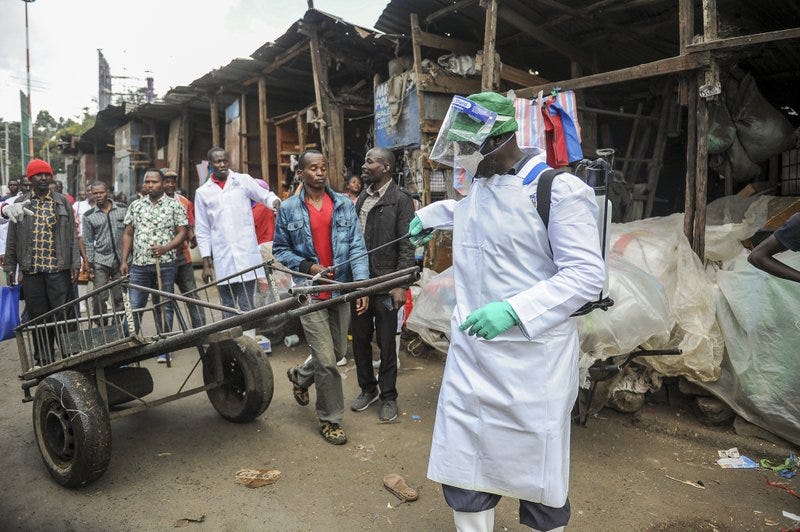
The so-called ‘sleeping elephant’ of Covid-19 is the response of Africa. Testing in African nations is practically non-existent, the prevalence of the condition there impossible to gauge. There is every possibility that the higher temperatures, and much lower span of geographical transit of which the individual African is capable on average, will mitigate the strides of Coronavirus. The alternate possibility is that a form of the condition may come to reservoir there, ready to make a contribution to any subsequent waves of the condition to come. It is highly unlikely that this will be humanity’s only brush with it.
While we are nowhere near net carbon-neutral even as air traffic quells and consumption naturally slows, carbon levels are bound to drop during the spike phases of the condition. It is unlikely that international travel will resume its normal course until late in 2020 at earliest, and return to prior levels until we have cleared the outbreak’s anniversary, and have been made the beneficiary of vaccination. There is, to take a pessimistic angle, enough in the comportment of many citizens in the less disciplined burghs of Europe to suggest that a return to global wellness might coincide with a massive spike in those regions’ carbon footprint, as people go back to normality in a celebratory splurge.
One very positive — and perhaps the most likely — outcome to be expected from the crisis is an improved public attitude to maintaining cleanliness in public and due care in social interaction. Simple techniques for the practice of good hygiene might have made the pace of Coronavirus’ spread that much slower, and allowed the response to be that much more acute.
The Value of Freedom in Sickness
One thing that is not likely to happen in any more than piecemeal fashion is precisely what must happen to make outbreaks such that we are facing, and the circumstances that exacerbate them, that much more unlikely: that we come to a greater degree of mastery of our mania for stimulation in absolute terms. Pascal was sage when he observed that “All of humanity’s problems stem from man’s inability to sit quietly in a room alone.” By-and-large, within the countries worst afflicted by Covid, a frantic nature and a lack of generosity in living has been the attitude that has underpinned poor civic behaviour, and that has increased the likelihood of transmission between people, reflected in the craven conduct of government. If it is indeed the case that the pasture of public service in the USA, the UK and beyond has offered up unworthy bulls in recent generations, it is time the public reckoned with their role in allowing this to be so — then in apathy and inaction, now in antipathy and over-reaction.
A public incapable of dealing with these crises breeds governing classes incapable of the same.
The morality of a world governed by technologically-abetted capital is, of all those states surveyed, most eagerly adopted in the States. At its most self-mythologising, tech tends to think of itself as a great democratising force, but this owes largely to a common conflation of what is democratic with that which is freeing. The kind of freedom capitalised technology is purposed towards leads to certain arrogances of the free being affordable among the greater mass of ordinary people in ‘peacetime’ — to flout convention and be congratulated for doing so, to award oneself with unlimited convenience, to conduct life primarily in service of appetite, defended by a reflexive anger at those who, it is perceived, prevent those appetites from being sated (usually public servants). However, under such pseudo-‘wartime’ conditions as we are, the unbound nature of a social contract thus determined is shown for its horrible weaknesses. A life lived without generosity, in a permanent suspicious state of competitiveness, prevents a connection between the average individual and the wider collective interest. It makes a kindly, genial disposition towards one’s fellow citizens, and a spot of sacrifice, look like a loser’s excuse, whether times be good or bad.
It is certainly not disciplined or interested in its fellows enough to be ‘democratic’. Nonetheless, it is a picture of ‘freedom’.
This kind of freedom, judging particularly by the States’ response to corona, must in other words equate to a loss of civic-mindedness and discipline needed to navigate times like these. It is not that technology originates these moral attributes — though it certainly embellishes, affects, abets them — but that these attributes must then necessarily underpin the development of technology, for they are intrinsic to the national psyche in the West, to varying degrees (and too moderated to varying degrees; German pragmatism has a lot to say in their success in dealing with Covid, for instance).
What the use of technology in the West shows is that its social instruments are designed to abet no virtue other than freedom, and that such freedom without knowledge or discipline is arid and self-defeating. Applying these freedoms and asserting them proudly when we are able is a fine thing. In times such as these, to be able to then harness a mute on our own desires, to be civic-minded and dutiful (especially when it takes so simple a form as a period of time doing nothing), is the price we must pay to responsibly possess such liberties.
The West congratulates itself, implicitly and at all times, that it enjoys the liberties in question, and often uses the East Asian nations who have found the beating of the Coronavirus as a demonstration of those nations that, to a greater or lesser extent, do not enjoy the same. This article itself should not be considered an outright salute to the broader constitutions of law and custom in China and other nations whose response to Coronavirus has been exemplary — it is intended as a comparative indictment of much of the West, that ethically and procedurally it has been so thoroughly outperformed comparative to its cousins that the West itself would, in epidemologically neutral times, consider ripe enough to look down upon on matters of social principle. It is not that Taiwan, Korea, China itself are technologically in another world compared to the West — it is because their public have allowed their governments to use this technology in a way that, in these circumstances, can be said to be more moral.
We’ve dedicated resources at Wonk Bridge to the coverage of Corona because we believe that the same flaws of state/collective character driving large tech are those driving the impotent response, at both a civilian, industrial and executive level, to Covid. The virus has, understood as such or not, shattered any vain notion that we around the world are of fundamental separation according to the political philosophies to which we are respective heir.
We live in a time — or perhaps we’ve just left it — where those who reckon themselves of a liberal and intelligent disposition fan themselves with platitudes concerning the interconnection of the world and its people. It is time we acquire an appreciation for a different kind of network effect — a moral one. The Corona comes bearing things to teach us in the most holistic terms about our societies. The most valuable lesson we might take from it concerns the fact that we are morally selective, and moral selectiveness is, by definition, moral deficiency. Proud and free though we may be, hubristic we have been proven — and to be so in daily life is to find oneself in a wider society, presided over by governments, that reflect these tendencies. One cannot live by a creed without expecting to live by the part of their neighbour that does likewise.
In the times of Covid, these Western character flaws have produced tried-and-true body counts.
Whether or not we have ourselves been tested, make no mistake, we are under test. And so must we learn.
For Your Information: Advice on Identifying and Protecting Against Covid-19
Virus Detection:
The simplest way to distinguish Coronavirus from a Common Cold is that the COVID-19 infection does not cause a cold nose or cough with cold, but it does create a dry and rough cough.
The virus is typically first installed in the throat causing inflammation and a feeling of dryness. This symptom can last between 3 and 4 days. The virus typically then travels through the moisture present in the airways, goes down to the trachea and installs in the lungs, causing pneumonia that lasts about 5 or 6 days.
Pneumonia manifests with a high fever and difficulty breathing. The Common Cold is not accompanied, but there may be a choking sensation. In this case, the doctor should be called immediately.
Experts suggest doing this simple verification every morning: Breathe in deeply and hold your breath for 10 seconds. If this can be done without coughing, without difficulty, this shows that there is no fibrosis in the lungs, indicating the absence of infection. It is recommended to do this control every morning to help detect infection.
Prevention:
The virus hates heat and dies if it is exposed to temperatures greater than 80°F (27°C). Therefore hot drinks such as infusions, broths or simply hot water should be consumed abundantly during the day. These hot liquids kill the virus and are easy to ingest.
Avoid drinking ice water or drinks with ice cubes.
Ensure that your mouth and throat are always wet, never dry. You should drink a sip of water at least every 15 minutes. Why? Even when the virus enters water or other liquids through the mouth, it will get flushed through the oesophagus directly into the stomach where gastric acids destroy the virus. If there is not enough water, the virus can pass into the trachea and from there to the lungs, where it is very dangerous.
For those who can, sunbathe. The Sun’s UV rays kill the virus and the vitamin D is good for you.
The Coronavirus has a large size (diameter of 400–500 nanometers) so face masks can stop it; no special face masks are needed in daily life.
If an infected person sneezes nearby, stay 10 feet (3.3 meters) away to allow the virus fall to the ground and prevent it from falling on you.
When the virus is on hard surfaces, it survives about 12 hours, therefore when hard surfaces such as doors, appliances, railings, etc. are touched, hands should be washed thoroughly and/or disinfected with alcoholic gel The virus can live nested in clothes and tissues between 6 and 12 hours. Common detergents can kill it. Things that cannot be washed should be exposed to the Sun and the virus will die.
The transmission of the virus usually occurs by direct infection, touching fabrics, tissues or materials on which the virus is present. Washing your hands is essential. The virus survives on our hands for only about 10 minutes. In that time many things can happen, rubbing the eyes, touching the nose or lips. This allows the virus to enter your throat.
Therefore, for your good and the good of all, wash your hands very often and disinfect them. You can gargle with disinfectant solutions (i.e. Listerine or Hydrogen Peroxide) that eliminate or minimize the amount of virus that can enter the throat. Doing so removes the virus before it goes down to the trachea and then to the lungs. Disinfect things touched often: mobile phone, keyboard, mouse, car steering wheel, door handles, etc ….