The World Is Starting To Feel Like 1936 (Not Good)
A healthy dose of expanding conflicts, global instability, and militarism
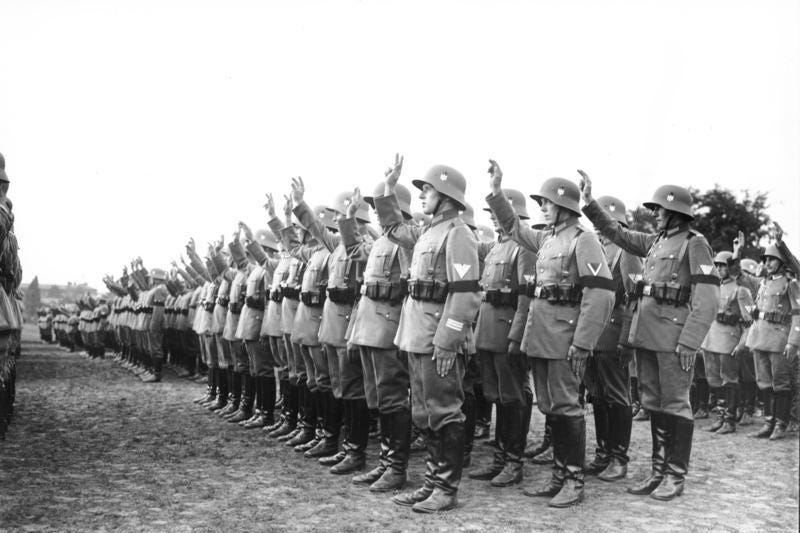
One of the things that is largely lost in the shadow of World War II was the state of the world in the lead-up to the start of the war. While most people know about the rise of fascism in Europe and the territorial ambitions of Nazi Germany, few people have put together a complete mental picture of the overall state of the world during this critical time. The years preceding World War II were filled with conflict and strife paired with dubious leadership on all sides. The results speak for themselves, but it is concerning to think that 2023 (and the rapidly approaching 2024) are starting to feel a lot like 1936.
Numerous conflicts were ongoing in 1936, including the Spanish Civil War (which dragged arms and money from numerous foreign actors), the Second Sino-Japanese War, the Italian invasion of Ethiopia, and the Arab Revolt in the Middle East. 1936 also saw Germany violate the Treaty of Versailles and start to rearm in the Rhineland. The world stage in 1936 was chaos. The geopolitical landscape today is very similar to that of 1936.
Today, there is a major proxy war going on in Ukraine, which has echoes of the Spanish Civil War, with two sides pouring money and materials into the country without committing troops. There is a major conflict unfolding in the Middle East between Arabs and Jews. Meanwhile, other nations are picking up on the global instability to seek new territory, including Venezuela, looking to take land from Guyana, and China, looking to press territorial claims in the Philippine Sea and South China Sea.
Leadership in 1936 was a toxic stew. There were actors like Hitler and Mussolini looking to exploit any perceived weakness in their foes. Career politicians like Stanley Baldwin of the United Kingdom and Franklin D. Roosevelt in the United States were running the show with the status quo in mind and no stomach to deal with the geopolitical realities staring them in the face.
The leadership in 2023 is in a similar state. There are bad actors running nations around the world with territorial expansion and war in mind. Names like Xi and Putin come to mind, but other leaders like Maduro in Venezuela and Assad in Syria continue to hang on to power against all odds. You have increasingly aging or feckless leaders in the United States and the United Kingdom in Joe Biden and Rishi Sunak, respectively. You also have political wildcards running around like Trump and Netanyahu. Leadership does not seem to be a global strong suit right now, at a time when leadership should be valued most. (Poor leadership was also endemic in the lead up to the US Civil War in 1859–1860.)
Lastly, the 1930s were a time of renewed militarism. As mentioned, 1936 saw the militarization of the Rhineland. Germany, as a whole, was rearming. Japan was boosting their military capabilities and building vast new fleets of planes and the world’s largest battleships. The Soviet Union was undergoing a massive military transformation. Everyone was gearing up for something.
The climate today is very similar. China is arming itself at an alarming pace. Germany is reinvesting in its military. Japan is reinvesting in its military and requesting a record budget for its armed forces. Modern weapons systems are flowing into Europe with the excuse of countering Russia. The United States continues to spend obscene amounts of money on its military and has shown no regret in sending arms around the world. (Israel recently used deadly white phosphorous allegedly supplied by the United States against Lebanon.)
Altogether, it is hard to read the headlines today and not start to feel the grim call of history. The state of the world today feels very much like the state of the world in 1936. Less than four years later, in 1939, World War II erupted and killed millions.
World War II was born out of instability, territorial ambition, and an appetite for conflict between great powers. Today, global instability is rampant, there are leaders with territorial ambitions, and there seems to be an increasing appetite for conflict between great powers. (Anyone who has advocated for a war with China or Russia is contributing to this appetite.)
Recap
There are numerous overlapping factors between today and 1936. 1936 was perhaps the year in which it became inevitable that another major world war would break out. The ground was ripe for sowing a future war, and no one did anything to mitigate the coming conflict. Something similar is happening today.
Similarities include:
- Global instability (multiple wars, civil wars, and military conflicts)
- Economic uncertainty
- Poor global leadership
- An inability or unwillingness to meet problems on the world stage head on
- Rearming of major world powers and increasing militarization
- An appetite for conflict and hawkish mentalities
China has made its future plans abundantly clear, and the Indo-Pacific has done little to counter them and seems unwilling to acquiesce to Chinese demands. There are people banging the drums and screaming that Putin wants a conflict with NATO after Ukraine (a claim I am not sure I believe.) People seem itching for a new fight. Antisemitism is on the rise. Everything feels like it is ready to fall apart at a moment’s notice.
History does not repeat itself. But it does rhyme. And it feels like 2023 and potentially 2024 are rhyming nicely with 1936. Hopefully, 2026 does not rhyme with 1939, and we can do something to prevent World War III before it is too late.