
The world is changing faster than we can imagine: can we keep up?
It’s a company that has been attracting our attention for a long time: with its range of robots, reminiscent of a pack mule, a dog, a humanoid or even a kind of ostrich, Boston Dynamics has come a long way since 1992, when it evolved from an MIT project, producing viral videos of its robots doing all kinds of things, from carrying objects to doing parkour or dancing rock ‘n roll.
The company was bought by Google, which tried to extract everything it could from its technology, and then sold it to Japan’s SoftBank, which in turn passed it on to the Hyundai Motor Group. Despite the changes, Boston Dynamics continued coming up with designs, perfecting them in anticipation of a future when robots will do the vast majority of the jobs once done by humans.
The recent advances in generative algorithms such as ChatGPT, now the fastest spreading technology ever, make it possible to imagine robots that instead of carrying out advanced automation of tasks in certain scenarios, will be able to capture many characteristics of those scenarios and, in many ways, adapt to them to perform those same tasks, providing them with capabilities that were difficult to imagine until now.
It has taken several generations to get from the robots we knew a few decades ago, crude machines unable to negotiate uneven terrain — I’ve seen videos of them doing parkour better than most people, a process that has involved many different learning models, and some basic technological capabilities — processing power, memory, storage, bandwidth, and more. In reality, everything is the result of its time and context: if we had tried to develop algorithms like ChatGPT a few years ago, we would have run into technological limitations that prevented it, and it’s the same with the development of robotics.
In a recent interview with Aaron Saunders, Boston Dynamics’ chief technology officer, who has been with the company for more than twenty years, reflects on what the incorporation of generative algorithms will mean for robotics: machines able to interpret the world around them, allowing us to come to a much better understanding of how to interact with robots.
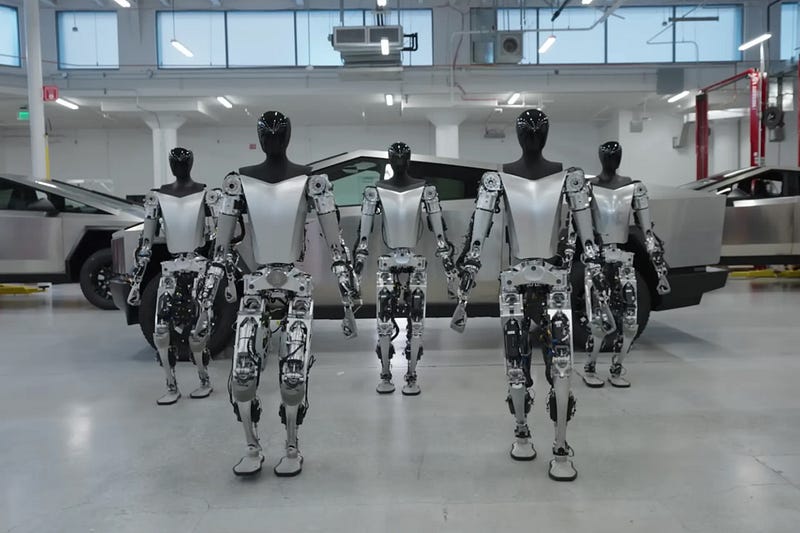
Reading between the lines, robots will no longer be limited to basic tasks in warehouses or factories, and instead will fulfil the prophecy of Elon Musk for Tesla’s Optimus robot: a future in which there are more robots than people, taking care of pretty much everything and more abundant than current industrial robots. We may laugh at “Elon Time”, his difficulty in offering believable deadlines, but the reality is that his predictions tend to come true, even if later than he originally said.
When ChatGPT and other generative algorithms appeared, many of us who depend on computers or handle data felt threatened: with the right training, it’s not hard to imagine those algorithms doing many of the things we do today. But this replacement of white-collar workers is nothing compared to what generative algorithms and robotics will mean, with these robots increasingly replacing all kinds of blue collar workers.
First, because there are many more manual workers. Second, because retraining them is harder. And above all, because we are talking about such a profound reinterpretation of work and human societies as we know it, which gives way to all kinds of unexplored scenarios that not even the most adventurous could predict accurately. A few days ago, Microsoft signed a historic alliance with labor unions to train them in AI, and the company president said that no guarantee AI won’t displace jobs.
That said, we’re pretty much there already and nothing can stop the technology: regulation, laws; nothing. Regulation may (and should) seek to prevent irresponsible individuals from misusing this technology, but that will not prevent it from developing, and some will see it as an opportunity to gain competitive advantage.
It’s going to happen, and sooner rather than later: robots capable of doing the work of people, but better, faster, with fewer errors, 24/7. That second transformation is the one that really counts, and it’s getting closer and closer. Either we redesign our societies to accommodate this, or we will face the consequences. That is the choice we have to make, looking to the future with an awareness of the inevitable, rather than simply trying to foresee what technology is already doing.
(En español, aquí)


