
The World Is Burning. Get Off Your Asana
We need healing, not a $150 pair of pants.
I confess I’ve been complicit as well. When I worked at a yoga studio, I would try to come up with cool pictures of myself in yoga poses to advertise for my classes. I don’t know why I thought this pose would somehow lure people in, but I used it nonetheless.
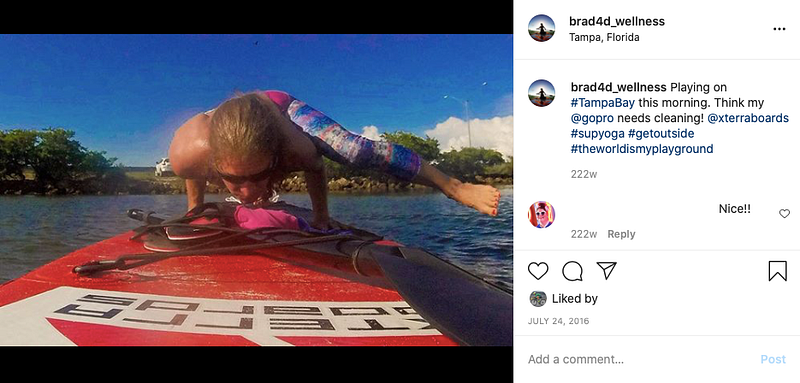
What the pose above doesn’t reveal is how long it took for me to get that picture. I had to drive down to Tampa, find a place to park along the causeway, blow up my SUP, paddle to the middle of the waterway, drop anchor, turn on my GoPro, bust the pose itself, then come back, deflate my SUP, drive home, transfer my pics to my computer, fix the picture just a little bit, then try to find a catchy caption to accompany my cool picture while also tagging brands for potential sponsorship.
This is not yoga.
I admit, I’m sometimes envious of other people’s photos. However, knowing how long it takes to get these photos takes the “insta” out of Instagram. Rather than taking a photo to capture a moment, we create fake moments to capture the moment. Then we wonder why we can’t find time to read a book.
Meanwhile, the world is burning. Literally, our warming planet is thawing the permafrost in the Arctic and the global mean sea level has risen 3 inches since 1993. But go ahead, get that picture so that you can afford that new Lululemon top.
I’m thankful that many leading yoga teachers such as Seane Corn and Alexandria Crow are addressing the need to change the perception of yoga away from the yoga poses. They know that after several years of yoga practice, yoga isn’t about any pose, let alone “quality” yoga pants or $80 essential oil.
Yet if you look at any hashtag related to yoga on Instagram, you’ll see the yoga stereotypes of people doing unrealistic things that the average person cannot do, and many shouldn’t anyway. The yoga pose, or “asana,” is just one element of one particular path of yoga.
The word “yoga” in Sanskrit translates to “junction, union.” Another translation means “a device or method.” What does the picture below say about “union?”
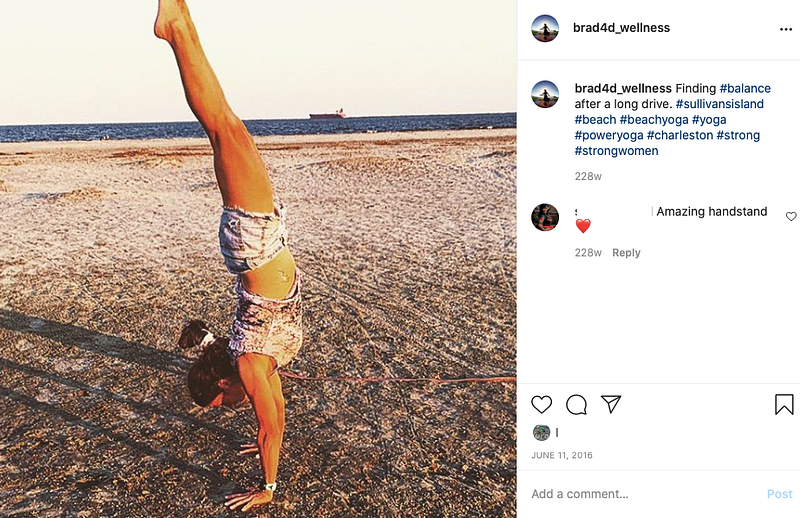
Yes, that’s me again. What you don’t know is that I had three cocktails before my mother snapped this of me. And about two seconds afterward, I flopped over on my butt.
What happens when we become too consumed with “conquering” a pose is that we lose the whole point of yoga — union. The yoga poses aren’t meant as an end, but instead they are the means to an end. That end is union of body, mind and spirit, but it is also about union of people.
Yet many yoga practitioners and teachers are stuck in the asana and do little about the other limbs of building union.
When the world is focused on individualism, the community suffers. We spend so much time marketing yoga the way we deem to be popular rather than authentic. I’ve been a part of many yoga communities that do a nice job of building and maintaining communities, but they focus too much on the asana — the physical. They do little to question the systems of inequality. They do more to challenge the body than they do to challenge the mind.
Why do we continue this facade when the world needs healing?
In fact, I’ve worked for yoga studios that don’t want to rock the boat. They don’t want to afflict the comfortable even when the afflicted needs comforting. After all, they don’t want to lose the business of the comfortable, even though the comfortable bank accounts might be able to help the afflicted.
Meanwhile, we continue to buy things we think we need to make us happy, even though it makes a select few more wealthy. We think the Fountain of Youth exists in a $100 bottle of micellar water or a 30-minute skincare routine. If yoga is supposed to be healing the body, mind, and spirit, why are so many Insta-yogis perpetuating the shallow goals of “perfect” poses done with “perfect” bodies wearing “perfect” outfits in “perfect” environments? Why do we continue this facade when the world needs healing?
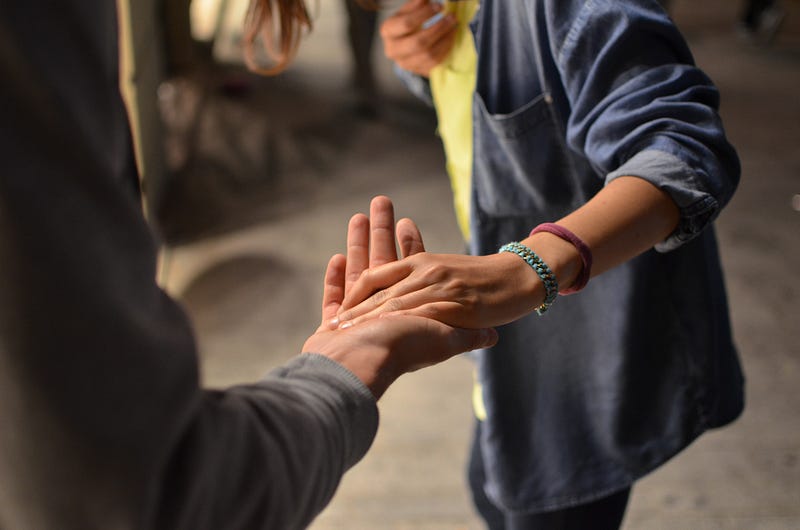
Here’s a story you might have heard before from the Gospel of John. Jesus had arrived at a pool where blind, lame and paralyzed people lied powerless. Jesus approached one who had been there for 38 years.
“Do you want to be well?”
The sick man answered, “Sir, there is no one to help me get into the water when it starts moving. I try to be the first one into the water. But when I try, someone else always goes in before I can.”
Then Jesus said, “Stand up! Pick up your mat and walk.” Immediately the man was well. He picked up his mat and started walking.
Imagine this story in the present day. Many people practice self-care, longing to be healed. Once they are healed, what do they do? Do they stay on their mat and keep telling others about how they couldn’t move before? Or do they come to their mat every day and keep brooding over their previous plight?
I would imagine others would try to sell their “healing” mat and become a Mat Influencer. They would offer a 20 percent discount to anyone buying their mat by entering the discount code on their bio. They’ll peddle bottles of water from Bethsaida and offer 5-day healing retreats.
Meanwhile, there are people around him who need healing, and they can’t afford his goods. He remains stuck in his own emancipation story even though those around him need his help.
The message behind this story is that we make our healing about ourselves. Rather than picking up our mat and walking, we seek to capitalize on our personal healing. We look for marketing opportunities so that we continue to profit on our healing rather than using our story to help others.
It’s not union.
Indeed, we’ve made the healing arts and self-care an extension of hyperindividualism. It keeps communities divided, salaries disproportionate, and environments drained. It keeps us in competition with one another as we strive for things that fail to satisfy. It’s not union. It’s not yoga.
What do we do?
Consider the messages you’re amplifying with your likes, shares, and comments. Do they perpetuate self-indulgence or self-inquiry? Do they seek to build competition or community? Do they feed on ego, or do they cultivate compassion for others?
We realize that healing ourselves and society can happen simultaneously.
We can stage a rebellion against the hyperindividualism that keeps us all stuck. We can recognize that by picking up our mat, it’s to help others pick up theirs. If yoga truly means “union,” our messages should convey that. Union shouldn’t need a 20 percent discount code.
We can redefine what it means by “The Good Life” according to The Relationalist Manifesto, which states that each of us has a role in the responsibility of the world:
A good life is a symbiotic life — serving others wholeheartedly and being served wholeheartedly in return. It is daily acts of loving-kindness, gentleness in reproach, forbearance after insult. It is an adventure of mutual care, building, and exploration.
This role might emerge from our mat, or it might make us aware of another injustice. We don’t ask “What’s in it for me?” Instead, we ask, “How can I serve?” We can weave together the social fabric of our community rather than rip it apart. We realize that healing ourselves and society can happen simultaneously. We see that our actions aren’t independent but interdependent, especially on social media.
We all have healing to do. We all have been on that mat by the pool. Rather than stay on our mat, pick it up and walk.


