
The World is a Fine Place, and We Should All Hate to Leave It
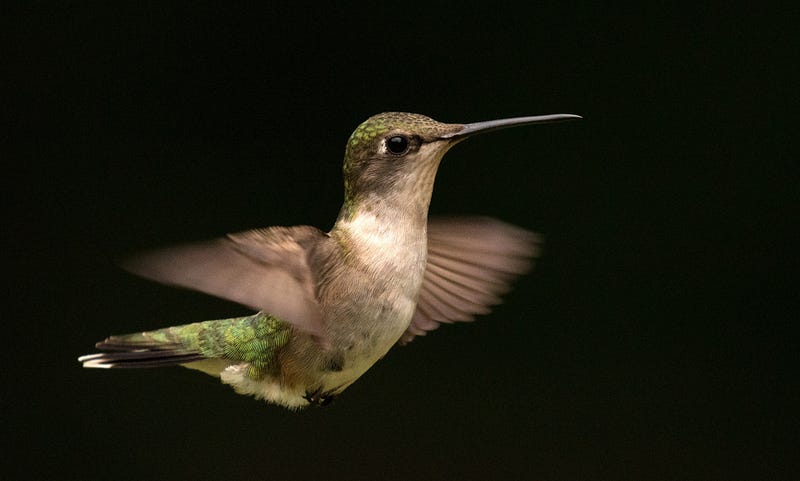
Yesterday, a hummingbird hovered in front of me as I sat on our balcony and looked past the hanging baskets and across the valley at the hills and the mountains beyond the hills. As he worked the red Petunias and pink Sweet Williams, he moved to face me, his wings beating rapidly, creating the illusion of many wings. They shifted and turned, even as he hovered before me. I, too, felt still and quiet. He watched me for a long while, then returned to drinking from the cup of each blossom. Eventually, he flew away across the valley and toward the hills. For a moment, we shared an intimate, safe, and simple relationship.
After he left, I started thinking about a passage from Hemingway I read when I was very young and recently re-read, the book still on the table beside me. It is a passage about presence and grace.
At the end of For Whom the Bell Tolls, Robert Jordan is wounded in the aftermath of his mission to blow up a bridge. He is bleeding internally from being crushed when his horse falls as he escapes from the battle. As the fascists approach him, he waits for death on a hillside, struggles to stay present and aware, and has one last moment to reflect on life.
“I hate to leave it, is all. I hate to leave it very much, and I hope I have done some good in it… The world is a fine place worth fighting for, and I hate very much to leave it.”
In my youth, I yearned for this composure and state of grace in the face of suffering. Now, older, I have it and only regret I did not have it at twenty-eight, like the character in the story. Of course, Hemingway was forty when he wrote this, and I have learned it would be the rare twenty-eight-year-old who would have such grace.
I often felt sorry for myself when I was young. I had grown up with abandonment, an alcoholic stepfather, hyper-religious mental illness with episodic violence from my maternal grandmother, my primary caregiver, and indifference from the sane people in the family as they also tried to cope with the chaos. In my room hung a glow-in-the-dark sign — lurid purple with green radium letters that would shine in the dark like a title poster for a Hollywood monster film — “Children Should Be Seen And Not Heard.” Later, I believed I had seen more than my share of death working in the medical field, taking burned bodies to the shower to de-breed blackened flesh with steel brushes and betadine and trying to seal out of mind the screaming as the dead burned flesh rolled off in strips or faces severed of tongues, jaws and voice boxes due to cancer or blood covering me so thoroughly it squished out of my shoes, my white uniform scarlet from the violence of it all, one time a shadow on the wall in blood like a victim of an atomic blast of light, in this case an explosion of blood.
Age and my vocation have taught me that we all see our share of death; even if we intimately see death only once, we see our end in that death. We all have a personal relationship with death. It is ever-present and fills us with fear because most of our experience of death is violent, whether it is the ripping violence of witnessed or experienced physical trauma or the reactive violence in our spirit of the fear of the unknown. After the violence and death that defined my youth, I chose to fill my life with beauty to find peace, clear my memory of violent images and find a way to stop being afraid. To that end, I spent a decade in the academic study of the History of Art, anthropology, and comparative religion.
The study of art and religion revealed that violence and death are the primary subjects in men’s and women’s lives in all times and cultures. But violence and death in art are transitory; they hang on the museum wall, frozen flashbacks of the story of humankind, representations of our collective memory hanging in a brick-and-mortar building, holding images we can turn to the wall out of sight.
I learned the images of our stories cannot be turned away so easily, not even with religion. They travel with us, haunting us, ghosts of intrusive thoughts or nightmares, pulling us from sweaty sleep if we can sleep at all. Though we can censor art when it reminds us of things we want to forget, we cannot as easily control and censor the images and stories inside us.
I left the study of art still struggling with stories and images of violence and death. These haunting images of burned bodies and faceless people held questions I could not answer for them or myself:
“Does anyone hear me?”
”Does anyone care that I lived?”
“Have I done any good?”
When art did not give me the beauty and peace I needed, I had what used to be called “a nervous breakdown” and went to a psychotherapist. After a few weeks of unstoppable grief and tears, she told me I had post-traumatic stress disorder, and my symptoms were a reaction to battles I could not find meaning to, explain or justify. I spent two years with her, learning how to answer these three questions and end the overwhelming sense of alienation and anxiety which had emotionally crippled me for four decades.
I learned that indulging in fear is a poor way to find the answers to these or any questions.
I learned that everyone is afraid and tries to hide it.
I learned that indulging in victimhood is the lazy way to navigate life.
I learned self-pity is the big lie that makes us feel alone and ill.
I learned that those who are suicidal do not want to die. Suicides want the alienation and anxiety to end, believing that their alienation and the pain are unique, unbearable, and not understandable by anyone else.
I learned that those who wrap themselves in religion and political propaganda, wallow in academic philosophies, financial greed, politics, cultural diversion, and celebrity are also suicides. Their external pursuits are efforts to avoid the existential pain of alienation by distraction. The obsessive pursuit of these external things is simply a different kind of “suicide,” which seeks control by evading responsibility for how they feel to taking or receiving power from an outside force just as surely as physical suicide evades the responsibility of life by dying.
I learned that though we live in a violent space between birth and death, we can choose to enter a life of peace and beauty. We do this by taking responsibility for our thoughts, words, and actions as we move through this life and let go of blame and shame.
I learned that mothers do love their young, and often the fathers do too. Parents often do not hear us because they, too, are wrapped in self-pity and fear, and they cannot read our minds, no matter how magically god-like we imagine them when we are children. I learned that parents do not wake up thinking, “I wonder how I can make my child miserable today?” I learned that parents don’t always give us what we think we need or want, because they are doing their best to deal with their fear — a best which is often not that good. After all, fear is as terrible a way to raise children.
I learned that because death terrifies us, and parents disappoint us, many of us embrace metaphorical parental “Gods,” hoping they will save us. When those metaphors do not magically protect us from the hardship and fear of life, some adopt an even more useless nihilism.
I learned that the person we need to listen to is ourselves. The person who has to care about how we live is ourselves. And that even when we make a mess of things, we can keep moving forward with dignity and grace instead of shame and fear. And I understood that we must learn to offer that same listening, caring and grace to others, or we cannot heal and find peace.
I came to accept that the truth of life is this.
Life is hard, and then you die.
It is a brutal truth, but it is a fact. Even happy people have hard times. How we choose our thoughts and actions matters because each choice creates meaning and purpose.
Life is that simple.
How did my therapist teach me this? She led me to answer the three fundamental existential questions by teaching me to accept personal responsibility for my life. She did this by hearing me, caring about me, and allowing me to see that I was valued with no strings attached. She was always fully present “in the moment” when we were together. She helped me escape the emotional drama and find calming solutions to my fears.
Through the relationship with my therapist, I learned that in the end, all we have is each other; all we want is someone to be there for us. She helped me understand that as a medic fighting death and suffering with patients, my relationship with them was as much healing for them as success against death. As a law enforcement officer sitting with accident victims quietly dying in the street and letting them know they were not alone, that they were heard, cared about, and valued, I entered the healing relationship they needed at the moment.
I learned to take responsibility for being present in each painful or joyful moment of life, letting go of past and future, fully offering my presence, and allowing relationships to become intimate for the one offering and the one receiving the offering.
Ultimately, I understood that we need each other and that our pain comes from how imperfectly we allow ourselves to need and be needed to help and be helped.
Experience has taught me that spiritual and mystical metaphors verbally represent that healing relationship. When we externalize metaphors at face value, we project our power to help others away from us onto images as static as the art I studied. Understanding this, I stopped believing in the great parent or Grandfather God in the sky. I am, after all, a parent and a grandparent and have been a Dutch uncle to hundreds of people. Grandparents and uncles no longer impress me.
Healing occurs in the intimacy of relationships, even painful ones because we learn from each other and heal by listening to each other, being fully present and caring for each other. When we see ourselves in others and stop wanting to punish and destroy ourselves, we stop wanting to destroy others and enter into a world so beautiful we are in no hurry to leave it but are at peace, knowing we will leave it and will have done well.
Everything has a beginning and has an end. Life lives on the ending of life; as the fish dies, the hawk lives, and as the hawk dies, the plant growing out of its decayed flesh lives. We all know this intellectually, but living with it as our most profound accepted awareness from abstract intellectualization. When we fully realize what living means, we are no longer alienated from ourselves or the world; we can honor life by respecting all life, even as we consume life to live. And only when we value and respect all life does alienation end. We have this life, this earth, and the sentience of everything around us to keep us company. Scientific research tells us what we all knew when we were three: that even plants care for each other. Many have given up the self-centered myths, metaphors and materialism preached by religious institutions that have fed our alienation from each other and all of creation. Still, far too many are stuck in spiritual pre-adolescence, waiting to be told what to believe and what to do and unable to recapture the wonder we experienced as children when we knew that everything alive also mattered.
I eventually became a therapist; a counselor is a more common term now. I learned to listen completely to myself, and others and care for myself and others without strings. I moved from teaching History of Art in college and teaching English in inner-city schools to teaching others how to answer these questions as Carol, my therapist, taught me. In this vocation, I have tried to do good in the world and live in a healing relationship with myself and others. I teach them happiness and grace occur one moment at a time, and our goal is to decrease the space between those moments. We do that by not overthinking, being present and paying attention when those moments occur.
I help people see that the world is a fine place, help them focus on not giving in to existential nihilistic alienation and show them they can find meaning in life, not some individual or personal fantasy fan fiction but a shared consensual experience communicated clearly and lovingly. I help them understand that we are never alone, that everyone struggles with anxiety and that we help ourselves by helping each other release the fear. We do this for each other by listening to their stories and sharing our own.
I help them understand that living means embracing who and what they are, passing life on as best as possible through the stories of their experience, and teaching another generation how to live with grace. Through our stories, we can understand that our primary purpose is to create and nurture a new generation — the rest: religion, politics, philosophy, financial greed, and celebrity, build a wall against caring for each other and are not the answer to our alienation and pain. In fact, within the healing relationship, people spontaneously see that religion, politics, philosophy, financial greed, and celebrity are the source of bitter resentments and alienation.
Sometimes, I, too, fail, but I continue to practice and generally manage to live, offering others a relationship that is present, hears them, cares about them and values them.
Life is very hard, and human character is fearful and flawed. Living with the clear personal values of honor, endurance, courage, and grace in a chaotic, stressful, and painful world is also hard. Those values are how we create peace for ourselves and others. We do this one person at a time, one vulnerable relationship at a time. We and those we offer a healing relationship struggle and make mistakes. When that happens, we keep working at it, accepting that none of us are perfect.
Ultimately, what we do and how we behave toward ourselves and with one another is all we have and leave to the world. Life improves when we offer grace to ourselves and others. That way of life is what supplies answers for us to the fundamental questions:
“Does anyone hear me?”
”Does anyone care that I lived?”
“Have I done any good?”
We experience the happiness and peace of grace when we know the answer to each question is yes.
The world is a fine place, and we should all hate to leave it, hate leaving it very much. But we will, and the greater shame would be to waste our lives arguing about the lies of religion, philosophy, political propaganda, scientism, financial greed, and cultural celebrity. I hate that I will leave this world; being present allows me to experience its beauty, even in the sadness of suffering. I know an accident can take my life at any time. Even if I avoid accidents and illness, a time will come to say goodbye. I know the days ahead of me are fewer in number than the days behind, which is true for those I love and those I have yet to love. The sadness of that can feel unbearable, but we must bear it with calmness, dignity, and courage.
Yesterday, I listened to a hummingbird’s wings hum as he hovered and studied me. I stepped into the moment, being fully present with him. I do not know what he experienced as he watched me. I like to believe my quietness and stillness communicated safety and caring to him as he hovered and that, for a moment, for both of us, life was not hard but good and kind, and we were present for each other, hearing each other, caring for each other and knowing each other’s value. In that moment’s grace, we both had a healing relationship and knew that in that moment, we were good in the world.
August 2023