
The Writing Life
The Workings of a Poetic Mind
Getting to Know Me
We all struggle to adequately introduce ourselves with Medium’s about section. I know I just don’t feel comfortable writing about myself. It’s a lot easier if someone asks the questions. I’ve been interviewed a few times in the past twenty years. I find these ventures tend to make me squirm.
Back in 2015 was my most fulfilling interview. I barely felt squirmy at all through the process. I was queried by a wonderful fellow writer who publishes interviews on WordPress. What follows, is blogger Meryl Mammen Kurien’s interview with me. Her questions are the subheadings of each section.
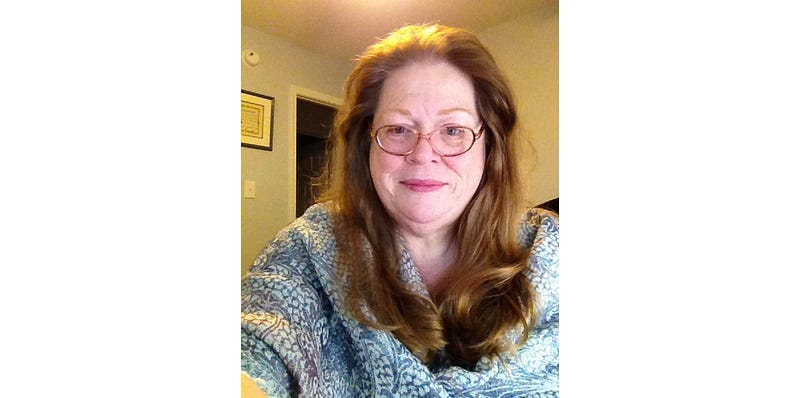
How did you start your poetic journey?
I began as a visual artist. Poetry, for me, was an extension of that. As I’ve always said, “Being an artist isn’t something I do; it’s who I am.”
Me: How has poetry become a powerful agency for you?
My poetry evolved from notes I’d make for pictures I created. I’d jot down things I couldn’t fully express in an image. It was a way to fully express my life and inspiration.
Would you call your writing style “confessional poetry”?
I write my life. I write what moves me, inspires me, frightens me, motivates me, holds me back, props me up, and tears me down. Whether it’s visual art, poetry, or other creative forms, the only way I know how to do them is to pour them out of myself. I don’t know if that’s confessional poetry.
What are your thoughts on contemporary poetry that focuses increasingly on introspection and personal experience?
What? Contemporary poetry “focuses increasingly on introspection and personal experience?” Was there ever a time when art forms and poetry didn’t do that?
Now, I’ve studied this… I mean, I’ve studied it A LOT. In every era and every genre, the arts is and always has been an expression of its time AND of its author. I do think it’s a great time today to be a poet and to be able to speak with my voice, unfettered by convention and censorship.
What is your recipe for the perfect/most satisfying poem?
To my way of thinking, there has never been a ‘recipe’ for creating. It’s down to opening your soul and letting all you are and all you know from your voice. Then, be willing to set it down in words, sound, image, or performance. For me, my poem ‘Inspiration’ says it all.
Inspiration
Lollipops and raindrops Sunflowers and sun-kissed daisies Rolling surf and raging sea Sailing ships and submarines
Old Glory and “purple mountain’s majesty” Screaming guitar and lilting rhyme Flight of fancy and high-steppin’ dances Set free my mind to wander…
Imagine the ant’s marching journeys. Fly, in my mind’s eye, on butterfly wings. Roam the distant depths of space. Unfurl tall sails and cross the ocean.
Pictures made just to enthrall Creating images from my truth Painting hopes and dreams on my canvas Capturing, through my lens, the ephemeral
Let me ruminate ‘pon sensual darkness… Tremble o’er Hollywood’s fluttering Gothics… Ride the edge of my seat with the hero… Weep with the heroine’s desperation.
Yet… more than all these things…
Give me words spun out masterfully… Terms set out in meter and rhyme… Phrases bent to rattle the soul… Prose that always miraculously inspires me!
The trill runs up my spine, as I recall… A touch… a caress…a whispered kiss… Ebony eyes embracing my soul… Two souls united in beat of hearts.
A butterfly flutter in my womb My lover’s wonder o’er my swelling The testament of our love given life Newly laid in my lover’s arms
Luminous, sweet ebony eyes Just so much like his father’s A gaze of wonder and contentment From my babe at mother’s breast
Words of the Divine set down for me Faith, Hope, Love, and Charity Grace, Mercy, and undeserved Salvation “My Shepherd will supply my need”
These are the things that inspire me.
© 18 September 2014 by D. Denise Dianaty
You cover the sad plight of several individuals such as army veterans, children, etc. Do you feel that empathy is something that comes naturally to a poet? What inspires you to write about the pain of such people?
There’s really no way to explain how and why I am moved by the plights of others which I’ve never experienced. Everyone sympathizes with others. It’s human nature.
To really feel what others feel isn’t often a comfortable thing. To pass a stranger and feel their pain is, to put it mildly, disconcerting. Children, especially, are like mobile beacons of emotion. In fact, children seem to drown out adult emotions. But, I believe most people are capable of empathy toward children. However, to be flooded by someone else’s joys is indescribable. You feel really good that you can honestly and sincerely share their joy. It’s part of what inspired my personal quote:
“Take sincere joy in the success of others. Being happy for them will make you feel incredible about YOU!”~MomzillaNC
That doesn’t really answer the question, does it? Permit me to offer this: Empathy, for me, is a rare, spiritual gift. Such gifts are not bestowed upon us without a purpose for their use. I hope one of my gifts is empathy and that I am using it intended through my creative efforts.
You wrote about the raising of the Confederate Flag in North Carolina, how has racism affected you as a person?
That’s a really difficult question. It actually hits quite close. See, my husband, Hamid, is an immigrant from the Middle East. He sought and received political asylum in Germany. For that reason, he couldn’t go home again from Germany to see his elderly father and family.
Hamid came to the US in the 1980s, on a student visa, to Columbia, MO. He chose the location because he knew a few people from his hometown. They had settled there after the fall of the Shah.
I met him in April of 1991. When we met, Hamid had his return ticket to Germany in his wallet. He never used it. We’ve been together ever since.
Anyway, he’s faced a lot of bigotry and racism in America. I can’t tell you how many times someone I worked with, whom I was really buddies with, would drop me when they learned Hamid was an Iranian American. It was always confusing and frustrating. And, I found it personally hurtful and demeaning.
Too often, I’ve seen people treat him as if he lacks intelligence. Hamid speaks six languages, reading and writing three of them fluently — Farsi, German, and English. To my ear, he doesn’t have a strong accent at all. My husband graduated from Lincoln University in Missouri on the National Dean’s List. He’s lived in three countries and traveled extensively throughout the Middle East, Europe, and the USA.
But, no one ever bothers to find out any of that. All they see is the “other” of him. They hear Hamid’s accent and decide he’s just not smart. Sometimes, they think they have to speak slowly and monosyllabically — or shout to be understood.
You know the type of person. They think speaking louder to someone whom they ASSume doesn’t speak English will somehow make them understood. We get Americans on the phone who do that all the time when they hear his accent. Hamid just says, “No English” and hangs up on them. I don’t blame him one little bit.
A Few Specific Examples of Bigotry
While Hamid was in college, he worked as a pizza delivery driver. Once, an order for food and a case of beer came in. He took the delivery to the house in question. Young children answered the door.
Hamid took the money and handed them the pizzas and change, then explained he had to give the beer to grownups. One of the children scampered off somewhere in the back of the house with the change. Hamid said he could hear someone loudly tell him they were there and that it was okay to let the kid bring in the beer.
Naturally, Hamid again explained that he could only hand the beer to an adult — it is, after all, the law. A woman came down the hallway cussing a blue streak and berating Hamid. She cursed him with every foreign epithet she could think of, then snatched the case of beer from him.
Her parting shot, as she slammed the door in his face, was “Learn to speak English or go back to where you came from!”
How do you comfort someone you love after such an experience?
There was another incident not long after we opened the café we owned in Missouri. It was well past closing and my husband was trying to get the car out of the alley behind the building, where business operators often parked while loading or unloading. While he was loading the car to come home, someone had parked at the entrance to the alley.
Our little alley turned off the through alley. It was a dead end. A set of dumpsters sat in the middle of the through alley — an obvious hint to people not to park there. Hamid was able to back into the through alley. But, he was stuck by some guy’s car parked at the opening of the alley.
After waiting for a long time, Hamid went up and down to the other small businesses along the block. In each storefront, he politely asked if anyone knew whose car it was. The guy was in one of those businesses.
The other patrons and employees of that business — who also parked in the alley and were frequently blocked in by patrons too inconsiderate to use the street parking — told the guy rather aggressively that the alley entrance was not for public parking under any circumstances. He followed my husband out of that business to his car. As he was getting into his car, he began berating Hamid, with much profanity, as a nuisance foreigner.
Why do people do that, especially when they’re in the wrong? Nothing is gained calling out the other over frustrating incidents. Their difference to you is not the cause of your frustration.
Another time, right after 9/11, a sales rep for a commercial decor company came into our café. He walked up to the counter and said to my husband, “I won’t do business with you people after what you did to us in New York.”
In all fairness, when other patrons along the street and other businesses heard about it, they leapt to Hamid’s defense and tried to assuage his hurt. Even the pastor of the big United Methodist Church up the street made a point of coming in to speak with Hamid. And, that following Sunday, our little café was full of church folk from the Methodist and the Episcopal churches in downtown Columbia.
One guy came in to poison our lives. A hundred or more came in with an antidote to his poison. I have to say, I was proud to be an American then.
I’ll offer one final and deeply personal example from Missouri. After hoping twelve years to have a child, we finally had a beautiful, compassionate, loving little boy whom we named Graham Mehrzad, and called “Gray” for his nickname. When he was not quite three years old, Gray and I were in the local mall one frigid winter morning. He and another beautiful, rambunctious little Arab boy were playing together. I often saw him and his mother in the mall play area.
She spoke very little English. But we always nodded and smiled at one another as we watched our two boys dash off to play together. She always sat in the corner as far from everyone as she could. The lady was usually occupied working on some kind of textile project. I had little opportunity to converse with her even if it had been possible.
One morning, there were also two other ladies, whom I’d seen there before. I had conversed with them, in the friendly way I have, on more than one occasion before they saw me with Hamid one day. After that, they never spoke to me again.
That particular morning, they were sitting nearish to me on the benches that lined the play area. One of them said to the other, over loud to my ears — as if they wanted me to hear them, “It’s a damn shame when you can’t even bring your kids to play without them having to play with sand n*ggers.”
It was like a punch in the gut.
I almost died bringing that child into the world.
Gray and that little Arab boy were two innocent souls, just happily playing with any and all the children who came to that place, a place that was supposed to be a safe space. It never occurred to them that they or the other children were somehow different. It didn’t occur to any of those children that one or the other was somehow not good enough.
I felt sick, physically sick. I was trembling right to the core of my being. I couldn’t see straight and realized tears were streaming from my eyes. My own nails were cutting into the palms of my trembling fists. For the first time in my adult life, I was utterly dumbstruck.
Those other two mothers whispered to each other behind their hands while I tried to gather up Gray and our things. I don’t know what they were saying. But, I don’t imagine it was nice. Their eyes were on me the whole time.
The little Arab boy’s mother got up and walked over to me. She placed a hand on my elbow and guided me to the bench across from the boys. I couldn’t tell her what I’d heard. I don’t think I’d have been able to make her understand, to be honest. But, I know that I would never have laid that hurt upon her heart.
I had Hamid’s flip phone in my hand and she asked, “Bad call for you?”
I just nodded. She patted my back and helped me neatly pack up our stuff and get Gray into his snowsuit. He didn’t want to leave while his little friend was still there to play. I know she wasn’t planning on leaving. However, she gathered up her things and her little boy. And, she walked with Gray and me to the mall entrance before indicating she was in the other direction.
She kept asking, “You will be okay?”
I don’t remember her name or her little boy’s name. I’ll never forget her humanity. I’m glad she couldn’t understand those poisonous words.
But, that was the moment. That was when I realized my family would always be ethnically profiled in Missouri. That was the moment I envisioned my beautiful, sensitive boy arriving to pick up his flame-haired young girlfriend (because boys marry someone like their mamas, naturally).
I imagined the girl’s father saying, “Get off my front step. No sand n*gger is dating my daughter.”
It has never happened. It’s what I envisioned happening to Gray because I’d known someone to whom just such an experience happened — albeit in Memphis, TN in the 1980s. That moment, though, was when I decided my husband was right and that there was nothing in Missouri for us. Hamid had been lobbying every winter to go anywhere that wasn’t so cold.
So, we opted for North Carolina to be near Gran and Grandpa Jack. At least there’s my family in North Carolina, I thought. It’s where I’m from, after all. For all the racial tensions in the South, I’d never heard or seen anyone act like those women over a couple of children at play.
All of the above acts of bigotry occurred before the rise of extremist rhetoric and hate speech from political leaders. I wonder now if people would circle and support us as they did after 9/11. For a bit there, I would wonder… and it still haunts my dreams as nightmares… I wondered if I’d find myself watching my husband and my son dragged off to internment camps… Or — and my breath still catches at the very notion — to concentration camps.
If you enjoyed my offering, please buy me a KoFi.

If you enjoyed this reading, join Medium and support all the contributors you love. That’s how Medium works: our membership fee is shared with everyone we read and theirs is shared with everyone they read. Please note, the link below is an affiliate link and by following it to join Medium, I will benefit from promoting membership with a tiny extra portion of your membership fee at no extra expense to you.
Shoutout to my WE PAW Bloggers publication contributors here on Medium: Carrie Ann Golden, Bob Metivier, My Alter Ego and Me, Deon Christie, David Perlmutter, Suzanne Hagelin, Harry Hogg, Kelly Santana Banks, Brian Lageose, Mason Bushell, Michael Embry, Samantha Bryant, Patrick Metzger, Subhasinghe SPS, PhilAndMaude, Jason Provencio, Janerisdon, Robert Trakofler, Shoreditchpoet, Nikolaos Skordilis, Stuart Aken, Dr.Titus Varghese, Tomas Ó Cárthaigh
WE PAW Bloggers group is a writers’ forum — it is a family of writing creatives supporting one another through networking and reciprocal interaction on our journey of growth as writers.
