
The Woodworker’s Dog
She educated the old man the same way my dog educated me
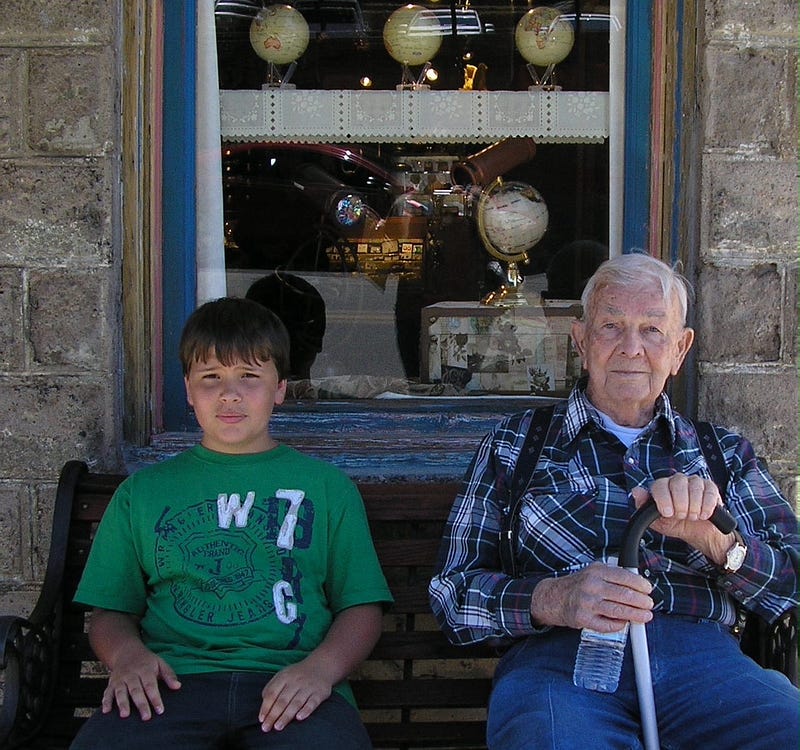
The woodworker’s grandfather was a master carpenter. He couldn’t read and write but he solved that problem by marrying a schoolteacher who liked to read to him in the evenings. Her daughter, the woodworker’s mom, lived on the same street but a quarter mile south, so the boy could come and go as he pleased. He liked it better with his grandparents.
Estrogen and testosterone find a balance in mothers and daughters
so that a more feminine, gentle woman will have a daughter who is more assertive. They will generally find a man who balances them. In this case the mother grew to six feet tall and married a man who was five six, and who, in their old age, would energetically clean the house while she sat in a recliner reading magazines. Her mother, placid, smiling, kind, patient, married the Master of the Dogs. He used an outhouse even after his wife had a toilet put in the house.
Shitting inside the house was not a habit he intended to acquire.
The boy adored the old man and followed him to jobs when he could, helping out, gradually learning his skills, until he had no need for nails or screws and did flawless inlay work as easily as framing a house. He could finish cement, do electrical and plumbing, and rebuild an engine. He grew in the shadow of his father, aspiring to be like the grandfather. One day he was on the sidewalk of the main street in the little southern town where he was born, and heard one man tell another, “See that old man over there? He’s tough as whang leather. Be careful of him.” The boy looked to see this old man. It was his grandfather.
The old man raised pit bulls, and showed the boy how to separate them if one of them was going to kill another one. “Use a straw,” he said. “Blow some pepper into the nostril and when he sneezes, jerk him back.”
The boy began looking for a fight. He had to start somewhere before Guadalcanal rotted his uniform off him and sent him to a psychiatrist, leery of letting him loose in friendly territory. He followed the highways, or preceded them, actually, with a transit and a rod man, surveying the route, making blueprints for the construction crews to follow. He was married and had children, but that’s not what this story is about.
This is about how a dog will show you some part of you that you hate to see, but need to take a look at.
In his last years he put his attention on making furniture, music boxes, cutting boards inlaid with rare hardwoods, he made gifts for people as a way to say he cared for them. When his black German Shepherd died in the driveway from ravages of old age, he had to decide whether he planned to live on into his ninth decade. If so, he would need another shepherd. He always had a shepherd to guard the fenced acre of land, to wait by the door of his woodshop while he spent his time concentrating on the wood, cutting it, shaping it, creating objects which are both art and utility.
Ada, the last German Shepard he would have in his life, had come in off the desert to meet up with him. They had some destiny to entwine.
She had been abandoned and had to catch her food, like he had so many years before, trapped behind enemy lines in a foxhole. Both he and the dog knew how to catch and eat rodents to survive.
Emaciated, her fur matted, Ada came off the high desert to the chain link enclosure where a lady had a dog rescue place near Seligman, Arizona, and visited with the dogs across the fence. The woman began to put food out for her and got her to turn herself in to be readjusted to civilian life. She arrived just ahead of our calling to see if there was a shepherd for adoption. The lady was concerned about letting the shepherd go to such an old man, but Ada behaved perfectly on the leash for him, which was a surprise because, like I said, she was nervous and did not play well with others. What the woodworker remembered about our ride back to Camp Verde in my black pickup is when we stopped in Ash Fork, and I went into a cafe to get us and Ada hamburgers. “She got right up here and put those big old paws on the dashboard, wanting to see where you went.”
What we did not initially see was that she had been abused so badly by somebody that she wouldn’t ever get past it. Speak to her with displeasure and she retreats like you are going to kick her. It was a man, naturally, because she was afraid of aggressive men. She could smell them coming. She remembered not just the physical pain, but the shame of helplessness.
She would forever remember the kicks, like the kicks a baby was feeling in my dream, in the arena with a man in combat gear, wanting him to fight. The wind from the kicks passing so close made him very still. “This one’s already dead,” a woman said. She supplied an alternative, an older daughter.
Ada was an abject coward, her body programmed early on to retreat from the blow, to take the only power available, the power of giving up control to somebody who has to have it to not fall apart. This put her in the shadow of his favorite shepherd, Lady, a fearless wolf hybrid. She patrolled the fence at night like the professional she was. Don’t open the gate if she doesn’t know you, especially if the master is not at home. If you do she will put you back out or escort you to the door depending on circumstances and how your intentions smell. The old man liked to talk about her as his dog, but his daughter met her first, and brought her to his place in the country.
Dogs show us ourselves because they love like Christ loves, and sometimes they mirror back what you cannot stand to accept in yourself.
The dog I had at the time was a rescue. He was the last in a litter of cattle dogs left beside the road in the summer sun, and he was damaged. He was already dead. The shelter didn’t know what I was talking about when I asked about him, knowing he was the last one in that litter. I had to insist he was there, and he was, on death row. Nobody would want him. He had disappeared into himself. We’d take him to the park and he would put his head down and refuse to play or even be interested. Then one night I woke up and heard him running all over the house. He’d decided to live. I loved him but I would get pissed off at him and think I could make him behave better by being angry, and while I was doing that, he was showing me how I was like my father, how I was treating him like I was treated. Meanwhile, Ada was teaching the old man about that lack of courage he couldn’t tolerate in other people. He saw that Ada was afraid of men because she’d been seriously abused. If she was with another dog and it tried to play with her, she would most likely fear bite it, and after the first vet bill arrived she stopped getting play dates. Ada was his last dog and when he died, she was taken to Nevada by my niece, where she eventually made friends with a cat. Who knew?