
The Woman Made an Impression: Artist Marie Bracquemond
A Painter of Searchers and Speculators Who Gave in Too Soon
Fruit and flowers were all very charming, but Marie Bracquemond (born Marie Quivoron in France’s Brittany in 1840) didn’t want to paint them. Instead, she populated her outdoor scenes with individuals.
Their searching, speculative expressions betray far more sophistication than she got credit for from the art establishment, then and now.
In 1860, Marie Bracquemond, a promising young student of the celebrated painter Jean Auguste Dominique Ingres, noted, “The severity of Monsieur Ingres frightened me… because he doubted the courage and perseverance of a woman in the field of painting… He would assign to them only the painting of flowers, of fruits, of still lifes, portraits and genre scenes.” — Nicole Myers
Shut Out
In the 1880s, females were shut out of life drawing classes featuring nude models at prestigious academies like the Paris École des Beaux-Arts. So women painters, denied access to the study of human anatomy and classical form, turned increasingly to Impressionism.
Marie Quivoron Bracquemond infused her Impressionism with the precision of a draftsperson, her figures suffused with light and transfixed with dynamic tension.
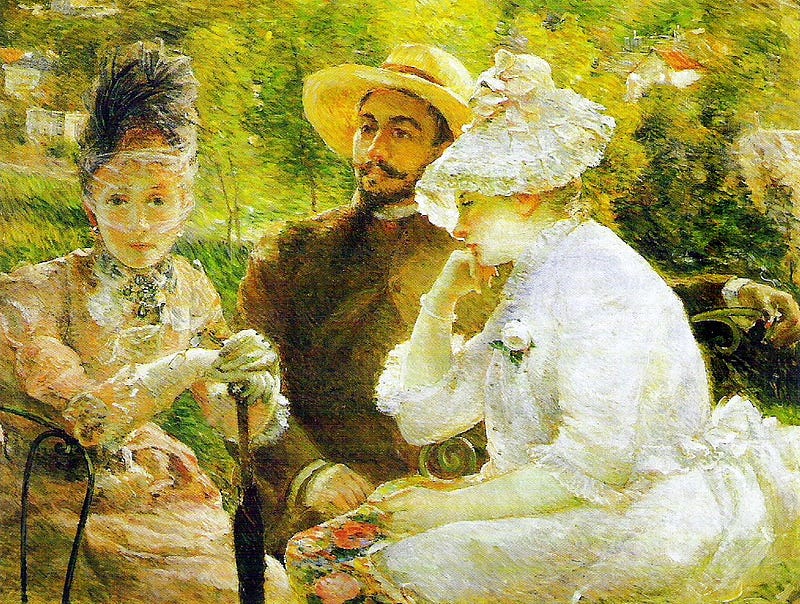
Marie Bracquemond had open-air work at the 1880 exhibition of the Impressionists that used colour in the Impressionist way and was flooded with light yet was also conspicuously exact in its draughtsmanship. — Web Gallery of Art
An Iron Grip
Many women painters remained unmarried or found a way to mesh married life with careers. Marie Quivoron, though, became entangled early in her career in a fraught liaison with engraver Félix Bracquemond.
They married quickly, over the objections of her mother, who had endured a loveless marriage. Bracquemond’s early influence on his bride later became an iron grip. Increasingly, he loudly discouraged her from associating with the Impressionist painters who took her under their wing and recognized her soaring talent.
Fresh Air
Inspired and mentored by Degas, Monet, and Gauguin, Bracquemond discarded her etchings, to her overbearing husband’s dismay. Instead, she escaped outdoors to paint en plein air.
With its emphasis on contemporary life, Impressionism was accessible to artists of all artistic backgrounds... Though their upper-class status prevented them from frequenting the Parisian café-concerts and dance halls so often celebrated by their male colleagues, they did have access to everyday subjects of middle-class leisure and domesticity and the landscapes that became the Impressionists’ staple. — Nicole Myers
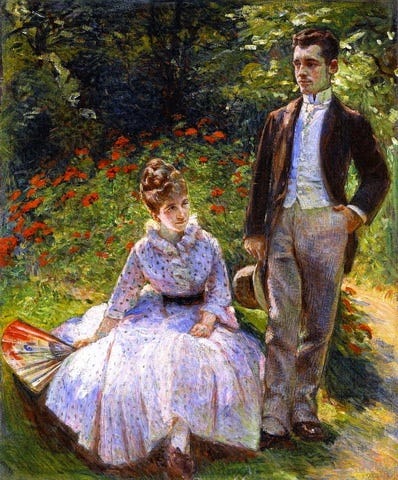
In “Sur la Terrasse à Sèvres” and “The Artist’s Son and Sister in the Garden at Sèvres,” Bracquemond’s women, genteelly costumed and accessorized, enjoy a stiff breeze while overseen by smarmy male escorts who seem to monitor their very thoughts.
The women gaze away or out of the frame at the viewer as if preserving their inner lives from male intrusion. An outing in the open air seems the only way to air their feelings, albeit with their facial expressions carefully composed.
She was one of four women artists to exhibit in the Impressionist exhibitions, in 1879, 1880, and 1886. — “Women Artists in Paris”
A Marginalized Talent
One of four noted female Impressionists of her day (Mary Cassatt, Berthe Morisot, and Eva Gonzaléz are the other three), Bracquemond has received much less attention in art history books than she merits.
A likely cause was her marriage to a jealous competitor. Although trained by Ingres and championed by impressionists Monet and Gauguin, she was restrained by her husband and fellow artist Félix Bracquemond from pursuing Impressionism. He preferred realistic engravings and insisted she follow suit.
Look Away
Perhaps for this reason, the expressions on her female subjects’ faces typically look out or away as if scanning for an escape hatch.
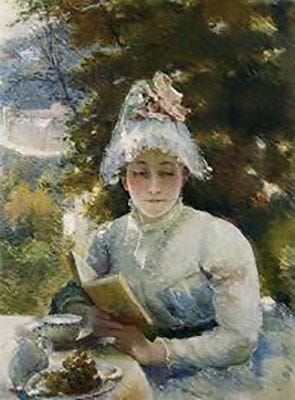
In “Afternoon Tea / Le Goûter,” a lady with a book can’t concentrate on what she’s pretending to read; her eyes stray toward fantasies of her own.
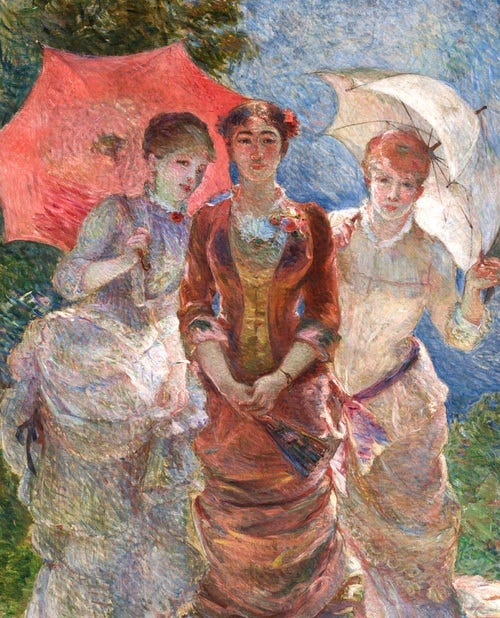
In “Three Women / Trois Femmes,” the artist is featured front and center, flanked by two upper-class companions. All three women lean eagerly out the frame, and toward a new direction they find more intriguing than the present guarded moment.
According to their son Pierre, Félix Bracquemond was often resentful of his wife, brusquely rejecting her critique of his work, and refusing to show her paintings to visitors. In 1890, Marie Bracquemond, worn out by the continual household friction and discouraged by lack of interest in her work, abandoned her painting except for a few private works. — The Women Impressionists: A Sourcebook
Big Brother Is Watching
She lived until 1916, but her painting career was over—by choice or coercion—by 1890, after constant discouragement from her husband and the demands of motherhood and ill health.
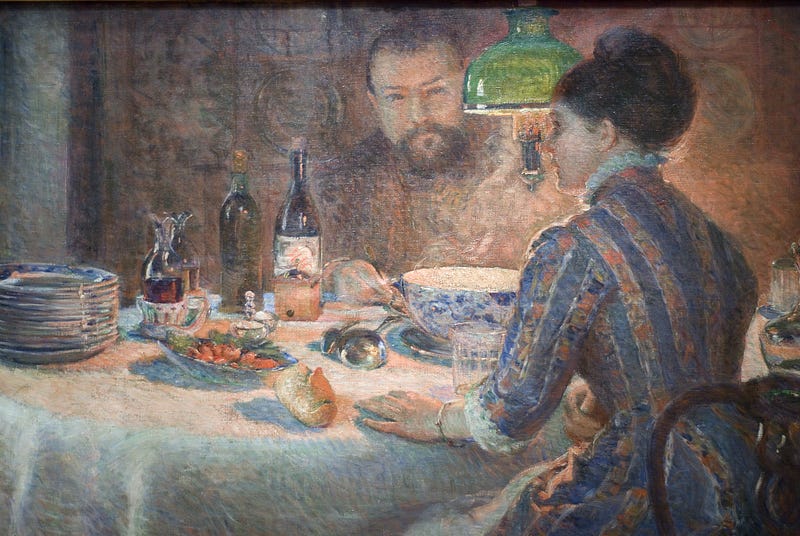
“Under the Lamp / Sous la Lampe,” a 1877 painting featuring British Impressionist Alfred Sisley and his wife, foreshadows the dampening influence of the domineering male gaze on Marie Bracquemond’s career.
Seen through a rising haze of steam, Sisley’s menacing floating head glares past his apprehensive wife like a specter. He locks eyes with the viewer, as if to warn, “Not on my watch.”
Overmastered?
That Marie Bracquemond caught the message in Sisley’s expression and translated it for the viewer is telling. It speaks to her own experience of being overseen and overmastered by male artists, including her own husband.
Making an Impression
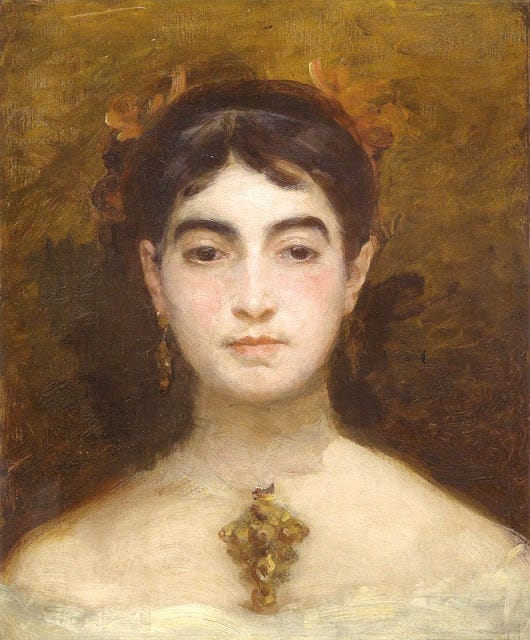
Even early in her career, Marie Quivoron Bracquemond was loyal to her own impressions of the world despite plenty of male influencers ready to see her as impressionable. In the self-portrait above, she gazes squarely and solemnly at the viewer, eyebrows slightly raised.
Sometimes love means giving your honest impression.
Read about Alice Barber Stephens, an artist whose illustrations meant business.


