avatarPaddy Corry

Free AI web copilot to create summaries, insights and extended knowledge, download it at here

2168

Abstract

Niebuhr </b>wrote a well known prayer that has spread far and wide since then. It goes like this:</p></blockquote><blockquote id="ed24"><p>“God, grant me the <b>serenity</b> to accept the things I cannot change, <b>Courage</b> to change the things I can, And <b>wisdom</b> to know the difference.”</p></blockquote><blockquote id="b477"><p>The prayer is about checking in on where we are with habits that we might want to change. It’s probably most closely associated with Alcohol Anonymous’s 12-step program… However its application to many different contexts means it can be useful to anyone dealing with change… or building up the courage to change something. And that’s what we’re going to talk about today!”</p></blockquote><h1 id="9045">Activity 1 — Candidates (10 — 15 mins)</h1><ul><li>Facilitator splits the group up into smaller units. Pairs are good, or groups of three. Introduce the first challenge as follows:</li></ul><blockquote id="7402"><p>“Your task is to think of the habits and ways of working we use as a team and as an organisation. Imagine there are no constraints… what would you like to change?”</p></blockquote><ul><li>Ask the groups to work together to identify and write candidates: one per sticky. After 5 minutes each group will be asked to present their two favourite candidates. (5 mins)</li><li>We also need to avoid duplicates, so the groups need some back-up ideas! (This is to avoid fast groups sitting pretty on two ideas.)</li><li>Each group presents (at least) two choices (5–10 mins)</li></ul><h1 id="f75c">Activity 2 — Vote on candidates and Order by votes (< 10 mins)</h1><figure id="b36e"><img src="https://cdn-images-1.readmedium.com/v2/resize:fit:800/1*bYzJP786tIcikKxrr64djQ.jpeg"><figcaption></figcaption></figure><p id="4b77">Use <i>anonymous dot-voting</i> to avoid biasing.</p><ul><li>Everyone has 3 votes. You may allocate your votes any way you like: 3 votes for your favourite candidate, or distribute them: 2 for one and 1 for another, or 1 vote each for 3 different candidates.</li><li>Write the numbers of your choices, and the number of votes for each, and give your sticky to the facilitator (3 mins)</li><l

Options

i>Once all votes have been collected, facilitator adds them to the whiteboard / flipchart (2 mins)</li><li>We order by the number of votes and work from the top-down (2 mins)</li></ul><h1 id="39ed">Activity 3— Voting: Accept or Change? (10 mins)</h1><ul><li>This is another anonymous vote, but this time, for each suggestion, each participant has to decide whether they accept the situation, or whether the team has the courage to change it.</li><li>Each participant votes beside each numbered candidate, write A for Accept, or C for Change.</li><li>Facilitator accepts the votes and updates the whiteboard / flip with the numbers of votes.</li></ul><h1 id="dd0f">Activity 4— Why did we vote to accept/change? (10 mins)</h1><figure id="ac4b"><img src="https://cdn-images-1.readmedium.com/v2/resize:fit:800/1*OyZajJaFsJ_0Mwspm6FZWg.jpeg"><figcaption>This flipchart, and this retro, works a little like a canvas</figcaption></figure><p id="c5be">The <i>Wisdom Questions</i>: depending on the outcome, facilitator asks the room why the verdict was one option and not the other.</p><blockquote id="cec3"><p>Why do you think we voted to accept this situation?</p></blockquote><p id="26fb">or</p><blockquote id="3e41"><p>Why do you think we voted to change this situation?</p></blockquote><p id="3440">Open discussion this time. See where it leads!</p><h1 id="dd67">Activity 5— What will we change? (< 10 mins)</h1><ul><li>Facilitator ensures that there is at least one concrete action to improve, and an owner for each action chosen. (< 10 mins)</li></ul><figure id="fa8b"><img src="https://cdn-images-1.readmedium.com/v2/resize:fit:800/1*J3Skv6bxAAPGKqFY1yJrsA.png"><figcaption></figcaption></figure><p id="420d"><b><i>If you do run this retro, please let me know how you get on with it!</i></b></p><figure id="a703"><img src="https://cdn-images-1.readmedium.com/v2/resize:fit:800/1*qsg-zjcnz5A8B1xmBbdIfw.png"><figcaption><a href="https://readmedium.com/your-invitation-to-the-serious-scrum-slack-workspace-f424aeea4093?sk=e8334e6ee505a85ae6b9d2a1ce37219c">Do you want to write for Serious Scrum or seriously discuss Scrum?</a></figcaption></figure></article></body>

SPRINT RETROSPECTIVE IDEAS

The Wisdom Retro

Exploring a Team’s Serenity, Courage and Wisdom in a Sprint Retrospective
Photo by James Lee on Unsplash

Niebuhr’s prayer

“God, grant me the serenity to accept the things I cannot change, Courage to change the things I can, And wisdom to know the difference.” (Source)

I love this little verse, so I’ve decided to use it as inspiration for a Sprint Retrospective. As a Scrum Master, I just couldn’t ignore the connection to Courage, one of the five Scrum Values.

Except that the purpose of this retrospective is only partly about courage to change. It is also about acceptance, but crucially, this retro is also about a team’s wisdom: why do we accept some things, and have the courage to change others?

In this exercise, we will be asking teams why they feel some problems need to be accepted, while others can be changed.

Knowledge and wisdom are not the same things. Wisdom can be difficult to see. In this retro we ask a team to verbalise their wisdom, and see how it sounds!

Setup

  • Works best with groups of 6–9 people.
  • Total time required: < 1 hour.
  • You’ll need a set of sticky notes and a sharpie or pen per participant.

Setting the scene (5 mins)

  • Facilitator introduces the theme of the retrospective, and the prayer of Thomas Niebuhr. (5 minutes)
  • You could use a speech like this:

“In the 1930’s, American theologian Reinhold Niebuhr wrote a well known prayer that has spread far and wide since then. It goes like this:

“God, grant me the serenity to accept the things I cannot change, Courage to change the things I can, And wisdom to know the difference.”

The prayer is about checking in on where we are with habits that we might want to change. It’s probably most closely associated with Alcohol Anonymous’s 12-step program… However its application to many different contexts means it can be useful to anyone dealing with change… or building up the courage to change something. And that’s what we’re going to talk about today!”

Activity 1 — Candidates (10 — 15 mins)

  • Facilitator splits the group up into smaller units. Pairs are good, or groups of three. Introduce the first challenge as follows:

“Your task is to think of the habits and ways of working we use as a team and as an organisation. Imagine there are no constraints… what would you like to change?”

  • Ask the groups to work together to identify and write candidates: one per sticky. After 5 minutes each group will be asked to present their two favourite candidates. (5 mins)
  • We also need to avoid duplicates, so the groups need some back-up ideas! (This is to avoid fast groups sitting pretty on two ideas.)
  • Each group presents (at least) two choices (5–10 mins)

Activity 2 — Vote on candidates and Order by votes (< 10 mins)
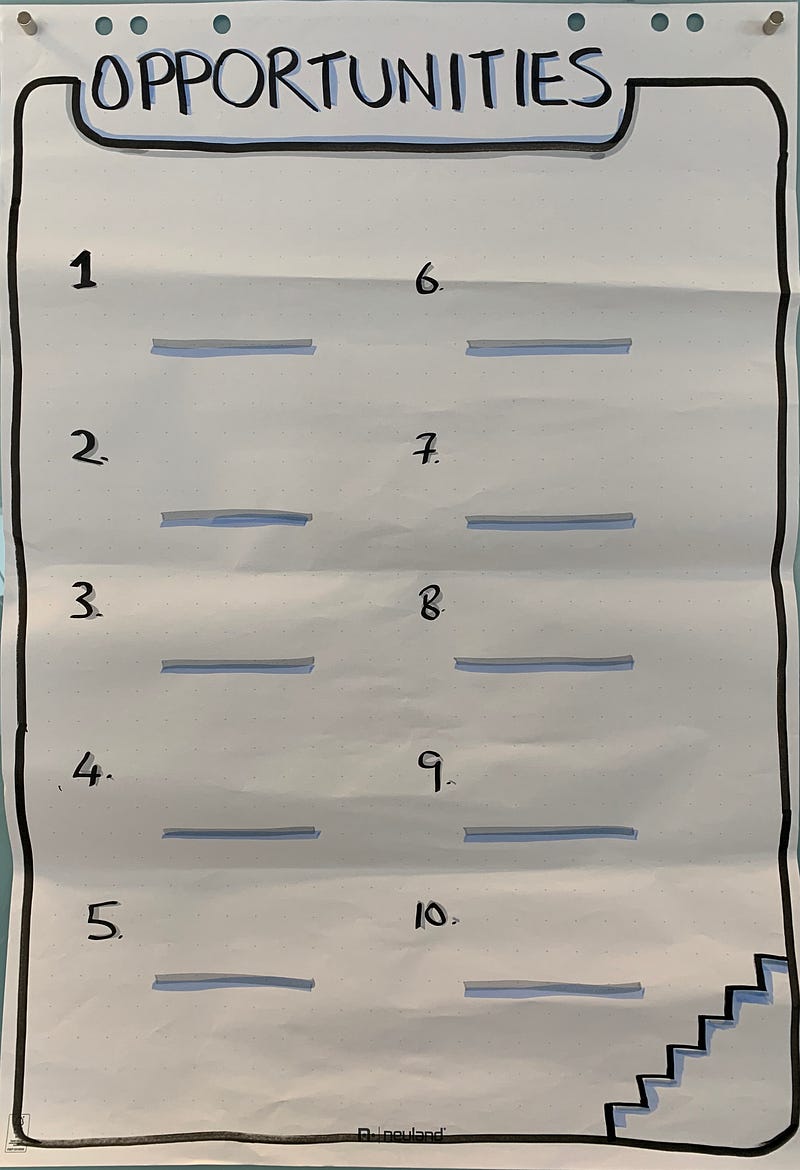
Use anonymous dot-voting to avoid biasing.

  • Everyone has 3 votes. You may allocate your votes any way you like: 3 votes for your favourite candidate, or distribute them: 2 for one and 1 for another, or 1 vote each for 3 different candidates.
  • Write the numbers of your choices, and the number of votes for each, and give your sticky to the facilitator (3 mins)
  • Once all votes have been collected, facilitator adds them to the whiteboard / flipchart (2 mins)
  • We order by the number of votes and work from the top-down (2 mins)

Activity 3— Voting: Accept or Change? (10 mins)

  • This is another anonymous vote, but this time, for each suggestion, each participant has to decide whether they accept the situation, or whether the team has the courage to change it.
  • Each participant votes beside each numbered candidate, write A for Accept, or C for Change.
  • Facilitator accepts the votes and updates the whiteboard / flip with the numbers of votes.

Activity 4— Why did we vote to accept/change? (10 mins)
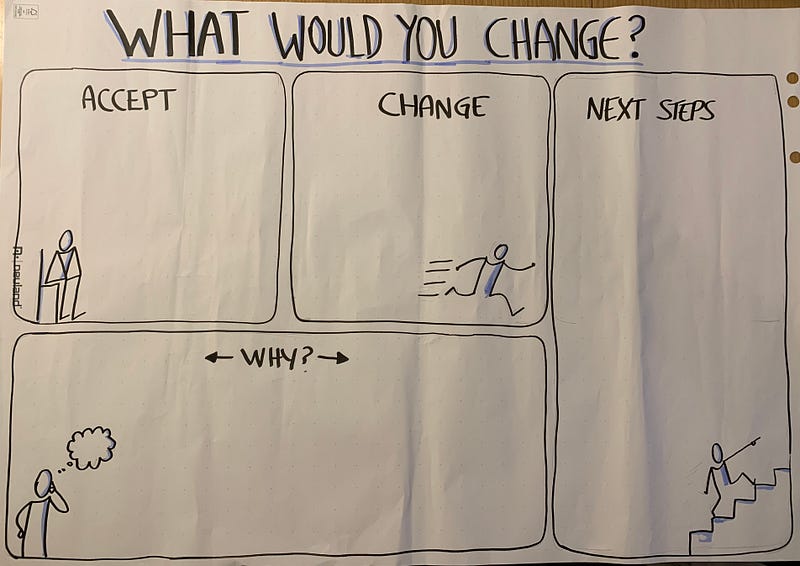
This flipchart, and this retro, works a little like a canvas

The Wisdom Questions: depending on the outcome, facilitator asks the room why the verdict was one option and not the other.

Why do you think we voted to accept this situation?

or

Why do you think we voted to change this situation?

Open discussion this time. See where it leads!

Activity 5— What will we change? (< 10 mins)

  • Facilitator ensures that there is at least one concrete action to improve, and an owner for each action chosen. (< 10 mins)
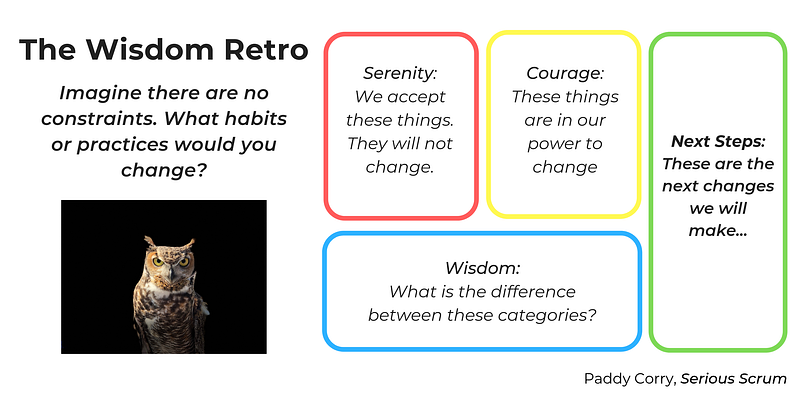
If you do run this retro, please let me know how you get on with it!

Do you want to write for Serious Scrum or seriously discuss Scrum?
Scrum
Retrospectives
Wisdom
Serious Scrum
Recommended from ReadMedium