
The Windfall in My Wood Stack
This Ill Wind Blew Some Good My Way
Four decades ago I spent a summer in the Oregon mountains harvesting wood for bowed instruments like violins, violas and string basses. The tops of these instruments, also called bellies, are carved from spruce, a light coniferous wood with a superior weight to strength ratio. I worked with a brilliant and crazy old guy who taught me the careful selection necessary for this kind of timber. We would use an “increment borer” to drill the trunk and extract a core section, looking for evenly and closely spaced growth rings. He would turn a practiced eye up the tree to calculate the length of limb free, “clear” trunk, and look for the tell tale black blemishes that betrayed the presence of a knot buried beneath the bark. Instrument wood must be knot free.

When we found a keeper we would buy it from the Forest Service, pioneer a foot path from a nearby logging road to the site, and he would fell it with his large Stihl chainsaw. Then for several weeks I took over the saw, milling out wedge shaped billets that would become blanks for the luthier. Around noon every day I would hear the approach of his Nissan pickup on the gravel road and shut down the operation. He would soon be trying to sneak up on me, convinced that somebody was trying to steal his methods; security must be maintained!
That summer the chain saw became an extension of my arms. The wedges of bright wet spruce gleamed nickel bright as I liberated them from the felled trunk. My love for wood became an obsession. Also I realized that wood does not necessarily come from the lumber yard.
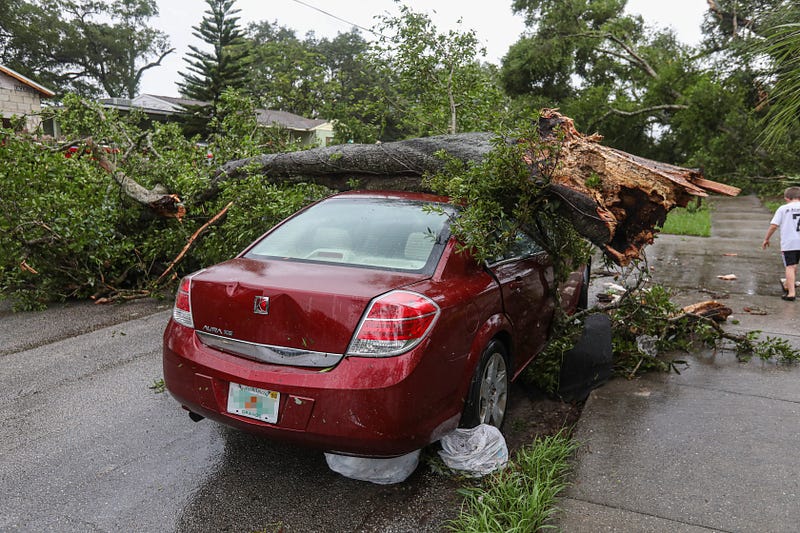
Last fall a hurricane force windstorm pummeled the Salt Lake Valley, uprooting thousands of mature trees. Looking down a street in an older neighborhood you could see six or eight huge hardwood trees tipped over, thrusting rough fans of roots and earth to the sky. The death of each tree hurt some local residents to the heart. On the other hand, for the wood obsessive, it was harvest time.
Armies of neighbors, power company trucks, city and and county maintenance crews rolled through the carnage, the snarl of chain saws ripped through the air. Mountains of log sections rose in church and public parking lots. I don’t have a chain saw to match the four foot bar of old Tom’s saw, but I do have a battery powered sixteen incher, and those mountains called to me.
Fresh wood is over 60% water, which comes in at over sixty pounds per cubic foot. My desire for tree sections was tempered by my surgically repaired back. Still I managed to haul fifteen or so trunk rounds, each two feet long or shorter, back to my side yard for milling. Now came the real challenge, milling the log sections into boards.
Chain saw milling turns out to be fairly common in forested areas, and a popular topic on YouTube. Most chain saw millers use powerful gas powered saws, set up a track system on the fallen log, and saw lengthwise through the end grain, literally the hardest path to take. My log sections were too short to merit the time and effort of a track system; I set them on end and tried free handing cuts down their lengths. My 40 volt battery could barely finish a pass and the slab cuts tended to wander. Back to YouTube.
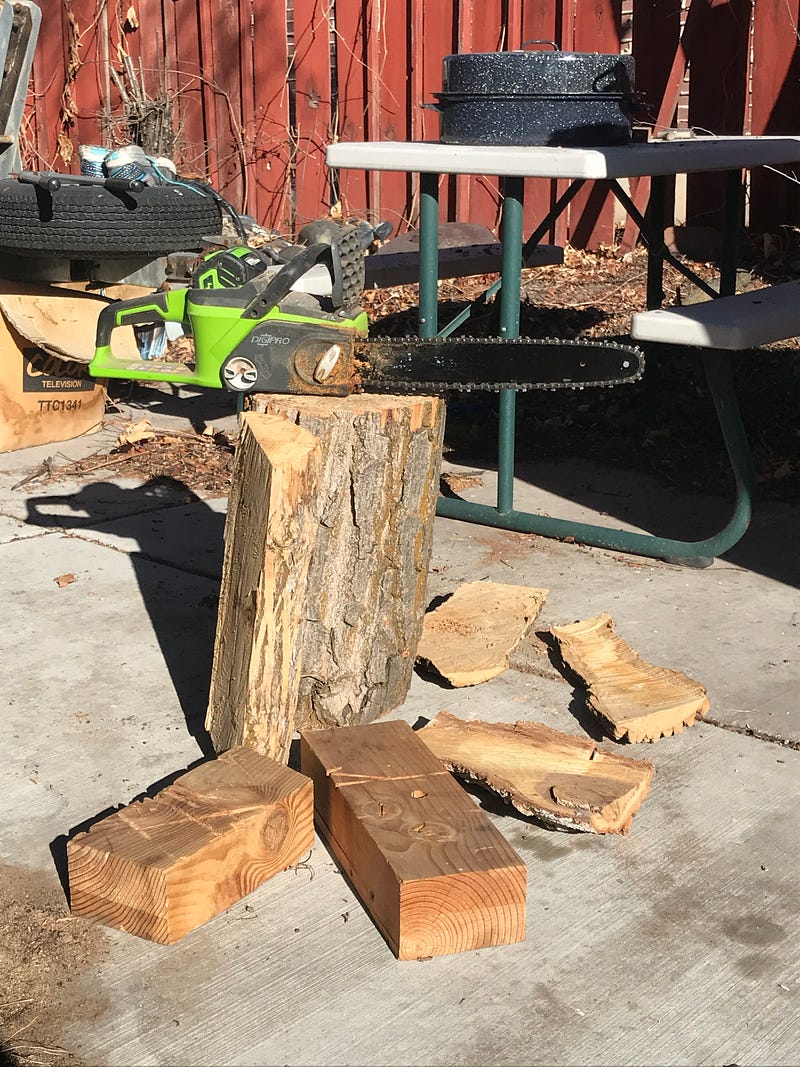
I stumbled across a guy who demonstrated his freehand technique, snapping a chalk line down the length of the log, scoring that line with the tip of the chainsaw bar, and then drawing the saw down that score, mostly with the last four inches of bar, using arcing strokes. This technique allowed him to cut along the grain, pulling long lengthwise shavings, and once the cut was established the saw wanted to follow the kerf, the path of least resistance. He was sawing nearly flat 16 foot long slabs with minimal effort or setup. Back to the side yard.
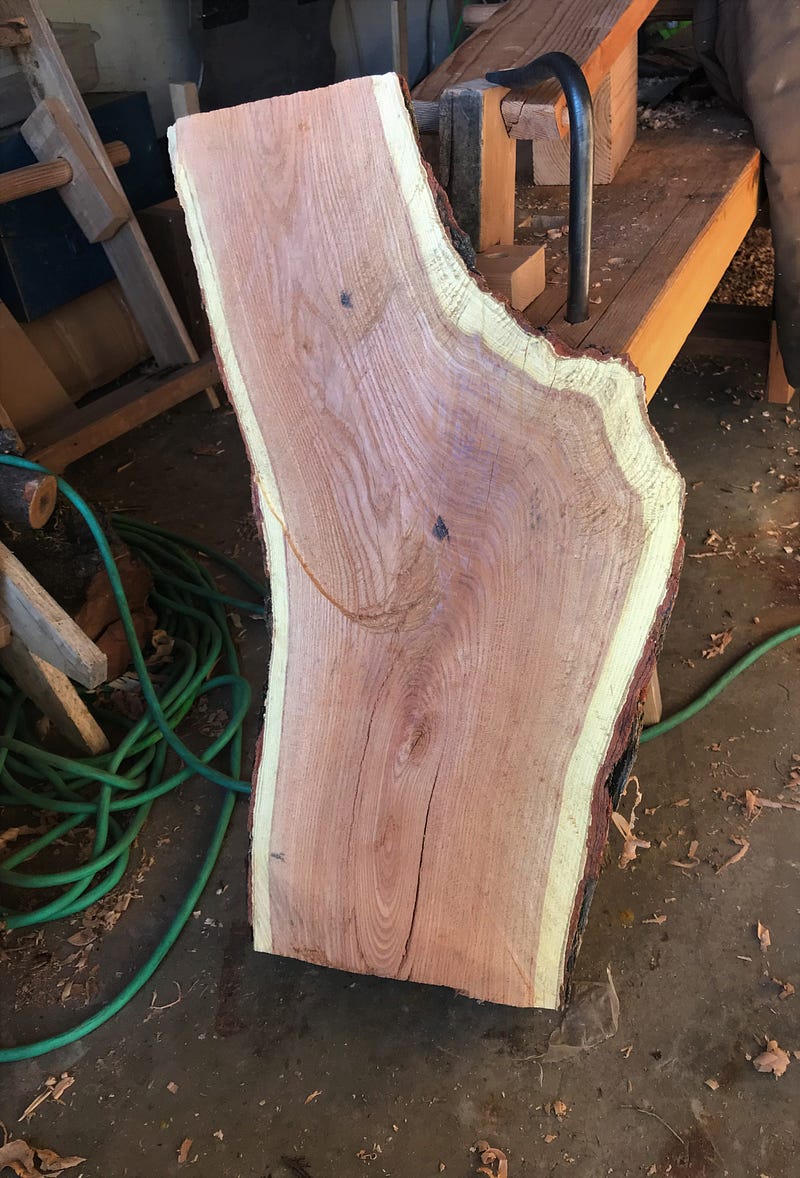
I laid out a log atop 4x6 cutoffs from my bench build, wedged the sides to prevent rolling, and trusted my carpenter eye to score the initial cut. Soon I was pulling those long shavings, a contrast to the fine sawdust from trying to cut down the end grain. I got three or four cuts before having to recharge, my pile of two inch thick rough slabs started to grow.
I should warn at this point that chainsaws are VERY dangerous tools, and I’m not recommending that the inexperienced sawyer should try any of this without research, practice, safety gear, and a huge degree of caution. Unlike a sharp chisel which leaves a clean cut, the chainsaw takes a half inch kerf. The chisel cut can sever blood vessels, nerves, tendons, most of which a good surgeon can possibly repair. Fixing the half inch wide kerf is much more difficult and sometimes impossible. Further, the chisel won’t remove a limb.
So, back to my slabs. That high water content of “green” wood can be a problem. There’s a long tradition of green wood carving, turning, even furniture building, but most woodworkers want to use “seasoned” wood that has dropped from the 60% water content down closer to 12–15%. Wood from the lumber yard has been kiln dried, construction lumber to the 20–30% range, hardwoods for furniture type projects dried to the seasoned range. Like most woodworkers I don’t have a kiln, though I am looking at some solar shed alternatives that work like green houses. For now I have to air dry.
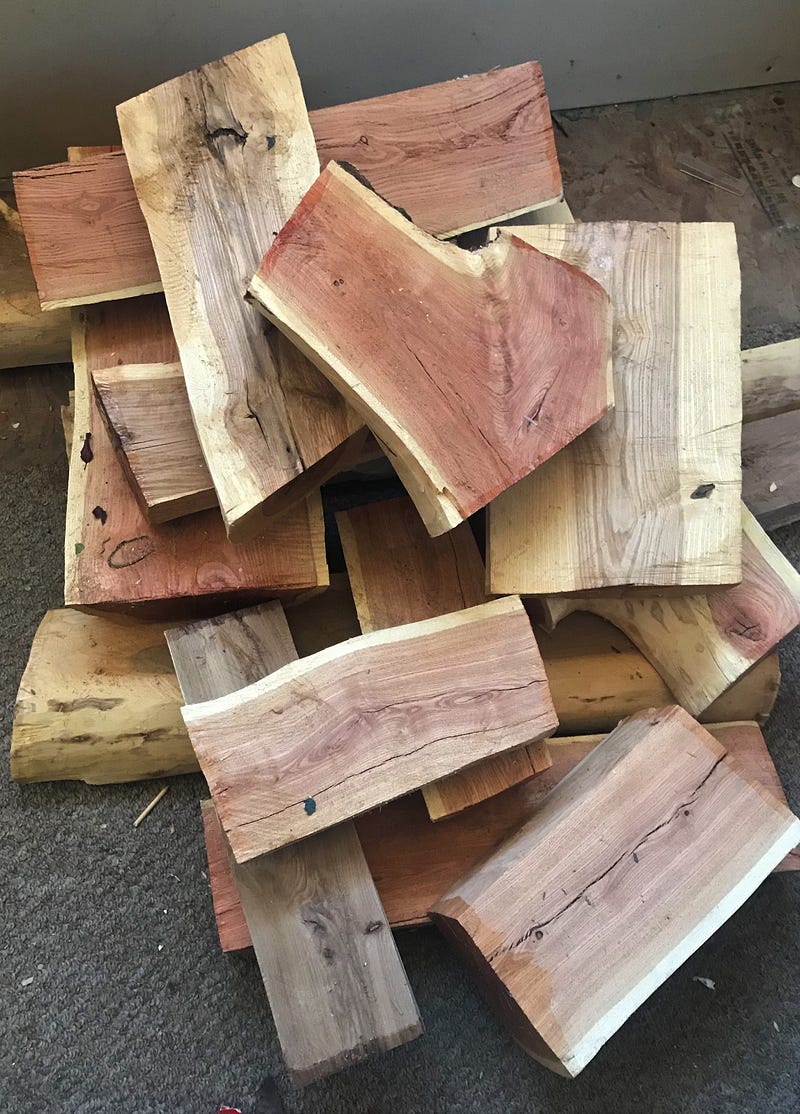
The crucial step in air drying is to seal the end grain of your boards. That end grain is literally the tubes that carry water up the trunk and they will quickly ferry moisture out of the ends of the board. When the water leaves, the wood shrinks. The ends of the boards lose water first, shrink quicker than the middle sections, and then they crack. Woodworkers call these cracks “checks”, and once started the checks are hard to stop. They can soon run down the length of the board. There’s an easy fix for this problem though, you just need to seal the ends of the boards.
Old Tom kept a large pan of paraffin wax on a camp stove outside his shop. After we loaded the spruce blanks in his little truck he would drive home, fire up the stove, dip the ends of the blanks in melted wax, and then stack them with thin slats separating them for air flow. So prepared, it can take a year or two for the wood to come down to a workable moisture content. I’ve recently found that stacking them inside in a heated space can cut this time by half or two thirds. As a bachelor this is an easy call for me, you might have to consult a spouse or partner.
Once again a warning. Hot wax on a camp stove can be a recipe for disaster; the wax is flammable, can burn you, and you don’t want to breathe the fumes. A more simple and safe alternative is to paint the end grain with a latex exterior house paint, a little will go a long way.
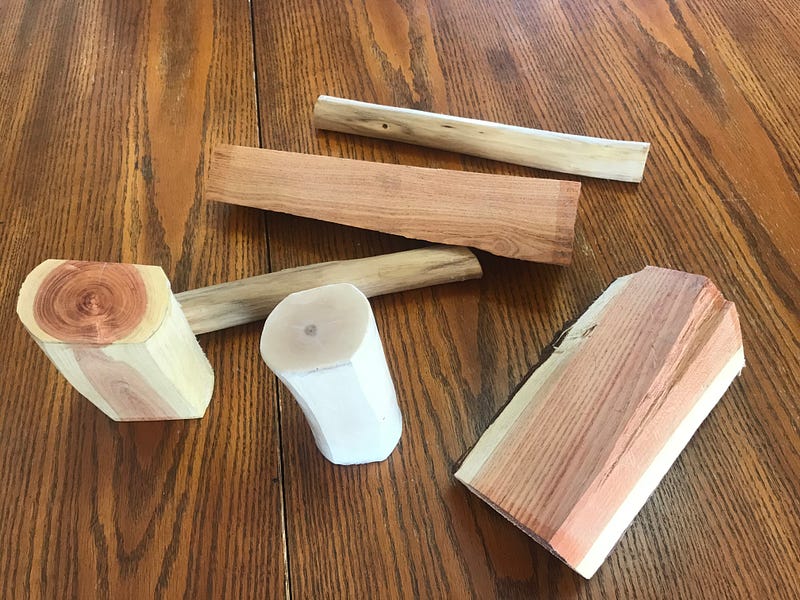
Identifying my new wood has been a challenge. Some appears to be in the hickory family with lovely reddish brown heart wood, medullary rays, and straight tight grain. At the very least it will make great tool handles, possibly plane bodies. I’ll be waiting anxiously for it to come down to lower moisture. Some has obvious cross linked grain and tends to fuzz when planed wet. It will require very sharp tools. A couple of slabs look like a cross between walnut and hickory; they are almost dry already and plane to a beautiful smooth surface and grain. I might try bowl carving with one of these.
Shortly after the storm our city conducted a survey about open space use and urban forestry. Though thousands of trees succumbed to the storm many thousands remain, providing shade, beauty, cleaner air, temperature reduction, and yes, hazards to our electrical grid during storms. The city foresters will be busy for years replanting the loss. My recommendation to them was to plant trees that we woodworkers find desirable. Fruit trees produce not only food but beautiful and desirable wood. Catalpa trees are common in the valley; they grow quickly, show off beautiful flowers in early June, and produce furniture grade, rot resistant wood.
Trees by themselves add health and spiritual benefits to our communities, but like us they all have to die. How much better would it be if during their lives of carbon sequestration they were also producing the materials that craftspeople covet for their craft? Turning windfall into useful goods beats throwing it away to rot in landfills and release the carbon back to the atmosphere. Why not plan ahead and keep that carbon sequestered while supplying wood workers with the stock to beautify our lives?


