
The Wild Worlds of Geometry
The word “geometry” usually brings about a wide variety of reactions. Most will think of their high school math course and painfully calculating the value of angles and triangle areas using a set of strictly defined rules. Indeed, this process is an essential aspect of geometry but it’s not the whole picture. These rules were laid out by Euclid in ancient Greece and have continued to serve as a cornerstone of mathematical theory. However, the modern field of geometry is much more varied than this presentation. Mathematicians have expanded geometry to the point where it can give insight into entirely new worlds.
Hold on, how could that possibly work? Most of us know geometry as a collection of abstract rules connecting lines, points, circles, and various other shapes. These facts provide the basic knowledge of structures and how they relate to each other in our everyday world. However, around the 19th century, mathematicians realized something very interesting. If they simply changed the starting rules, the resulting set of rules described something entirely different but just as true. They could invent entire new frameworks of understanding the world just by changing the basics.
At first, this was nothing more than a mathematical abstraction. These new worlds were certainly interesting but had little use. As is common in math, a practical purpose for these theories came much later. When Einstein laid out his groundbreaking theory of relativity, he used one of these alternate geometries. Since then, countless other uses for these new geometries have been discovered. We’ve moved far beyond the simple world of Euclid.
This is a lot to take in, especially since I haven’t given you any details about these different geometries. Let’s spend some time going over exactly what I mean. In this article, I’m going to go over what a specific geometry is using Euclid’s earliest theories. Then, we’ll talk about some examples of other fascinating geometries. I’ll then show you how these geometries apply to all sorts of cool scientific discoveries. There’s a lot to cover here, so let’s dive in!
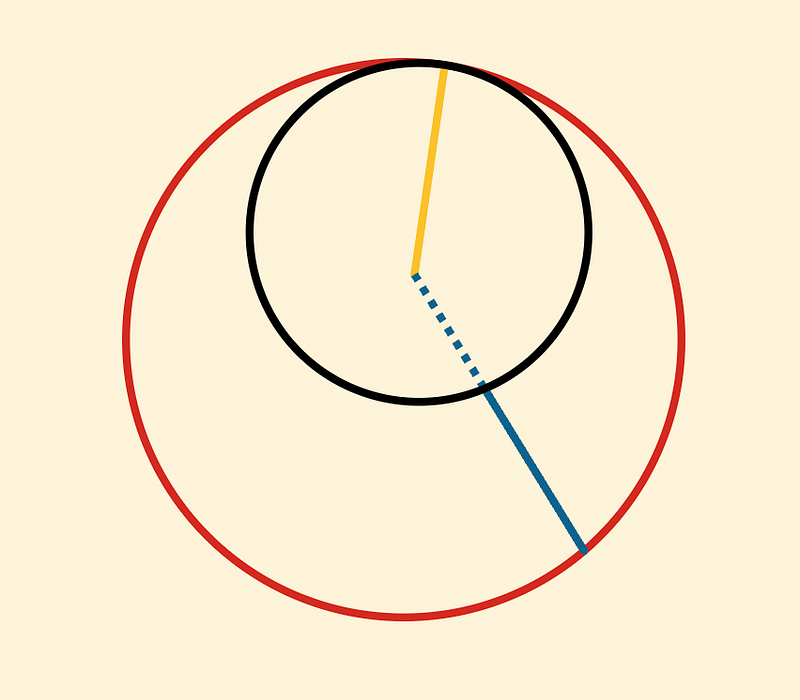
What Is A Geometry?
The study of geometry is one of the oldest forms of math. Its age can be attributed to how practical it is. Geometry had basic uses for astronomy, surveying, and construction. It is important to be able to calculate areas and volumes for these purposes. Some texts found in ancient Egypt contain very basic theories, such as how to calculate the volume of a cylinder. This has the practical purpose of getting the storage for a cylindrical granary.
All of the earliest mathematical books we know of provide the rules for how to solve practical problems. That all changed with Euclid. In this book Elements, he lays out an entirely new approach to geometry. This is widely considered the most influential textbook of all time.
What made Elements so important was that it revolutionized how to think about math. Instead of simply providing a list of rules for how to solve practical problems, it began with the theory working behind the scenes. Readers could then take this theory and apply it to all sorts of situations beyond what the author intended. Euclid begins with a series of five axioms and then spends the rest of the book using them to prove other theories. Let’s see what these axioms are.
- A straight line can be drawn between any two points.
- Any straight line may be extended infinitely.
- A circle may be drawn with any given point as its center and of any length of radius.
- All right angles are equal.
- For any given point and line, there is exactly one line through the point that does not intersect the other line.
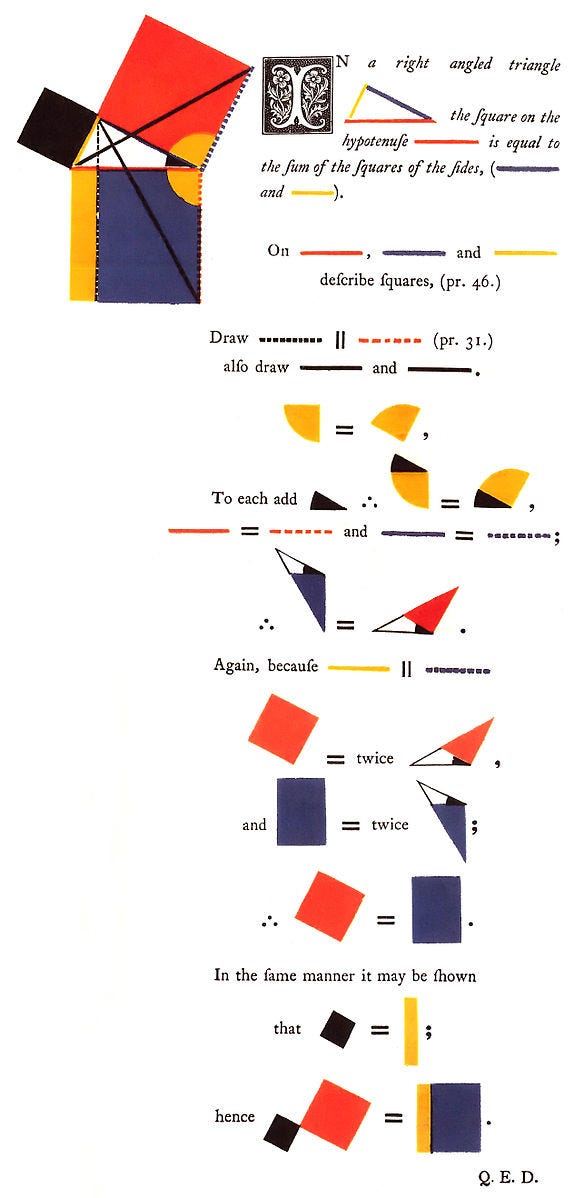
Most of these axioms seem extremely basic. Why do we even need to say them? Euclid’s revolutionary idea was to pick these five starting points and derive every single other theory in geometry. I’m not going to talk about exactly how this is done, but if you’re interested I have examples at the bottom of this article. I’ve given an example visual proof below.
The book Elements has continued to remain widely influential over 2000 years since it was first written. Several important historical scientists such as Johannes Kepler, Galileo Galilei, Isaac Newton, and Albert Einstein talk about how they were strongly impacted by it. Abraham Lincoln kept a copy with him at all times and studied it regularly.
Many important historical documents have followed the structure used in Elements. The United States Consitution lays out its basic principles in the beginning, then comes to more complex conclusions from there. Some attempts have been made to set up other areas of study, such as philosophy, in the same basic format.
The geometry laid out in Elements reigned supreme for 2000 years. It was considered the only possible structure. This is mostly because Euclid’s geometry holds true for most of our everyday experiences. However, that all changed as some mathematicians began to question the very basics. What if we were to change the starting axioms? Let’s see where that leads us.

The Troublesome Fifth Axiom
Looking at the five axioms above, the last one stands out. It’s much more complex than the first four. This axiom serves as a basis for parallel lines. It basically describes how parallel lines work in this geometry. Mathematicians have never liked this axiom, and an immense amount of work has been devoted to trying to work around it. Many tried to prove it using the first four axioms or develop proofs without using it at all. Euclids goes out of his way to avoid using it whenever he can in his work.
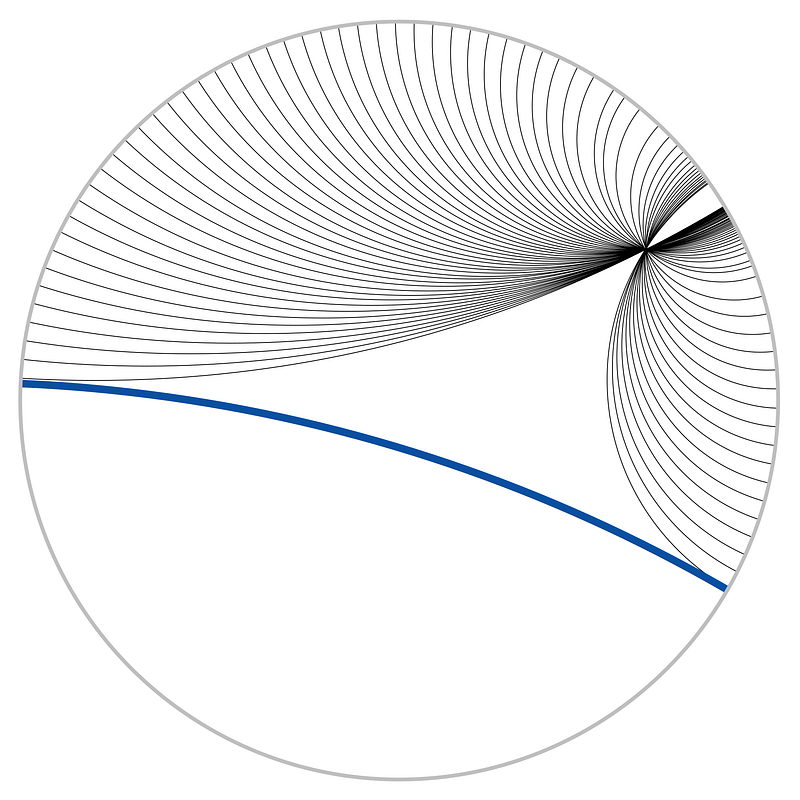
All this effort culminated in a massive breakthrough in the year 1829. Nikolai Lobachevsky published a work with an entirely new geometry which he called hyperbolic. In this version, the fifth axiom is replaced with the following:
- For any given point and line, there are at least two lines through the point that do not intersect the other line.
We end up with a wildly different world by just making this one change. It can be tough to visualize this setup, but mathematicians usually do so with the Poincaré disk model. The example below uses this model and shows many lines in black which are all parallel to the blue line and pass through the same point. Believe it or not, these lines are all considered straight in hyperbolic geometry, they just look curved due to the projection.
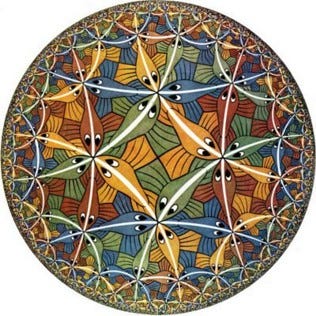
The artist M.C. Escher was well-known for using hyperbolic geometry in his art. Despite having no formal mathematical training, he displayed many concepts of this system very accurately. See the example below for one of these art pieces.
Hyperbolic geometry serves as the basis for special relativity. Einstein used a special version of it called Minkowski Space. This space uses four dimensions, time and three spatial directions, in a hyperbolic setting. This was a revolutionary discovery and Einstein could only have made this leap with the prior work about these other geometries. There is clearly some aspect of truth in this geometry which seems so foreign at first glance.
Other Geometries
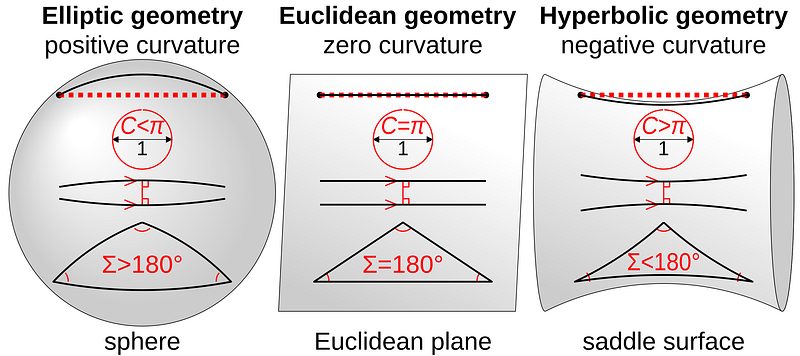
Once hyperbolic geometry was discovered, mathematicians quickly began to catalog a wide variety of new systems. Most of them involved changing the fifth axiom of Euclid’s geometry in some way. For example, see the alternate fifth axiom in spherical geometry.
- For any given point and line, there are no lines through the point that do not intersect the other line.
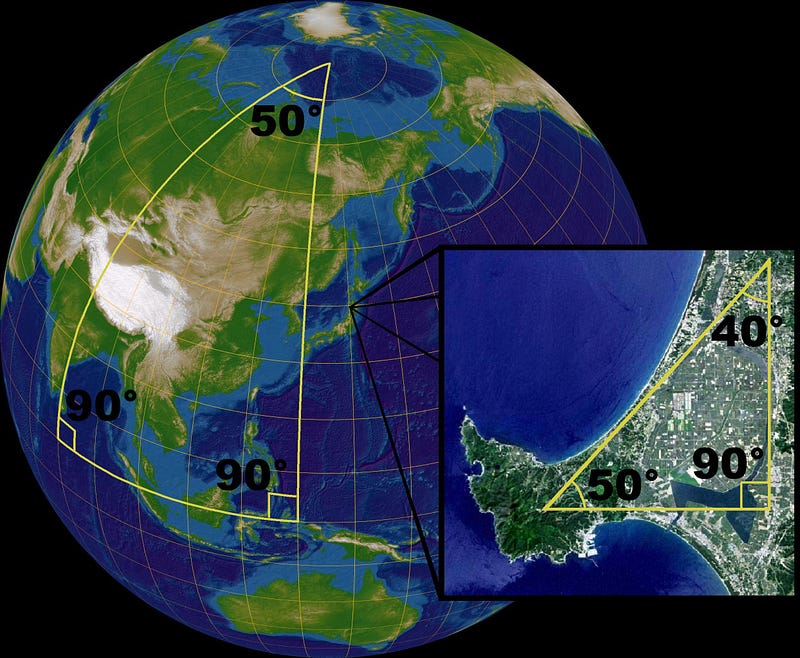
As its name suggests, spherical geometry is immensely useful for calculating motion around our planet. It works well when dealing with different points around a sphere. We also need to alter the idea of a straight line for spherical geometry to something called a great circle, shown below. Note that I’m simplifying a bit here. Spherical geometry requires a few minor changes to the other four axioms, but they are not as important as the fifth one.
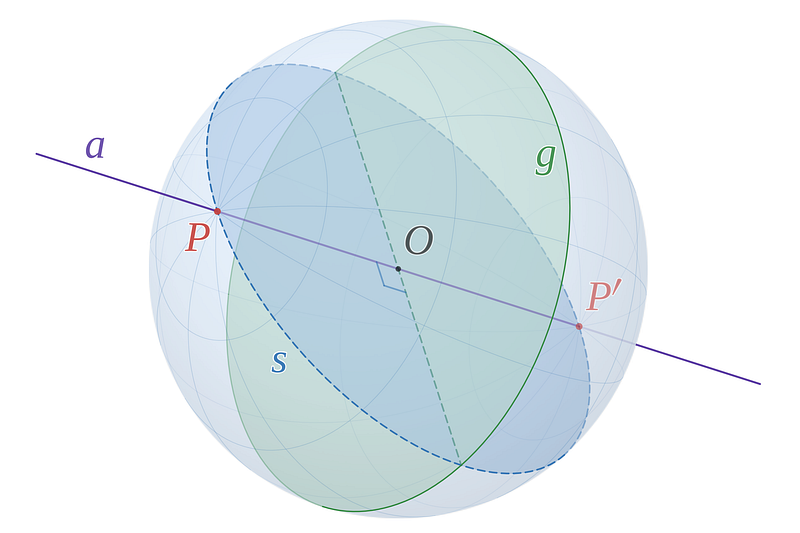
Just like in hyperbolic geometry, this change results in a very different setup. Many basic intuitions that we have about geometry seem to go away. Instead of the shortest distance being a straight line, it now is something called a geodesic. Yet, this new setup is incredibly useful for thinking about navigating our planet. Airplane flights will typically travel in an approximate geodesic to minimize travel time. Again, while this geometry seems weird it does contain some truth.
I’ve just described a few common alternate geometries here. As it turns out, there are many more! Each revolves around questioning the basic axioms laid out by Euclid. These have led to all sorts of insights.
Going Further
I hope you learned something! Geometry is a fascinating topic, much more interesting than how it is usually presented in school. It leads to a wide variety of interesting worlds that are so fun to explore. I’ve only begun to talk about it in this article. If you want to learn more, then I have links provided below for you to check out.
- The entire text of Euclid’s Elements is free online and linked here. That link contains the original Greek and its English translation. It’s a fascinating book to look through, but it is quite dense. I also really like this website which allows you to easily flip through the theorems and provides really clear visuals. Both are valuable resources!
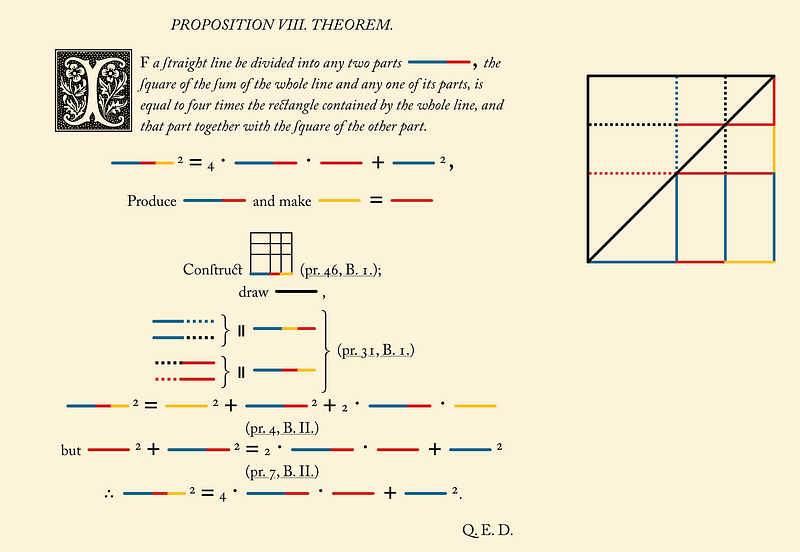
- However, if you really want to understand Elements on a fundamental level, then I highly recommend Oliver Byrne’s Elements of Euclid. This is an amazing book that walks through each proof with clear pictures. It is visually striking to read and will give a very clear sense of each proof, more than just the words can do. There is also a free online version linked here. It is a fairly old book so it is in the public domain and the s’s are written like f’s. I showed one earlier, but see another example proof from the book below. This example may seem a little daunting, but it comes later in the book so an understanding of previous proofs will help you make sense of it. The necessary ideas are given in parenthesis.
- It is also fun to explore these ideas for yourself. The website Geogebra has a cool interactive page for messing with Euclidean Geometry. People have also made pages on Geogebra that allow you to mess around with other geometries linked here.
- Many games have been created in hyperbolic geometry. These are fun ways to get intuition about this structure. I love HyperRogue, but there are others such as Hyperbolica.
- This is a cool website that has a ton of information about non-euclidean geometry with lots of visuals and interactive pages.
I also have some similar articles to this one that you may be interested in, check them out!
If you liked this article, then consider clapping for it! You also may want to follow me for more stories like this, or subscribe to my email list! I publish weekly about math and science.


