

The Wicked Affair of the Golden Emperor
Chapter 7
A Charles Goodfoote Mystery
A visit to a newspaper and a lady is snatched from the jaws of death
As I was only a few blocks from the offices of The Morning Observer, and the day was sunny and warm, I decided a visit to the paper was in order. In truth, the poster bearing Sam Clemens’s name seemed more a harmless puzzle than real threat, but I felt I should earn my wages by gathering as much information as possible.
The newspaper office, reached by a short flight of stairs, was housed in a two story brick building on Commercial Street. Inside, a young man with a thatch of spiky dark hair and slight beard directed me to an office with a glass paneled door that proclaimed, in gold paint, Avery P. Doyle, Editor. After politely knocking, I opened the door and stepped in. A rail thin man with a cadaverous face and a shiny bald dome sat behind a desk piled high with papers. Surrounding the desk, scattered newspapers carpeted the floor. Mr. Doyle was engrossed in scribbling on a sheet of foolscap and continued his work while I waited just inside the door. The office was small with only a short shelf of books behind Doyle’s chair. Other than a faded purple and grey carpet, the desk and the bookshelf, the room was unfurnished. The only chair was occupied by the editor.
Doyle finished his writing, threw his paper onto a stack, and looked at me.
“What in the hell do you want?” he barked. He peered over his wire-rimmed glasses. “Wait a minute. You’re that Pinkerton man from over on Montgomery Street. I saw you at the Blue Boar last week when the mayor was running his mouth off about how he was going to clean up City Hall.”
“I do get around, Mr. Doyle.”
“Well, what do want from my newspaper? The obituary department is down the hall, first door on the right.”
“What I want, Mr. Doyle, is to look at the past couple months of newspapers for articles written by Mark Twain.”
Doyle snorted. “That scoundrel Clemens is paid thirty-five dollars a week to cover the financial affairs and the theatre, but he spends most of his time in the gin joints up and down Pacific Street. I told him I wanted facts and truth and you know what he said? He told me the truth was too important to waste on a newspaper story! So if it’s his flotsam you want to read, head up to old Jim Conover, back steps, turn left. He’s full of dust and snuff behind a door marked ‘Archives’.”
“Thank you, Sir. It’s been a pleasure meeting you.” I turned to go.
“One minute there, Mr. Detective.” He got up, pulled off his eyeglasses, and came around his desk. He looked up at me with pinched eyes, hands on his hips. “When you’re done snooping around in my paper, you come back here and tell me what’s of any interest at all in the local gossip, because that’s all you’ll get from Clemens’ stories.”
“I can tell you right now, Mr. Doyle. Someone has taken a dislike to your reporter and I wonder if it’s something he’s said in print.”
Doyle gave another snort and returned to his lair behind his piles of paper. “Most likely someone who thinks the press should be factual,” he growled. “That man wouldn’t know the truth if it reared up and bit him in his aspirations.”
With that fanciful declaration of Mark Twain’s ability as a reporter ringing in my ears, I climbed the back stairs as directed, and found a door with a beaded glass panel marked “Archives” in peeling silver lettering. I knocked, turned the brass doorknob and found myself in a spacious room overflowing with wooden shelves full of large brown envelopes. A tall counter stood directly ahead, and a large multi-paned window behind it admitted daylight. Dust motes rode the beams of sunlight before settling on all flat surfaces. The rest of the room, with the exception of a heavy table and two chairs directly in front of the counter, consisted of racks of envelopes.
As I stood at the open door, an elfin head rose slowly from behind the counter. The head, nearly smooth as a bare rock, was rimmed with a few wisps of white hair. I had trouble focusing on his face, for the light in the early May afternoon shone brightly through the window behind him. As I moved closer to the counter, his features came into view. His large blue eyes peered up at me over round eyeglasses that settled onto his bulbous nose. It appeared to me that all the hair from his head had flowed onto his cheeks and mustache for he had the most bristly muttonchops I had ever seen, including in that bastion of prodigious muttonchops, the military.
“Mr. Conover?” I inquired. He nodded, eyes squinting. “My name is Goodfoote. Mr. Doyle said perhaps you can help me.”
Another nod.
“I’m looking for any newspaper articles or stories by Samuel Clemens or Mark Twain written in the past three months. I know there’ll be a passel of them but I mean to have the whole slew. Can you assist me?”
Another nod.
He wiped his hands on his dark vest which once had been black but now was gray with age and dust. Without a word, Conover turned, shuffled to one of the shelves, and pulled down three of the large brown envelopes. He walked slowly around the end of the counter and stacked them on the table.
Another nod, this time in the direction of the envelopes, and he away he shuffled, back behind his counter. He slowly sank from sight until only the crown of his head was visible. I rose on my toes to glance over the top of the ledge. He was perched on a wooden stool in front of a small table, had picked up a pair of scissors, and was cutting long strips of articles out of a newspaper. A pot of glue stood on the table and a stack of neatly folded newspapers were on the floor next to his chair. He never looked up.
The Morning Observer was a daily paper with Saturday the only day it didn’t print. And Sam Clemens was its only full time reporter. I noticed the articles he authored were signed with his pseudonym, Mark Twain, an appellation he had assumed while working for The Territorial Enterprise in Carson City, Nevada. Considering the dark edge to his scribblings, and his savaging of elected officials, a pen name was probably a good defensive move.
The first folder contained enough of Sam’s articles to give me a formidable list of possible enemies. A few weeks past, when a renowned actress came to town, Twain reviewed her famous act caustically.
“She carries on like a lunatic from the beginning of the act to the end of it.”
The respected actress had fled the city in tears, and a troupe of her followers stormed the offices of the newspaper screaming for a retraction and apology. But Clemens had taken off for the gold fields and was unavailable. Once he returned, he wrote a follow-up article that said he only wrote what he saw with his own two eyes.
In another column, Clemens took on the prosecutors and courts:
“It is proposed to require the Attorney-General to assist the several
District Attorneys in the prosecution of persons charged with capital crimes,
when called upon to do so, and when not otherwise engaged. If this is done,
we may possibly succeed in hanging another man one of these days.
Other serious subjects were reduced to farce. For an article on gold mining, Twain wrote as if he were attending a funeral, and described some of the wealthiest men in San Francisco as pallbearers who got knee-walking drunk and dropped the casket onto a hill of slag. The corpse, who happened to have the fanciful name of Mr. Skullduggery, fell out of the coffin and rolled down the slag heap through the front door of the Busted Luck Saloon, where he was promptly revived by the other robber barons. In an effort to maintain a consistent theme of dubious railroad owners, Twain wrote that of twelve hundred tons of gold dug out of the Sacramental valley mines, only enough for a ten dollar gold piece made it to the San Francisco Mint aboard the Western Central Railroad, and that was in the pocket of the railroad’s owner, Stanley Walker.
Still another story, one that had been spiked by Doyle was probably true. Sam Clemens had observed a Chinese man being beaten by a mob and Sam’s vitriolic article denounced the police who stood by and let it happen.
It was a mob from the Gaelic shore that laid upon a Chinaman who
was heavily laden with the weekly wash of his Christian customers.
The assault was first with insults then with bats and bricks, as the
Irish police, the ‘protectors of civilization’ stood back and jeered.
Apparently, editor Doyle felt this was too inflammatory for consumption by a readership that was largely immigrant Irish.
As I slogged through the incendiary articles, my attention was caught by a recent column. Clemens had mentioned Captain Bullump as a toady of the railroad barons, taking orders from them like “…a Chinese waiter in one of the establishments Bullump eats at for free.” It wasn’t much, but it could have given the cohorts of Bullump a reason for putting up that hatchetman poster on Murderers’ Wall.
The sun had slid to just above the horizon when I finally put aside the last envelope. I now had a good indication of people who could have taken exception to Mr. Clemens hard-hitting pieces, both fictional and real. A series of “misunderstandings,” as Sam had called them, collected around the man like ticks on a bear.
The mystery was that no one had threatened him before.
The rumble in my stomach as I left the offices of The Morning Observer told me it was time for a stop at Little Annie’s Pot of Glue Eatery. Despite its name, Little Annie’s laid out the best spread in the City. The sideboard groaned with cuts and slabs of venison, elk, beef, bear, and several types of fish, both fried and smoked. Loaves of fresh bread and plates with butter and jams were further down the table, along with spring vegetables fresh from Annie’s garden. For the price of a beer, a man could wash down enough of a supper to feed a stable of teamsters. And I did just that.
While I ate, I thought about the perplexing problems facing me. The death of Jack Skaggs before he could reveal who was going to be murdered had me concerned, as did the conundrum of the threat to Sam Clemens. But they were part and parcel of the life I led as a Pinkerton Detective, and I felt confident I would be able to unravel these mysteries.
There was one stone in my boot that was still bothering me: the case I’d been sent to San Francisco to solve, the one case that hadn’t given up a whisper of a clue.
It was the murder of fellow Pinkerton Detective, James Hoople. The body of Hoople had been found floating in San Francisco bay, his throat slashed, two years ago. I was roaming around the country at the time, but I remember the firestorm it had caused in the Chicago headquarters. When the case went unsolved after a full year, I was promoted to Senior Operative and dispatched to California. I was expected to do what fifty agents had been unable to do after a year of hard work, and I had arrived full of confidence. But as the months passed with one dead-end after another, the other operatives were assigned elsewhere, until only three of us kept the case active, and it grated on the very marrow of my bones. Again, for what felt like the thousandth time, as I sipped the brew Annie served, I dropped into a blue fugue about the riddle of the agent’s murder.
This won’t do, I finally thought. So, with a shrug, I pulled myself out of my funk and reflected on my plans for a pleasant evening ahead. A dear lady friend was tutoring me in the virtuosity of the Italian masters. As a man with a philosophical turn of mind, I find artistic endeavors of a vigorous kind both strengthen my character and bring peace to my spirit.
It was going to dusk, and the old oil lamps along Kearny Street were being lit when I emerged from Little Annie’s, feeling a few pounds to the good.
Living a life close to calamity almost since birth, I have developed a heightened awareness whenever I am threatened by an unseen menace. It has saved my scalp on more than one occasion. Now, on a busy street during this clear spring evening in the bustling city of San Francisco, my sense of danger pushed to the front of my brain, but it was still too vague, the threat too uncertain. I paused to light a cheroot, the flame of the sulfur match barely flickering in the gentle breeze. Something was wrong in the scene I was taking in. Something that posed a serious risk.
The crack of a whip caught my attention. A heavy carriage drawn by two coal-black geldings barreled out of the dimness, and roared straight at a lady crossing in the middle of the street. Its teamster, swathed in dark clothing with only his eyes showing, stood in the driver’s box, and laid the whip on his team like a monk gone mad. As the other sidewalk strollers looked on in horror and shock, I plunged onto the roadway, grabbed the young woman, and hauled her to safety. As the carriage thundered by, it threw out a spume of dust and stones from the unpaved street..
“Mr. Goodfoote, please,” she said as I set her down. “That was gallant, but completely unnecessary. I was about to step back when you manhandled me.”
“Miss O’Rourke,” I said, surprised, for I had not recognized the lady.
“You are taking Mr. Fong’s instructions far too seriously, Sir. I am quite capable of walking the streets of this city alone without masculine protection. Indeed, I have done so for some time now. Years, even.” The crimson hue of her complexion, whether from embarrassment or anger, added to her beauty.
I bowed and tipped my Stetson. “Yes, Miss. My apologies for interfering with your evening stroll.” In truth, the young woman had hesitated in the road as the renegade rig was bearing down on her with murderous intent. I had swept her away inches from certain doom.
“Well, now that you are here, Sir, you can see me to the Mission House.” She fastened her eyes on mine. “Unless, of course, you have more pressing business of your own.”
Again, I tipped my hat, for I was about to suggest the very same journey together. “It will be a pleasure and honor to escort you, Miss O’Rourke. I’ll hail a carriage.”
“No, Mr. Goodfoote. I prefer to walk. These streets hold no terror for me.” They should, I thought. Someone just tried to send you to an early rendezvous with St. Peter.
“Walk it is, then. I was about to amble in that direction myself,” I lied.
I noted she turned her head to check behind us, as she willingly took my proffered arm. “Your meeting with Administrator Dillman,” I said as we began our stroll, “must be important for you and your sisters.”
“It is, Mr. Goodfoote. The meeting is, however, a subject I am unprepared to discuss with you. Or anyone else for that matter. Please don’t ask me to elaborate.”
We sauntered arm in arm along Kearny Street. The Catholic Mission House was several blocks the other side of Chinatown proper, and we would need to walk through some of the most unsavory parts of the city, including an area of Chinese bawdy houses that catered to Whites.
In time, we turned a corner and started up Sacramento Street. The sense of danger hadn’t left me since we began our perambulation, but now, surrounded by the deepening darkness, it was acute. I scanned each doorway and alley opening as we approached them.
“You are silent, Mr. Goodfoote. Are there no topics available for conversation, other than the one I’ve forbidden you to pursue?”
“I’m sure there are many, Miss. For instance, your astounding rescues of young girls is of great interest to me. My understanding is you and the others dress in Chinese men’s wear. Then, according to the newspapers, you run across roofs in the dark of night, climb down skylights, and take the girls right out of their beds.”
Emily laughed. “At times, Mr. Goodfoote, but we usually just get four big Irish policemen to break down the door. Acrobatics are seldom used.”
“None-the-less, it’s dangerous work for you and your friends. I wouldn’t have expected young women to be engaged in such perilous endeavors.”
“And you, Mr. Goodfoote. You are not what I expected from a detective. Not at all. You said you were born in an Indian village, but your speech is that of an educated man.”
“Well, as I said before, my father was Irish. But he died before I was out of my cradleboard, so I was raised Indian. While the road from my family’s Blackfoot camp in the Crazy Woman Mountains to the halls of Harvard was long and often difficult, I found it always interesting.”
I felt myself warming to this remarkable woman’s company. Even in the dim street lamp light, her dark eyes shown brightly, and the Irish lilt in her voice was pleasing to my ear.
“Being raised a heathen must have been a torment to your soul,” she said.
I felt my back stiffen a bit. “No, Miss. My soul never suffered when I lived among the Blackfoots. The difficulties started when I became White.”
“But you were always half-White, Mr. Goodfoote.”
“No, Miss. I was always half Irish.” To that, she had no comment.
We passed safely through the red-light district, occasionally stepping into the street to avoid sleeping drunks. As we approached the front door of the Catholic Mission House, Miss O’Rourke gave my arm a squeeze. At the top of the stairs, she paused, her hand on the bell pull.
“Thank you, Mr. Goodfoote, for being my escort. I’m sure we’ll have nothing to fear tomorrow evening.”
I removed my hat and waited while she pulled the bell. The door opened almost immediately and Emily O’Rourke slipped across the threshold.
The Wicked Affair of the Golden Emperor
Chapter 8
A Charles Goodfoote Mystery
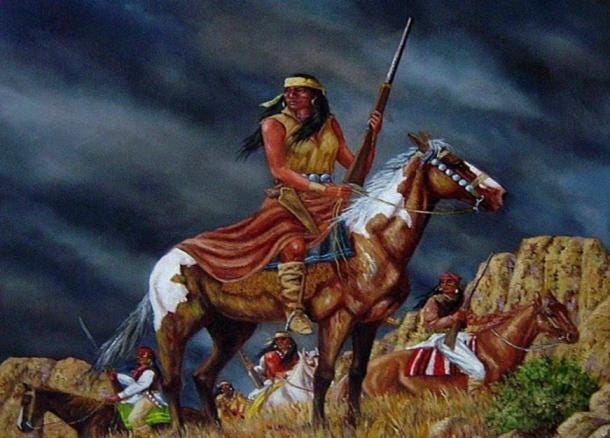
Kaya leads the Apache into battle
Instead of a sleepy village of women and children, the Mexicans found a hornet’s nest of aroused Apache fighters. Kaya leapt onto her pony and charged right into the midst of the enemy. Her lance pierced the chest of a Federales, and her war club struck another’s shoulder, knocking him from his horse. She jerked free her bloody spear from its victim and drove it into the side of another. All around her spun a torrent of fighting. She heard the war cry of the Apache mixed with the curses of the dark people, and smelled blood and dust as the warriors on horseback slammed into the ranks of the Mexican soldiers.
From the rocks around her, the Apache warriors on the slopes behind the lines of enemy flankers descended onto the confused vaqueros like a thunder storm. With a glance, Kaya saw a Mexican lieutenant sitting ahorse next to Colonel Morales sighting his rifle at the whirling figure of Dashante who was tearing a hole in the ranks of mounted soldiers. Before he could fire, Kaya’s launched her lance in an overhand throw that drove the spearhead into the man’s side. His horse bucked sideways into Colonel Morales charger and knocked the officer to the ground. As the Colonel, saber in hand, gained his feet amidst the dust of the prancing horses’ hooves, Kaya smashed her war club onto the head of the Mexican leader, sending a plume of blood spraying into the air. The enemy was falling back, trying to turn their horses from the terrifying onslaught of these screaming demons from hell. Those who stood to fight were cut down in their tracks by the enraged warriors.
An attempt at an orderly retreat turned into a Mexican rout. Soldiers and vaqueros who could stay on their horses fled down the path the way they had come.
Kaya, her crimson-soaked lance clasped in her upraised hand, screamed the Apache victory cry.
The Wicked Affair of the Golden Emperor

Chapter 9
A Charles Goodfoote Mystery
A visit to a Florentine Lady of Cosmopolitan Views
The waning gibbous moon floated over the bay as I hailed a cab and made haste to further my education in the Italian Renaissance culture that was flourishing at the time in the byways of Nob Hill. An essential stop at Toussaint’s Flower Emporium, where I paid an unwarranted fee for a handful of flowers, took only a minute or two.
My weekly lessons in the intricacies of tempera, fresco, and the like, including a study of the sculpture and some study of the Italian language, were held in the home of a buxom lady of Florentine origins, although her recent history in San Francisco wouldn’t bear close examination.
Gina Vitti, a young woman of vast experience, ran the most elegant bordello on the Coast. Her home, where she taught “art” to her select clientele, was near the peak of a hill, miles from her working life. It was decorated like a museum, full of paintings, naked statutes, and marble fountains, paid for by the labor of the girls she employed.
But culture is where you find it, and I had spent many an evening being tutored in the likes of Botticelli, Donatello, and Bellini. Mostly religious works of the Renaissance period, but a few of later origin. A butler, known only as Mr. Bask, opened the door to my knock. Built like one of the new Cincinnati safes, Mr. Bask filled the doorway. Unable to speak above a whisper, his scarred face and dark hair that flowed to his massive shoulders spoke authoritatively enough to anyone without an appointment. Well known, I was admitted with a nod, entered its marble-tiled foyer, and finally shown through glass-paned doors to a graceful sitting room.
Unlike many residences of ladies in Gina’s profession, Madam Vitti’s withdrawing room was furnished with a tasteful elegance. Not excessively opulent or vulgar, it had just the right touch of naked statuary of a classical nature, enhanced by several paintings by Italian masters.
An elderly Chinese housekeeper, Mrs. Kan, always smiling, served me tea in a bone-white set, then soundlessly disappeared. I was kept waiting the dignified quarter-hour before Miss Vitti swept in, silk scarves swirling. As always, she was perfumed by scents that would give a dray horse the wobbles.
“Bonasera, Charles,” she said, giving me a kiss on each cheek. Fashioned in ringlets, her dark hair was bejeweled with sparkling rubies and emeralds. As in the past, I admired her long eyelashes and lustrous dark eyes. “The flowers are beautiful. Please put them in a suitable vase, Mr. Bask.”
She kept up a running conversation while she took my hand and lead me up the wide carpeted stairway that led to her upper chamber. “We must not delay, dear Charles. The Masters of Venice will not wait. Today, we study the exquisite form of the human body. You may remove your coat.”
My lesson was confined to an hour, for beyond that, the price climbed exorbitantly. I won’t dwell on the particulars of Gina’s tutorage, but Harvard could take a few pointers from her on holding students’ interest.
As we shared a carafe of red wine at lesson’s end, Gina, her face aglow from her exertions during our class, smiled at me over the rim of her glass. “I may have some tidbits of information for you, dear Charles.”
I said nothing, but gave her an inquiring look. In the past, Gina has saved me time and trouble with her tidbits. Her “art students” ranged from city officials to leaders of the railroad cartel, and they often became loquacious after reviewing the finer points of Bellini or Pisano.
“A man came to see me at an hour when only the tradesmen are afoot,” she started. “He was not a gentleman or he would not have called on a lady at such an hour.”
I sipped my wine, and wondered how an early visitor had gotten past Mr. Bask.
“He did not come to learn about the great art of the Renaissance,” she continued, pushing out her lower lip. “He wanted me to give a message to that ugly policeman who smells like cabbage.”
“Captain Bullump?”
“No names, please, dear Charles. The policeman who smells like cabbage had his lesson yesterday, and he was very disagreeable. This man who is not a gentleman came with his messaggio in the wee hours of this morning.”
“And who is this man who calls on a lady before she has had time to attire herself properly?”
“No, no, Charles. I do not reveal names, but he smelled of incense and rice wine.”
“He was a Celestial, then?”
She smiled her answer.
Trying to get information from Gina when she was in a playful mood was like trying to get a rabbit out of the mouth of a hungry coyote. It requires finesse or a club. I chose finesse.
“What was the message, my darling, that you were to give to the ugly policeman?”
She sat close to me on the divan we shared. “Let me see. Oh, yes. It was very peculiar. Something about a gold emperor and a dragon. But I can’t remember.” She smiled revealing her famous dimples. “Somewhere is the paper with the strange message.”
“What did Bullump say about the note?”
“But I did not give this message to the cabbage man.” Her mouth turned down in a pout, her dimples disappearing. “Is Madam Gina Vitti a messenger like the little men who runs here and there delivering little slips of paper? If a notice is to be sent, one must call Western Union, then the little men will run to the cabbage man. But not Madam Gina.” She raised her pretty little nose in the air. “I do not deliver the message.”
I turned on my widest smile, the one that would get the knees of a nun knocking with desire. “Do you have that little piece of paper, my Bella Donna?”
“I may have it somewhere, il Mio Amante. Perhaps if you come back tomorrow…”
“Tomorrow may be too late. If Bullump finds out you didn’t give him the note, he may become angry. We don’t want unwelcome callers to inconvenience a Delicato Donella.” I had now exhausted my stock of Italian endearments.
She reached into the bodice of her dress and withdrew a folded piece of paper. “And you will keep the cabbage policeman from becoming angry with me, Charles?”
“Of course, my honey-blossom.” I could invent American compliments by the hour, if need be. I unfolded the piece of paper and read,
“The Golden Emperor rides the jade dragon through a moonless night.”
The phrase meant nothing to me, but the Golden Emperor was again showing his head. And both times, Captain Bullump was somehow involved.
Here was food for thought. First, why give a message, even encoded, to a madam to pass on to a policeman? And why would a Chinaman need to tell the head of the police Chinatown Squad in such a clandestine manner? Did Bullump have his own sources of information among the Chinese? Gina was known to be discreet, but it seemed foolhardy in the extreme to trust a message of any importance to her.
Henry’s warning flashed through my mind. Watch the left hand when the right holds a puppet.
With these questions in mind, I kissed Gina goodbye, left a heavy fee in the glass jar at the entrance, and followed Mr. Bask as he showed me out. The evening had progressed to the eleventh hour, the time I normally made my rounds amidst the tattlers who kept me abreast of the darker deeds in town.
Accompanied by the shining moon just past its prime, and a sky bursting with stars , I made my way to the Barbary Coast and its establishments of the lower sort. A few years ago, Australia had emptied its prisons and madhouses, giving each inmate a one-way passage to San Francisco. Shortly after disembarking in the Golden City, the inmates formed a criminal group known as the Sydney Ducks, and it controlled most crime on the Coast. My first stop was with a man who was generally accepted as a leader of the Ducks.
Big Willy Roylott owned and operated the Bull Run, and took pride in the fact it was known as the toughest saloon on the Barbary Coast. No one knew Willy’s real name. Although an Australian, he claimed to have fought for the Union in both battles of Bull Run in the recent Civil War, and no one dared dispute him. He topped the scale at three hundred pounds of gristle piled on a six foot frame, had a head like a buffalo, and hands the size of stove-lids. His sore spot was his bright red nose that he covered with flour to reduce its glare. Any reference to it brought catastrophe to the offender.
Spilled beer and old urine were the predominating odors of the place. The dance floor was crowded with floozies dragging their drunken marks in loose circles. When the time was right, the couples disappeared up the stairs where the unsuspecting miner or sailor would be treated to a knock on the head, followed by a quick frisk to steal his purse, and finally, an unceremonial heave out the back door into the offal ditch behind the gin mill. If the victim wished to lodge a complaint, Big Willy’s goons would spend some quality time with the poor man and he would quickly withdraw his objection.
I stepped up to the long oak bar that occupied one wall of the main hall, and studied the reflection of the room behind me in the gilded mirror as I ordered my beer. A large cigar stuck in his mouth, Big Willy himself was sitting at a table with three other men. Something humorous must have been said, for all four men burst into raucous laughter.
The barkeep couldn’t give me any information for his tongue had been split during a knife fight over a year ago, and he couldn’t speak above a mumble. So I took my beer and walked through the dancers to where Willy sat with his friends.
“Goodfoote,” he bellowed upon seeing me. “Here’s a sight to make a cow go dry. What brings you to my Happy Hunting Ground on the Bay?”
I smiled with my lips. “Just some enlightenment, Willy. Some pearls of wisdom that you might let drop in an unguarded moment of merriment.”
Willy gave a nod to the three men who got up without a glance at me, and made their way to the bar where they were served immediately. I noted that all three wore their guns in low-slung holsters with tie-downs, sure signs of gunfighters. I turned back to Willy, but didn’t sit down. Instead, I set down my beer and put my hands on the sticky table, leaned in, and spoke quietly to him.
“Jack Skaggs got himself corpsed last night,” I said. “I know he’s a regular here. You see him around the past few days, maybe talking to one of your hired help?”
“That gimp-eyed thief hasn’t been here in weeks, Goodfoote. I got nothing for you.”
“That right, Willy? You’ve been taking my gold pieces for months now, and the pickings you’ve been giving me are getting mighty slim. You hear anything, I want to know about it. This is a road that runs two ways, Willy.” I stood and wiped my hands on my handkerchief before I turned my back and slowly sauntered to the door. My eyes never left the mirror, and I could see Willy again joined by the three men. My hand was on the handle of my revolver in my cross-draw rig, but no one made a move to stop me.
After a couple of hours spending Pinkerton’s petty cash with nothing to show for it, I headed back to my hotel and climbed the long curved staircase to my suite on the third floor. My chambers in the Metropolitan weren’t as luxurious as those at the Oriental or Palace Hotels, but they had the advantage of a double bolted door lock and view of ships in the harbor just beyond the waterfront saloons across the alley.
It has long been my peculiar habit to make up a bedroll from blankets supplied by the hotel and spend my night on the floor. It’s an old habit born of sleeping on the earth, and hotel beds are far too soft for my taste and comfort. On more than one occasion, this habit saved my bacon when malefactors came a’calling with serious mischief in mind.
This night, I sat up long into the night, staring across the rooftops at the bay. Jack Skaggs was my tattler, and he had been killed while bringing me information. I had been in the same room with him when he was murdered, yet I hadn’t even been aware of it, let alone able to stop it. And to top it off, I had no idea who had coshed him. The death of the little gimp-eyed thief settled inside me like a lump of clay, and I determined to find the low-life who had corpsed him. Now I had two killings to contend with, Agent Hoople and Skaggs.
There is no word in Blackfoot for revenge, but there is a word for justice.
The Wicked Affair of the Golden Emperor
Chapter 10
A Charles Goodfoote Mystery
Kaya goes up on the hill to seek a vision
For several days after the battle with the Mexicans, Kaya was busy helping heal the wounds of the warriors. It wasn’t until she paused to rest that she began to feel a pull towards the Black Mountains that rose behind her village.
“It is time for me to go up on the hill,” she told Dashante.
“Four days,” Dashante said. “You must go onto the hill for four days. I will wait for you with water and food.”
So Kaya walked up the slope and into the pine trees of Black Mountain. She went as high as she could go without reaching its peak. In her way of thinking, the peak of the mountain belonged to the spirits and it would have been arrogant for her to climb that high. Finding a flat spot that overlooked a deep valley with purple and blue mountain ridges in the distance, Kaya unfolded her blanket and sat.
Her thoughts drifted back in time. Goodfoote had been staying in the village for several suns, and her father had sent her to find him. She had walked to the warm springs behind her village and found Goodfoote floating in the large pool. The sun was just over the hills to the West, and the whole landscape took on a golden hue. She sat down on the shore on top of Goodfoote’s clothes and waited for him to know she was there. In her heart, she burned for his touch, and her blood pounded through her body as she watched him bathe. When he noticed her, he walked out of the water, took her by the hand and led her back into the pool. The sun had long set before she brought him to her father. It was her favorite memory of the time she and Goodfoote had spent together.
Now he was gone and she must open her heart to the Great Mystery to understand the darkness that had settled on her like a mist, turning her world gray. For three days and nights she stayed on her ridge. Thirst and hunger never entered her mind or body. As the sun came up on the fourth day, she noticed two children standing near her, a boy and a girl. They were dressed in simple robes made from animal skins. She had not heard them approach, nor did she understand how they had climbed the path without her seeing them.
“Come with us,” the little girl said.
“He wants to see you,” said the little boy.
Kaya simply nodded, stood and took the hands of the children. They led her along a path to a cave opening that she hadn’t seen before. The girl pointed to a low entrance, so Kaya got onto her hands and knees and crawled inside.
The entrance was the doorway to a large circular room with a high ceiling, much like the meeting lodge of the People of the Red Paint. The floor was covered with hides of buffalo, elk, and cougar. A small campfire burned in the center of the floor, with fragrant smoke rising to a center opening in the roof. The scent , familiar to Kaya, was cedar from the mountain slopes.
On the far side of the campfire, a man sat smoking a long pipe with a red bowl. The woman warrior studied the man’s wrinkled face and thin body in the glow of the fire. He was dressed in a breechcloth and a headdress made from feathers that stood straight up, unlike any headdress Kaya had ever seen. Bright eyes set deep in his thin face looked up at the woman.
“You have questions about your vision. Ask.” The elderly man’s voice was strong and deep, but not unkind.
Kaya hesitated, her eyes never leaving the man’s face.
“My friend has gone away.” In the way of her People, the name of a dead person was not used for fear it would summon the person’s ghost.
“No. The man called Goodfoote lives in a place near a great sea that tastes of salt. But if he is not helped, he will die near a yellow mountain.”
“Can I go to him? Help him?”
“That only you can know. If you decide to stay with the People, no one will think less of you.” He paused and took another puff on his pipe.
Kaya watched him closely, her eyes moist with happiness that Goodfoote still lived. She had heard of the great salt sea and knew it was a long journey by horse.
“If you go to this man, you will face many dangers, see things you will not understand, dwell in the very heart of the White-Eyes.” He waved his hand, brushing out any enticement to make the journey. “He is half White, and not of your People. In the end, he may cast you out, for that is the way of the White-Eyes.”
Kaya looked directly into the man’s eyes. “I will leave tomorrow and find my friend.”
The old man chuckled. “It is as it should be, so listen while I speak of this journey. You must dress as a Mexican boy, with your hair tucked under your hat, not chopped off. The White-Eyes chop the hair of the People to make them slaves. Loose clothing will hide your womanhood.”
Kaya’s nostrils flared when she heard she must go as a Mexican, her hated enemy. But why should she ride dressed like that? The old man seemed to read her mind.
“You must take the Smoking Horse on the Iron Road of the White-Eyes.”
Kaya had seen a train only once, many years ago, when her father had traveled with her and her brother Wolf to an Army fort, many suns ride from the village. The train she had seen took only soldiers and large bags. As a child, she remembered that the Smoking Horse drank much water that came down a round log from a high tower. And a fire in its belly ate wood, like a man eats meat.
The old man chuckled again. “Your Power will guide you. The danger lies inside you, Woman. Not from the White-Eyes.” He tapped his head and then tapped his chest. “You must use both your head and your heart.”
The old man stood and turned his back to Kaya. As he pulled aside a blanket that must have covered a back exit to the lodge, he said, “You will return a different woman, and must take a new name. No longer will you be called ‘Fights-without-Weapons.’ Go now. I have said all that I will say.”
And, with that, he was gone.
Kaya crawled out of the cave by the door she had entered. She sat on the ledge and leaned against the rock wall. A smile danced across her face when she saw the sun was in the same place as when she had gone into the cave. Now it warmed her face and she closed her eyes, dropping into a deep sleep. When she awoke, the golden Lifegiver had risen directly overhead and Kaya knew it was time to leave the hill.
As she had promised, Dashante met Kaya with a skin of water and food. As they sat in the shade of a large rock outcropping, the two women ate in silence. Dashante was very curious about what had happened to her friend, but Kaya seemed lost in thought.
Finally, Kaya spoke. She told Dashante about being guided by the children on the ledge, crawling into the cave opening, and her meeting with the elderly man. Dashante asked no questions and did not interrupt her. Then, when Kaya waved her hand to show she was finished speaking, Dashante said, “I have the hat and cloak of a sheepherder you can wear. Your boots are Apache boots, so we must get a pair of sandals like the dark boys have. I think Gothahay has a pair.”
As they walked back to camp, Dashante was silent. Then, just as they arrived at the herd of horses, she said, “I will come with you to the Army fort where you will find the Smoking Horse. The Mexicans give a coin to a man who lets them ride. We have many coins we took from the soldiers. With them, you can ride as far as the iron road takes you.”
The Wicked Affair of the Golden Emperor
Chapter 11
A Charles Goodfoote Mystery
A worthy agent arrives in time to help, and a politician meets an unhappy end
Early the next morning I hired a carriage and picked up Mr. Samuel Clemens at his hotel. As we rode toward Pier Number Three where the Ajax was berthed, Sam decried the state of newspapers in San Francisco in general, and The Observer in particular.
“I gave Doyle my notice,” he said, winding down as we reached the wharf. “I’m finished at his paper. It’s time for me to move beyond the boundaries of mere reporting. As I told you yesterday, the editor at The Sacramento Union has offered me a princely sum for my observations and comments on the flora and fauna of the Sandwich Islands.”
As he glanced around at the small crowd of fellow passengers, Sam grumbled that no brass band was present to see him off. But he smiled broadly as he watched several of his trunks being carried aboard. I assured him I would investigate the poster that carried his name, but for now, it looked harmless to me. He merely nodded. I think he had forgotten all about it by the time he pumped my hand, gave a wave to the few standers-by, and shambled up the gangplank. I waved him bon voyage as the Ajax blasted its whistle and slowly steamed out of the harbor. Then I climbed back into my cab and headed to work.
The smell of fresh baked apple pie, mixed with the acrid aroma of a particular pipe tobacco, greeted me as I reached the top floor of my office building. Only one man I knew smoked Ships. It meant my partner, Jubal T. Bedford, one of the youngest of the Pinkerton Operatives, was back from Nevada. Noted for his quick fists and even quicker gunhand, Jubal T.’s talents ran deeper than fighting and shooting. In the past, I had observed his fierce loyalty to any cause he took up, from his bravery fighting for the Confederacy, to backing my play more than once when gangs of gunmen had me outnumbered.
Henry was bringing a coffee tray out of his cubby when I arrived. “Back ye be with yer skin still intact, I see,” he grumbled. “And his royalness jest arrived from the wilderness.”
Jubal T. stuck his blond head out of his doorway. “Extra cup, if you please, Henry. Charles and I have some palavering to do.”
Henry plopped the coffee tray onto Jubal’s desk. “I always have an extra cup, yer majesty.” He turned and clumped out. I shook Jubal’s hand and settled into his visitor’s chair. A yellowing bruise on his right cheekbone and a scrape mark on his forehead didn’t lessen the glow of his wide smile. The man spent much of his salary on his wardrobe, and today wore a man-about-town light blue suit with matching vest. His boots were freshly polished, although he had just spent the better part of a month in a mud hole in Nevada called Virginia City. The white Stetson he favored lay on his desk.
“Successful trip?” I inquired. Jubal had been tracking down slim leads relating to the death of Agent Hoople.
“Moderately. All the signs pointed right back to San Francisco. There were false trails aplenty in Virginia City, but nothing we can use.”
“So here’s where Hoople met his end, and here’s where the killer still abides,” I added.
Jubal T. nodded. “That’s the way it looks.” Jubal puffed on his cherry-wood pipe, being careful to avoid a healing cut on his lower lip. “Where’s Hobbs?” Pike Hobbs was the third Agent assigned to the San Francisco office.
“Pike is working on a crooked gaming case Headquarters sent us. He’ll be in shortly.”
JT snorted. “I suspect Hobbs is just the man for a case of that nature,” he said.
I smiled. “If Hobbs was losing regularly, I’d worry. But he keeps his gambling in check, and seems to win as much as he looses.”
“Pretty quiet while I was away?”
“One-Eyed Skaggs was killed right in front of me at the Board of Enterprise. I’ve been racking my brain trying to figure why I didn’t see it coming. I saw no one in that mob I recognized, but that doesn’t mean much. It was a contentious crowd.”
“Skaggs is the snitch who sent me to Nevada. Someone may have objected to him feeding us information.” Jubal took a puff and blew a stream of smoke toward the ceiling. “Or he may have tried to sell his tales to the wrong person.”
I nodded. “I was with Sam Clemens, that reporter for the Morning Observer, in the saloon just before Jack was drubbed. Clemens then stopped by yesterday morning and hired us. He found his name on a poster on Murderer’s Wall. Maybe one of the city’s finest is blowing smoke up Sam’s behind, or it could be more. He’s paying to have us investigate it. I took the poster to John Fong for translation.”
“Putting someone’s name on that wall is downright dangerous. Some hopped up Celestial with a new hatchet may feel the need for extra money. What did Fong have to say about the poster?” Jubal asked.
“He says it wasn’t meant for highbinders. It’s written in an old calligraphy that only a few well-educated Chinese can read. Certainly none of the assassins. And it has nothing to do with murdering Clemens.”
“Did he say he could translate it?”
“Of a certainly. Fong is about as literate as you can get. He told me it has something to do with an old myth and someone named The Golden Emperor.”
“Just the same,” Jubal T. said. “I’d sleep with one eye open if I was Clemens. We hired to protect him?”
“No, just to find out who put his name on that wall. And Clemens is out of the country for a few weeks. I put him aboard the Ajax this morning, outbound for the Sandwich Islands.” I thought for a moment. “Sam was hired to write from the Sandwich Islands just as this threat appeared. He thinks it’s a lucky accident.”
Jubal nodded, stood up to stretch, and gave a wide yawn. “If nothing immediate is brewing, Boss man, I’ll see about getting a little shut-eye. I’ve been in the saddle for six days.”
“Sounds like a good idea,” I said. “Get some rest.”
Jubal picked up his hat. “ I got a notion the local Gun and Knife club are behind Hoople’s murder. I just may wander over to Broadway and do a little checking later tonight.”
“Well,” I said, “I hope you have more luck than I’ve been having. Watch your topknot out there, JT. Jack Skaggs had something for us about an upcoming killing, and that got him dead damn quick. Everyone else is shut down on the whole subject, like they’ll catch the plague if they so much as open their mouths. I spent two hours along the Trough last night and got nothing but a headache for my troubles.”
Jubal nodded. “Skaggs wasn’t much, but he had his uses. It’s bad for the detective business when snitches get murdered.”
“It’s up to us to find out who killed him. I can’t see any tie-in with anyone else’s murder just yet, but we may be seeing only part of the picture. We can talk about it after your rest.”
“What are your plans for tonight?” Jubal asked. “An exciting evening ahead?”
“I’ve been hired to escort three ladies from The Catholic Mission House to an interview with a State Administrator. I’m to pick them up at seven, drive with them to The Concord, and then back to the Mission. It shouldn’t take long.”
“You sure you can handle three church ladies?” Jubal laughed as he opened the door to the hallway. “If you need help, just let me know.”
After Jubal left, I walked to Henry’s cubby. “I need all the files Agent Hoople was working on for the six months before his death. And I’d be obliged for a coffee refill.”
Within minutes, I was deep in the reports Hoople had written to the Pinkerton Headquarters in Chicago. When I finished the formal reports, I pulled his per diem financial slips, the receipts for travel, and the unofficial notes he had included in his file. This was the third time since I had arrived in San Francisco that I reviewed the entire folder. Everything seemed of a routine nature, nothing that gave a reason for his being on the docks that night. Nothing that would get him murdered. I opened his notebook that held several pages with only letters and numbers.
“Henry,” I called.
“More coffee, yer worship?”
“No. Did Hoople ever explain these letters and numbers? They make no sense to me.” I handed him the notebook.
“Agent Hoople weren’t as gabby as most,” he said, studying the pages. “Can’t help yer, Capt’n. Sure about that coffee?”
“Maybe another cup, if you have some hot,” I said as he handed back the book.
I put the notebook aside and was re-reading one of Hoople’s formal reports when Henry returned. “Jest had a thought, Capt’n. I’ll take another peep at that there book, iffen you don’t mind.”
I handed him the notebook and he looked at it for a long minute. “I see sumpin’ here, Capt’n. It may be nothin’, but I think these here are a’breviations fer the names of ships that come and go, regular-like.” He pointed to a series of letters.
“This here “G.S.” could be the Glenda Stein. She’s a steamer, runs out of Plymouth, England, two, three times a year.” He furrowed his brow. “I don’t know what them numbers mean, though.”
I pointed to another set of initials. “And this ‘L.S.’ ?” I asked.
“The Lonely Spur,” like as not. A baroque out of Galveston. I seen her outbound jest yesterday.”
“ ‘T.N?’ ”
“Could be that Rooskie three-master out of the North Sea, the True North.”
I sat back and looked at Henry. “Do you know the names of all the ships in the harbor, Henry?”
“Not near enough, Capt’n. Down the Listin’ Scow, we get ’em all comin’ ashore, with their wild tales. Jest natural to pick up a name or two of them ships that are here reg’lar.”
He turned the page. “Here’s the Ning Shin out of Hong Kong. And her sister ship, the Ning Wha. They’s sea-going Chinese junks, twenty foot beam and near four hundred feet over deck. Carry thirty ton o’ rice.”
“Yet there’s no formal report about Hoople’s activities on the docks. Only in his notebook. Are you sure some files aren’t missing? “That’s the lot, Capt’n. Like I said, he weren’t too gabby.”
“Thanks, Henry. I want you to copy these pages out of his notebook. Put the full names of the ships next to their initials, please. And put the numbers in, too. Until we can make sense of it all, we don’t know how important this is — or isn’t. I have other paperwork to do now, but let me have the copy when you’re finished.”
I plowed through some routine office work until late afternoon. Henry gave me his copy of the ships and the numbers from Hoople’s notebook before I left and returned to my hotel. It was a bit early to pick up the church ladies, so I had time to put on a clean collar and change into a grey wool suit, for the night promised to be chilly. A cup of coffee and a wedge of pie in the hotel restaurant would hold me until I can catch a late supper, I thought, since my bodyguard assignment shouldn’t run too far into the night. More importantly, I was looking forward to being reacquainted with Miss Emily.
A short time later I emerged as the sun was calling it a day. What had been mere threads of mist were now heavy fog and I was grateful I had worn my woolen vest and coat. Forms rose up out of the brume, identifiable as men wrapped in long cloaks, women in capes, only when they came within a few feet. The sun, settling behind a cloud bank over the ocean, gave the fog a yellowish glow.
I hired a six passenger Clarence coach and we moved off at a walking pace, the cab’s running lights parting the gloom. I still had nearly an hour before my engagement, but the pace was slow and I wanted to arrive a bit early. In the Handbook of Detection, as written by Mr. Allan Pinkerton, “…an operative will arrive for an appointment one half hour early and scan the surrounding area for suspicious characters.” Sound wisdom, I thought, but finding a character in this city who wasn’t suspicious would be the challenge.
Although the fog away from the docks was lighter, my perusal of the streets was still obscured. The glow from the streetlamps only made the shadows deeper. I scanned the darkened doorways and openings to pestilent alleys, homes to unspoken deeds that Blackbeard the Pirate could never have imagined. Hindered by the fog, I arrived only ten minutes before my appointment. Nothing stirred but the occasional shifting of the horses’ hooves, as I asked the cab to wait, climbed the three stone stairs to the front door of the Catholic Mission House, and pulled at the bell.
A middle-aged woman in a plain shift swung open the heavy door and stepped aside to let me enter. I removed my hat and began a study of the ornate architecture in the high-ceilinged foyer until the whisper of crinoline and satin heralded the entrance of Miss Emily O’Rourke and two other young women.
“Good evening, Mr. Goodfoote,” Miss O’Rourke said with a smile, pulling on her white gloves, “This is Miss O’ Shannahan and Miss McMasters, my dear sisters in the work of the Mission,”
I bowed to each of the young women in turn.
“We will take you up on your kind offer, Mr. Goodfoote, but only as far as the hotel lobby where you will wait for us, if you please, and then see us back here afterward.” Again, a generous smile. “Is that acceptable to you, Sir?”
Again, I bowed. “As you wish, Miss O’Rourke. The pleasure of the company of three elegant ladies will brighten my evening.”
“Yes, well. We’ll see about that, Mr. Goodfoote. Now, have you a carriage? It wouldn’t do to keep the Administrator waiting.”
During the long, slow drive, the women spoke among themselves, and my few questions were answered with smiles rather than information so I used the time to observe the two women with Emily O’Rourke.
Miss Meghan O’Shannahan had the red hair and blue eyes of a true Irish lass. Her nose and cheeks held a spattering of freckles, and her smile would charm the varnish off a coach door.
Jonna McMasters was the opposite in appearance. Her dark, shorter hair and flashing eyes bespoke a Spanish influence overlaying her Gaelic heritage. She spent most of our journey gazing out the coach window, turning to me only when directly addressed. At one point, however, I caught her staring at me with knitted eyebrows, her head cocked to one side.
In due time we arrived at the Concord Hotel, an ornate three-story brick building well lit with gas lamps. Any politician visiting the city, from the governor on down, luxuriated in its spacious suites of rooms with large, sash-hung windows, flying beam ceilings and thick carpeting. For Administrator Dillman to occupy an entire suite on the top floor told me he had a means of income beyond his government salary.
Once in the expansive lobby, Miss O’Rourke gave me a glance and a smile, which I returned with a polite bow and doff of my hat. As the three ladies climbed the sweeping staircase to the third floor, I made myself comfortable in an overstuffed chair, picked up a discarded newspaper, and commenced to read.
In only a matter of minutes raised voices from above, followed by the sounds of loud blows as if an ax was being used, propelled me up the stairs, along with several of the hotel staff. There was a loud crash followed by a man’s shout as we reached the upstairs balcony. We continued up another flight to the top level to find Miss O’Rourke and her two companions standing outside a door halfway down the corridor, together with a gathering group of onlookers. A uniformed hotel staff-man grasped an ax in one hand, and with the other held a handkerchief to his nose.
Billows of gray smoke poured into the hallway from around the shattered door. Two uniformed police officers, one a sergeant, appeared along with a hotelman carrying a bucket of water. The sergeant, a tall, burley man with a drooping handlebar mustache and a flat, full face, pushed aside the splintered door and several of us entered though the thick smoke coming from the fireplace.
The chimney damper must be closed, I reasoned.
“Get that window open, Schmidt!” the sergeant roared. A beefy officer dashed to one of two windows in the room.
“I can’t, Sir. She’s bolted shut!” the copper said as he tugged at the sash. “Should I smash it out?”
“No, you dolt. The street below is full of people. The glass will kill ‘em.”
A second officer had run to the other window. Finding it latched, he pulled his truncheon and pounded on the snap-lock. I heard a click and he threw open the sash. The hotel lackey emptied his bucket of water onto the fire, but charred wood and balls of paper still gave off plumes of grey smoke. Papers were scattered on the floor around the fireplace and more were stacked on a nearby table.
“The damper is stuck, Sergeant,” one of the policemen said as he rattled the handle on the fireplace.
“Don’t bother about the damper, Hennessey. Get out your hand lamp,” ordered the sergeant.
With the fire out, the room was in near darkness, with only the policemen’s lanterns swinging beams of light on the walls and floors. A hotel lamp was found and lit, but with the smoke and high ceilings, the light was mostly absorbed by the darkness. A hotel staffer was sent for more lamps, and one of the officers was dispatched to the hallway to prevent the crowd that was gathering from coming into the room.
“Sergeant,” I called. “Over here with your lantern.” The policeman approached and swung his lantern beam to where I stood.
A man was sitting on a chair behind a writing desk in a dark corner. The policemen and I moved closer, studying the somewhat corpulent body fully dressed in evening wear.
“Saints preserve us,” the officer said.
A bloody stump sat above the body’s collar.


