

The Wicked Affair of the Golden Emperor
A Charles Goodfoote Mystery in old San Francisco
Chapter 26
Valuable information on tattoos and Asian weapons is discovered
They say hope springs eternal, and I hoped Jubal T. would find out something in Sacramento. Meanwhile, I continued to gather information closer to home. A Chinese triad, specifically the League of Righteous Tigers, going after a state Administrator on their own didn’t make sense. And the attempted run-down of Miss Emily O’Rourke had to be considered as part of this whole sorry scheme. Was it the wicked mind of a master conniver moving events to suit himself? And, if so, to what end?
I took a cab to Chinatown, but being unable to locate John Fong, decided to continue on to the headquarters of The Six Companies where I hoped to speak with his daughter.
The cabbie dropped me off in front of a two-storied building with the traditional sloping roof and swept-up corner peaks. I found Fa Soo working at a black wooden desk in a large, sunny office. After proper bowing and greeting, I learned she hadn’t seen her father for two days, but wasn’t concerned. Apparently, disappearing for several days was not unusual for Fong.
As an afterthought, I asked Fa Soo if the Tong had a member who was familiar with Chinese tattoos.
“Of course, Uncle. Mr. Kong Chai is very knowledgeable. He speaks no English, but I will be happy to translate for you. Please be seated while I approach him with your request.”
“Thank you, Fa Soo.” After she left, I pulled out my notebook and sketched, as well as I could, the tattoo I had seen on Grues’ left hand. Just as I finished, Fa Soo bowed in an elderly gentleman dressed in an elaborately embroidered blue and white traditional style short jacket with mandarin collar, black slacks, and a round blue cap.
We exchanged pleasantries with smiles after which Fa Soo served a black tea from a beautiful tea set with a blue bamboo design. As she translated, I showed Kong my sketches of the tattoo. His eyes narrowed and a frown creased his face. He spoke rapidly, shaking his head from side to side. At first I thought his head movement indicated he didn’t recognize the tattoo. I was wrong.
“Mr. Kong is troubled. This is a tattoo of a criminal group known as The Short Swords.” She waited while the gentleman continued to speak. “They have been very active in recent times, attacking towns and cities in Shandong Providence. He wishes to know where you saw this design.”
“It was on the hand of a Whiteman,” I said. “Right here in San Francisco.”
“He says it is very disturbing that a Foreign Devil is a member of this group. He asks for this man’s name.”
“His name is Grues. A former sailor who now works with the police.”
Mr. Kong replaced his tea cup and said something to Fa Soo. He then stood, smiled at me, and bowed himself out. I wondered if he had recognized Grues’s name.
I thanked Fa Soo and left shortly thereafter. The mysteries in this whole affair were only deepening. Every door I opened led to Chinatown and its fog-filled shadows.
My interest in Samuel Clemens’ poster had pretty much been eclipsed by the sudden brutal death of Administrator Dillman. But Bullump’s determination to get the paper brought it back front and center. Were these unrelated events, or was I missing the connection between this placard in an ancient Chinese script and the murder of a politician by a nimble assassin?
With Sam safely out of the country, I felt my next order of business was to learn more about the Chinese Triad shadow killers, especially their weaponry.
It was going on two o’clock when my rig pulled up at Doc Thorp’s. His surgery was on the lower floor of a three-story Queen Anne house on Franklin Place. A bell over the door jangled as I entered the waiting room. Within a few seconds Miss Agnes Thorp, Doc’s older sister and apothecary dispenser, emerged from a side room carrying a gallipot. She greeted me with a smile and led me to where the doctor had his living quarters. The upstairs, I understood from previous visits, were under the providence of Miss Agnes and housed three bedrooms and a storage room. The ground floor at the front of the house held the consulting room and surgery. The remaining chambers, including the drawing room, contained collections of exotic objects from Thorp’s travels.
We found the doctor in his parlor in a wingback chair, smoking his churchwarden pipe and reading a book. His feet rested on a footstool covered in needlepoint. As we came through the door, he rose and grasped my outstretched hand.
“Goodfoote, glad you could make it. And right on time. Thank you, Agnes.” His sister closed the door on her way out.
“Ready to improve your education, Charles? I’ve laid out a few weapons that might have done the trick on our politician.” He walked me to a table displaying several knives and swords of different lengths, picked up a long, double-edged blade with a cloth-covered handle and said, “This jiàn is out of the question. Too long for swinging it about indoors. Made for military fighting, either infantry or on horseback.”
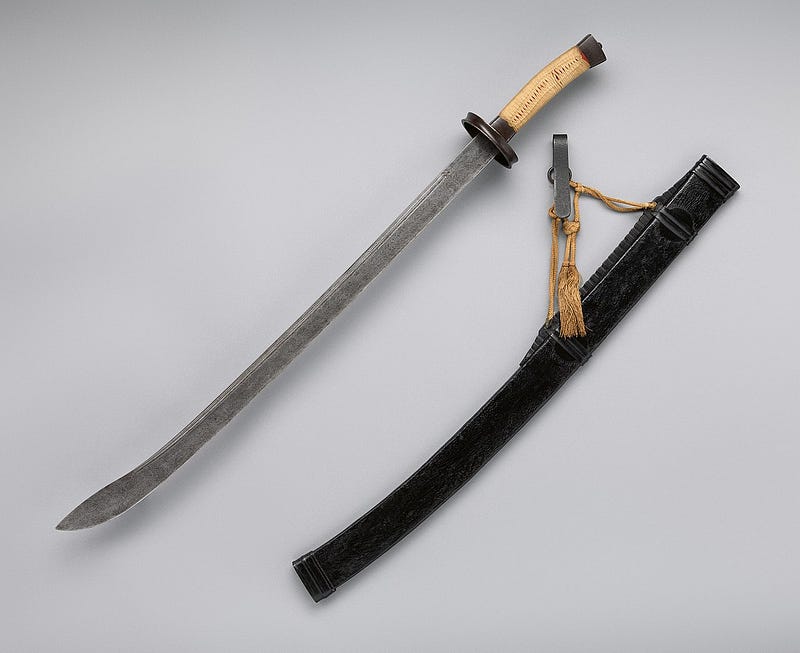
Next, he picked up a shorter, curved blade instrument with a circular hand guard and carved wooden handle. “Now this little beauty, the dao, if wielded by a master of the trade, could easily inflict the damage we saw on Dillman.” I held the dao and examined its heavy blade.
“The man we want scampered up the side of the building carrying his weapon. This seems a little awkward to be holding in his hand.”
“Not at all, Charles. He would have carried it in a sheath strapped to his back.” Thorp opened a drawer and removed a large, ornate key. Striding to a paneled door, he said, “We’ll need to visit my personal museum.”
The room we entered had indeed much of the flavor of a museum. Most of the wall space was given over to cabinets with glass doors, and a wealth of natural specimens crowded their shelves. Colorful butterflies were pinned to a board, and various dried leaves were stored alongside skins of small animals. A large table held a microscope, bottles of various shapes filled with colorful liquids, and a row of flowering plants. The wall opposite the entrance drew my attention, as it was covered with various bladed weapons, from spears to broadswords.
Thorp stepped to a cabinet, swung open its door, and pulled out a leather sheath. “Here’s the scabbard for that dao,” he said. “With this strapped across his back, he would have had his hands free.”
Taking the flat leather holder, I noted its light weight and cloth shoulder strap. After handing it back, my attention was caught by a black shirt, pants, and hood hanging on a hook inside the same cabinet. Doc noticed my interest and gave me the outfit to examine. “This is something a cìkè, or assassin, would be wearing if he wanted to be invisible. And these are the slippers he would wear.”
“These are unusual shoes,” I said as I turned them over. “The large toe is separate from the rest of the sole.”
“Better for grabbing with the feet when climbing a tree,” he explained.
For the next half hour, the Coroner educated me on the cutting weapons of the Chinese and Japanese.
As I was getting ready to leave, I mentioned I was impressed by the large number of ancient weapons in his collection.
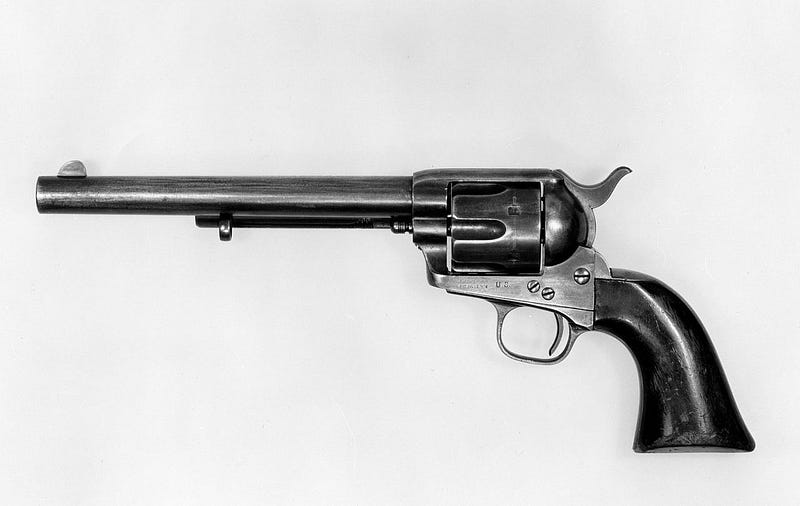
“Here’s something not so primitive, Charles,” he said. He opened a carved wooden box which held two beautifully tooled revolvers. They were nickel-plated and had carved ivory handles. “This revolver uses a metal cartridge. It’s not on the market yet, but a friend who designs these things made a matched set for me. It can fire six shots and be reloaded in seconds. Colt and Smith are currently fighting over the patent.
“Six cartridges, Charles,” Doc marveled as he pulled out one of the guns and opened its cylinder. “Fire away and put in six more. No more loading each chamber with powder and shot. All in one unit. Simple design, really.” He then went on to explain the firing mechanism, the makeup of the cartridges, and other advantages of the weapon. “I have a firing range in the backyard and I use up a box of cartridges a day. My friend sends them to me by the case. You’re welcome to join me.”
“The guns are a wonder of ingenuity, Doc,” I said. “Perhaps I’ll take you up on your offer when I get some free time. The deaths of Skaggs and Dillman are keeping me occupied at the moment.”
“Did Skaggs warn you of a threat to the Administrator?” Thorp asked. “Maybe some rumor he picked up in Chinatown?”
“Perhaps he had it in mind, but he was demised before he had a chance.” I picked up my hat from the rack. As an afterthought, I asked, “Did you ever hear of a man named Lo Ping?”
“Ooooh, Charles, you are trawling in deep and dangerous waters. I know quite a bit about the man, if you believe the gossip. Lo Ping has both great wealth and influence. He’s a bit of a recluse, hiding out among his antiques. Fancies himself an expert at Xiangqi — Chinese chess. Some say he was a favorite of the Emperor, but then ran afoul of the Dragon Empress Dowager. She’s the Emperor’s mother, and one hard woman. Now he imports rice by the shipload, buys and sells only the best jade pieces, and collects artifacts from Chinese history.”
“Your gossip seems mighty detailed,” I said. “Have you ever met him?”
“No, we don’t travel in the same social circles,” Doc smiled. “I do work with other Chinese, of course. The Six Companies calls me in from time to time when they need advice from a regular sawbones. But I would be unknown to a man like Lo Ping. I only repeat what I’ve heard floating around.”
I had started walking to the door, but Doc’s information about Chinatown was so engaging, I probed for more facts. “How did you get connected with The Six Companies?”
“They hired me when that law was passed mandating all Chinese immigrants had to be checked by an American doctor. They were grateful I spoke their lingo and had an understanding of their culture.”
“So you’re their medical consultant, then?”
“Well, that’s the way it started. More and more I’m used as an intermediary between the Chinese Tongs and the Whites over at City Hall. It doesn’t take up much of my time, and it helps keep things calm on both sides. But I steer clear of the Lo Pings of the Celestial world. There’s a rumor he sided with the Tai Ping rebels, after the Dowager Empress found him wanting.”
“The next time he has me over for tea,” I said, “I’ll see if I can get you invited. What’s he doing over here? Is his rebellion still going on in China?”
“That rebellion is over, but there are a few die-hards who refuse to believe it. Lo Ping’s involvement is more than a rumor, if I’m any judge. Two years ago, someone informed the police and the federal government we had a rich, dangerous escapee from China in our midst, but they just laughed. ‘Who cares’? was their attitude. I suspect the escapee is Lo Ping, but as far as the authorities are concerned, he’s just another Chinaman.”
“He invited me to his home.”
“Well now,” Doc said. “that’s an invitation I’d look at mighty carefully before accepting. I hear tell he’s an expert on rare poisons.”
As I stepped out onto his front porch, Thorp said, “Charles, if the Righteous Tigers have been resurrected, then the man or woman who decapitated that politician follows a two thousand year tradition of murder by stealth. Watch the shadows, my friend. Watch the shadows.”
That evening, I directed a cab to the address Lo Ping had given us, dismissing the hack a few blocks away. In the darkening shadows, I walked along the street outside the large stone wall that enclosed his sprawling compound. When I was sure I wasn’t being observed, I slipped into some brush along a side wall and moved to the rear of the enclosure. The trees in the wild area behind the estate were mostly pines, and I selected one a stone’s throw from the wall. From its upper branches, I saw a series of courtyards and several ponds. I watched for nearly an hour, hoping to catch a glimpse of human activity, but the place seemed uninhabited. Although I could hear evening song birds, no sign of children playing, meals being prepared, or kitchen fires were evident. Nothing suspicious, I thought.
The Wicked Affair of the Golden Emperor
A Charles Goodfoote Mystery in Old San Francisco
Chapter 27
A mental chess match with a dangerous opponent
My sense of foreboding had, for the most part, left me by the time I arrived at Lo Ping’s compound the next afternoon. The black and red lacquered gate set into the high wall glided open nearly noiselessly. A slight Chinese gentleman, gray hair done up in a long queue, was dressed in a short white silk jacket, black pants, felt shoes, and a small black cap. Smiling, he bowed me through the gate into a courtyard patterned with rocks surrounded by raked gravel, and led me through a small arbor to a door decorated with two cranes in mother-of-pearl in-lays facing each other.
My guide bowed me through a foyer into a high-ceilinged, simply furnished room before disappearing from sight. I took the three steps down onto a blue and white tiled floor. The furnishings included intricately carved black armchairs with red embroidered cushions, and a small tea table.
A beautiful Chinese woman stood in the middle of the room, her hands clasped in front of her. Her hair was done up in an elaborate three coil style, with three gold filigree hairpins. Dressed in a long-sleeved, cheongsam of green silk with a large white sash under her bosom, she approached me with small steps, her clasped hands raised in the traditional Chinese greeting. She bowed from the waist.
“Detective Charles Goodfoote,” she said in a high-pitched voice “this house is honored by your visit. My husband will receive you in the garden. This way please.” She led me through a moon door to an open courtyard at the back of the residence, an area I had been unable to observe from my perch the previous night.
Sycamore and white alder trees provided shade. Rare in California, Jacaranda trees, their branches hanging with purple blooms spread along a winding footpath made of flat white stones. Water rippled over rocks in a small brook that meandered between brushes festooned with colorful flowers perfuming the air. Birds sang from the branches of spreading willows.
At a turn in the path, a green lily pond came into view, a round island in its center. On the island was a gazebo shaped like a pagoda with red-lacquered poles and black tiled roof. My guide led me to a marble bridge that connected to the island, then stepped aside. She bowed politely and indicated I should continue on to an elderly man standing behind a table watching us. His long white beard was neatly combed while loose gray hair escaped from his black gauze cap. He was a tall man, high shouldered with a thin face, dressed in a long red robe decorated with gold lotus blossoms.
“You honor my humble house with your esteemed presence,” Lo Ping said with a deep bow, hands hidden in his wide sleeves. “Miss O’Rourke has informed me of her sad duty, and her regret at being unable to grace my simple home.” His English was very good and only slightly accented. I thought he looked truly remorseful.
“Please, join me for some tea,” he said. “It’s from a small village in Guizhou province on the side of White Cloud Mountain. The leaves are carefully selected by the tea master himself.” He continued talking as he motioned me to a chair set at a low tea table. Lo Ping waited for me to sit, then sat opposite me. The elderly man who had opened the gate re-appeared, poured our tea and went to stand behind his master.
I hesitated tasting my tea until Lo Ping, watching me closely over the rim of his cup, took a small sip. One of the good things about tea is you can sip it in polite company without really drinking much, and this tea had the taste and aroma of wild flowers. Perhaps I was being overly cautious, but there was much here I didn’t understand, and felt prudence was the wiser course. Doc’s warning about poisons was also rattling around my brain.
“This is an auspicious day to meet and conduct business, Detective Goodfoote. I am a great supporter of Miss O’Rourke’s work with the young girls of China,” he said. He then paused, waiting for a response from me.
“Yes,” I replied. “Her dedication to the children is admirable.”
“Regretfully, she places herself in great danger.”
Where are we going with this, I wondered? “Her friends in the community keep her quite safe,” I countered.
“And you, Detective,” he said with a smile and a bow of his head. “Do your friends keep you safe, also?”
Was this a threat? This early in our meeting?
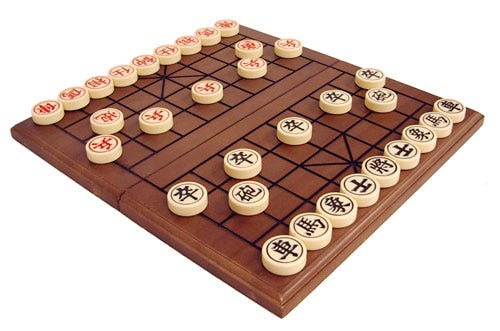
Doc Thorp had told me this man was an expert player of Chinese chess, Xiang qi. I knew little of the game, although John Fong had shown me its basic rules. Now, facing this man across the tea table, I wished I had paid closer attention, for my sense was he had just made an opening gambit, and was quietly awaiting my response.
“The law protects me, Mr. Lo. You may recall the disruption in Chinatown that occurred just two years past when one of my colleagues was murdered. My enemies do not wish to repeat that unfortunate incident.” I felt confident Lo Ping was fully aware of James Hoople’s violent death, and the resulting hoard of out-of-town investigators who tore the city apart, including Chinatown, looking for the killer.
My suspicion was growing that Lo Ping had wanted to meet and evaluate me, and knew I would be here without Miss O’Rourke. That meant he knew of Dillman’s death within hours of the murder. With that thought, came another. Could Lo Ping have ordered the beheading of Administrator Dillman?
“Of course, Detective. The law protects us all from the rougher elements of this city.”
I put down my tea cup. The European chess I had learned at Harvard often favored an aggressive response to gain the upper hand. Time to get on top of this discourse with a complete change of topic.
“I notice,” I said, “that your tea set has the beautiful green and white floral design. I’m more accustomed to seeing the blue and white willow pattern.”
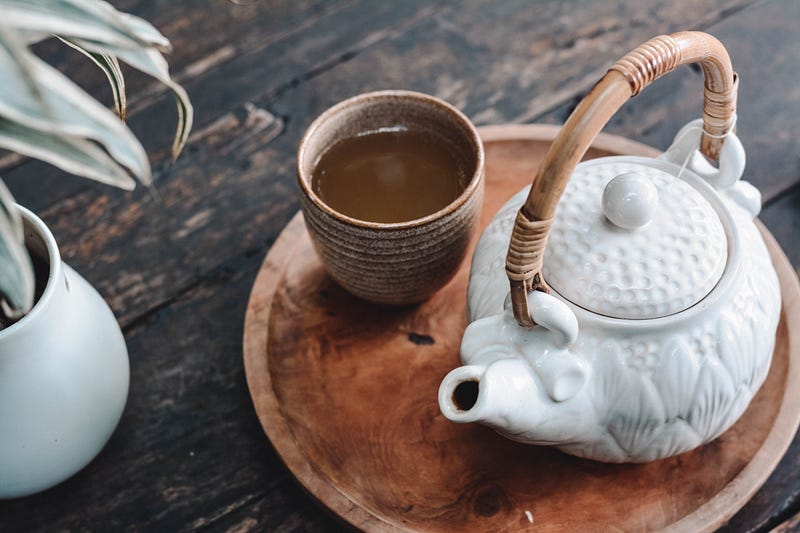
Lo Ping stared at me for a long moment and I thought I may have insulted him unintentionally, made some faux pas. But he quickly smiled. “Very observant, Detective Goodfoote. Yes, this is a very old set, from the early Song Dynasty. It belonged to a famous official of exalted rank in the high court.”
He put down his cup as the servant presented me a tray of dried candied fruit and seeds.
“These may seem exotic dishes to you, Mr. Goodfoote,” Lo Ping said when I hesitantly selected a dried lychee morsel, “but I’m sure the Blackfoot people have delicacies I would find equally curious.”
I smiled and took a tiny bite of the brown fruit, then picked up my cup. “You’re well informed about me,” I said, as I took a sip of tea.
“Oh yes, Detective. But many details of your life are missing. For example, little is known about your father.” As my father was pretty much a man of little merit with a prodigious drinking habit, I felt Lo Ping’s Xiang qi skills were pushing back, trying to get me into a weaker defensive position. Did Lo Ping already know about dear old Dad?
“My father was born in Ireland, came to this country, and became a fur trapper. He died when I was very young.” I didn’t elaborate. My father had died of a broken neck after he fell from his horse while in a whiskey haze.
“My deepest condolences. And how did you get from a Blackfoot camp to Harvard, if the question is not too distressing? I have a strong interest in the history of this great country, and you have lived much of that history.”
“Very well,” I replied, deciding straight answers were called for. “My mother’s camp was raided by a dishonored Army officer and his gang of thugs when our warriors were away hunting. They killed or captured anyone who couldn’t hide among the trees. I was struck on the head and woke up as their prisoner.”
Here I paused as silence around me spread. Then, a single robin, perched on a branch a few feet away, warbled its song.
“I hope I didn’t cause you pain in recalling such a difficult time with my thoughtless question.” But he then plunged on. “So it was the Army that took you to Harvard?”
Again, I smiled. It seemed the polite thing to do, although I had no mirth in me. By this time, I was pretty sure he was playing lawyer, and, like a good lawyer, already knew the answers to his questions. The advantage in our little chess game was his at the moment. I knew I had struck a nerve with my offhand comment on the teapot, but had no idea why. Now, he was attacking with a show of knowledge. At this point, I had little choice but to play along.
“No, Mr. Lo. I was taken under the wing of a man in Boston and he sent me to Harvard.”
“Ah yes. Oliver Wendell Holmes, I believe,” Lo Ping nodded. “The very honorable and prominent poet and physician.”
Bang, I thought. Someone’s been telling tales about me and this man probably has a network of spies as efficient as John Fong’s. “Your information is again correct, Mr. Lo,” I said with a nod. He just showed he knew my entire history and thought himself as the cat to my mouse. Not to be outdone, however, I thrust back at him. “You know a great deal about me, Mr. Lo, for a man whose business is selling rice.”
When he didn’t respond, I continued, “And your home is most impressive. You must import and sell a great deal of rice.”
Lo Ping gave a quick laugh. “I am a humble rice merchant, as you say, Detective. My needs are few, and I find this poor dwelling adequate.” Apparently, Lo Ping’s concept of an “adequate dwelling” differed from my own.
“Does your business require much travel, Mr. Lo?” Now I began to throw questions at him to which I knew, or strongly, suspected, the answers. A merchant importing rice would of necessity spend a large part of each year in China.
“My duties do include frequent trips to the Celestial Kingdom. My rice purchases are from a number of dealers in several districts, so I see much of the country.”
“What are your exports, if the question isn’t too indelicate?”
A narrowing of his eyes, although quickly replaced by his smile, told me I had regained the upper hand.
“Exports? I import rice.”
I took another sip of tea, determined not to let my slight advantage slip. “Your tea is delicious, Mr. Lo,” I said. “But surely you don’t send your ships back to China empty. It would be poor business, and you, obviously, are a very good businessman.” His nostrils flared and his mouth became a thin line. I pressed on. “Daily, ships leave here filled with raw wool, chocolate, raw sugar. Surely, you must have some cargo bound for the East.” For some reason, unknown to me, I had him backing up.
Abruptly, Lo Ping stood. “Please pardon my abominable manners. I sit talking tiresome business matters as the spring sunshine reflects off the lotus pond. Come this way, please. I have a humble gift for the gentle Miss O’Rourke.”
I hesitated but a moment, then rose and followed. Although he was smiling, this elderly Chinese gentleman was visibly upset.
Acting as my guide, his wide sleeves swinging as we walked along the path, Lo Ping led me back over the bridge to the main house, through a high, keyhole shaped doorway, into yet another open courtyard. Here was a second pond, much larger and deeper than the first, where frogs were sunning themselves on lily pads. A pair of large white wading birds rested on the shore and ignored giant golden and white carp swimming in their forest of floating green plants.
The pond was flanked on three sides by cloisters. Three carved doors of dark wood were visible along the marble walkways, one in each wall. Beams of blue lacquered wood supported the walkways’ blue tile roofs, but the rest of the courtyard was open to the sky. This quiet, cloistered space was as serene as the first.
“This is my workroom,” Lo Ping said, as he led me to one of the doors. His servant, who had padded along behind, stepped forward and unlocked the door with a large key, swung the door open, and bowed as we entered what appeared to be a writer’s studio. Scrolls of white paper bearing various sizes of calligraphy covered the walls, and a carved teak desk opposite the door held an ink block, and a carved brush holder with four brushes.
A tall, six panel red lacquered screen with intricate carvings occupied one corner of the room.
“Early this morning I wrote a poem for Miss O’Rourke,” Lo Ping said, “ a few lines to express my sadness at her absence.” He pulled a small roll of paper from one of several wicker baskets on shelves, and unrolled it. It was covered in Chinese figures in black ink.
“Without your company, the White Moon and Bright Stars dim,” he read. “A sadness reflected in a dark cloudy sky.” For some reason, his recitation made me feel a little uneasy, as if he had just gained the upper hand in our little game. “My humble calligraphy is considered by some to be art,” he said with another slight bow.
Lo Ping rolled up the paper and handed it to his servant. He spoke sharply in Chinese to the man who then shuffled quickly behind the paneled screen. Almost immediately, he emerged carrying something wrapped in a red silk cloth. The retainer bowed to his master, then placed the object carefully on a nearby table. Slowly, Lo Ping unfolded its silk wrapping to reveal an ivory box, elaborately carved with Chinese figures and scenes. It was near enough the size of a Blackfoot buffalo hide parfleche, I thought.
“Inside this vessel was part of an old copy of the Neijing, the Golden Emperor’s Canon on Chinese Medicine. Wang Bing, great scholar of the glorious Tang Dynasty collected and organized this Canon. His annotations in red ink could still be seen on the parchment.” Lo Ping gave a deep sigh. “The scroll itself has been stolen. Only this ivory container remains to remind China of the achievements of our glorious ancestors.”
Without touching it, I studied the carvings on the box. My curiosity was going full throttle. Poems and ancient treasures. Where was this going? And could it have led to murder, I wondered.
“It’s beautiful workmanship,” I said.
“Yes. It is beautiful, Detective Goodfoote. But it is the manuscript itself, of incalculable value, that is the national treasure of China.”
“Do you have any idea who took the book?”
“Who took it is unknown. However, there is a whisper the scroll is now in San Francisco.”
I said nothing. Lo Ping rewrapped the container and handed it to his servant.
“The man who finds the Neijing and returns it to me will be paid ten thousand dollars in gold. Five thousand dollars for simply searching diligently.”
“Are you hiring the Pinkerton Detective Agency to find the Neijing?” I asked.
Lo Ping smiled like a lizard. “No, Detective. I am hiring you.”
A simple job offer, or a lucrative bribe? For the kind of money he was offering for just a diligent search, let alone a returning of the scroll, he could hire the entire Pinkerton Agency with its far-reaching resources. No, I thought, this was a bribe, plain and simple. First, the subtle threat, a round of gamesmanship, and now a serious bribe. Curiouser and curiouser.
The elderly servant stepped forward and handed Lo Ping Emily’s poem, rolled up and now tied with a red ribbon. Lo Ping offered it to me with both hands and another deep bow.
“I’ll be happy to deliver your poem to Miss O’Rourke, Mr. Lo,” I said with my own bow. “However, before I leave, you mentioned in your note you had some information for the lady. May I inquire as to its nature?”
“Merely something to do with one of her rescued girls, Detective. It is of no immediate concern. I will speak with Miss O’Rourke when she returns.” More evidence that he never expected Miss O’Rourke?
Lo Ping continued to smile as he led me back through the courtyard to the front door. His servant ran ahead and pulled it open. “I took the liberty of sending for a carriage,” Lo Ping said. “Please consider my offer. I will await word from you.”
And, with bows all around, I took my leave.
An interesting afternoon, I thought, as I climbed into the carriage. Lo Ping’s threat was subtle, his bribe substantial. Yet our meeting had had the flavor of a theatrical play. It was clear the man was not expecting Emily, but the invitation had gone to her. The puppet was on full display, I thought. And I had better watch my back.
That ivory box he had showed me was indeed a treasure. It was so yellowed I had no trouble believing it was ancient. According to Doc Thorp, the Tang Dynasty was a thousand years ago. Before it escaped my memory, I rendered a quick sketch of it in my notebook.
I had the carriage driver travel a short distance, turn a corner, and stop. Within minutes, Henry climbed into the rig. The handle of a pistol stuck out from his jacket pocket.
“Anything interesting, Henry?” I asked.
“I snuck up on that wall in the back, Capt’n, like you tol’ me. Kept a close eye jest in case them Chinee was fixin’ to scupper ya. But all was peaceful as a vicar’s garden in summer.”
“Thanks, Henry. I’m glad you weren’t called on to rain hell on the compound’s inhabitants. Few servants for a place this big, I’m thinking.”
“Wal, Capt’n, they was a sneaky lookin’ jasper watchin’ you and the Chinee beard from inside the wall when you were palaverin’ on thet island. He wore a sword longer than a spar on his back. And I seed three more coves hidin’ in the bushes outside the walls.”
I thought for a moment. “Lo Ping’s bodyguards, perhaps. Or maybe others with a strong interest in either my activities or Lo Ping’s. It’s good to know, Henry.”
“I’m tellin’ ya, Capt’n, steer clear of them yellow people, yer never know what they be thinkin’ and plottin’. The whole place is too rummy, too rummy by half.”
“Rummy it may be, Henry. But I’ve a notion we’ve picked up some sign here, and it’s up to us to follow and see where it takes us.”
I examined my drawing of the ivory box, then stared at the passing city. Lo Ping, the compound, the poem, all had me moving down a trail shrouded in fog.
And The Golden Emperor, whoever he had been, was making his presence known yet again.
The Wicked Affair of the Golden Emperor
A Charles Goodfoote Mystery in Old San Francisco
Chapter 28
Kaya sets up at the ambush pass, and awaits Goodfoote
The afternoon sun was four fingers above the horizon when Kaya found the place she had seen in her vision. There, the White-Eye’s road emerged from a forest of pine and spruce trees and ran up to a jumble of large stones. It then entered a passage among the rocks.
The exact spot where Goodfoote was laying when the men with rifles shot at him was just inside the gateway. A big hill covered in golden plants was near the road. Kaya examined the ground carefully and saw no sign of a fight or disturbance. She knew then that her vision had been of a possible future and her Power had brought her to this place in time. Goodfoote was still alive.
Not wanting to be seen or to leave any footprints, Kaya avoided the road and climbed up a narrow path into the rocks. She noted the place was perfect for a stronghold. Two or three riflemen could stop a large number of men coming through the narrow passageway. Cover among the rocks was available, white bark pine trees growing in abundance providing even more concealment. Inside the gateway, side-canyons and small room-size pockets honey-combed the area. It looked to Kaya as if the Blue Stone Twins had battled the rock monster right here in this spot, when the world was being formed. The monster’s teeth and bones were strewn about as the hero twins fought and killed the beast, their lances made from the branches of the purple pine.
But Kaya saw no purple pine here. The tree grew far away in her homeland. The story of the Blue Stone Twins and their battle was also within the land of the Red Paint People. Kaya didn’t know the stories of this place, but she sensed it was a place of death. Ghosts of those who had died here filled every nook and crevasse. But there was always room for more ghosts.
The tracks had told Kaya the road was little used of late, but showed signs of heavy traffic in the past. She moved up into the rocks so she could see glimpses of anyone coming from inside the ambush area, and anyone coming out of the forest outside the guardian rocks. Slowly the sun settled into the great water, just behind the low western hills. Just before the last rays left the sky, a kettle of hawks swirled above her. The large group soared and flapped in a large circle, the kettle moving in a northern direction. A smile crossed Kaya’s face. If she had had any doubts that this was the area her vision had shown her, that doubt vanished with the hawks.
Stars began to appear in the East, then spread across the blackness of the heavens. There was no moon visible and the road became little more than a light ribbon. Patience is taught to the Apache from earliest childhood, and Kaya was content to sit and wait.
The Wicked Affair of the Golden Emperor
A Charles Goodfoote Mystery in Old San Francisco
Chapter 29
More clues point to a Chinese plot, but Goodfoote has his doubts
John Fong studied my sketch of Lo Ping’s ivory box. “This container is remarkable,” he said. “Please describe it to me in more detail.”
“It had the spider-web cracks you see in old paintings, and it was yellow with age. As my sketch shows, it had a dragon and a phoenix carved on it, along with other smaller figures.”
I glanced at Fa Soo, who was sitting on the settee dressed in a purple jacket over a white gown hemmed in gold braid. Her round face was set off by her thick hair, done up in a simple coil on the back of her head. Holding Emily’s tied scroll, she smiled at me and asked, “May I read Emily’s poem? I will be very careful with it.”
“Of course” I answered. “I don’t think Emily will mind. Besides, I’m sure she’ll need it translated by you or your father.”
Carefully, the Chinese girl removed the red ribbon and unwound the scroll. As she read, a frown crossed her face.
“Father,” she said “this makes no sense.”
“What does it say, Fa Soo?” I asked.
“There are two sections. The first is part of an ancient poem, but the second part is a puzzle.” She again studied the scroll. “Something about the Golden Emperor and a moonless night. When you have the opportunity, venerated Father, please see what Lo Ping has written for Miss O’Rourke. The poem is an ancient one and not very flattering.”
“Oh?” John said, motioning for the scroll.
John looked at the calligraphy, then at me. “Lo Ping said this was a poem for Miss O’Rourke?”
“Yes. He said he wrote it this morning, and that it’s related to Miss O’Rourke’s absence.”
John Fong bowed from the waist and smiled as he returned the rolled up paper to me. “Thank you for letting me read it, Charles. But not only is this poem not original, it is not written in Lo Ping’s calligraphy.”
I stared at him. “ What do you mean, John?”
“The poem was written by a famous poet from the Tang Dynasty, as old as the container you saw. Also, I have studied Lo Ping’s calligraphy. It is noted for its art and force combined. This writing is much different. It has the force, but none of the art.”
“Of course I couldn’t read what he wrote, but he translated it for me.”
“What did he tell you it said?”
“Something about the moon and stars being sad because you’re not here.”
“No, Charles,” Fong said, “the poem reads, ‘A beautiful face and a lightning bolt last only for a brief moment.’ And the second part is not poetry.” John again seemed lost in thought. “There is much here I don’t understand,” he said at last. “but I sense a warning for Miss O’Rourke’s safety. What will you do with this scroll, Charles?”
“I’m going to drop it off at the Mission House. Miss O’Rourke will be back from Sacramento in a couple of days.”
“Of course. Perhaps it would be wise not to reveal the true meaning to Miss O’Rourke. It would not be a pleasant thought for a beautiful young woman, written by someone other than Lo Ping. Of that there is no question. I can only conclude the scrolls have been switched.”
“Only one person had the opportunity to do so. When we were in Lo Ping’s writing chamber, his servant took the scroll behind a screen. He must have made the switch at that time. Can Emily read Chinese?”
“I am certain she cannot,” John said.
“Then why send a warning to her in a language she can’t read? Unless the servant knew she would bring the message to you.”
“Perhaps. That would mean this servant knows her well.”
“Very well, I would say. And Fa Soo mentioned a puzzle. What type of puzzle, John?”
“’The Golden Emperor rides the jade dragon through the moonless sky’,” he recited quietly, as if the lines weren’t completely unknown to him.
Although this was the second time I’d heard that jingle, I hesitated sharing that information with John. Too many clues pointed to Chinatown as the center of all these mysteries, and from what I was learning, nearly anything that happened in Chinatown eventually came to John’s attention. I felt my friend was not telling me all he knew about the mysteries surrounding Dillman’s death, Lo Ping, and the triads. Was he, too, in the dark, or was he simply being enigmatic, keeping his counsel until sure of his facts?
I picked up my hat. “Please let me know if anything regarding the murder occurs to you, John. And have a care with Sam Clemens’ poster. Captain Bullump has taken a sudden, and serious, interest in it.”
I spent a couple of hours strolling around Chinatown, talking to Fan Tan dealers, street vendors, and Joss House priests, feeling the climate in tea shops and apothecaries. It was still only mid-afternoon, but my head needed rest from all the twists and turns this case was taking. As I had done in the past when my head was too full, I rented a horse and rode into the hills outside of town. The natural, clean silence of the land just as the sun began its late afternoon descent washed my mind clear of the case and took me back to my early days with The People.
I thought about something my uncle Keeps-the-Lodge of the Blackfoot Nation had taught me. “All the wisdom is in the last track you can see,” he had said. What he meant was, if you’re reading the sign correctly, the last track will show you where to look for the next one, and the one after that. The last track of an animal holds the evidence of a change in direction, or speed.
Sam Clemens’ poster seemed like a track that pointed in one direction, and the deaths of first Skaggs, then Dillman, if related, pointed to a change. From subtle threat to brutal murder. That violent a change needed a reason, and that reason must have been a good one.
The song of a coyote in the distance set my heart and mind at peace, but it was time to return. A waning moon lighted the night as I mounted up and rode into the city. Threads of mist stretched their tentacles from the wharfs to my hotel.
As I passed the desk in the lobby, Silas, the night clerk, called, “A message for you, Mr. Goodfoote.”
“Who delivered it?” I asked, taking the envelope from him.
“A boy in fine livery, Sir. And he came in a Brougham with a matched pair of Cleveland Chestnuts.”
Thanking Silas, I inspected the envelope. It was constructed of heavy paper with a gold seal on the back embossed with a locomotive and a large “SW.”
“Now what would Stanley Walker want with me?” I asked under my breath, for there was only one “SW” who I knew of who could afford a Brougham with matched cattle.
I climbed to my suite of rooms on the third floor, locked the door behind me and lighted the oil lamp. Using my pen knife, I slit open the envelope and found it was an invitation to a dinner party to be held the following week, tails optional. I could bring a guest.
Emily O’Rourke sprang immediately to mind.
.
The Wicked Affair of the Golden Emperor
A Charles Goodfoote Mystery in Old San Francisco
Chapter 30
Breakfast with the Coroner reveals a hidden, dangerous presence
The next morning I decided to break my fast at one of the finer eateries in the City, a quiet retreat tucked behind a stone wall and wrought-iron gate. Given over to paneled walls, deep carpet and large windows, the Café Chez Jacque was run by a Frenchman with a passion for service, catering to the more respectable customer trade. Open for breakfast, often before dawn, it also stayed open for lunch. It lay on the border between Chinatown and the City proper.
To my pleasant surprise, as I entered, Doc Thorp was just being shown to a table.
“Goodfoote,” he called across the room, “come break bread with me.”
We sat at a table set with a white tablecloth, sparkling silverware, and crystal water glasses. The maître de stood aside as our waiter, dressed like an undertaker in a black suit, white shirt, and white gloves, presented us with menus.
“The usual for me, Sammy,” Thorp said as waved away the menu.
I took a moment longer. “Eggs scrambled and whatever is fresh off the hoof, ” I said. “And bring me a glass of your special coffee.”
“So, Charles,” Thorp began. “What progress in our headless politician case? ”
“Not much forward movement, I’m afraid. It’s getting more and more complicated.”
Bread, a platter of vegetables, and a dish of sauces accompanied our drinks.
“You have the weapon, which is a sword, and you have the body, which is dead. Now all you need is the Chinaman who put the two together.”
“Maybe a Chinese, maybe not,” I said. “I’m still working on a motive. Dillman was helping the Chinese as much as anyone, so why kill him? I’m aware that everything points to the triads, but their reason for so heinous an act still eludes me.”
Thorp picked up a piece of bread. “The Chinese are hard to figure out sometimes. We in the West follow Euclid who says the shortest distance between two points is a straight line. In the East, it’s a lot more complicated. They never heard of the Greeks, so don’t assume you know how they think. You, being a Harvard man, probably don’t.” He carefully buttered his bread while I sipped my brew. “Have you talked to John Fong about the League of Righteous Tigers?”
I gave a slight shake of my head. “Earlier he mentioned a few are still around practicing their trade.”
“Well, he’s the man who would know.”
“Of course, he works for The Six Companies, so he’s a colleague of yours,” I said.
Thorp stopped buttering his bread and squinted his eyes ever so slightly. “Have you ever heard of the Imperial Censor?”
“No. More Chinese history?” I’ll need another ride in the hills if this keeps up, I thought.
“The Imperial Censor is an office in the Chinese government. It’s usually a temporary office, given during war or rebellion. The single most powerful man in China, other than the Emperor himself, is the Imperial Censor. The holder of that office has full authority to command an army and ships at sea, and full arrest powers, even over the palace eunuchs. Only the Emperor can issue the document, signed with the vermillion brush, that gives a man that much power.”
“Are you saying John Fong is the Imperial Censor?”
In answer, Doc Thorp put his bread down and lowered his voice. “I met Fong Leung San over in China years back. He was a high court magistrate who specialized in catching rebels hiding in plain sight. Along with the power of his position, which was considerable, he was given the Imperial Censor mandate. When I saw him in this country, I suspected something big was brewing.”
So, John Fong’s reticence, given his government position, now made sense. Despite our friendship over the past year, he would be careful not to disclose details of an on-going scrutiny of enemies of the Emperor who were currently living in Chinatown.
“Any idea what he’s up to? ”I asked.
“Nope. Something long-term, considering the time he’s already spent here.”
As we started in on our entrees, Doc smiled and changed the subject. “I see you’re still among the breathing, so your tea with Lo Ping must have been a success.”
“It was certainly an unusual afternoon. He showed me an ancient ivory box of some value. It was supposed to hold part of a document that was written a thousand years ago. But the document’s been stolen.”
“ Can you describe the case? Other than it was ivory?”
“It was yellow with age, full of carvings, including a dragon and a phoenix.”
“The dragon represents the throne,” he said. “The symbol of the divine power of the Emperor.”
“What about the phoenix?”
“A phoenix is the symbol of the Jade Empress, the first lady, or primary wife of the Emperor. If that piece is authentic, you saw one of the great treasures of China. And, my friend, it’s priceless.”
He took a sip of his coffee. “Watch yourself, old man. Lo Ping wouldn’t show you that piece of art unless he felt it would benefit him somehow. Foreign devils are usually not allowed near the real valuables.”
“He asked me to find the missing document and offered a fortune for my services.”
“Ah, the usual Chinese bribe. Bribery is common in China, but what do you suppose warrants a bribe in this case?”
“Since at this point I know very little, maybe it’s something he fears I’ll learn.”
Doc Thorp nodded slightly. “So, tell me about the compound, Charles. I imagine it’s large and his house must be well furnished.”
“Large it is, Doc. With ponds, flowering trees, and an island. Lo Ping has a workroom, of sorts.”
“Lots of servants, I imagine,” Doc said.
“No, I saw only one retainer. I did meet Lo Ping’s wife who is quite young,”
Nodding, Thorp set down his eating utensils, and said, “Let me tell you a rumor circulating in Chinatown about Lo Ping.”
Another rumor. I was beginning to wonder if anything to do with the Chinese was bare fact. So far, most everything had been gossip, rumor, and innuendo.
“There was a highly educated man in the Qing court by the name of Yee. This Yee had a mind that was nothing short of astounding, knew more about bugs, spiders, and snakes than all the learned men of the empire combined. Some Dutch merchant had given the Emperor a telescope and Yee used it to make predictions on the flight of comets and a host of other planetary observations. According to my sources, he was a trusted advisor on all things.”
“Sounds like an interesting man.”
“Indeed. When the Tai Ping rebellion broke out, Yee was given, at his request mind you, a generalship. With it, he hunted down anyone who even hinted at disloyalty. At one village he set up a system to behead hundreds of innocent farmers and merchants because they lived in the same town as a rebel leader. It’s said he drank tea and munched melon seeds while he watched the slaughter. That’s what caused the Empress Dowager to finally give him the old heave ho.”
“So he went over to the other side?”
“A little more complex than that, Charles. Supposedly, he threw himself into the river in an effort to take his own life, which to the Chinese would be the honorable thing to do. That was the last anyone in the Qing dynasty heard of General Yee.”
“Are you telling me Yee swam ashore and became Lo Ping?”
“The story is that some rebels happened to rescue him. In time, he fell in with their cracked idea that their rebel leader was Jesus Christ’s younger brother.”
“He may have been using the rebels to get his personal revenge. But surely someone would have recognized Yee.”
“Unlikely. Yee lived in the Summer and Winter Palaces where only few people were admitted. I’m sure the Emperor and a few of his advisors could set us straight, but Yee is dead and gone to them.” He resumed eating.
“Does he have any scars or birthmarks? Some way of telling if Yee and Lo Ping are one and the same?”
Thorp shook his head no. “I wouldn’t know, Charles. I’m just a listener at a keyhole, like you.” He grinned like a lizard, then took a drink from his water glass.
So, I thought, John Fong must be aware of this connection between Lo Ping and a rebel of General Yee’s standing, yet he mentioned nothing to me. Why had he not shared what he knew? Maybe just a rumor, but I should have been told about it. In spite of Fong’s government position, my unease with my friend’s reluctance to share information had reached an uncomfortable point.
After removing our empty plates, Sammy de-crumbed our table. We then ordered pie. Raspberries were in season, so I had the waiter bring me a large wedge of berry pie, while Doc went for the apple with cinnamon.
“One other thing of interest,” Thorp said. “General Yee was the reigning expert on Chinese artifacts, and had an enormous collection.” Doc smiled, his eyes crinkling. “The best pieces were confiscated by the Throne, but in time, most of them disappeared from the Emperor’s vault. Four eunuchs lost their heads, but the antiques were never recovered.”
“And now you’re going to tell me the ivory manuscript holder I saw was one of them?”
“No, Charles, me lad,” he said with a quiet chuckle. “It’s all only rumor, after all.” He grew serious. “But there’s enough there to make a man wonder about the possibility of a connection between Yee and Lo Ping.”
After our breakfast, we strolled over to Chinatown and ambled up Dupont as the early sun chased the shadows off the bustling street. We stopped to watch a Soothsayer reading from a large book.
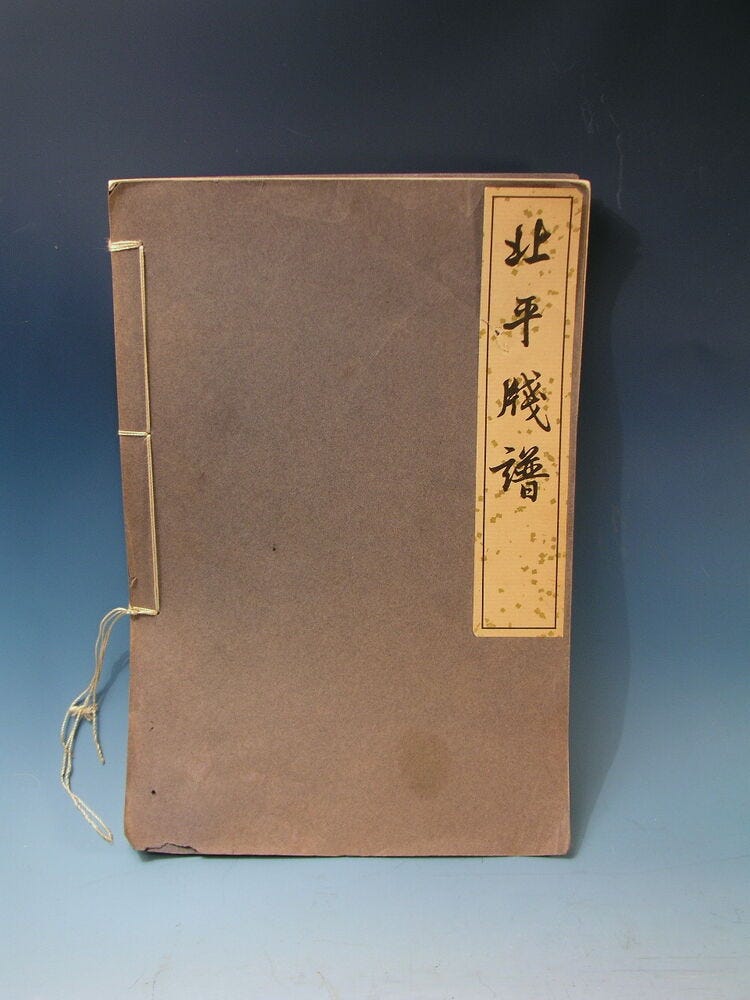
“The Yi Jing,” Thorp said. “Sometimes called ‘the Book of Changes.’ One of the world’s greatest works of wisdom. Six thousand years of Chinese thought between those covers, Charles.”
“I know old Wang here,” I said. “He tells fortunes for the Christian trade.”
Thorp chuckled. “Some use it for prophesy. Most Chinese use it for its smarts. See those yarrow sticks he’s counting? He uses them to build a hexagram, then he looks up the hexagram in the Yi Jing. What he finds there will gives him insights into the mysteries of whatever question he’s asking.”
“Sounds useful. ‘The Book of Changes’?”
“Yes sir. Everything in the universe is constantly changing,” Doc Thorp said quietly. “In fact, the question changes as soon as it is asked. For example, a man may ask, ‘Am I going to be rich’? The answer from the Yi Jing may indicate happiness, not specifically monetary riches. Wang then builds a second hexagram to see how wealth in this case is related to happiness.”
I nodded. “The Blackfoot have a similar view of this world, change as the only constant.”
We strolled on, resuming our earlier conversation as we watched the life on the street. “If Lo Ping and Yee are the same man, I would have expected him to recognize John Fong,” I said. “Lo Ping’s spies must have told him about John.”
Thorp nodded. “You’re right, of course. But if our Johnny Fong is the Imperial Censor, to kill him would be a direct attack on the Dragon Throne. If caught, the murderer’s punishment would be barbaric, even by Chinese standards. Death by a thousand cuts. Confiscation of all his worldly goods. Death to all members of his family so his blood would not be carried on to the next generation.”
“Sounds like they mean business.” I didn’t know what ‘death by a thousand cuts’ entailed specifically, but it sounded markedly unpleasant.
“They do indeed. Still, John takes precautions. He makes himself a moving target. You’ve been to his apartment. That’s one of many he has all over Chinatown. He travels in disguise, usually as an herbalist or Soothsayer, like Wang back there.”
I thought about this as we walked along in silence. My mind flashed back to Sam Clemens’ poster. John Fong had called the calligraphy written on it an old, unused style.
“What about calligraphy?” I asked the Doc. “Does each Chinese dialect have its own written language?”
“No. Again, it’s more complex than that. The government in Peking is conducted in Mandarin, but the Cantonese can’t understand much of it. There are so many dialects, if you travel from one village to another fifty miles away, you wouldn’t be able to understand a word they’re saying.
“But here’s the thing. They all write the same language. Every literate Chinaman can understand the written word of any other Chinaman. Just one more curious custom of China.”
“Could General Yee, if he is still among the living, read an ancient script? Specifically, one that hadn’t been used in a couple thousand years?”
“Yee was a historian of the first order. A poet, mathematician, and dedicated student of ancient Chinese, all the way back several thousand years to the Shang Dynasty. Yes, I believe he could read it — and probably write it.”
So, Sam Clemens’ poster could have come from Lo Ping. Now I knew of two men in Chinatown who could have written that poster, Fong, and possibly Lo Ping. “How about you, Doc? You seem to have a handle on these Chinese. Could you write in such an ancient script?”
“No, my boy. I spent only two years in the Celestial Kingdom. It would have taken me another ten to master anything other than the rudiments I picked up.”
“So Lo Ping, a rice merchant,” I said, as we passed a joss house and inhaled the jasmine incense wafting through the doorway, “comes and goes in China and no one suspects he may be the dangerous rebel Yee.”
“That’s pretty much it. He does much of his business in Hong Kong, which, as you know, is a British Colony. And he pays enough in taxes to hide behind their Limey guns. To them, he’s just a rich Chinese merchant named Lo Ping. And the governor of Hong Kong doesn’t involve himself with the internal politics of the Qing government.”
“Lo Ping’s servant brews a good cup of tea, though,” I said.
“As I said before, Charles, Yee was known for his deadly poisons. So it’s nice to see you still upright.”