
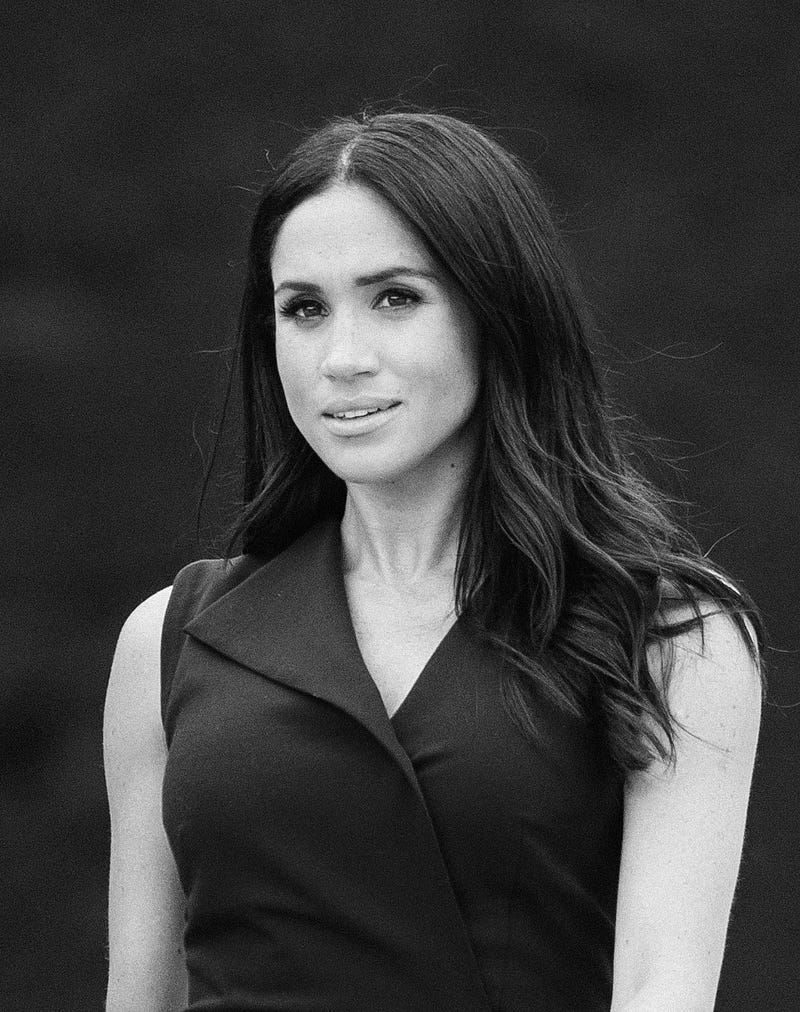
The “Naivety” Surrounding Meghan Marrying Into the Royal Family is the Reason Why We Still Haven’t Solved Racism
We need to understand racism — systemic racism — in order to solve it, and our ignorance is showing.
I wrote a piece a few months back that was titled “No, Black People Can’t Be Racist.” It was, much to my relief, pretty well received, although there were some dissenters (which was to be expected). As I stated in that piece, my aim was two-fold; it was not to demonize White people or posit that somehow Black people are morally blameless, but rather to absolve Black people from the burden of fixing a problem that they did not create. Secondly, it was for us to really think about what racism means — racism as an “ism,” as a system of power and hierarchies much like other “isms” like sexism, ableism, and speciesism.
While racial hatred and belief in one’s racial superiority may be part of it, I still believe that it is far too limited to think of racism as just mere racial hatred. Human rights commissions seem to agree with me. That’s why those of us who work in social justice propose equity measures as a redress as opposed to just kumbayah/lets-hold-hands-and-learn-to-love-one-another love fests.
At its core, racism is about power. It’s not just about skin color and hatred (which is more often than not prejudice and which is, etymologically speaking, pre-judging someone), but how skin color plays into power (or perhaps how hatred of a certain skin color plays into power). It’s not synonymous with unfair treatment based on skin color (which is discrimination), but rather unfair treatment set against the backdrop of power dynamics.
If we don’t understand racism, we won’t know how to solve racism. If we think racism is about hate, then we will make love its antidote. But we all know that you can love someone and still be racist or perpetuate racism. One’s marriage, as a person of color, into a racist institution does not make that institution any more accepting. And one’s proximity to Whiteness will not save you from an establishment committed to anti-Blackness.
There are many lessons to be gleaned from Meghan and Harry’s story of stepping back from their royal duties. I’ve written about a few of them. This interview and this situation have also, however, laid bare our weak understanding of systemic racism.
In case the Duke and Duchess of Sussex ever read this (I say this because stranger things have happened), let me make it clear — I don’t think that Harry or Meghan are racist (I mean, there is an argument that all White people are racist, and it is possible to be both racist and nice and a good person, but I’ll leave that for another day). Meghan and Harry seem like lovely people really. I’d love to be their friends and sit and have tea with them one day (in my wildest of imaginations). I spoke kindly of them in the piece a wrote a few days ago.
I do think that Harry served, at once, as a male ally and a White ally. I think that many White people — again, some of the kindest of them — can perpetuate racism. Most of them do it completely unknowingly and unconsciously or subconsciously (and I’m not even talking about Harry dressing up in a Nazi costume when he was younger. I mean that even as people mature and “listen and learn,” they can still perpetuate racism). I think that the fact that Harry only really realized what Meghan was up against when he started dating her is an example of White privilege. It doesn’t mean that Harry is a bad person at all. It just means that he had the privilege of not experiencing racism, benefitting from his Whiteness in a White supremacist society, and the added “benefit” of being a member of a White supremacist institution. In other words, his life may have been hard (as hard as a royal life can be), but his Whiteness was not one of the things that made it harder.
I do think that Meghan has benefitted from her proximity to Whiteness throughout her life. I respect her decision — and anyone’s decision really — on how they choose to identify. Meghan identifies as biracial, having faced the same dilemma many people of mixed-race face: the decision of choosing one race (or consequently the race of one parent) over the other. Some make this decision strategically, whether for belonging, or to advance their careers or for protection and survival… to “pass.” For others, the decision is made for them by society. Through no fault of her own, being multi-racial is fetishized in our society and the lighter we are the more beautiful we are seen (again, White supremacist society), and so it is quite possible that her features were an advantage in her life and career (even if unbeknownst to her). To quote Ijeoma Oluo, “This is the story of how if you are a thin, abled, white-passing celebrity, you literally have to become royalty before you begin to experience some of the more harsh realities of being Black in a white supremacist institution that has been murdering darker-skinned folk for hundreds of years.”
Whether this was the first or the fortieth time is one thing. Regardless, like many mixed-race people the world over, she has probably found herself in a familiar double-bind; the same features that were lauded and applauded in White supremacist society are hated in the White supremacist royal institution. This biracial woman was too Black for royalty.
We make ourselves vulnerable to repeating past mistakes when we believe that the mere passage of time has made us and our institutions better and more just.
I think that it is telling that she did not know what she was marrying into. I totally get not wanting to or feeling a need to Google the guy you are dating, especially if he is being transparent with you all along. I also wrongly take for granted that everyone knows about the British monarchy. I have had no choice but to know about the British monarchy since I am a Canadian born of Jamaican immigrants. I pretty much see the Queen every day — on my money at least. And as a Black descendent of Black Jamaican slaves, it was no secret that Britain was a part of that. So I have a different frame of reference and relationship with the British monarchy and have from an early age
As I have written elsewhere, the ability of someone to be naive about something can be quite telling. “…[H]ow [could] Markle herself […] have been so oblivious to the long history and the precedent proving that a divorced Black American woman marrying into this family would not be warmly embraced? How could she not know? And how could she have believed them?” Kathleen Newman-Bremang writes. I wasn’t sure if I should chalk up Meghan’s naivety to being an American as much as I should to the fact that she may not have had to grapple with her Blackness in the same way as I have.
I suppose that many of us, Meghan included, may know that the British monarchy is the epitome of White supremacy and colonialism — at least historically. But our ignorance lies in the belief that we’re in 2021, so certainly it’s not like it was 1200 years ago.
We make ourselves vulnerable to repeating past mistakes when we believe that the mere passage of time has made us and our institutions better and more just.
Harry and his family typify that even if the individual actors of a system are not racist (this is arguable, but let’s assume this for the sake of argument), that is not enough if the whole system is racist in how it operates — or has a racist foundation. The British monarchy is one of our best contemporary examples of an institution steeped in (perhaps even part author of) racism and colonialism.
It’s the reason why people are calling for the abolishment of other institutions like police services. Police services were created off of a colonial model of subjugating and controlling Indigenous and later free Black people (see also here). It was and is racist in terms of its conception and at its foundation. So while it is commendable that many police services and departments have put in place more accountability measures and hired more people of color, it’s like putting new furniture into a rotting house that was built on manure. Yeah, the interior design is stunning but the house still stinks. You’ll need to build a new house altogether.
“Racial discrimination can happen on an institutional — or systemic — level, from everyday rules and structures that are not consciously intended or designed to discriminate. Patterns of behaviour, policies or practices that are part of the structures of an organization or an entire sector can disadvantage or fail to reverse the ongoing impact and legacy of historical disadvantage of racialized persons. This means that even though you did not intend to, your “normal way of doing things” might be having a negative impact on racialized persons.” — Ontario Human Rights Commission
This is why we have to be so careful about putting Black public figures on a pedestal when they ascend to a position in an institution previously barred from people like them. We did the same thing with Barack Obama and lulled ourselves into the lie of a “post-racial society” (almost laughable given the presidency of Trump that followed suit). We’ve done the same thing to people before them. Their influence is so necessary but is also so limited when the structure and the system in which they operate actively work against them. As many a Black concubine in the Antebellum south would tell you were they given utterance, marriage to your oppressor does not cease your oppression. And marriage into a system of oppression just as well. And then we have the audacity to find ourselves disappointed when the system of oppression lets us down or mistreats us and systemic racism rears its ugly head (ask any Black police officer who has, much to their surprise, been racially profiled or harrassed. See also here and here.). The problem is not always with the person but with the system.
Ijeoma Oluo writes: “We can battle White supremacy and we can win, but only when we recognize that trickle-down social justice isn’t a thing. When we tackle the anti-Blackness targeting dark-skinned Black folk, disabled Black folk, queer and trans Black folk — in that work, we will find liberation for our light-skinned selves as well. But it will never work the other way around.”
So yes, let us continue to be proponents for people who are marginalized and especially for those who are the furthest away from privilege. If we have power relative to others, let’s use it to advocate for others on their behalf, kind of like what Harry did for Meghan as a White person and as a man and husband.
Meghan took great pains in differentiating between the family and the institution — the “firm” as Prince Philip has been known to call it, and the “establishment” as Diana once referred to it. In a statement released by Buckingham Palace, it says that “The issues raised, particularly that of race, are concerning. While some recollections may vary, they are taken very seriously and will be addressed by the family privately.”
As they should be. But let’s also realize that that will never be enough because the family exists within the firm.
For institutions with racism and colonialism as their bedrock? We must challenge their existence, effectiveness, and relevancy and in some cases, start over, and not be so naive that our participation in, employment in, or marriage into those systems will protect us.
_____________________________
Simone Samuels is a writer, diversity, inclusion, and equity expert, and body-positive fitness professional, among other things. You can join Medium to read all her essays, here.