
The White Privilege And Racism Of Lensa’s Magic Avatars
And how the app made me “white”
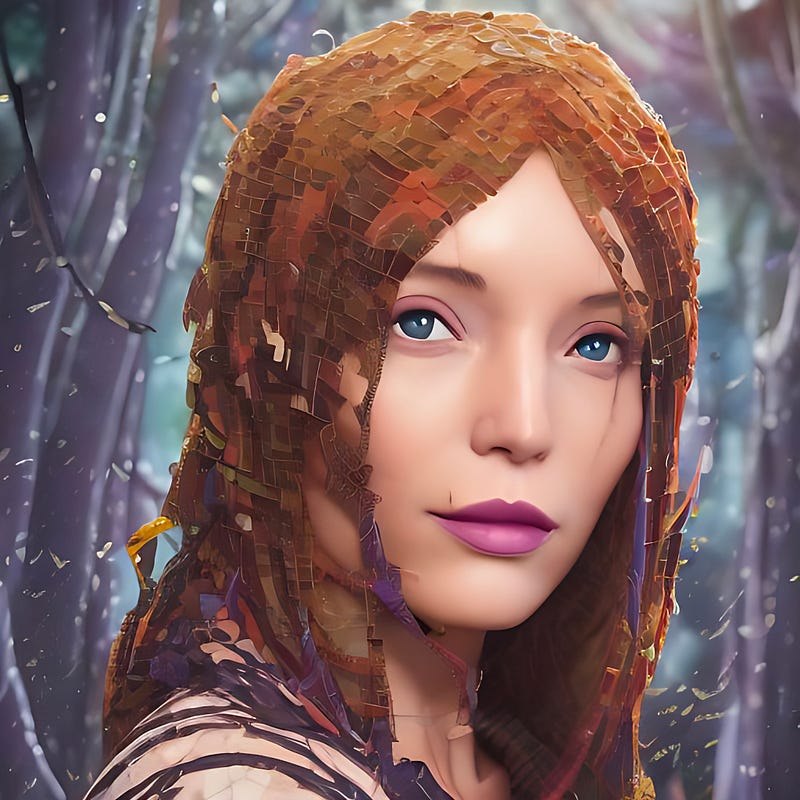
Unless you have been living under a rock for the last few weeks, you must have come across lots of artistically designed selfies or portraits of your friends in their social media feeds.
I was curious about this new phenomenon and quickly found out that an app called Lensa could generate these well-designed selfies or what they refer to as “magic avatars”, at a reasonable cost. I immediately thought it was a great Christmas gift idea for members of my family.
Now, if you’ve read a few of my stories, you’ll know that I’m a Black woman married to a white man. We have two mixed-race children. Basically, in my household, we are Black, brown, and white, and Lensa definitely treated us differently based on the color of our skin — and not at all in a good way, for me as a Black woman. Let me tell you why.
I did a free 7-day trial with the app and brought a discounted $3.99 pack of 110 magic avatars each for my white husband, my mixed-race son, and one each for my mother and me who are Black.
So my white husband’s avatars turned out great. They actually resembled him. I offered to print out one in high quality for his Christmas gift and he couldn’t quite choose only one. Out of 110 magic avatars, 100 of them really looked like him. So basically, for him, a white man, this experiment was a resounding success.
It was the same for my son who is mixed-race and is pretty fair at this time of year. Here again, the avatars resembled him so incredibly well. He looked regal, dashing, and handsome. Out of the 110 magic avatars ordered, all of them look like him.
I am currently writing an afro-futuristic book in which my son is the main protagonist. He plays the role of a heroic freedom fighter. The image I conjured in my mind while writing the book perfectly fits several of his magic avatars. In short, one of them will now definitely be on my book cover.
Contrary to my husband and son, when I ordered the magic avatar pack for myself, I couldn’t believe what I received. Yes, there were some that looked like me, but they were really very few, about 20 of 110 pics in the pack. The other pics had one or two of my features affixed to a face with caucasian features. Even worse in some of the selfies, my skin tone was changed to white. Like wtf? I was not impressed.
I thought I had just had some bad luck and so I tried again, but this time with my mother’s selfies. I was shocked. There were literally only 5 of the magic avatars that looked like her. In most of the others, her eyes were all over her face, and her face was in a constant grimace in almost all of them despite me inputting selfies of her smiling.
It just seemed that the app did not know what to do when faced with a Black face. It just randomly spewed out 100 selfies of people that barely resembled my mum. Again some of these people were Black and some were white. They were people for sure, but they weren’t her. How does one explain that on a white or fair face, the app works well, but when one puts in a Black face, one gets rubbish, stuff that barely resembles oneself?
I basically felt the whole thing was a scam and it made me angry. Right this moment, my mum is eagerly awaiting her avatars, I don’t have the courage yet to tell her that the racist artificial intelligence behind Lensa hasn’t reproduced her gorgeous eyes, high cheekbones, and beautiful full lips. What they’ve done is re-create someone that isn’t my mother — from a mental health perspective, this is jarring.
I went online and put two words into my search engine: “Lensa” and “racism”, and some interesting articles came up. If only I had done my research before, it would have saved me from getting crappy AI images that distorted my face — in some I literally look like a cyborg, and as much as it pains me to say, this has really affected me.
Yes, the fact is that as a Black person I hardly see myself represented in art. It’s something that I have struggled with all my life. With Lensa, I thought that I could surround myself with photos of beautiful Black people. I wanted to quench my thirst to surround myself with images of people that looked like me, I wanted drawings of my mother and sisters. With the rubbish avatars that the app sent me, I realize that I have yet again been cheated of this opportunity. Like, why is the world like this? Why do Black people always get the short end of the stick, why?
As a Black person is it too much to ask to get accurate, nice, beautiful portrayals of myself like my white husband and white friends? Why am I again denied something good because of the color of my skin?
I know some will say that I am taking this too seriously and that I should just relax, but if you are thinking that, please ask yourself this one question:
Why can’t Black people be treated the same way as white people? Why do we face racism daily — the old lady that clutches her handbag when she crosses a Black person on the street, a Black person who struggles to find employment, or the total lack of service at a restaurant? Why are our lives sometimes a version of hell on earth?
If anything though, this Lensa experience shows me that artificial intelligence does not know Black people and this is worrying because many of the tools we use in today’s world rely on it — i.e. facial recognition apps, the faucet to wash hands that one finds in many washrooms today, and so many other things.
AI is also increasingly being used by law enforcement. If this technology can’t recognize a Black face or makes a Black face seem threatening and menacing like it did my mum, that could spell dire consequences for Black people.
Maybe white people don’t care about this because it might not affect them directly, but to stop racism, as a society, we need to do something to fix AI algorithms that are not representing Black people correctly. We need to do this before we get to the point of no return.
Thank you for reading my perspective.


