avatarSimon Spichak

Free AI web copilot to create summaries, insights and extended knowledge, download it at here

2901

Abstract

he weird mismash of platypus body parts (Photo: <a href="http://digitalcollections.nypl.org/items/510d47d9-5118-a3d9-e040-e00a18064a99">New York Public Library</a> ! In the Public Domain)</figcaption></figure><p id="025f">In the late 19th century, the people hunted the platypus to retrieve its organs, <a href="https://books.google.ca/books?id=fZVfBgAAQBAJ&amp;dq=robert+knox+platypus&amp;source=gbs_navlinks_s&amp;redir_esc=y">preserving and shipping them to European anatomists</a>. British anatomist Everard Home of the Royal College of Surgeons in London noted that it had reptile-like sex organs and a duck-bill organ that sensed electricity in the environment. Using this sensory organ it night, the platypus closed its eyes as it dived in search of food. <a href="https://www.atlasobscura.com/articles/why-19th-century-naturalists-didnt-believe-in-the-platypus">Anatomists debated if it was a mammal, a bird or something altogether new</a>. Even Charles Darwin was intrigued by this strange animal.</p><p id="cd28">While the platypus didn’t have visible teats or nipples, figuring out whether it nursed its young with milk would help determine if it was a mammal. Several decades after discovery, scientists did not even know whether the platypus gave birth to live young like mammals. There were rumours that the platypus laid eggs, but nothing was certain. Studying the platypus became more challenging as they continued being slaughtered in <a href="https://books.google.ca/books?hl=en&amp;lr=&amp;id=b-_RAAAAMAAJ&amp;oi=fnd&amp;pg=PA1&amp;ots=bpj0_xoQ-m&amp;sig=bM3Z8EZ_NqNPkzB7kjhTxRe2OkA&amp;redir_esc=y#v=onepage&amp;q&amp;f=false">high numbers</a>:</p><blockquote id="611a"><p>Many of the Australian quadrupeds and birds are not only peculiar to that country, but are, even there, of comparatively rare occurrence: and such has been the war of extermination recklessly waged against, that they are in a fair way of becoming extinct. (<a href="https://books.google.ca/books?hl=en&amp;lr=&amp;id=b-_RAAAAMAAJ&amp;oi=fnd&amp;pg=PA1&amp;ots=bpj0_xoQ-m&amp;sig=bM3Z8EZ_NqNPkzB7kjhTxRe2OkA&amp;redir_esc=y#v=onepage&amp;q&amp;f=false">Bennett 1860, p. vi</a>)</p></blockquote><p id="9db1">Incredibly, in <a href="https://academic.oup.com/bioscience/article/49/3/211/242550">1833 George Bennett found that they still produce milk for their young</a>! Milk released through its pores is collected in bowl-like abdominal ridges. So the platypus has built-in bowls that allows their young to drink milk. Weirder, it turned out that rather than giving live-birth like other mammals that provide milk to their young, they laid eggs. The eggs had a yolk, like a bird’s egg, but the yolk isn’t divided into separate cells. So the platypus laid bird-like eggs. Even stranger, the embryos began development while the egg was still in the uterus and matured after being lain. <a href="https://www.scien

Options

tificamerican.com/article/extreme-monotremes/">They were classified as mammals in the order <i>Monotremata, </i>becoming one of the few egg-laying mammals.</a></p><p id="fed4">The platypus only became more wonderfully absurd the more that we studied it. Advances in technology allowed us to <a href="https://www.nature.com/articles/nature06936">sequence the platypus genome in the 2000s</a>. Over 360 million years ago, the distant relatives of the platypus were classified as amniotes. Interestingly these amniotes evolved and diverged into reptiles and birds through one lineage, while the other lineage formed mammal-like reptiles. These eventually lost some of their reptile-like lineage, evolving into different classes of mammals.</p><p id="9778">They found mammalian genes involved with sensing odours as well as reptilian genes such as those involved in laying eggs. The platypus also had five pairs of sex chromosomes, with males having 5 X and 5 Y. These sex-determining chromosomes showed more similarities to birds, which also have multiple pairs. <a href="https://www.discovermagazine.com/planet-earth/the-platypus-can-poison-you-80-different-ways#.VxZ3rGPsP-Y">Even the 80 toxins in the platypus spurs’ evolved from many different lineages</a>. Somewhere along the way, they also picked up their ability to sense electric currents with their beak. We are still learning a lot more about these strange animals every day.</p><p id="d66c">Recently, scientists discovered that platypus fur is biofluorescent. Lead author Dr. Paula Anich described this <a href="https://www.nationalgeographic.com/animals/2020/11/glowing-platypus/">surprise</a>: <i>“I was a little flabbergasted to [see] the platypus is biofluorescent.” </i>After finding that flying squirrel pelts were biofluorescent, she wondered what other animals possessed this ability. <a href="https://www.degruyter.com/view/journals/mamm/ahead-of-print/article-10.1515-mammalia-2020-0027/article-10.1515-mammalia-2020-0027.xml">Platypus fur absorbed wavelengths of ultraviolet light, emitting a blue-green glow.</a> It is unclear why the platypus shows this ability or what it might use it for.</p><p id="a7c8"><b>So far we’ve discovered many fascinating details about the duck-billed platypus:</b></p><ul><li><b>They sense electrical currents with their bill.</b></li><li><b>Males have venomous spurs with 80 different toxins</b></li><li><b>They lay eggs with a partially developed embryo</b></li><li><b>Their body has ‘built-in-bowls’ allowing their young to drink milk from their abdomen</b></li><li><b>They have five pairs of sex chromosomes</b></li><li><b>They are biofluorescent</b></li></ul><p id="fd95"><b>We must continue preserving these wonderful animals as well as their habitats to allow them to thrive, so that we may learn from them. What other secret knowledge does the majestic platypus hold?</b></p></article></body>

The Weird Egg-Laying Mammal that Glows Under Blacklight

A brief history of the incredibly absurd duck-billed platypus and its many abilities
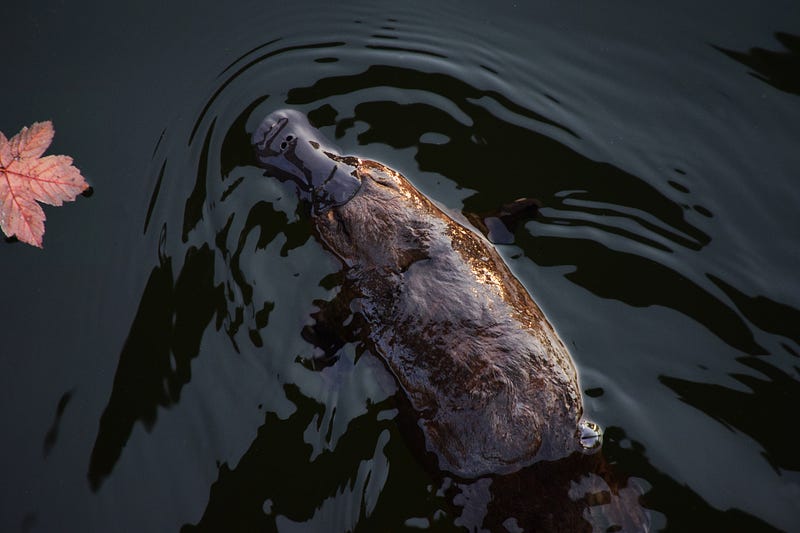
Photo by Meg Jerrard on Unsplash

Have you ever felt something was too strange to be real? Over 200 years ago, biologist George Shaw received a specimen from New South Wales that left him perplexed. He even tried to snip off some fur around the beak, expecting to see the evidence of stitches and fraud. Despite how strange this specimen was, he did not find any evidence it was a fraud. Describing it in a scientific journal, he wrote:

Of all the Mammalia yet known it seems the most extraordinary in its conformation; exhibiting the perfect resemblance of the beak of a Duck engrafted on the head of a quadruped.

George Shaw was rightfully skeptical as hoaxes were all too common. After all, the duck-billed platypus was a strange sight to behold, perhaps enough to be an elaborate hoax. In the 18th and 19th centuries, many anatomists and biologists fell for frauds. Johann Beringer fell prey to fake fossils thought to be planted by his colleagues. Notable swindler and grifter P.T. Barnum showed off the Feejee Mermaid. This ‘mermaid’ was created by sowing together body parts from a monkey and a fish.

Though there was initial doubt, more specimens kept arrived over the next few decades. It would be almost impossible to pull off such an elaborate hoax. Stitching together the fur and bones of different animals would be too simplistic an explanation for the platypus. Their abnormal physiology was unlike anything they’d seen before. Was it a result of two very different animals mating? If not, how in the world did it evolve?
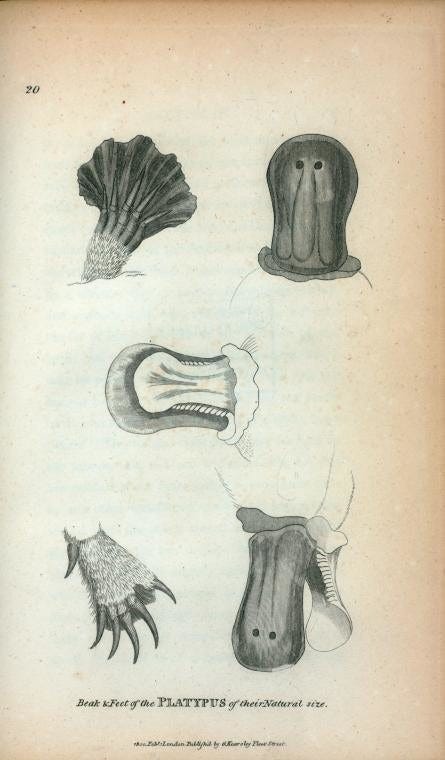
George Shaw’s illustration of the weird mismash of platypus body parts (Photo: New York Public Library ! In the Public Domain)

In the late 19th century, the people hunted the platypus to retrieve its organs, preserving and shipping them to European anatomists. British anatomist Everard Home of the Royal College of Surgeons in London noted that it had reptile-like sex organs and a duck-bill organ that sensed electricity in the environment. Using this sensory organ it night, the platypus closed its eyes as it dived in search of food. Anatomists debated if it was a mammal, a bird or something altogether new. Even Charles Darwin was intrigued by this strange animal.

While the platypus didn’t have visible teats or nipples, figuring out whether it nursed its young with milk would help determine if it was a mammal. Several decades after discovery, scientists did not even know whether the platypus gave birth to live young like mammals. There were rumours that the platypus laid eggs, but nothing was certain. Studying the platypus became more challenging as they continued being slaughtered in high numbers:

Many of the Australian quadrupeds and birds are not only peculiar to that country, but are, even there, of comparatively rare occurrence: and such has been the war of extermination recklessly waged against, that they are in a fair way of becoming extinct. (Bennett 1860, p. vi)

Incredibly, in 1833 George Bennett found that they still produce milk for their young! Milk released through its pores is collected in bowl-like abdominal ridges. So the platypus has built-in bowls that allows their young to drink milk. Weirder, it turned out that rather than giving live-birth like other mammals that provide milk to their young, they laid eggs. The eggs had a yolk, like a bird’s egg, but the yolk isn’t divided into separate cells. So the platypus laid bird-like eggs. Even stranger, the embryos began development while the egg was still in the uterus and matured after being lain. They were classified as mammals in the order Monotremata, becoming one of the few egg-laying mammals.

The platypus only became more wonderfully absurd the more that we studied it. Advances in technology allowed us to sequence the platypus genome in the 2000s. Over 360 million years ago, the distant relatives of the platypus were classified as amniotes. Interestingly these amniotes evolved and diverged into reptiles and birds through one lineage, while the other lineage formed mammal-like reptiles. These eventually lost some of their reptile-like lineage, evolving into different classes of mammals.

They found mammalian genes involved with sensing odours as well as reptilian genes such as those involved in laying eggs. The platypus also had five pairs of sex chromosomes, with males having 5 X and 5 Y. These sex-determining chromosomes showed more similarities to birds, which also have multiple pairs. Even the 80 toxins in the platypus spurs’ evolved from many different lineages. Somewhere along the way, they also picked up their ability to sense electric currents with their beak. We are still learning a lot more about these strange animals every day.

Recently, scientists discovered that platypus fur is biofluorescent. Lead author Dr. Paula Anich described this surprise: “I was a little flabbergasted to [see] the platypus is biofluorescent.” After finding that flying squirrel pelts were biofluorescent, she wondered what other animals possessed this ability. Platypus fur absorbed wavelengths of ultraviolet light, emitting a blue-green glow. It is unclear why the platypus shows this ability or what it might use it for.

So far we’ve discovered many fascinating details about the duck-billed platypus:

  • They sense electrical currents with their bill.
  • Males have venomous spurs with 80 different toxins
  • They lay eggs with a partially developed embryo
  • Their body has ‘built-in-bowls’ allowing their young to drink milk from their abdomen
  • They have five pairs of sex chromosomes
  • They are biofluorescent

We must continue preserving these wonderful animals as well as their habitats to allow them to thrive, so that we may learn from them. What other secret knowledge does the majestic platypus hold?

Science
History
Nature
Discovery
Technology
Recommended from ReadMedium