
The Weight of Memories
Sifting Through Tombs of Time
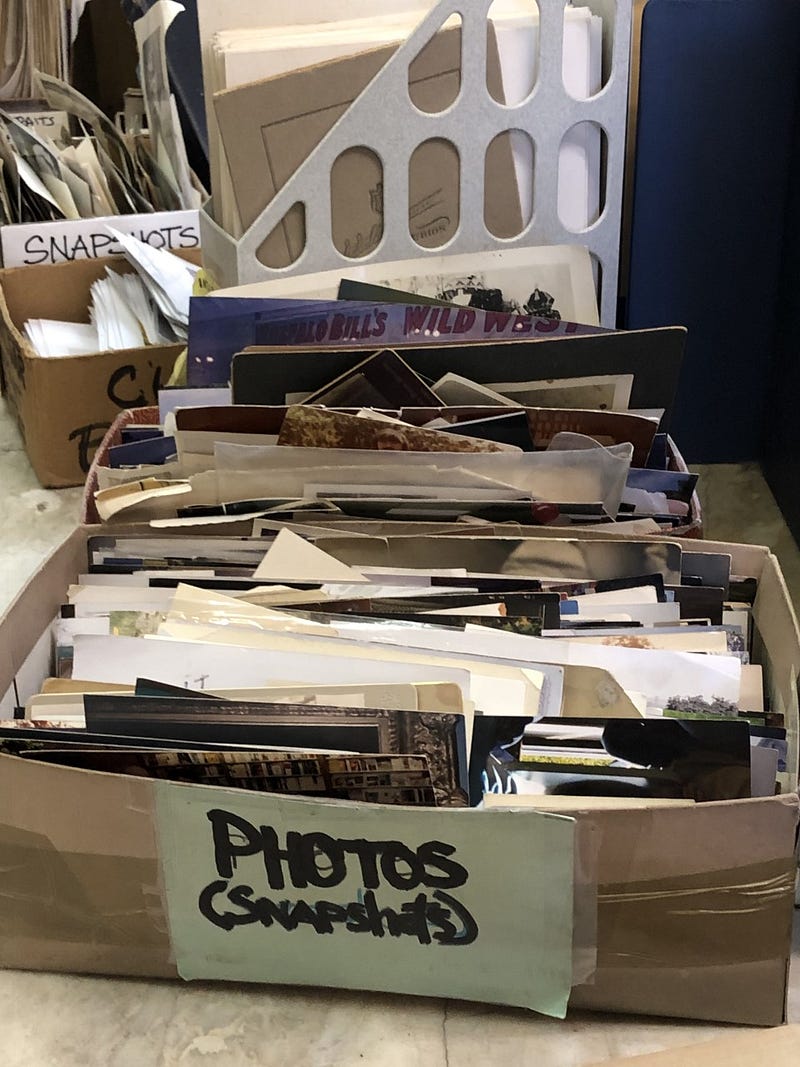
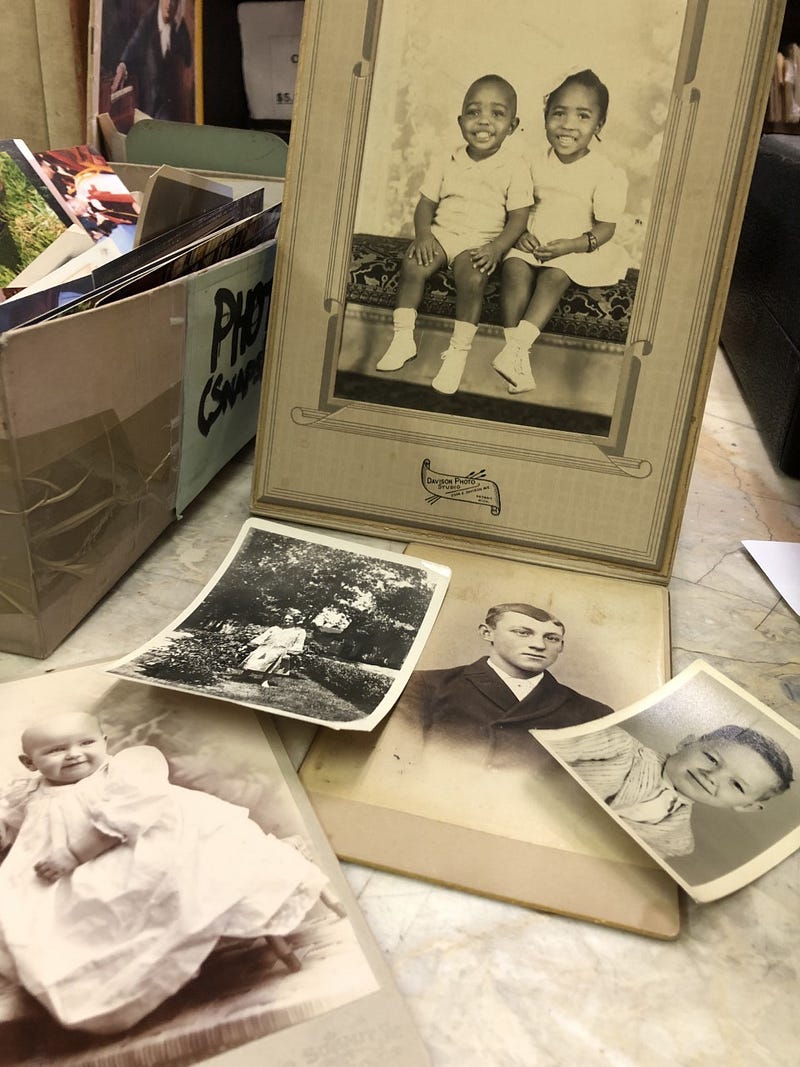
When I was in college, one of my favorite ways to escape my roommates on a rainy Saturday was to visit an antique store in Mt. Pleasant’s downtown district. I’d grab my umbrella, a little cash for a snack, and leave the dorm room drama behind. I always found something little to buy: An antique valentine, a 1960s chunky plastic bracelet or a brittle sheath of turn-of-the-century sheet music. I loved looking at the old tintype photographs in their yellowed cardboard stands. Sometimes, I’d buy one or two and use them for writing prompts. They always made me feel a little sad, though.
Who had these people been? Where were their loved ones? How did they end up abandoned and nameless in musty shoeboxes labeled “2 for a $1?” Was there no one left who loved them?
“The worst part of holding the memories is not the pain. It’s the loneliness of it. Memories need to be shared.” ― Lois Lowry, The Giver
“I need you girls to go through your mother’s walk-in closet,” my father says. My sister is a magician who performs a disappearing act every time I make the four-hour trip to visit my dad. She listens silently on the phone’s speaker. An hour later, she calls to explain about her sudden migraine and how she ran out of Ritalin for the boy child, and that she just can’t make it today.
My father’s new wife sits in my mother’s favorite chair in the sun room and explains how it isn’t her place to go through my mother’s papers and boxes.
It begins with the burgundy-red housecoat. Once a plush polyester velour, the elbows have been rubbed threadbare by mom’s many hours in her recliner watching Law & Order. After she died, my father lay her housecoat on her side of the bed every night and fell asleep clutching it like a teddy bear. Now he asks if my sister or I can make use of it. In the middle of her world-famous disappearing act, my sister can not answer for herself. For a brief moment, I imagine telling my father that she would really treasure it. I picture myself handing it to her, saying, “Dad wanted you to have this.” But one look at my father’s face, and I know that’s not a good idea.
“I don’t know what to do with it. I can’t just throw it away.” His voice cracks. He hands it to me, and I promise to find a home for it. “She was wearing it when she died,” he reminds me.
“I know,” I say, and I swallow the hard knot of grief at the base of my throat that is threatening to choke me. I set the housecoat of death on the foot of the bed as he digs into a bin of my mother’s papers. He fans out thirty-one funeral brochures. Her face smiles up at me.
“I can’t just throw her away,” he whispers.
“Doing okay in there?” the new wife calls.
“Just let me do this,” I tell him. His shoulders sag as I hug him. At seventy-six, muscles still ripple underneath his Fruit-of-the-Loom work shirt; he leaves to pour coffee and watch the woodpeckers make a mess of the birdseed in the feeder outside the sunroom window.
I reach for one of the black garbage bags and channel the last episode of Hoarders I’d watched in a late-night stupor the week before. Three piles: Keep, donate, trash. The housecoat of death begins the trash pile. I bury the funeral brochures under it so her face is hidden.
The sorting goes quickly at first. She had saved every obituary card from every family funeral over the last 60 years. As I toss them into the trash pile, I marvel at how little funerary stationery has changed over six decades. My pace quickens as I make my way through the first bin. Thirty-year-old newspaper clippings? Trash. Fifty years of birthday cards? Trash. A costume jewelry rhinestone pin missing one crystal? Donate. A four-generation photo of the women in my mom’s family? Keep.
Every anniversary card my father has ever given her? Pitch. Wait. One of the cards flips open, and I read my father’s old-fashioned cursive: I will love you forever. He has underlined important words. The next card has a sappy poem about soulmates, and he has written You are the love of my life. My chest tightens, and my heart flops around in its cage like a broken-winged bird overcome with its longing for a piece of sky blue and never-ending horizon. I shove the cards under the shiny-elbowed housecoat before I can read another. His words are too close and too private.
I watched my father care for her after she was finally diagnosed with Alzheimer’s. It was a brutal verdict, delivered with clinical professionalism. Its possibility had terrorized her for years as she cared for her own mother whose mind had descended into oblivion years before. He cut up the chicken breast on her plate so she wouldn’t choke on it and reminded her to put on her socks first and then her shoes. Every night, he told her that he would take care of her, “Don’t worry. I’m here.” They held hands as he helped her toddle off to bed, and I looked away, as if I’d walked in on them in the throes of passion. Too close. Too private. Too real.
I reach into the bottom of the bin and pull out piles of Kodak photos rubber-banded together. She had written the occasions and years on pink strips of paper in her perfect teacher script: Christmas 1978, Tracy’s confirmation 1982. These go in the keep pile. I put the housecoat and its secrets into the Hefty trash bag before calling out to my father, “I’m finished!”
He stands in the doorway, holding his coffee mug in one hand as he leans against the molding.
“You did all of the bins?” he asks.
“There’s more?”
He points to the high shelf at the top of the closet. There are six more, two of them marked “Xmas angels.”
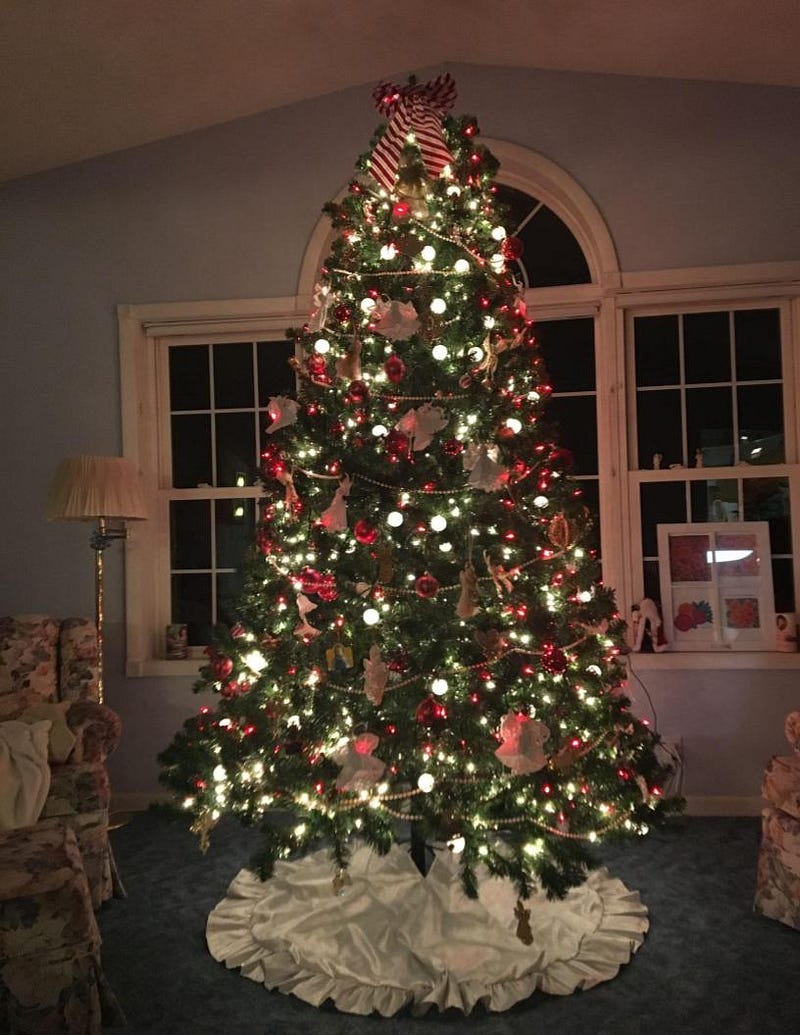
My father dislikes Christmas. He is a fastidious man who abhors disorder and change. She used to argue with him every year about hauling the eight-foot Christmas tree and the endless bins of baubles, angel’s hair trim and tangled twinkle lights out of storage. Her last Christmas, he brought them out without putting up a fight, and we lined up ready to dive in. Suddenly cognizant, she stood up from her recliner, marched into her bedroom, then came out dressed in jeans and a sweatshirt. She put her hands on her hips and ordered, “Let’s get this party started.”
We obeyed and sprang into action. We fussed with the fake tree branches, untangled the lights and watched as she hung each ornament in the same spot until the tree began to lean to the right. Just as quickly as the festivities had begun, they were over.
“I’m tired,” she announced.
“Do you need to take a nap?” he asked her.
“Where’s my housecoat?”
He kissed her hand. “You’re my girl,” he said as he led her into the bedroom to change back into her burgundy uniform.
My sister and I redistributed the ornaments before the tree toppled onto the floral loveseat. I could hear him singing “Strangers in the Night” to her through the closed door. Moments later, he helped her nestle into her fleece blankets and pillows. Law & Order music blared from the living room. He hid the tv remote on top of the piano.
I open the second bin after a sweat-popping, acrobatic struggle to wrangle it from the high closet shelf. My father has returned to his birds, coffee and wife. I snap open the lid. Another pink paper, bigger this time. It says “Tracy’s things.” Underneath it, she has bundled twelve piano recital programs. I played “The Spaceman’s Walk” in the spring of 1978. I set the programs in the “Keep” pile, although I’m not sure why.
Next is a pile of report cards, stiff cardstock in institutional brown jackets. Year after year, my teachers noted that I talked too much in class. I remember countless recesses writing hundreds of sentences designed to cure me of that fault. Carefully, I unfold a brittle sheet of 1970s kindergarten drawing paper. A family portrait. Mom with a big bowling ball stomach (my sister). Dad. Me. My dog Holly. I used as much orange, yellow and sky blue as possible. Funny how some things don’t change. They’re still my favorite colors. I scan the rest of the box’s contents. She has catalogued my entire childhood within this box.
The last Hoarders episode flashes in my mind, and I set my box aside. Pawing further through its contents would be like Alice-in-Wonderland falling down the rabbit hole. My sister’s bin is just a full as mine. I set it aside.
The next bin reveals her life before the history of our nuclear family had begun. She archived faded college photos of young bee-hived women wearing pencil skirts and cat-eye glasses or matching night gowns and robes, their hair set in bristle-cone rollers with pin-curls taped down in front of their ears with pink hair tape. Looking at them, I can almost smell the Dippity Do hair gel.
In one exuberant photo, she looks directly into the camera, her mouth partially open, ready to belt out the chorus of “Puff the Magic Dragon” to the lab school third graders seated in front of her. She cradles her ukulele to her chest.
My earliest memory of my mom is of her voice. She had a soprano voice that soared over top of the entire Lutheran church congregation on Sunday mornings. I’ve listened to recordings of the church services, and I’m not exaggerating. I remember snatches of the songs she sang to me as a child. It’s funny. Most people can remember favorite childhood books and stories that were bedtime rituals. Some can still rehearse portions of Good Night Moon and Blueberries For Sal. I know I was read to, but I don’t remember the books. I remember the songs. She was always singing to me, “Little Rabbit Foo Foo,” “Froggy Went A-Courting,” and “The Orchestra Song.”
As I grew older, her big voice embarrassed me. One Sunday morning, I crawled under the pew to escape the attention of the other kids who were staring at her as she belted out “Onward, Christian Soldiers.” She hauled me up by my elbow and hissed, “Sing.” I was old enough to know better than to try that maneuver in church.
Now, I miss it and listen to a carefully hoarded voicemail of my mother and father singing “Happy Birthday” to me the year before she died. In the recording, they start out strong, but when my mom tries to harmonize with my dad, she gets him off track, and the song disintegrates into a mix of warbling laughter.
In the next bin, I find Geraldine, my grandmother, who bequeathed her WWII love letters, war-time ration books, delicate handkerchiefs edged in knitted lace and albums of black, white and gray photos arranged chronologically in albums with embossed covers. My mother inherited these and treasured them, along with envelopes stuffed with Gerri’s report cards from the 1930s, grocery lists scrawled out on receipts, and journals she kept on every road trip she made with her sister, Rachel. She wrote long and hard about following Laura Ingalls Wilder’s pioneer path and about visiting her own family farm in Minnesota.
When I take the cover off the final bin, I discover, Reba, my great grandmother. Reba of the thick ankles fame who bewitched my great grandfather until he could see no other woman but her. Reba bequeathed hayfield photographs of her turn-of-the-century friends in overalls and pageboy haircuts, their names long forgotten. She saved baby booties that were knitted for her by her own great grandmother, along with yellowed baby bonnets embellished with handmade lace. I find faded ribbon sachets that lost their scent a hundred years ago.
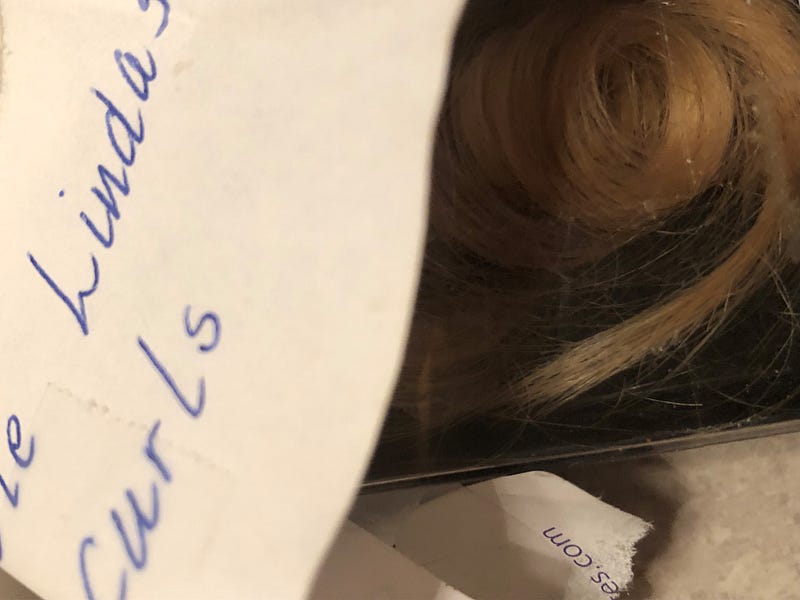
Both bins contain locks of hair tied with delicate pink ribbons labeled, “Linda’s hair” and “Geraldine’s locks.”
The women in my family hoarded their memories in shoeboxes, albums and creased envelopes. In the end, each one of them lost their mind. Reba became senile in old age. She marked the time on her Judy Garland calendar. She gave whiskery kisses to her great grandchildren, although I suspect she wasn’t sure who she was kissing. Someone was there, and that was enough.
Gerri faded over time, like the print on the war-time telegram that announced that my grandfather was coming home to stay. Once a teacher with a sharp wit and wicked domino-playing skills, she cycled through conversations like she was learning her lines for a community theater production. “Alzheimer’s” was whispered, and in the end, when she couldn’t speak anymore, we crowded around her in the care home and sang hymns and Christmas carols to her. She smiled and batted her eyes at my father. She still knew a handsome man when she saw one.
And then, my mom, Linda. “Alzheimer’s” wasn’t whispered. She secretly suspected long before she kept the doctor’s appointment we begged her to make. After it was said out loud, she cried. While her mother’s disease was slow and steady, her own was like a series of tsunamis. Each of my weekend trips home became part of my grieving process. A little more loss every time, and I cried the entire four-hour trip home, mourning the loss of laughter, loss of connection, and eventually, the loss of her life.
Cleaning out three generations of memories is haunting. Three women who treasured their lives enough to chronicle them with baby bonnets, photos, love letters, journals, report cards, telegrams and locks of hair lost their memories in the end. The weight of their memories is heavy.
Sifting through their memory tombs like a middle-aged Howard Carter, I have to ask: How does one cope? How does one make room for their own life story? How does one purge?
What does one keep?
“To truly cherish the things that are important to you, you must first discard those that have outlived their purpose.” -Marie Kondo