
The water’s edge
Times and tides of Corio Bay
I live a few hundred metres from Corio Bay, an arm of Port Phillip, in Victoria, Australia.
It’s a quiet, unassuming body of water, shallow and fringed by low hills, crumbling marl and limestone cliffs and windswept saltmarshes. At its western end lies the busy industrial and commercial hub of Geelong, with its oil refinery, its elegant waterfront, shops and restaurants. To the east, it opens into Outer Harbour, and thence into the broader expanse of Port Phillip.
Twelve thousand years ago, Corio Bay (Jillong) was part of the vast floodplain of the Barwang, where it flowed into the Yarra Yarra. The grassy basin was drowned by rising seas after the last Ice Age, creating an extensive shallow bay, whose rich seagrass beds nurture the young of countless fish and other sea creatures.
Two hundred years ago, the only humans to walk Jillong’s reedy shores were the Wadawurrung people of the Kulin nation. Custodians of this land, they harvested seafood, hunted kangaroo and wallaby, trod lightly at the water’s margins, gently shaped the land with firestick and digging stick. They called the bay Jillong and the land where Geelong now lies Coraya.
In the 1830s came the busy whitefellas: the explorers, the squatters with their sheep and cattle. The convicts and the chancers, the entrepreneurs with their get-rich-quick schemes. In the 1850s came the Victorian Gold Rush.
Somewhere along the line, the names Jillong and Coraya were switched: Jillong is now Corio Bay; Coraya is now Geelong.
Call her what you will: I love her.
Today our bay is fringed by industry and plied by commercial shipping, yet not too-much spoiled.
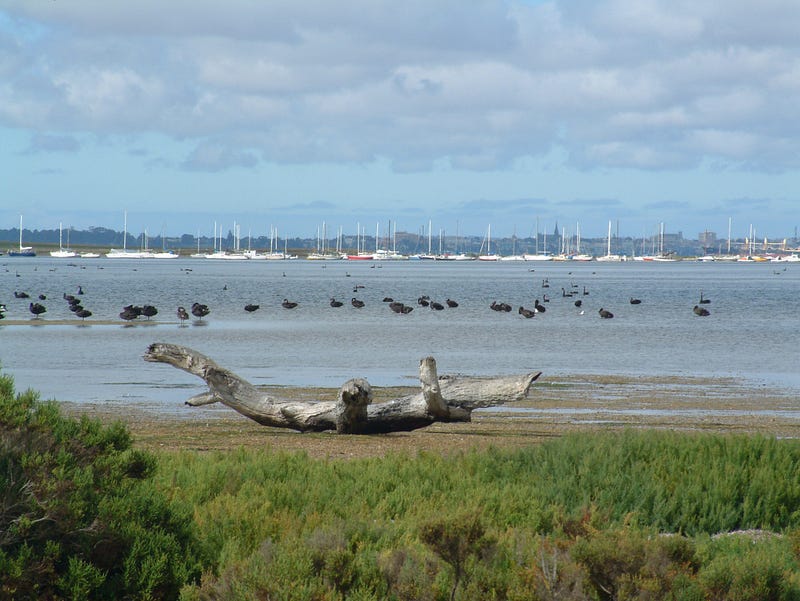
She’s still home to fairy penguins and fur seals. Sea eagle and cormorant, gannet and pelican still wheel in her skies and fish her rich waters. Fleets of black swans sail the shallows. Winter may see a rare visitor from the stormy Southern Ocean – a black browed albatross, maybe, or a young male elephant seal.
On a bright, sunny day (the usual kind in these parts) our resident dolphin pod may cruise off the busy Geelong waterfront. From the bluestone breakwater a rakali dives happily for shellfish and an egret stalks baby mullet, as townspeople and tourists stroll by oblivious, metres away.
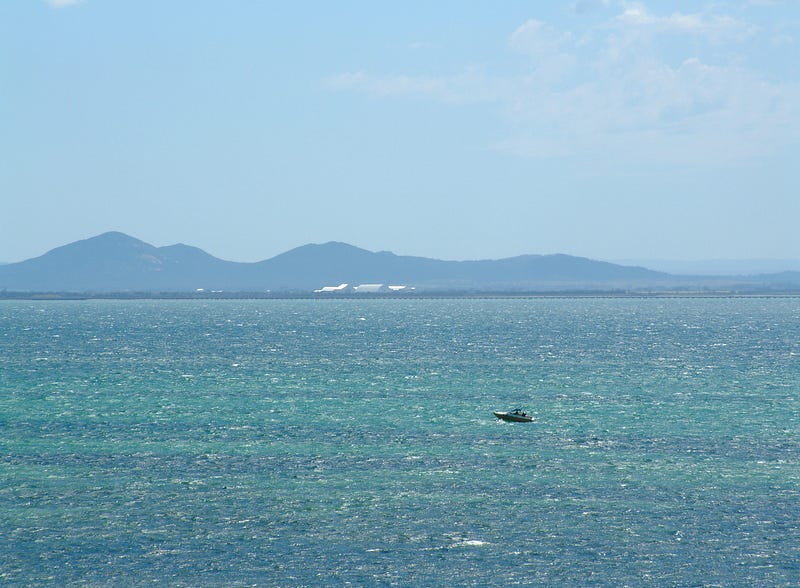
On my morning clifftop walk I see alternate bands of turquoise and ultramarine, as the sand banks give way to deeper water and the shipping channel. Across the bay rise the low but striking peaks of the granitic You Yangs. Only three hundred metres high — but the nearest thing we have to mountains in these parts.
Some days the bay is like a mirror. I’ve glided effortlessly across its surface in my canoe and marvelled at the clarity of the water — water sometimes so clear you can almost feel that your boat is suspended in mid-air. I’ve lain aboard my little yacht bobbing at anchor and let the gentle waves rock me to sleep.
Yet she has teeth, too, our quiet pocket of sea, and you’d be wise to respect her. When one of our famous Cool Changes comes through with a ruler-straight edge of cumulus advancing from the west, and 40-knot winds whipping the sea white, you’d do well to be safely ashore.
Text and images © 2021 the author. All rights reserved.