
The War of the Worlds (BBC miniseries)
A great adaptation of the novel by Herbert George Wells
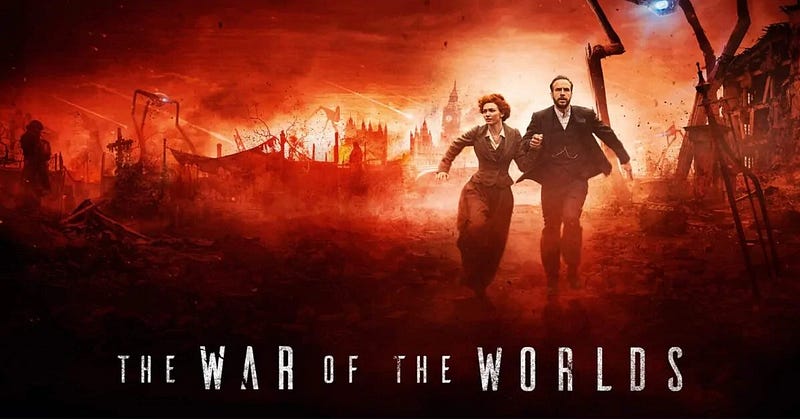
This BBC miniseries from 2019 (directed by Craig Viveiros and produced by Mammoth Screen), set in the Edwardian period, is yet another adaptation of the novel by Herbert George Wells (published in 1898) and consists from three episodes of about an hour.
It is considered one of the most faithful transpositions of the book both because of the historical setting (despite being set a few years later, in 1905), which further highlights humanity’s impotence in the face of an alien invasion, and for the narration of events itself.
What is added to the original plot is the personal story of the two protagonists, Amy and George, who live together despite the fact that they are not married and that he is unable to obtain a divorce from his wife. These two only partially replace the narrator of the book and his wife, however shifting the attention to the female character, who was completely marginal in the original text. They are played by Eleanor Tomlinson (already seen in Poldark in the role of Demelza and in The Pemberley Mysteries) and Rafe Spall (son of Timothy Spall; seen in Prometheus, Jurassic World — Fallen Kingdom, and Men in Black International).
Furthermore, the main narrative is intertwined with the one in the future in which we see Amy and her son wandering in the devastated world after the “failed” invasion of the tripods.
Even though I had not read the book, I immediately perceived the Wellsian imprint in the story, starting with the character of Ogilvy, the scientist also present in the novel and here played by the great Robert Carlyle, and continuing with the attempt to a scientific approach, although limited by the knowledge of the time, towards the consequences of the invasion, although this last post-apocalyptic part from the point of view of the female protagonist was added to the original story.
While reading various reviews, I noticed that the main criticisms concern a certain depressing effect of the story, its slowness in some parts, the lack of characterisation due to the limited time of the narrative (which perhaps, therefore, is not so slow) and even the acting skills of the main actors. Someone said it was a missed opportunity.
Well, I don’t agree at all. Personally I greatly appreciated this miniseries, both from a visual point of view and from that of the actors’ performance and the pace of the narrative.
I watched this series in the original language, and as always in these circumstances, this led me to focus completely on the story without the slightest distraction. Furthermore, while watching it, I already knew that the ending would be sad. Some of it was immediately obvious due to the flash-forwards of the protagonist with her son in that hellish setting, and some of it was told to me precisely in these terms.
Faced with all this, however, I just had fun.
I like Tomlinson a lot (I’m a Poldark fan) and I appreciated her performance. And I also liked the way she interacted with Spall and also with the character of Ogilvy and Frederick (Rupert Graves), the co-protagonist’s brother.
The story between the two protagonists, who challenge the conventions of the time, goes perfectly alongside the political problems, which are shown to us at the beginning of the miniseries (with the frictions between the British Empire and Russia), in highlighting how many aspects considered important not only fade into the background, but are completely swept away by the encounter and clash with a species from Mars that intends to eliminate our civilisation and take possession of our planet.
Obviously, the story of the two protagonists offers a further element of conflict that is appreciable by the contemporary public and increases their involvement.
As for the rest, I found both the historical reconstruction and the special effects very effective. Watching the immense tripods move through London at the beginning of the twentieth century is fantastic, precisely because it is completely unusual and yet extremely realistic, and underlines even more the sense of human fragility towards an adversary that is too bigger and technologically advanced to be even just faced. In some ways it mocks the expansionist aims of the British Empire, which feels invincible in the face of any enemy and is instead forced to come to terms with the hard reality.
I particularly liked the part in which Ogilvy, together with the protagonists, begins to study what he believes to be a meteorite and then what happens when the latter wakes up, the shell opens, and we see a sphere inside capable of impressing a reflected image on itself. Not to mention what happens next.
The sense of helplessness of the characters is effectively conveyed to the viewer, as is the fear of the terrifying aliens, particularly in the last episode, when they find themselves hunted by the latter (whose appearance we finally see), and the story takes on horror nuances. Here the dramatic element reaches its peak, and the inevitable sacrifice has a very strong effect due to the involvement it creates in the spectator.
The part set in the post-apocalyptic future, with which the series ends, actually has something depressing about it. I, in particular, don’t like post-apocalyptic stories for this reason. Even from a visual point of view, it seems it wants to oppress. But everything is saved by the bittersweet ending, which gives rise to hope in the protagonist, and in the spectator.
I close with a quirk. Although this version is faithful to the novel in many parts, there is another version in the form of a film which seems to be completely faithful. It was produced in 2005 in the wake of the concurrent release of Spielberg’s film starring Tom Cruise and Dakota Fanning. This is “The War of the Worlds” by Timothy Hines. There have been numerous other adaptations of this work, ranging from the first very famous radio show by Orson Welles (1938), through musicals and video games, up to comics (including Mickey Mouse in Italy), as well as obviously films and TV series. An almost complete list is available in an article dedicated to it on Wikipedia.
Here is the original trailer for the series.
This article is taken from a phantom episode of FantascientifiCast (Italian podcast about science fiction), recorded in 2020 but never released.


