
ESSAY
The Waist to Take in a Single Hand and The Hip Like a Cartwheel
Sri Lankan poetic cultural references in describing the beauty of a woman
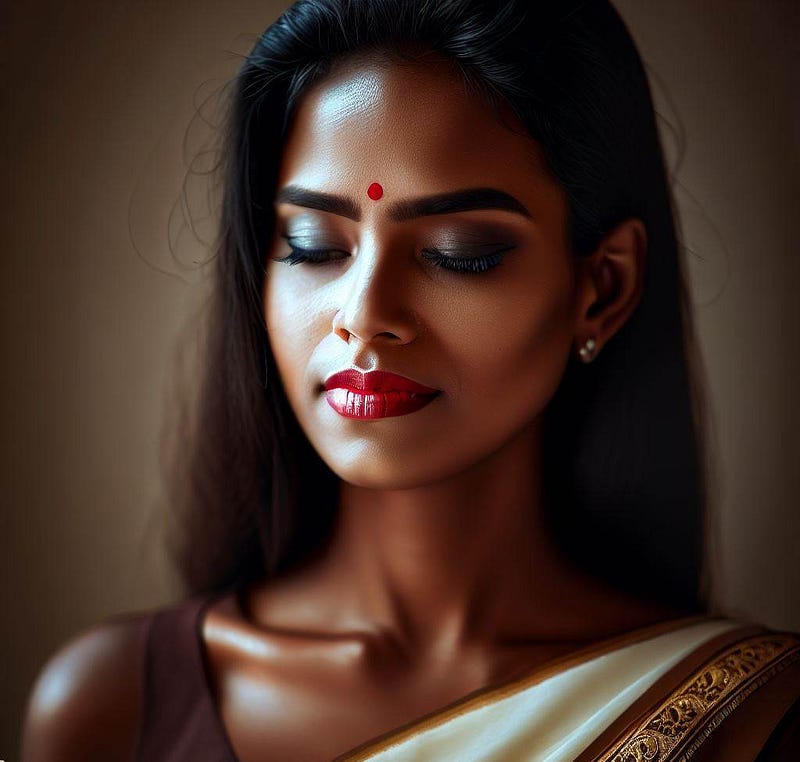
I recently came across an interesting post from a writer that described his princess of the heart beautifully. The author, a very talented guy, did an excellent job. The poetic expressions used by the author compelled me to discuss how, in our culture, writers and poets described women in their works.
Please understand that this is not about body shaming or enforcing anything else. The pure intention is to discuss the historical use of poetic language to describe women’s physical attributes and how these descriptions were influenced by cultural values.
Our society always admires women’s beauty openly, and it is not considered a taboo subject. However, some examples I will discuss may be regarded as extreme based on today’s standards. I ask for forgiveness in advance if I cause an inconvenience to anyone.
First, let’s talk about the hair, the long black hair. Our earlier generation’s writers considered it as beautiful as a flower cluster of the Kithul Tree. The flower cluster shares similar properties of thick, long, and dark in color, justifying their selection for comparison.
Next, we have forehead & face. Our ancient poets found similarities to the crescent and full moon, respectively. It may seem unusual for the forehead, but I can understand its reason. In our culture, having a wider forehead was considered a sign of good intellectuality. And the full moon reference seems to be a universal one.
A description of a woman without mentioning her eyes is meaningless. In our culture, beauty comes with blue eyes, so they thought blue gems were a good alternative. And those lips, red in color and thin, are very similar to the young leaves of the Ceylon Ironwood tree. Their white-colored teeth gave the impression of shining, rounded pearls.
The most appreciated body part of a woman is perhaps her breasts. Our writers used to refer to a woman’s breasts as a couple of swans ready to fly. Each term is carefully chosen, especially the “ready to fly” reference.
In addition to the figurative meaning, it also holds a deeper significance. In our culture, a swan is believed to separate milk from water. Giving a swan a mixture of water and milk will drink only the milk part.
I don’t know the truth of this statement. Still, this concept connects with a mother’s breastfeeding, as her breast can separate milk from her body fluids.
A woman’s waist is always described as very thin, such that one can cover its entire circumference with a hand. It may seem impossible and unnatural, but what could I say? It was a standard in those times. When it comes to the hips, they were told to have a rounded shape, like a cartwheel. Don’t look at me; that’s the actual comparison.
If we go further, Female genitalia is believed to share a similarity with the blue color of the Clitoria flower or blue water lily buds. Blue is essential because, in our language, blue is often replaced with a darker color.
The list goes on, describing each body part, but surprisingly, it is not a creepy list. Through poetic expressions, it provides an excellent impression to any reader. There is an accepted theory that you can express even the most explicit ideas in poetic terms without causing any offense.
You know what? A language is considered developed when it can express something poetically. The highest level of this ability is showcased when delicate subjects like the female figure are described. It is safe to say that the Sinhala language achieved this level prior to thousands of years ago.
Even with a language that has a wide range of capabilities to share ideas, not everyone has the fluency to express it. It is a natural talent, one that I wish to possess.
Follow The Hub Publication for practical tips and inspiring stories.