avatarRigópoula T Tsambounieris

Summary

The text is a poetic and reflective piece where the author personifies a book as a long-lost friend, engaging in a deep, introspective conversation about their reunion, the act of writing, and the interplay of their shared experiences.

Abstract

The author addresses the book as a dear friend, expressing regret for the time apart and questioning if the book has missed their presence. The visit to the book is seen as a pilgrimage, a chance to wipe away tears and share stories. The author declines to apologize, instead attributing their absence to the influence of Greek poets and the complexity of language. They propose to turn a new leaf and fill the book with tales of love, loss, and pain, acknowledging the book's role in preserving these experiences. The act of writing is described as both a cathartic and violent process, as the author skins their heart to etch their life onto the pages. The book is portrayed as a confidant, a vessel for the author's confessions, and a source of solace. The author recognizes their symbiotic relationship, admitting that without the book, they would be no one, and vice versa. The narrative concludes with an acknowledgment of the book's importance and a belated apology, suggesting that the book's identity is intrinsically linked to the author's inscription.

Opinions

  • The author views the book as a living entity capable of nostalgia and emotional connection.
  • There is a sense of reverence for the act of writing and the power of words to capture human experiences.
  • The author believes that their experiences and the book's pages are interdependent, each giving meaning to the other.
  • The text suggests that the relationship between writer and book is complex, involving both harmony and conflict.
  • The author seems to find forgiveness and understanding within the pages of the book, indicating a deep trust and reliance on it.
  • There is an acknowledgment of the transformative impact of literature, as seen in the references to Greek poets and the shaping of the author's own narrative.
  • The author implies that the book gains its true purpose and identity through the act of being written upon.
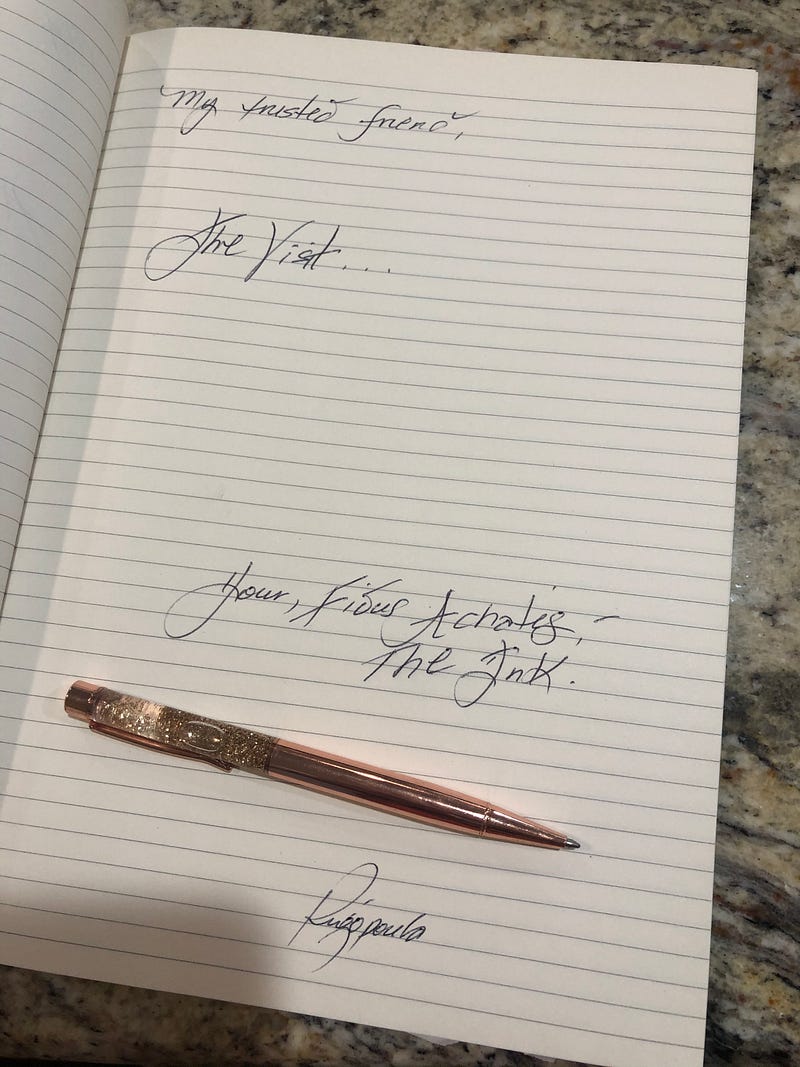
Image; Courtesy of the Author.

The Visit

Page & Ink

My Trusted Friend,

I’ve been amiss — remiss, and have neglected you,

may I ask you about that other most nostalgic ‘miss’ —

“Haven’t you missed me”?

I’m here now, I’ve come to pay you my respects,

a long lost visit,

Shhhhh, now allow me to wipe our tears along your lines

Will you invite me in?

I won’t apologize for my absence, I

was held up by the lyricism of Elytis, his

directions towards Ithika were written in

the prose of Papadiamantis, the

translation bordered dialectical materialism, and

dialectical interplay, Ufff!

Apologies have no place between us, within

the safety of your lined corridors,

Let’s turn a new leaf —

I’ve so much to tell you, so much,

to press upon the leaves of your abstrusive trust

I’ll exhaust you with my escapades, as

you live vicariously through me

I’ll tell you of my love’s, my loss, my pain —

you’ll enjoy drinking up those words, as I

put them to rest within the freshly,

laundered whiteness of you sheets

Forgive me, my most trusted companion, I

have skinned your knees on abrasively erased entries

As I skin my heart upon the footnotes of your page,

that I may etch my life,

in graphite’s sharp point of periodic endings

So pure within your folds, my sin addresses you in past tense

My ails rub their course, taken from the borrowed pages of

some Damoclean life unfinished,

They swirl across your blank features in calligraphic scrawl,

across your blue-veined river — breaking your banks,

I’ll be sure, to mend your rickety spine,

In the brace cast of, ‘In Memoriam’,

would you have it any other way?

Ahhh, I see, it’s to much to take in all at once

But — You invited me in… who would you be without the caress of my turning?

After all, I am — Your, Fidus Achates, The Ink —

Now I feel is the appropriate time to apologize, because

You see —

I always knew I’d be no one without the purity of you, and

surely as befits the narrative — not just any ordinary — open book.

Copyright @. R Tsambounieri Talarantas. Sept 30, 2019. All Rights Reserved.

Prose Poetry
Prose Poem
Poetry On Medium
Poems On Medium
Poem
Recommended from ReadMedium