
The Village
On the nature of group thinking
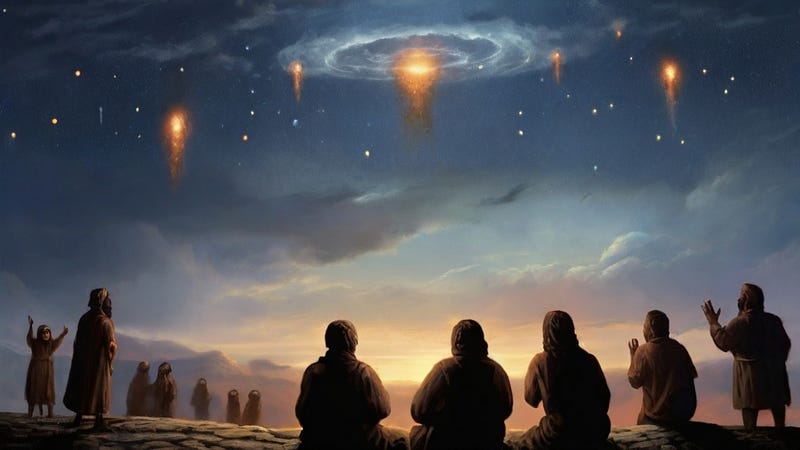
Let’s say you have a village of about 100 people. Or maybe 1,000. Whatever.
One night, there’s an event in the sky, a flickering ball of light. Roughly a third of the village witnessed the event directly, the others only heard about it from those who saw it.
One of the villagers thinks it is a meteor. Another thinks it was an alien spaceship. Another thinks it was a trick of the light; some kind of sun-flare off of atmospheric particulates. And still another thinks it was a spiritual thing, a sign from God. In fact, across the village are many different interpretations. Some certainly overlap, but depending on where someone was or what they were doing at the time, they have differing views.
Those who didn’t see anything at all must draw their conclusions secondhand, or thirdhand. They differ too, depending on who they heard from, what their relationship was to that person, their basic understanding of the physical world, religious inclinations, and so on.
But everyone has their own opinion. Based on their circumstances, context clues, on backgrounds, and personalities, each has his or her distinct point of view.
Gradually, though, accounts of what happened start to sound more alike. People who can’t remember certain details adduce the details remembered by others. The more fundamental aspects of the event corral people the most: whether it was a natural phenomenon, like a comet or lightning storm; or whether it was divine, otherworldly, a sign from god.
As more time passes, more merging occurs. The extraterrestrial morphs with the supernatural/spiritual to form a group that believes the event was simply “not of this realm.” The terrestrial phenomenon group (meteor in the atmosphere) merges with the celestial phenomenon group (sun flare), in their shared belief that the event can be explained by natural phenomena.
By the time all possible explanations and recollections have circulated through the village, two main interpretations have consolidated, with other versions of either having fallen away or been absorbed. Villagers are now a part of the NOT OF THIS REALM group, the NATURAL PHENOMENA group, or one of a handful of stragglers “undecided,” a tenacious few still clinging to their original, now misfit, theories.
More time passes, and the villagers find that they get along better with the people who agree with them about the sky event. Just about general things, really, about life — anything from the kinds of performances they enjoy at night around the fire, to the kinds of fabric they like for their basic clothes. NOT OF THIS REALM prefer their own company.
Those stragglers feel increasing social pressure to agree with and join one group or the other — a family member, or a friend believes in NATURAL PHENOMENA, and so the straggler thinks, What do I know, anyway? Maybe I’m wrong about what I think, and they could be right. The groups continue to strengthen and distinguish themselves from one another.
Meanwhile, not far from the village, a mountain rumbles and spews hot red goo. Another sign from God? Or part of the Earth’s natural cycles? This time, the bifurcation happens much quicker — instead of many differing opinions eventually converging, the two main ones emerge almost right away. They even have a shorthand now: NOTR versus NATP.
More events occur. Things which, prima facie, have nothing in common with sky events or mountain eruptions. The village food supply is raided by animals, and the villagers have to change their agricultural practices in order to survive. About half the village thinks that the key is to move the growing fields to higher ground. The other half thinks that the area is also at risk — better to adopt more predator-resistant practices, like fences and other deterrents.
As it turns out, the people who want to move the growing fields are almost entirely NOTR people. Whether the sky event or the mountain eruption have anything to do with more aggressive animals, the NOTR villagers just tend to get along better, and so tend to agree across almost any issue. Perhaps more importantly, they’ve come to resent those NATP villagers for their wacky beliefs, and whether they’re right about the crops or not doesn’t matter as much as them not getting to be the ones in charge.
From then on, any event, no matter its nature, splits the village down the same lines. Like a fault that’s prone to earthquakes, this social fissure divides the village over everything and anything.
Eventually, villagers only socialize with — or even date, or marry — those from their side of the endless debate. (NOTR children never play with NATP children.)
Fights between the two tribes get worse. Over water, resources, and territory. The village keeps getting hit with calamities, but the two groups can never agree on any single thing that happens in the world they share. It’s a foregone conclusion that each will think the opposite of the other, no matter the situation.
(Of course, every once in a great while, the two groups DO agree, but someone who wants to be the leader of NOTR, let’s say, scuttles an impending agreement before it becomes policy so he can be the one to promise the solution to the issue in question.)
Over many years, due to NOTR villagers eventually living in a different part of the countryside than the NATPs, physical characteristics begin to differ within the groups. Skin tone, height, upper back strength versus lower back strength, longer or shorter thumbs.
NOTRS are better swimmers. They begin to form their own language.
NATPs prefer the taste of strawberries and tend to get their wisdom teeth early. After millennia, the two groups barely resemble one another.
And so it goes.
While it took some time for the information and opinions about the sky event to circulate through the village, in our world today, the internet makes that happen lightning quick. But the effect is the same: seemingly unrelated events are divvied up along the same lines. What does gun ownership have to do with abortion, gay marriage, or climate change?
How can someone say “small government” over one issue, but “the government should decide” over another? How does being pro-Citizens United reconcile with being anti-establishment, anti-donor class?
We can audition for some reasons, but ultimately groupthink is probably to blame.
Critical thinking means transcending biases through the pursuit of objectivity. This may mean having to look at information on “both sides” of an issue. Or all sides of an issue.
Critical thinking does NOT mean we abandon all established epistemology and get our information exclusively from “alternative” sources. It’s not just about “doing our research,” nor does it mean knee-jerk rejection of anything “mainstream” or “legacy.” Though our institutions and leaders sometimes get it wrong, we shouldn’t abandon the whole project of a reality-based society.
It’s good to have experts and organizations to help guide us through the complexity of human life on Earth. It’s good we don’t have to start from scratch on every issue; we have a constitution of knowledge, we have history, we have legal facts.
Believing something because it conforms with your in-group is not freedom or liberty. Stop, think; check your underlying assumptions. We meet in the middle, not on the outer fringes.
And it was a natural phenomenon, by the way.
TJ