
The Value of Self-Help Books
Why I think self-help literature doesn't deserve its bad reputation
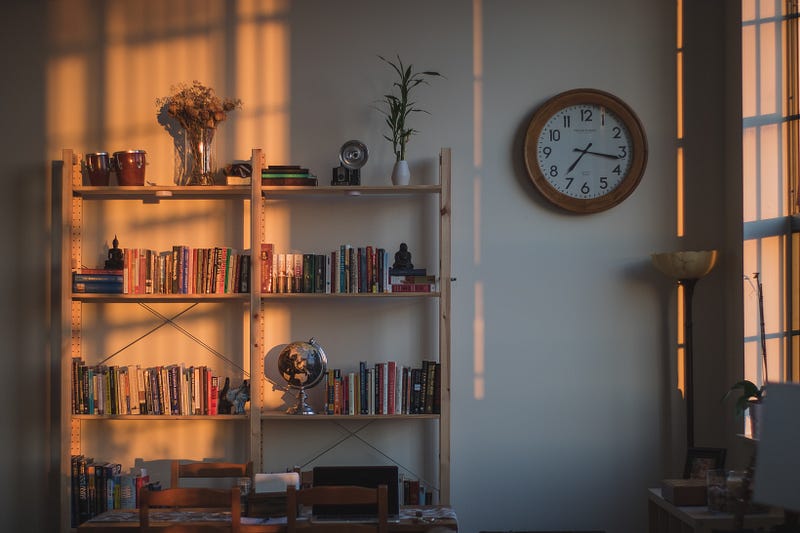
Recently, when I was sorting my books, I discovered that there's a hierarchy in my bookcases.
And it isn't based on whether I've already read the book. It's not based on the author's name, on the color of the book, on the price, or even on how much I like the book.
It's based on shame. I realized that I have something that I like to call:
The shelf of shame.
The shelf of shame
I have three bookcases. And that’s quite an achievement, especially considering that I live in a very small studio apartment (hello, housing crisis).
Still, I wouldn’t consider not having three bookcases. Even if that meant that I could finally comfortably move around in my own living room.
I treasure all the books that I keep in those bookcases, even the ones that I know I won’t read again. Or the ones that I spilled coffee on. Or the ones that I spilled coffee ánd wine on.
But there's still a very obvious hierarchy going on.
In the middle of the bookcases, at eye height, I have Lydia Davis. I have Kurt Vonnegut, Leo Tolstoy, Audre Lorde, Maggie Nelson, Charles Bukowski.
In other words, I have the books that people are allowed to see. The books that I am proud of.
But the bottom shelf of my bookcase contains a completely different type of book. It’s where I store all the books that I don’t necessarily want to be seen by guests coming over.
Maybe you've heard the expression:
Show me your books and I tell you who you are
Well, in my case I think that should be:
Show me the books on the bottom shell of your book case and I tell you who you are
These are the books I’m secretly a bit ashamed of. The guilty pleasures. And, as you’ve might have guessed by now, this bookshelf is mostly filled with self-help literature.
But as I was realizing that I unconsciously hid these books from visitors all these years, I decided it was time for me to own up to the fact that I do in fact like self-help books.
So here I am, proudly declaring myself a reader of self-help books!
In defense of self-help books
Self-help books clearly have a bit of an image problem. They're not considered intellectual or highbrow. They don't win any literary prizes.
According to The School of Life, the fact that people tend to attack the entire genre of self-help literature comes from a Romantic prejudice against the idea of Emotional Education:
"Offering explicit Emotional Education is regarded as beneath the dignity of any serious writer. We should — if we are at all intelligent — know how to live already."
But this brings me to the exact reason that self-help books are actually helpful:
We do not, in fact, know how to live already
Of course, I don't want to speak for everyone. Maybe you've got it all figured out. But in general, I think it's safe to say that there's always more to learn on how to live.
Being open to reflecting on the way we live is necessary if we want to grow, not only as individuals but as a species.
And there's no genre that so directly offers a reflection on 'how to live well' as the self-help genre. This is why, according to The School of Life, self-help was once actually very highly regarded, namely during the classical culture of ancient Rome and Greece.
During this time, the highest ambition of any author was to offer self-help:
Self-help books were at the pinnacle of literature. The most admired thinkers — Plato, Aristotle, Cicero, Seneca, Plutarch and Marcus Aurelius — all wrote self-help books, whose aim was to teach us to live and die well.
These books, like Seneca’s On Anger and Marcus Aurelius’s Meditations, are now considered to be of great intellectual and literary value. And they are great books.
But they're also, undeniably, self-help books.
The importance of self-help in today's society
So why did we start seeing self-help books in such a different light? Are we living in simpler times now? Times in which we no longer need lessons to navigate life?
Times in which we can rely entirely on intuition?
I think everyone will agree that the world has become if anything, a lot more complex.
With fast-developing technologies, globalization, climate crises, alienation, and people struggling with all types of mental health problems as a result of all this, doesn't it makes sense to examine life?
As philosopher Alain de Botton states:
A culture which gives a role to guidance and the self-help book stands a chance of making at least one or two fewer mistakes than the previous generation in the time that remains.
So next time someone tries to shame you for reading self-help books, you'll know that Alain de Botton and Marcus Aurelius are on your side.
(Also, never let anyone shame you for your taste, of course. Whether it's self-help or Taylor Swift, there's no such thing as a 'guilty pleasure '— all pleasures are valuable.)
As for me, I've reorganized my bookcase. Lydia Davis and Charles Bukowski are still there, at eye height. But they're right next to their new neighbors: my self-help collection.
To end with an intellectual Socrates quote (which you can use to defend your love for self-help books at dinner parties):
“An unexamined life is not worth living” — Socrates
If you enjoy reading stories like these and want to support me as a writer, consider signing up to become a Medium member. It’s $5 a month, giving you unlimited access to stories on Medium. If you sign up using my link, I’ll earn a small commission.