avatarDavid C. Wyld

Free AI web copilot to create summaries, insights and extended knowledge, download it at here

5712

Abstract

�🇳 <a href="http://www.ccb.com/en/home/indexv3.html">China Construction Bank </a>(Banking/Financial): 203B</li><li>🇨🇳 <a href="https://www.abchina.com/en/">Agricultural Bank of China </a>(Banking/Financial): 187B</li><li>🇨🇳 <a href="https://group.pingan.com/">Ping An Insurance </a>(Banking/Insurance): 182B</li><li>🇺🇸 <a href="https://www.cardinalhealth.com/en.html">Cardinal Health</a> (Health Care): 181B</li><li>🇺🇸 <a href="https://www.cigna.com/">Cigna</a> (Health Care/Insurance): 180B</li><li>🇨🇳 <a href="https://www.sinochem.com/17150.html">Sinochem Holdings</a> (Chemicals/Fertilizer): 174B</li><li>🇨🇳 <a href="http://www.crecg.com/english/index.html">China Railway Engineering Group</a> (Holding Company): 172B</li><li>🇨🇳 <a href="https://www.cnooc.com.cn/en/">China National Offshore Oil</a> (Oil and Gas): 165B</li><li>🇨🇳 <a href="https://english.crcc.cn/">China Railway Construction</a> (Construction): 163B</li><li>🇨🇳 <a href="https://www.baowugroup.com/en/">China Baowu Steel Group</a> (Steel/Metallurgy): 162B</li><li>🇨🇳 <a href="https://www.boc.cn/en/">Bank of China</a> (Banking/Financial): 157B</li><li>🇨🇳 <a href="https://corporate.jd.com/">JD.com</a> (Retail): 155B</li></ol><p id="2ebf"><b><i>Source Data:</i></b> <a href="https://www.visualcapitalist.com/">Visual Capitalist</a>, “<a href="https://www.visualcapitalist.com/ranking-the-largest-companies-by-revenue-usa-vs-china/">Ranking the Largest Companies by Revenue: USA vs. China</a>,” January 2024</p><p id="e61d">As you can see, Walmart is the largest revenue company not just between the United States and China but also in the world today, with 2022 revenues of 611 billion dollars. The second-ranked firm is the State Grid, the largest utility company in the world, which services 1.1 billion customers in China and has over 870 thousand employees. While American companies dominate the top 10 ranked firms between the two nations, taking 7 of the top 10 spots and 11 of the top 15 positions, Chinese firms command 3 of the top 5 based on their revenues. These three companies, State Grid, China National Petroleum, and Sinopec Group, are, like most of the Chinese companies in this list, formerly state-owned companies that are now at least quasi-private in their operations.</p><p id="fd67">As you can tell by examining the list, most of the Chinese companies are in traditional lines of business — construction, oil and gas, and banking. In fact, the only Chinese retailer to make the list come in at number 30 in the revenue rankings between the two countries, and that was the Internet retailer JD.com. By way of contrast, the American companies in this list are a mix across diverse industries, with:</p><ul><li>Retailers <i>(Walmart, Amazon, and Costco)</i></li><li>Tech Companies <i>(Apple, Alphabet, and Microsoft)</i></li><li>Oil and Gas <i>(ExxonMobil and Chevron)</i></li><li>Health care <i>(UnitedHeatlh Group, CVS Health, McKesson, Cencora, Cardinal Health, and Cigna)</i></li><li>Insurance and Investments <i>(Berkshire Hathaway)</i>.</li></ul><p id="26b3"><b>Table 2: The Combined Revenues of the Top 15 Companies in Both the U.S. and China (based on 2022 revenues in billions of U.S. dollars)</b></p><figure id="96d7"><img src="https://cdn-images-1.readmedium.com/v2/resize:fit:800/0*uco4igl1XpQ89h6g"><figcaption></figcaption></figure><p id="22d9"><b><i>Source Data:</i></b> <a href="https://www.visualcapitalist.com/">Visual Capitalist</a>, “<a href="https://www.visualcapitalist.com/ranking-the-largest-companies-by-revenue-usa-vs-china/">Ranking the Largest Companies by Revenue: USA vs. China</a>,” January 2024</p><p id="6fe9">If you look in the aggregate at the top 15 American and Chinese companies <i>(see Table 2 — The Combined Revenues of the Top 15 Companies in Both the U.S. and China {based on 2022 revenues in billions of U.S. dollars})</i>, you can see that the 15 largest American companies had revenues totalling 4.8 trillion (yes, with a “t”) dollars in 2022. By way of comparison, when you add up the 15 largest companies in China, based on their 2022 revenues, their aggregate revenue (of $3.7 trillion) stands at more than a trillion dollars <i>less</i> than their counterparts in the United States. And so, one can safely say that the market power of these top-ranked American companies — at least for today — far outweighs their Chinese counterparts. Also, the American companies could be said to be operating not just in faster-growing markets, like tech and retailing, but less reliant on their domestic operations as their Chinese counterparts, which are, by their very nature, focused more on growing their operations domestically due to their lines of business in construction, railroad transportation, utilities, etc.</p><figure id="eaab"><img src="https://cdn-images-1.readmedium.com/v2/resize:fit:800/0*5nrh140iASTqX-ux"><figcaption>Photo by <a href="https://unsplash.com/@isaacmsmith?utm_source=medium&amp;utm_medium=referral">Isaac Smith</a> on <a href="https://unsplash.com?utm_source=medium&amp;utm_medium=referral">Unsplash</a></figcaption></figure><h1 id="62f7">Analysis and Discussion</h1><p id="54b3">This article should be of interest to<i> anyone</i> who follows global business today — and in truth, <i>that should be everyone</i>, due to the impact these companies and their operations have on our daily lives. As a strategic management professor and consultant, I can safely say that if one asked the average “man on the street,” a random college business student, or yes, even a random corporate executive to name the top 15 American companies, at best, they would get Amazon, Walmart, and then a few others. Even top corporate ma

Options

nagers would likely not guess any of the concentration of healthcare companies that actually made the list, and they would likely wrongly bet that <a href="https://www.facebook.com/">Facebook</a> and <a href="https://twitter.com/?lang=en">Twitter (X)</a> would be on the list! They would also likely guess that the big auto companies (<a href="https://www.ford.com/">Ford</a> and <a href="https://www.gm.com/">GM</a>) and the big banks (like <a href="https://www.jpmorganchase.com/">JP Morgan Chase</a>, <a href="https://www.wellsfargo.com/">Wells Fargo</a>, and more) would be on the list as well, but they would be wrong. And if you asked that same group of people to name any of the top 15 Chinese companies, they might get the Bank of China (well, assuming wrongly that China would only have one bank since it’s a communist country with a sort-of-free. I dare say that no one — not even most college business professors, like myself, unless they closely follow the Chinese market or are natives of China, would be able to name <i>even</i> 2 or 3 of the top Chinese firms!</p><p id="92d0">So what is the moral of all of this? We talk all the time in business schools that our students — and Americans in general — need to be more “globally aware.” These lists are proof positive that we <i>do</i> need to be aware of <i>not only</i> the goings on and the major players in our biggest competitor in the global economy, <i>but those in our domestic economy right here as well</i>. The top American companies list is particularly revealing for the very fact that the largest companies today are not those that you would consider the “<a href="https://www.imdb.com/title/tt0114814/">Usual Suspects</a>,” beyond say Walmart, Amazon, Apple. and the oil companies! The market power of the healthcare industry is immense today, and yet, this flies under the radar of most Americans. And yes, one shouldn’t sleep on companies like Alphabet (Google) and Microsoft, which continue to play a huge innovative role in the tech industry today.</p><p id="d097">In sum, we need to instill some degree of “corporate literacy” (for lack of a better term) in business students and, yes, in company executives today! One should know the names of some of the biggest companies in the world — and not just those that are based in the U.S. and China, but major players in the global market from European and Asian countries as well. With the immense power of these global corporations today, not knowing who is a “player” can lead to disastrous consequences in one’s career and, yes, one’s investing. And so, hopefully, our media — particularly the business-focused media, will take a broader perspective and cover the <i>real</i> major players in the U.S. and world economies far better than they do presently — not just announcing the latest missive that <a href="https://www.biography.com/business-leaders/elon-musk">Elon Musk</a> posted on his site! Maybe names like Cencora and Sinochem are not as sexy and don’t get as many clicks as do “celebrity CEOs” like Musk and Jeff Bezos, but what they are doing may have a much greater impact on your wallet, your career, and your life than the latest billionaire’s rocket launch!</p><figure id="d64a"><img src="https://cdn-images-1.readmedium.com/v2/resize:fit:800/0*cvWh5jdbrTjV-jH-"><figcaption>Professor David C. Wyld</figcaption></figure><h1 id="a14f">About David Wyld</h1><p id="ed4a"><a href="https://davidwyld.medium.com/">David C. Wyld</a> is a Professor of Strategic Management at <a href="https://www.southeastern.edu/">Southeastern Louisiana University</a> in Hammond, Louisiana. He is a management consultant, researcher/writer, publisher, executive educator, and experienced expert witness. You can view all of his work at <a href="https://authory.com/DavidWyld">https://authory.com/DavidWyld</a>. You can subscribe to his <a href="https://authory.com/DavidWyld">Medium</a> article feed at <a href="https://davidwyld.medium.com/subscribe">https://davidwyld.medium.com/subscribe</a>.</p><p id="7c18"><b>Social Media Links to David Wyld:</b></p><ul><li>on <a href="https://www.facebook.com/david.wyld">Facebook</a></li><li>on <a href="https://www.linkedin.com/in/david-wyld-4923707/">LinkedIn</a></li><li>on <a href="https://www.threads.net/@wylddavid">Threads</a></li><li>on <a href="https://twitter.com/GoodAdvicePub">Twitter (X)</a></li><li>on <a href="https://post.news/@/DavidCWyld">Post</a></li></ul><p id="19a6">Visit us at <a href="https://www.datadriveninvestor.com/"><i>DataDrivenInvestor.com</i></a></p><p id="3e5c">Subscribe to DDIntel <a href="https://www.ddintel.com/"><i>here</i></a>.</p><p id="599e">Have a unique story to share? Submit to DDIntel <a href="https://datadriveninvestor.com/ddintelsubmission"><i>here</i></a>.</p><p id="49d6">Join our creator ecosystem <a href="https://join.datadriveninvestor.com/"><i>here</i></a>.</p><p id="bd21"><a href="https://ddintel.datadriveninvestor.com/"><i>DDIntel</i> </a>captures the more notable pieces from our <a href="https://www.datadriveninvestor.com/"><i>main site</i></a> and our popular <a href="https://medium.datadriveninvestor.com/"><i>DDI Medium publication</i></a>. Check us out for more insightful work from our community.</p><p id="9c60">DDI Official Telegram Channel: <a href="https://t.me/+tafUp6ecEys4YjQ1">https://t.me/+tafUp6ecEys4YjQ1</a></p><p id="f362">Follow us on <a href="https://www.linkedin.com/company/data-driven-investor"><i>LinkedIn</i></a>, <a href="https://twitter.com/@DDInvestorHQ"><i>Twitter</i></a>, <a href="https://www.youtube.com/c/datadriveninvestor"><i>YouTube</i></a>, and <a href="https://www.facebook.com/datadriveninvestor"><i>Facebook</i></a>.</p></article></body>

Who are the biggest American and Chinese companies today?

The USA vs. China: The Scorecard on the Global Battle of the Corporate Titans

A handy primer on the major American and Chinese players in the global business war today — and what this means for you.
Photo by Li Yang on Unsplash

Overview

The battle is on! We know that the world’s two largest economic superpowers — the United States and China — are locked in a high-stakes contest to see which country will dominate the current century. And this is not just the stuff of CNBC and business news, as the economic struggle between the two nations is in many ways a “proxy war” for the real battle between them. In today’s world, these economic battles have huge stakes, as the ebbs and flows of the contest between the two nations impact all of us in both countries and, indeed, everyone on the planet. The moves both American and Chinese companies — and that their own and other governments make in response to them — greatly impact the goods that we have available and the prices we pay for them. These moves also translate into more or fewer jobs in specific areas and regions and, ultimately, impact the way that not just our economy but our politics operate. In short, this is important stuff to know about — and you should know the names of the “starting lineups” in the top ranks of both American and Chinese companies today. You might be surprised at how little you know about the top companies in both China and right here in the U.S.A.

Photo by Kelly Sikkema on Unsplash

The List

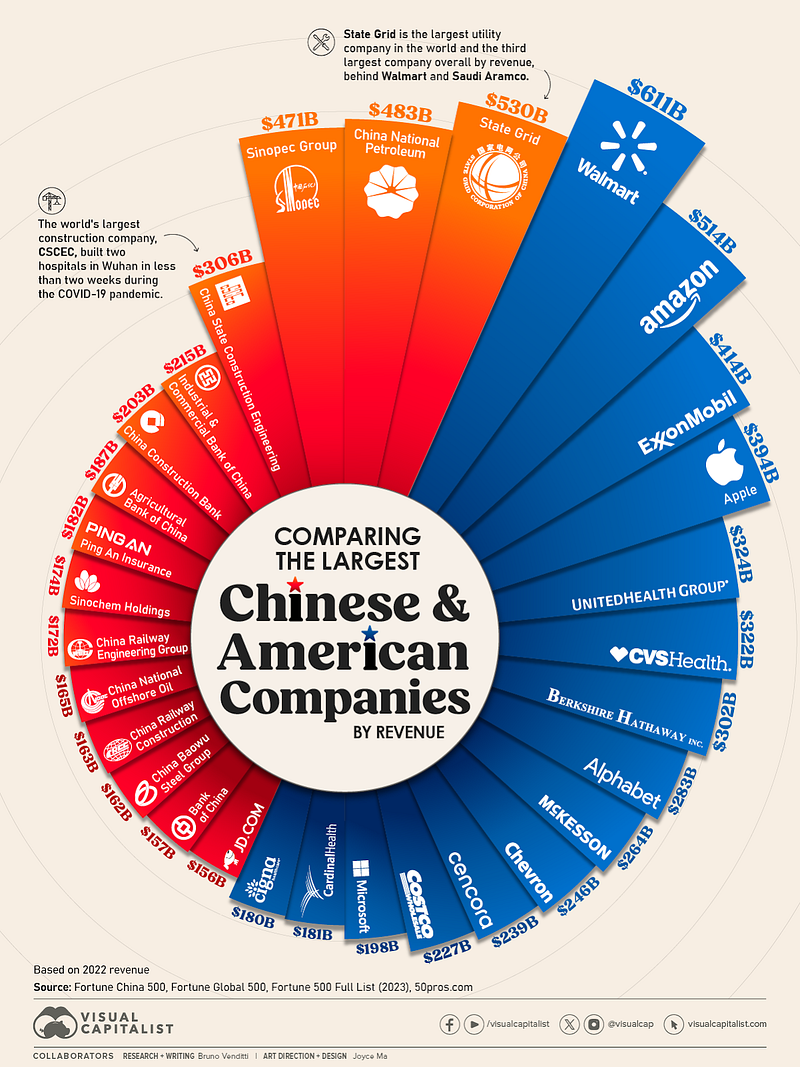
Recently, the data journalists at Visual Capitalist (a great site to follow, by the way!) put together the chart shown in Figure 1 (The Largest Companies in China and the United States, Ranked by 2022 Revenues {in billions of U.S. dollars}). In this visual (“Ranking the Largest Companies by Revenue: USA vs. China”), they ranked the largest 15 companies in both the United States and in China. The complete list of companies in both countries, with the

Figure 1: The Largest Companies in China and the United States, Ranked by 2022 Revenues (in billions of U.S. dollars)
Source: Visual Capitalist, “Ranking the Largest Companies by Revenue: USA vs. China,” January 2024 (Used with permission)

companies ranked according to their 2022 revenues, is provided in Table 1 (The 30 Largest American and Chinese Companies, Ranked {Based on 2022 revenues, expressed in billions of U.S. dollars}). And yes, each company’s “country of origin” is told with the small American or Chinese flag by their name!

Table 1: The 30 Largest American and Chinese Companies, Ranked (Based on 2022 revenues, expressed in billions of U.S. dollars)

  1. 🇺🇸 Walmart (Retail): $611B
  2. 🇨🇳 State Grid (Utility): $530B
  3. 🇺🇸 Amazon (Retailer): $514B
  4. 🇨🇳 China National Petroleum (Oil and Gas): $483B
  5. 🇨🇳 Sinopec Group (Oil and Gas): $471B
  6. 🇺🇸 ExxonMobil (Oil and Gas): $413B
  7. 🇺🇸 Apple (Electronics): $394B
  8. 🇺🇸 Berkshire Hathaway (Insurance/Property and Casualty/Stocks): $383B
  9. 🇺🇸 UnitedHealth Group (Insurance/ Health Care): $324B
  10. 🇺🇸 CVS Health (Health Care/ Pharmacy): $322B
  11. 🇨🇳 China State Construction Engineering (Construction): $306B
  12. 🇺🇸 Alphabet (Internet Services/ Retail): $283B
  13. 🇺🇸 McKesson (Health Care/Pharmacy): $264B
  14. 🇺🇸 Chevron (Petroleum Refining): $246B
  15. 🇺🇸 Cencora (Health Care): $238B
  16. 🇺🇸 Costco Wholesale (Retail): $227B
  17. 🇺🇸 Microsoft (Computer Software): $227B
  18. 🇨🇳 Industrial & Commercial Bank of China (Banking/Financial): $215B
  19. 🇨🇳 China Construction Bank (Banking/Financial): $203B
  20. 🇨🇳 Agricultural Bank of China (Banking/Financial): $187B
  21. 🇨🇳 Ping An Insurance (Banking/Insurance): $182B
  22. 🇺🇸 Cardinal Health (Health Care): $181B
  23. 🇺🇸 Cigna (Health Care/Insurance): $180B
  24. 🇨🇳 Sinochem Holdings (Chemicals/Fertilizer): $174B
  25. 🇨🇳 China Railway Engineering Group (Holding Company): $172B
  26. 🇨🇳 China National Offshore Oil (Oil and Gas): $165B
  27. 🇨🇳 China Railway Construction (Construction): $163B
  28. 🇨🇳 China Baowu Steel Group (Steel/Metallurgy): $162B
  29. 🇨🇳 Bank of China (Banking/Financial): $157B
  30. 🇨🇳 JD.com (Retail): $155B

Source Data: Visual Capitalist, “Ranking the Largest Companies by Revenue: USA vs. China,” January 2024

As you can see, Walmart is the largest revenue company not just between the United States and China but also in the world today, with 2022 revenues of $611 billion dollars. The second-ranked firm is the State Grid, the largest utility company in the world, which services 1.1 billion customers in China and has over 870 thousand employees. While American companies dominate the top 10 ranked firms between the two nations, taking 7 of the top 10 spots and 11 of the top 15 positions, Chinese firms command 3 of the top 5 based on their revenues. These three companies, State Grid, China National Petroleum, and Sinopec Group, are, like most of the Chinese companies in this list, formerly state-owned companies that are now at least quasi-private in their operations.

As you can tell by examining the list, most of the Chinese companies are in traditional lines of business — construction, oil and gas, and banking. In fact, the only Chinese retailer to make the list come in at number 30 in the revenue rankings between the two countries, and that was the Internet retailer JD.com. By way of contrast, the American companies in this list are a mix across diverse industries, with:

  • Retailers (Walmart, Amazon, and Costco)
  • Tech Companies (Apple, Alphabet, and Microsoft)
  • Oil and Gas (ExxonMobil and Chevron)
  • Health care (UnitedHeatlh Group, CVS Health, McKesson, Cencora, Cardinal Health, and Cigna)
  • Insurance and Investments (Berkshire Hathaway).

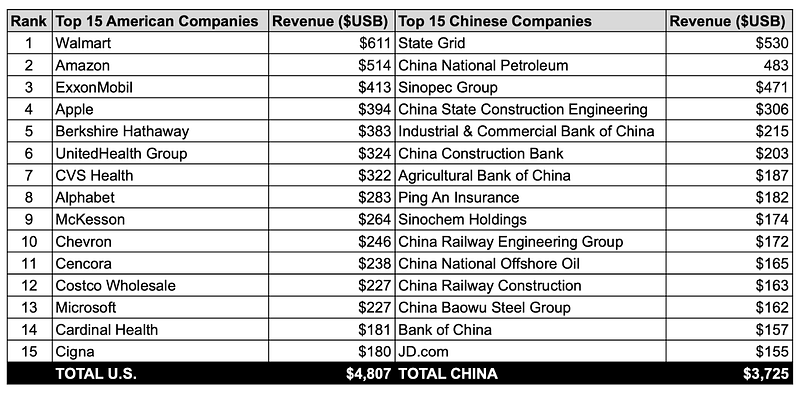
Table 2: The Combined Revenues of the Top 15 Companies in Both the U.S. and China (based on 2022 revenues in billions of U.S. dollars)
Source Data: Visual Capitalist, “Ranking the Largest Companies by Revenue: USA vs. China,” January 2024

If you look in the aggregate at the top 15 American and Chinese companies (see Table 2 — The Combined Revenues of the Top 15 Companies in Both the U.S. and China {based on 2022 revenues in billions of U.S. dollars}), you can see that the 15 largest American companies had revenues totalling $4.8 trillion (yes, with a “t”) dollars in 2022. By way of comparison, when you add up the 15 largest companies in China, based on their 2022 revenues, their aggregate revenue (of $3.7 trillion) stands at more than a trillion dollars less than their counterparts in the United States. And so, one can safely say that the market power of these top-ranked American companies — at least for today — far outweighs their Chinese counterparts. Also, the American companies could be said to be operating not just in faster-growing markets, like tech and retailing, but less reliant on their domestic operations as their Chinese counterparts, which are, by their very nature, focused more on growing their operations domestically due to their lines of business in construction, railroad transportation, utilities, etc.
Photo by Isaac Smith on Unsplash

Analysis and Discussion

This article should be of interest to anyone who follows global business today — and in truth, that should be everyone, due to the impact these companies and their operations have on our daily lives. As a strategic management professor and consultant, I can safely say that if one asked the average “man on the street,” a random college business student, or yes, even a random corporate executive to name the top 15 American companies, at best, they would get Amazon, Walmart, and then a few others. Even top corporate managers would likely not guess any of the concentration of healthcare companies that actually made the list, and they would likely wrongly bet that Facebook and Twitter (X) would be on the list! They would also likely guess that the big auto companies (Ford and GM) and the big banks (like JP Morgan Chase, Wells Fargo, and more) would be on the list as well, but they would be wrong. And if you asked that same group of people to name any of the top 15 Chinese companies, they might get the Bank of China (well, assuming wrongly that China would only have one bank since it’s a communist country with a sort-of-free. I dare say that no one — not even most college business professors, like myself, unless they closely follow the Chinese market or are natives of China, would be able to name even 2 or 3 of the top Chinese firms!

So what is the moral of all of this? We talk all the time in business schools that our students — and Americans in general — need to be more “globally aware.” These lists are proof positive that we do need to be aware of not only the goings on and the major players in our biggest competitor in the global economy, but those in our domestic economy right here as well. The top American companies list is particularly revealing for the very fact that the largest companies today are not those that you would consider the “Usual Suspects,” beyond say Walmart, Amazon, Apple. and the oil companies! The market power of the healthcare industry is immense today, and yet, this flies under the radar of most Americans. And yes, one shouldn’t sleep on companies like Alphabet (Google) and Microsoft, which continue to play a huge innovative role in the tech industry today.

In sum, we need to instill some degree of “corporate literacy” (for lack of a better term) in business students and, yes, in company executives today! One should know the names of some of the biggest companies in the world — and not just those that are based in the U.S. and China, but major players in the global market from European and Asian countries as well. With the immense power of these global corporations today, not knowing who is a “player” can lead to disastrous consequences in one’s career and, yes, one’s investing. And so, hopefully, our media — particularly the business-focused media, will take a broader perspective and cover the real major players in the U.S. and world economies far better than they do presently — not just announcing the latest missive that Elon Musk posted on his site! Maybe names like Cencora and Sinochem are not as sexy and don’t get as many clicks as do “celebrity CEOs” like Musk and Jeff Bezos, but what they are doing may have a much greater impact on your wallet, your career, and your life than the latest billionaire’s rocket launch!

Professor David C. Wyld

About David Wyld

David C. Wyld is a Professor of Strategic Management at Southeastern Louisiana University in Hammond, Louisiana. He is a management consultant, researcher/writer, publisher, executive educator, and experienced expert witness. You can view all of his work at https://authory.com/DavidWyld. You can subscribe to his Medium article feed at https://davidwyld.medium.com/subscribe.

Social Media Links to David Wyld:

Visit us at DataDrivenInvestor.com

Subscribe to DDIntel here.

Have a unique story to share? Submit to DDIntel here.

Join our creator ecosystem here.

DDIntel captures the more notable pieces from our main site and our popular DDI Medium publication. Check us out for more insightful work from our community.

DDI Official Telegram Channel: https://t.me/+tafUp6ecEys4YjQ1

Follow us on LinkedIn, Twitter, YouTube, and Facebook.

Business
News
Finance
Corporate
Marketing
Recommended from ReadMedium