
CULTURE
The Upside of Bullying
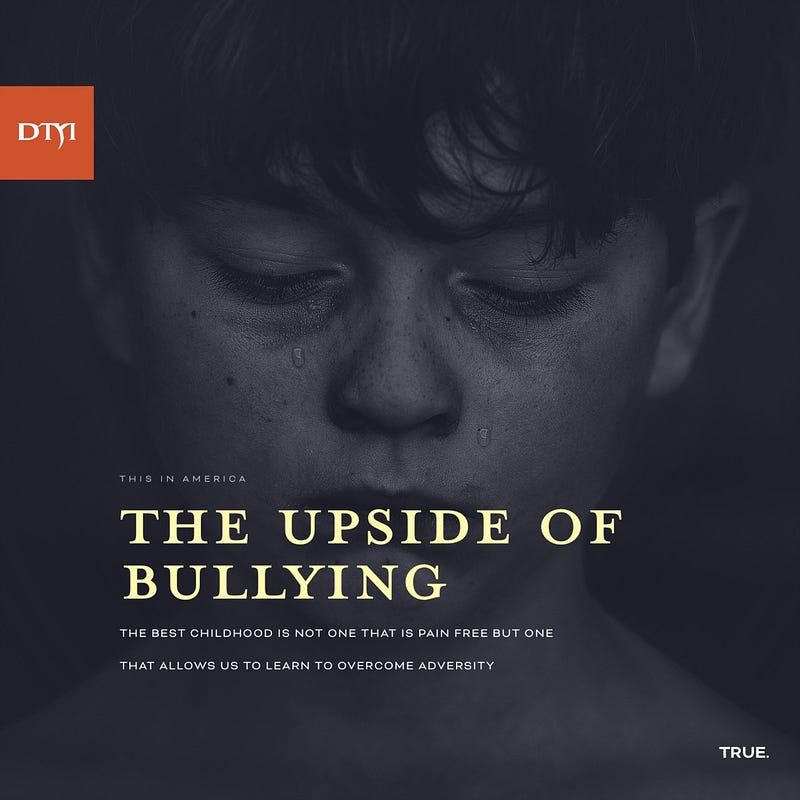
The best childhood is not one that is pain-free but one that allows us to learn to overcome adversity
I once wrote a short piece about my childhood that began, “When I was in the fourth grade, we had a genius who lived in my closet and smelled of garlic. He lived on the third floor of our house in Hatfield, Pennsylvania, slept at odd hours of the day, and kept his mail in our cereal cabinet. It’s a credit to my absolute belief in the normalcy of my family that I didn’t find this strange in the least.”
My sister took this story to her therapist and said, “Here, this might explain some things.”
I’m not even entirely sure what she meant by that, since we have very different recollections concerning our childhoods. She found a lot of it rather traumatic, apparently while I considered most of my childhood pretty idyllic. Nobody has a perfect childhood, and if you did, you’re probably underdeveloped and uninteresting. I don’t know anyone interesting that had a perfect childhood.
I was listening to a podcast today. It was David Spade, Dana Carvey, and Chris Rock. They were all talking about their various childhood traumas and how it had affected them as adults. Chris Rock was talking about his almost daily bullying as a kid, for being small and one of the few black kids in his school. One time he really got humiliated in front of other kids, and I guess he snapped.
He got a brick, put it into a book bag, and beat the kid half to death with it. Even a few days later, there was concern that he’d killed the kid and that he might have to try to escape to family in the South. After that, he was so afraid of losing his temper that he never allowed himself to show it. Only in the last few years has he allowed himself to express anger towards people in a controlled way. And only because of therapy.
But I also remember a bit Rock did about bullying. The basic premise was, some kids need to be bullied to bring out the best in them. His question was, “Who’s going to find the cure for cancer? Or discover new technologies? The kid who got bullied obviously.”
Of course, this was a bit, a comedic effort. Rock has been fairly open about how traumatic his bullying was. He once compared it to the Tim Robbins character’s life in prison at the beginning of Shawshank Redemption. A daily struggle to stay alive and not get raped. That’s not a lighthearted recollection of your childhood.
No one condones bullying, not even Chris Rock, despite his jokes on the subject. But he recognizes that his trauma also made him who he is today, and helped to create the comedian he was to become. Both David Spade and Dana Carvey said essentially the same thing. If they’d had safe, secure, normal, happy childhoods, would they have had the drive to succeed at the highest levels of show business? Undoubtedly no. Not according to them.
I’ve known people who grew up with wealth and privilege and who are miserable adults. I’ve also known people who had unimaginable childhoods that were nothing but trauma, and yet who are some of the most well-adjusted, happy people I’ve ever met.
The people who peaked in high school, the popular kids with all the right accouterments, rarely go on to great success in the world. They become middle managers and bureaucrats, wielding little power and influencing no one. They had their time in the sun, and that was that.
“Who’s going to find the cure for cancer? Or discover new technologies? The kid who got bullied obviously.”
Nerds rule the world, not jocks or beauty queens. The ugly duckling that becomes the supermodel. The awkward kid who becomes the movie star. The science geek who reinvents the world. The political science dweeb who becomes the president.
And it’s likely that every one of them was bullied.
Some of you will accuse me of supporting bullying or giving it a pass as just “kids being kids.” You’re wrong. I hate bullies and always have. I’ve spent much of my life standing up to them. There is nothing more disgusting to me than someone with power picking on someone weaker than them. It’s the ultimate disgrace for humanity.
What I am suggesting is that we have entered this phase of our culture, where parents now believe that they can protect their kids from any discomfort, pain, or struggle to survive, and consequently, we are in danger of raising a generation of mediocre slugs.
When I first started working on the West Coast, I was struck by how different our work culture was compared to competitors out there. Coming from the Northeast, we were more aggressive, faster, meaner, quicker to the cut, and all-around hungrier. We worked twice as fast and three times as hard. We used to clean up. They were no match for us. We simply wanted it more than they did.
We used to joke that the weather was just too nice. They lost their edge because their lives were soft. They had lowered the bar on their adversity, and they had forgotten what it was like to struggle. It’s like those memes that go, “some of you haven’t had to shovel your driveway for the third time this week, and it shows.”
If I had two candidates for a job and they were equally qualified, except one grew up rich in San Diego and the other poor in Cleveland, I’m going with the kid from Cleveland. The kid from California is probably going to be more polished, more confident, and will fit it anywhere I put him. He will always look the part and will never embarrass me.
But the kid from Cleveland that had to scratch and claw her way to where she is, she could change the game if you give her a chance to play. She is more likely to make mistakes and because she has less fear of failure, and is more likely to actually make a difference. If you want to be successful, don’t hire experience, hire talent. Look for passion, not professionalism.
You can hide a great many weaknesses with a polished presentation. But it’s only a razor-thin veneer. There is no depth there, and when things get difficult, you will flounder because there are no reserves to tap. A person who has overcome adversity has reserves they might not know they have. They will find a way.
Why? Because it’s personal.
We are truly doing a disservice to ourselves as a culture. We have attempted to engineer a stress-free environment for our children and have only succeeded in not preparing them for a life of adversity.
Failure has to be an option, or you will produce fearful, hesitant people. Creativity demands confidence. Innovation requires fearlessness. Confidence can come from privilege, but fearlessness comes from the experience of knowing you can’t be destroyed.
If you grew up fighting, I mean physically fighting, you’ve been punched in the nose a time or two. It hurts, but it won’t kill you. If you’ve never been in a fight in your whole life and someone punches you square in the face, you have no way of processing the pain and fear. You will crumble. The fight is over. But the person who has been through it before will continue fighting because they know that is not how it ends.
The point is to embrace all aspects of life. Success and failure. Adversity and luck. Challenges and opportunities. We learn way more from our failures than we ever do from success. Show me someone who has skated through life with little effort, and I’ll show you someone who isn’t prepared for adversity. They’ve gotten by on their looks, intelligence, money, or station, but they have no tools to deal with a crisis.
It’s important to understand how past trauma affects us, both positively and negatively. But at some point, you have to recognize that who you are as a person is an amalgamation of all your experiences, and you cannot separate the good from the bad, the joyful from the painful, without changing who you became.
The old golf legend Harvey Penick once said that in golf, your strengths and weaknesses will always be there. If you could improve your weaknesses, you would improve your game. The irony is that people prefer to practice their strengths.
If we want to improve, we need to focus on our weaknesses, not our strengths, and that means recognizing that we have them in the first place. Weakness is not the failure we have been led to believe it is.
No one gets better from winning.


