
The Unspoken First Step of Self-Care That No One Teaches You
Filling in the gaps for what you might not have learned as a kid

Do you ever get that advice: “Check in with yourself once in a while”? For me, I had no idea what it meant. I would sit there and ask myself the “check-in” questions you get on those pretty Instagram photos under the #MentalHealth hashtag. They were words I was familiar with but didn’t understand.
Ask yourself those questions right now:
What do you need? How are you feeling?
What did you answer?
If you had a clear-cut answer to what you needed, that’s great! Give yourself permission to meet that need.
If you didn’t, you’re in the right place because every time I asked myself that question, every time I saw those colourful Instagram posts and Twitter reminders, my internal monologue said:
Well, I guess I’m fine.
I had no idea how to even do the first step of the check-in.
What “I guess I’m fine” really was
For one historical reason or another, you may not have learned (or it was hard for you to learn) what it meant to even tune into yourself and know how you’re feeling. You’re not alone.
For the longest time, my “feeling fine” was this constant feeling of tension, anxiety — I was that elastic pulled to its limits.
But because this was the mode that I was constantly in, I didn’t know there could be another way. This was just my default. There were ways of existing that I truly hadn’t unlocked.
But here’s how the anxiety had been screaming out of my body.
Constant aches and pains
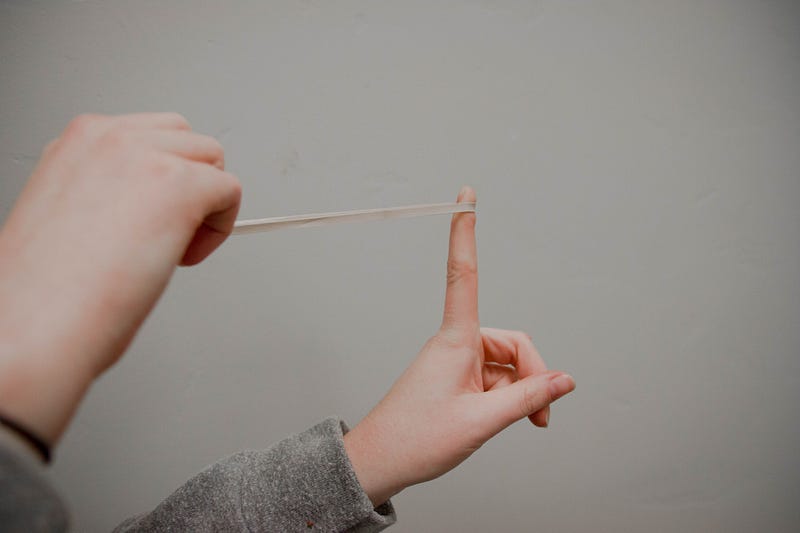
I was so in the habit of ignoring how my body was doing and not even thinking of where my body was in relation to space that I never actually noticed how much tension I was holding.
My neck, shoulders and jaws, oh my god, my jaws were constantly clenched so tight that my first tangible warning bell was my dentist telling me that I was grinding my teeth at night.
I didn’t even realize there was a relax mode until my therapist showed me Progressive Muscle Relaxation, which is this exercise where you tense up the muscle so that you know how it feels to relax it. I’m guessing that Yoga and other exercises might tackle this too, but you’d have to consult someone more knowledgable on this one.
Quick check-ins:
Are your shoulders basically scrunched up so high that they’re basically beside your ears right now? Let those drop.
What about your jaw? Are you exerting the force strong enough to chew the toughest well-done piece of meat?
Are your brows furrowed, can you feel that?
The Hunger…?

I used to think that I was someone who was constantly hungry. I was constantly filling up on snacks. My boyfriend jokes about it but sometimes I’d even settle down for a bowl of rice.
I also never understood the saying of “butterflies in the stomach” that protagonists would describe as I grew up because I had only felt three modes in my stomach: full, hungry, pain.
It turns out that I just never thought to pay attention to my stomach. Can you do that right now? Can you pay attention just to your stomach? Where is it? What is it doing? Does it feel full?
When I do this I realize that most of the time I’m actually sucking in. I tune into exactly how full I actually am. I especially tune into that feeling of your stomach going “gululgulu” after you’ve had two whole cups of water in one Zoom meeting. In the beginning, it was actually only when I tuned in with this level of intentional attention towards this body part that I realized there was a difference between “hungry” and “butterflies”.
The “hungry” and “butterflies” signals were getting mixed up and interpreted as one because I was focussing on something else. I probably just complained about this feeling in my stomach one day and my parents were probably just like “go have a snack”, and I never questioned it since.
It sure explains why I’m always hungry before a presentation!
The realization
A quick caveat, both of these symptoms could have valid physiological or medical reasons that are outside of stress or anxiety. Please consult your healthcare provider if you’re struggling with either of these.
After incorporating stress-relieving exercises, therapy and a better daily routine, these two things have substantially improved. For me, the stress was a huge factor in contributing to these seemingly unrelated inconveniences that I was having. In hindsight, it also makes so much sense.
How many times have articles touted that stress is the underlying cause of a ridiculous number of health conditions? At the same time, how many of us know what those stats feel like and look like in a real human being?
I sure didn’t.
What I learned is that sometimes, to check-in to your mood is to tune into how your body is responding to the mood, because there’s a lot we could be ignoring out of habit.
What are you ignoring right now?
Lucy (The Egg Girl) thinks there are a lot of things that people struggle with that others might assume are “common knowledge” or “obvious”. She’s here to fill in the gaps because she’d wish someone had come out and said the obvious things anyways, instead of all the roaming in the dark that she had to do to figure out all of these building blocks alone. This goes as well with being a new writer struggling with imposter syndrome, and being hesitant to tackle certain article formats that frowned upon in certain spheres.


