
The Remarkable Unremarkableness of William Stoner
In a rush to create a memorable character everyone thinks they have to design a deluge of eccentric characteristics and quirky flaws. Stoner is the antidote to this, proving the remarkable can lie in the unremarkable.
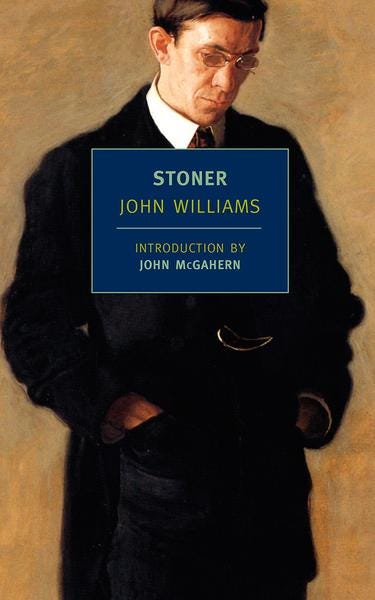
It’s 1 am. I’ve just finished reading Stoner, John Williams’ posthumous classic for the second time. I can’t sleep. How can I knowing I’ve been touched so heartily by a character who now exists more in my soul than in those tender pages which reveal his broken but wholesome life? For that’s the true achievement of Stoner, the deft creation of a character who defies comparison with his gentle ordinariness and manages to burrow his way into your heart nonetheless.
Occasionally when you consume a story you’re invested in the character’s lives, in their journeys, so much so you walk away thinking, ‘oh, wow!’ — and thereafter you look back fondly, nostalgically remarking on the change it’s insighted within you. Stoner doesn’t do this. Stoner is a portrait of naivety and affability without pretence whose genius lies in its simple ability to make you fall in love with the titular character.
In this way, Williams’ novel cannot be said to grab you from page one; it’s no wild ride or edge of your seat crowd pleaser. It’s an experience like a slowly warming embrace, perhaps a little awkward at first, but by the end, you're so contentedly wrapped in those delicate arms you could hardly wish to be anywhere else.
What hooks you is Stoner’s simple innocence, his quaint and unassailable manner; his integrity to witness life as a passive vessel of himself that he produces a profound yearning in the reader. Characters who act and try and strive we can get behind. They’re so omnipotent in storytelling so as to leave people thinking that a story cannot be such without one. And yet here’s Stoner. A hero who doesn’t act, doesn’t win, doesn’t stand up where he should and in the end bows to the strength of others. It's in this quiet obsequence, this affable reliability that the reader is deeply endeared to him. A unique yearning is triggered, whereby all those who come to love Stoner’s story with anticipatory fingertips at the corners of each page desire only for happiness in our hero. As his life unfolds the goal all great screenwriting books will tell you any character needs is instead prescribed to the reader. With each turn of the page, we’re being drawn in as the driving force of this (to everyone around him) forgettable man's life. Yet to us, he’s anything but. He’s remarkable purely because he’s not like the rest. He stands so separate and so human from many of the other larger than life characters who inhabit fiction.
I can’t help but draw a comparison to Winston Smith in 1984. In the dystopian classic, the main character, while disenfranchised, jaded and lonely is also subservient, fearful and cowardly enough as to warrant an unlikely hero or vessel by which the reader wants nothing more than their happiness. The trappings of both Stoner and Smith’s world’s and the meagre measures by which they take to escape instil us with a gentle hope that hooks us so decidedly into the narrative: Can our hero’s escape their crucibles?
The fact that their own agency is that of a thin-paged yet absolutely lovable old book in a world where they are but a minor and insignificant cog reel us in and make us invest in a way we never quite can to quests, adventures and philosophies of far grander narratives. In the end, Stoner’s account is, perhaps, one of the most personal books I have ever read and one that brings a delight to reading that, frankly, has no equal. For in the appreciation of his life, as is laid bare on brittle pages, we see not ourselves or necessarily any profound meaning gleaned, but a sideways understanding that in each of us lies a Stoner: a harmless loner who seeks only to be at best passingly happy.
It’s possible this is why the book has gained a second life and now lives on as a posthumous classic in the hearts of many in a modern world who are able to connect with the themes and woes of a character so separate yet so similar to themselves. Having now reread this delicate and compassionate novel, Stoner’s timeless appeal is all the clearer, but almost more importantly inspires a deep relief in me. It’s as though I’m happier, more fulfilled when I know that others are looking at the cover and on the verge of a journey they can never know will touch their heartstrings.
In this way, Stoner’s legacy lives on as an experience as unassuming as its main character. And it’s one I will recommend to anyone willing to open their hearts and let in this truly remarkable hero.