The United States of Reparations?
A new frontier in American discourse is gaining traction.
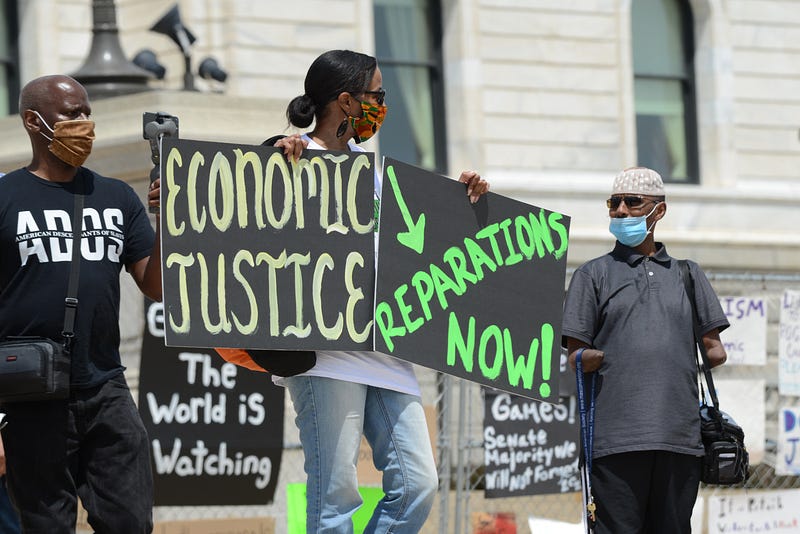
In the labyrinth of America’s historical narrative, the question of reparations for the descendants of enslaved individuals has emerged as a seismic fault line, shaking the very foundations of social justice and economic equity.
This once-contentious debate has witnessed a resurgence in recent years, taking center stage in popular opinion polls and political discourse, igniting fervent discussions nationwide.
The focal query: Could reparations serve as a catalyst to jumpstart the U.S. economy while addressing the long-standing wounds of systemic injustice?
Some Democratic Party leaders are increasingly willing to entertain the idea.
“New York launches commission to consider racial reparations,” reported Reuters on December 19, 2023. “New York Governor Kathy Hochul on Tuesday authorized a commission to consider reparations for the state’s role in perpetuating historic discrimination against African Americans, making New York the second U.S. state to launch such an effort.”
“The state will not be required to follow the recommendations of the commission,” Reuters was careful to note. “New York lawmakers and civil rights activists who attended Hochul’s signing ceremony at the New York Historical Society in Manhattan hailed it as a key step toward confronting the state’s legacy of slavery and resulting racial gaps in wealth, housing, employment, and criminal justice.”
“Prior to the American Revolution, there were more enslaved Africans in New York City than in any other city except Charleston, South Carolina, and the population of enslaved Africans accounted for 20 percent of New York’s population, while 40 percent of colonial New York household owned enslaved Africans,” said Governor Hochul’s office in a statement. “This was an integral part of the development of the State of New York, and the consequences of the institution of slavery — and subsequently, discrimination and systemic racism borne of that institution — can still be observed today.”
“Governor Kathy Hochul today signed legislation to continue New York’s leadership on racial equity by creating a new commission to study reparations and racial justice,” announced Hochul’s office. “This commission acknowledges the horrific injustice of slavery and will be tasked with examining the legacy of slavery, subsequent discrimination against people of African descent, and the impact these forces continue to have in the present day.”
Hochul’s decision was met with plenty of support, a similar effort has thus far failed to come to fruition in California, though advocates for reparations are mixed about whether to call the effort a success.
Nor is the question of reparations settled in California. Some of the recommendations made by a reparations task force were met with skepticism — “$5 million for each longtime Black resident? S.F. has a bold reparations plan to consider,” as Justin Phillips observed for the SF Chronicle last year — others received lukewarm support. Still, the majority of California voters continue to oppose cash reparations.
There are also budgetary constraints to consider.
“The Legislative Black Caucus next month plans to unveil the first handful of bills addressing recommendations the state’s reparations task force spent years developing,” wrote Holden. “Newsom and Democrats in 2020 cheered the creation of the group, which held meetings throughout the state to discuss the best ways to begin repairing centuries of racism Black Californians have endured.”
New York and California might not be the last states to consider reparations.
“Chicago’s progressive mayor Brandon Johnson claims REPARATIONS will help tackle ‘the cycle of violence’ amid a 17 percent surge in crime,” reported Nic White for the Daily Mail on December 28, 2023.
“Johnson’s 2024 budget includes $100 million for violence prevention, but also $500,000 to form a Commission on Restoration and Reparations,” wrote White. “The commission will study the issue and provide recommendations on whether and how to compensate Chicago’s descendants of slaves.”
“Johnson was asked about the latest crime statistics in Chicago that showed a 17 percent uptick in crime this year,” White continued. “Crime exploded across Chicago last year under his predecessor Lori Lightfoot, rising from 46,572 total complaints to 65,421 — though this was almost entirely driven by massive increases in car theft, burglary, and robbery. This year did not reverse the city’s fortunes as crime was up 64 per cent from two years ago, 68 per cent from three years ago, and 55 per cent from four years ago.”
Is Mayor Johnson right about reparations?
The premise of reparations hinges on the acknowledgment of the profound and enduring legacy of slavery — a dark chapter that not only marred America’s past but reverberates through its present reality. Proponents argue that reparations are essential to rectify the imbalances created by centuries of institutionalized oppression. It’s not merely a matter of financial compensation but a moral imperative to recognize and reconcile the historical injustices that continue to shape societal structures.
Amidst the fervor, economists and policymakers are grappling with the complex web of implications surrounding reparations. The debate intertwines notions of economic restitution with moral obligations, political feasibility, and the potential for socio-economic transformation. While detractors question the practicality and feasibility of reparations, proponents argue that it could inject a much-needed stimulus into the economy.
Advocates for reparations suggest that the infusion of capital into marginalized communities could fuel economic empowerment, fostering entrepreneurship, homeownership, and educational opportunities. By dismantling financial barriers and addressing wealth disparities, reparations could unleash a wave of economic productivity that benefits not only the recipients but the nation at large. The ripple effect could reinvigorate local economies, amplify consumer spending, and create a more inclusive economic landscape.
However, the intricacies of implementing reparations present multifaceted challenges. Determining eligibility, quantifying the extent of reparations owed, and devising a fair and equitable distribution mechanism are formidable tasks. Skeptics argue that reparations could be a logistical nightmare, fraught with administrative complexities, and could potentially exacerbate societal divisions rather than heal them.
(contributing writer, Brooke Bell)


