
The United States Has Always Been Dystopian For Black People
Science fiction doesn’t have a dystopian story worse than the reality of what was chattel slavery and its continuing legacy
Dystopia: an imaginary place where people are unhappy and usually afraid because they are not treated fairly. (Merriam-Webster.com)
I am blessed to still have my mother with me. At 70, she was alive during segregation in the South. The stories she has recounted to me of that period in history still leaves me reeling.
Like the time she and her cousin were walking home from school when a car full of white men pulled up beside them. One of the men stuck his torso out of a passenger side window, yelled “You filthy n*ggers!” and struck my mother’s cousin on her head with a metal bar.
My mother’s cousin bore a deep scar where she was struck for the remainder of her life. This is only one incident of the many my mother has shared with me about the stark differences in living conditions between Black and white people during segregation — a time period that isn’t that long ago.
Recently, I fell down a rabbit hole on YouTube and found myself watching a white couple reacting to The Hunger Games movies. The husband and wife team expressed shock and horror at the brutality of the powerful totalitarian government depicted in the films.
The wife even broke down in tears when a cat belonging to one of the main characters is endangered.
While I was watching this couple have visceral reactions to fictional oppressions they were seeing on film, I couldn’t help but think about how inured and callous white America is to the very real trials and tribulations of Black Americans caused by the legacy of chattel slavery.
Chattel slavery was a waking nightmare for millions of enslaved Africans. Its evil system is the very definition of dystopia — and unlike in science fiction, it was very real: the endless acts of sadism, brutality, terror enslaved Africans were subjected to in order to break their spirits and dehumanize them.
Families were ripped apart, and enslavers could beat, whip, maim, mutilate, rape, imprison, and murder enslaved Africans for any or no reason whatsoever with impunity.
Enslaved Africans were considered property with no human rights; this marginalization was codified into law here in the United States.
This fact alone is what differentiates chattel slavery from other systems of enslavement that came before it. Since enslaved Africans were considered subhuman, enslavers asserted they didn’t qualify for the inalienable rights promised by the Constitution.
Because of the whitewashing of this nation’s history, many white people have no true comprehension of just how insidious an institution chattel slavery was.
As much as I love science fiction, whenever it comes to dystopian narratives like the classic novel 1984 or the more recent The Hunger Games, I can’t help but think, “Black Americans have been subjected to and have endured over the centuries so much worse than what these stories imagine.”
But white Americans and other non-Black citizens want to treat chattel slavery and its continuing legacy as a mere blip in time in an otherwise pristine history of exceptionalism — a lie we have been inundated with as part of our educational system. Lies reinforced by the fairytales spun by Hollywood.
If you are a fellow sci-fi fan and enjoy dystopian stories, I challenge you to dig deep into the historical reality of the very real dystopia known as chattel slavery.
Learn about the horrific ways the transatlantic slave trade was constructed to capture, transport, and sell Africans into chattel slavery in the colonies which would go on to become the United States.
Dive into historical accounts of the extreme cruelty that was daily life for the enslaved. Uncover how ̶p̶l̶a̶n̶t̶a̶t̶i̶o̶n̶s enslaved labor camps were operated. Then consider how many existing enslaved labor camps operate as tourist attractions where people can have weddings and host parties.
Now just imagine people holding weddings and other special celebratory events at the sites of former Jewish concentrations camps like Auschwitz.
Enslaved labor camp sites serving as vacation destinations and tourist attractions? It’s insane.
It’s dystopian.
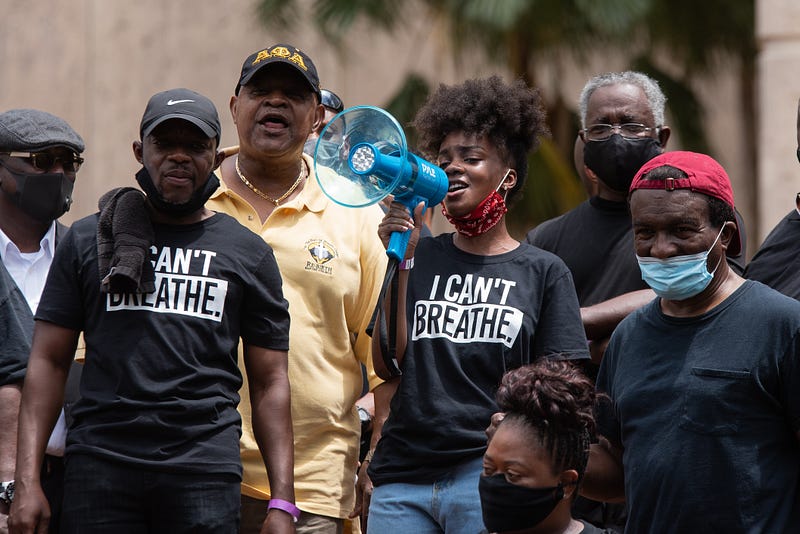
In the present day, Black Americans still continue to live in the dystopia known as the United States. One act of racism can rob an innocent Black person of their life, as in the case of Ahmaud Arbery, George Floyd, Trayvon Martin, Breonna Taylor, Sandra Bland, and so many others publicly known and those we will never know.
Black Americans still fight for economic and social justice. The wealth of Black families trails far below those of white families — and Black wealth is diminishing.
Racism is still very much alive and well.
Efforts like The 1619 Project, which put forth a more complete, complex, and nuanced history of this nation by centering the crucial role enslaved Africans hold in its founding and economic success, is met with vitriolic opposition by those who want to deny the truth and maintain the propaganda of American exceptionalism.
It’s insane.
It’s dystopian.
It’s the reality of life for Black Americans in the United States.


