
The Unguarded Cell
How to Recover from Insanity by Unlocking the Prison of Distorted Perception

“We are like prisoners in an unguarded cell. No one confines us against our will, and we have heard that the key that will release us is also locked inside. If we could find the key, we could open the door.
— Don Riso
Tis the season to be — over-scheduled, over-functioning, over-spending, over-indulging.
Tis the season to do — a list of to-do’s out of obligation rather than conscious decision-making.
Tis the season to — say “yes” when what serves our being would be to say “no.”
The thing is, no one changes until business as usual becomes so painful that change is the best option. Scratch that — no one changes until the alternative (not changing) becomes so painful that change is the ONLY option.
Humans are humans, after all — and we are excellent at homeostasis (an organism’s version of business as usual). Per Wikipedia:
Homeostasis is any self-regulating process by which biological systems tend to maintain stability while adjusting to conditions that are optimal for survival. If homeostasis is successful, life continues; if unsuccessful, disaster or death ensues.
The challenge with self-regulation is sometimes the survival skills we learn early in life no longer serve us. Our self-regulation becomes problematic and unhealthy. Yet, we continue business as usual.
Don Riso in Understanding the Eneagram, continues, “This is not a meaningless metaphor: we are prisoners of our ego, enchained by our fears, restricted in our freedom, suffering from our condition. No one prevents us from searching for the key that would free us. We must, however, know where to look for it and be willing to use it once we have found it.”
I can choose to do the same things over and over all the while expecting different results — (insanity!) — or I can do it differently today.
The key is knowing myself.
Humans are pattern finding animals.
Communication at its most basic is pattern finding. Finding patterns is how our frontal cortex has evolved to perform higher functioning that allowed us to solve our problems by working smarter, not harder.
One way our brains did this is by evolving to sort experiences into positive and negative.
In our not so remote past, a positive experience might be the discovery of a great store of berries or honey in a particular location.
A negative experience, in contrast — much stickier for our nervous system — could be the massive saber-tooth tiger that we narrowly escaped in a certain part of the forest.
That negative experience is one we remember with exquisite detail — down to the color of the tiger’s eyes and the smell of it’s breath — BECAUSE the memory of the life-threatening is crucial to our survival.
And that negative experience impacts our perceptions and behavior in the future — SO THAT we no longer risk walking through that part of the forest, even if it means going farther to get food or water.
The way we see the world is often distorted by fear or rage or resentment, or a particular trauma from the past.
And until we recognize our distorted perceptions, we remain trapped in the prison of our mind’s explanation of our perceived reality.
The key is transforming my very being.
Every moment has the possibility of delighting us, nurturing us, supporting us — if we are here to see it. Life is a tremendous gift, but most of us are missing it because we are watching a mental movie of our lives instead.
— Don Riso
What if I told you there was an ancient system that clarifies why we experience distorted perceptions, and why certain people perceive similar experiences in extremely different ways?
The Enneagram is that system.
The Enneagram identifies nine interconnected personality archetypes, each with different attributions.
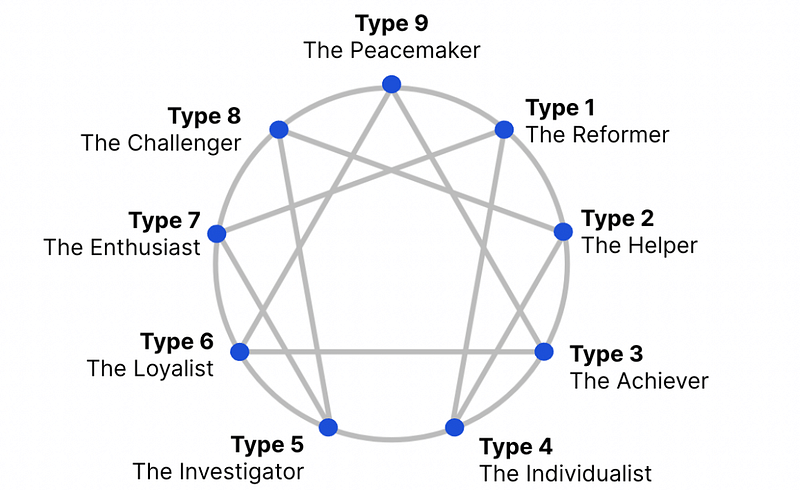
The wisdom of the Enneagram lies in its ability to illuminate the motivations and core beliefs of each type, offering self-awareness and personal growth to those who study it.
- The Enneagram helps individuals understand their core motivations, desires, and fears, providing insights into why they think, feel, and behave the way they do.
- It delves into the internal dynamics of each personality type, emphasizing the interconnectedness of traits and how individuals navigate stress and growth.
- It identifies both the strengths and challenges associated with each personality type, fostering a holistic view of oneself and others.
- It provides a roadmap for personal development by outlining paths for growth and integration, encouraging individuals to move beyond their default patterns.
- It improves interpersonal relationships by promoting empathy and understanding. It helps individuals recognize and appreciate differences in others.
- It sheds light on how individuals respond to stress and discomfort, offering tools for managing these responses in healthier ways.
- It fosters compassion for oneself and others, recognizing that each type has its unique strengths and challenges, and that personal growth is a lifelong journey.
The key is compassion for self and others.
The process of transforming the heart can be difficult because as we open it, we inevitably encounter our own pain and become more aware of the pain of others.
— Don Riso
The world is a hard place.
And there is beauty. And there is connection. And there is joy.
Studying the Enneagram can be a helpful process in self-knowledge and healing. But, such awareness is only useful if I treat myself, and others, with kindness — understanding our human conditioning and becoming willing to hold space for the grief and hurt that all humans experience.
The key is compassion for self and others. The key is observing my thoughts without judgement. The key is humility.
The key is courage.
Doing things differently is scary. Saying no to what no longer serves is scary. Other people may not appreciate it when we change the status quo.
I can say no to what no longer serves my highest good. I can say no, and that is a complete sentence.
I can say yes to what scares me when I know it is the next right step.
I can say yes and trust that all my needs are met. I can do my part and surrender to the flow of life, knowing the universe has my back.
And saying yes to my own life is scary.
But if not now, when? And if not me, who?
If we observe ourselves truthfully and non-judgmentally, seeing the mechanisms of our personality in action, we can wake up, and our lives can be a miraculous unfolding of beauty and joy.
— Don Riso
When I hold space for my own cracks, I find a deep well of compassion for all beings. When I make time for quiet contemplation and reflection, I come to know myself better. When I observe without judging, I make space for new awareness.
I find the key to the unlocked cell.
You can follow me on Instagram at RBGPoet. Thank you for your support and for reading my work. Click here to join Medium with my referral link.
For a great read on the power of observing rather than judging, here is another article of mine entitled The Sacred Space of Choice.