
The Unfathomable Wokeness of Kanye West
Decoding the internet’s most memeable music video and why we all missed the point.
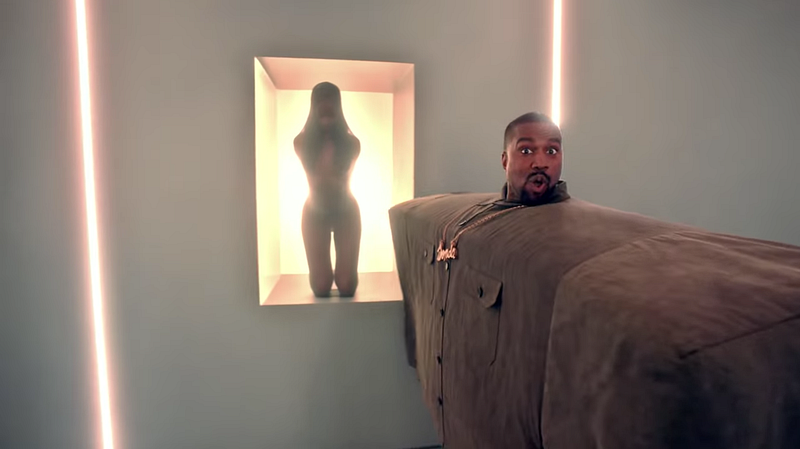
Kanye West is a public figure that allows no room for ambivalence. He’s either a problematic idiot or a brilliant, misunderstood genius — and both seem equally likely.
Recently, the fans of both theories have been forced to reconcile their differences to agree on one thing: the music video for West’s new track I Love It is one of the strangest things on Youtube. And now it’s the #1 song in the world.
Perhaps we have become so desensitized by the objectification of women in popular music that we no longer find it strange or inappropriate to sing along to a song whose chorus is “You’re such a fucking ho. I love it”.
Perhaps we are so blinded by the meme-ability of the video’s outfit choices that the words of the songs are an inconsequential detail getting in the way of us enjoying a harmless piece of pop art.
Perhaps Kanye West’s sometimes provocative (and often antagonistic) attitude, paired with his openness about his mental illness, caused us to dismiss this as just another instance of Kanye being Kanye.
Or maybe, just maybe, Kanye West is an artist whose latest work serves a deeper purpose than giving him a soapbox from which to announce that he’s a sick fuck who likes having his dick sucked.
So here’s another theory.
Not only is the video for “I Love It” a thoughtful satire on treatment of women in pop music, but it’s the only interpretation of the video that makes any sense.
Disclaimer: This is not an endorsement of Kanye West, his music, or his public behaviour in any way. It is a speculative commentary on a single piece of popular culture artwork. If you want to read the dissenting opinion to this essay please see here and here.
The backstory
A quick summary for the uninitiated: On September 6th, 2018 the inaugural PornHub awards took place is Los Angeles, California. The awards were co-creative-directed by Kanye West and longtime collaborator Willo Perron. At some point during the awards West debuted the music video for a new song called I Love It featuring 18 year old rapper Lil Pump and comedian Adele Givens. The music video co-directed by Kanye West and Amanda Adelson.
The combination of the song’s theme and the context of it’s unveiling should have caused many to question the meaning behind Kanye’s message. But instead it became the outrage that never was.
Yes, it is possible that West is as tone deaf as some people believe him to be, and misguidedly believed that the song’s chorus — “You’re such a fucking ho. I love it” — serves as a message of support and appreciation for the women being honoured during the ceremony. (i.e. acknowledging and appreciating their sexual liberation and saying that he, too, is a sexual deviant in the eyes of the public).
But upon further scrutiny that seems extremely unlikely. Because in order for that to be true it would mean that the organizers of the event, co-director Amanda Adelson, executive producer Spike Jonze, and Adele Givens, would all have had to have shared bizarre perspective.
Put another way; a lot of very smart people would have had to fail to see why this isn’t a good idea. Which makes me believe that they didn’t have to. Because they know something about the video’s messaging that we don’t.
Kanye West: The Director
Kanye’s history as a director, at least in the last decade, makes the possibility that the song and video are meant to be taken on face value seem almost impossibly unlikely.
Consider his resume:
In Runaway — the 34 minute short film that served as the visual accompaniment to My Beautiful Dark Twisted Fantasy he covered everything from identity and belonging to race politics. And in his most recent directoral credit — the controversial video for Famous — he offered a challenging and timely meditation on our obsession with celebrities, bringing up questions about how much ownership they have over the narratives surrounding their bodies and their lives.
Regardless of how recklessly arbitrary and impulsive his actions and opinions seem to be, the fact remains that every time West chooses to use film as a medium of expression it’s because he’s making a calculated and thoughtful critique of something. So why would he buck that trend by releasing a simplistic video that does nothing more than demean women, advertise his sexual appetite, and inspire memes?
He wouldn’t.
The true purpose of the video
Like many artists, Kanye’s body of work exists in perpetual conversation with itself. And the last word in that conversation would have come from Violent Crimes — the last song on his 2018 album ye.
In Violent Crimes Kanye reflects on his past relationships and treatment of women — behaviour that he now regrets as the father of two daughters of his own. The crux of the song is summed up pretty articulately at the beginning of Kanye’s verse:
Niggas is pimps, niggas is players ’Til niggas have daughters, now they precautious Father, forgive me, I’m scared of the karma ’Cause now I see women as somethin’ to nurture Not somethin’ to conquer
It’s unfortunate that, like many men, having daughters of his own was seemingly the only thing that led him to this realization (more on that later). But none the less Violent Crimes shows a version of Kanye that has an evolving perspective on women. A perspective that is more nurturing and, one can only assume, more respectful.
Taking I Love It on face value would be a disappointing remission back into the old Kanye (a la Kanye’s Workout Plan). That’s because I Love It is a self aware parody of the exact attitudes and behaviours towards women that Kanye is distancing himself from. And I would argue that both the song and video are one piece of art and are meant only to be understood through that perspective. I Love It (the song) becomes problematic when divorced from the video. Satire without context simply serves to perpetuate the ideas it mocks.
Decoding I Love It through a satirical lens
The intro
The video opens and closes on the same scene. Adele Givens is looking down on Kanye and Pump while delivering a monologue in which she talks about how women no longer need to fake orgasms.
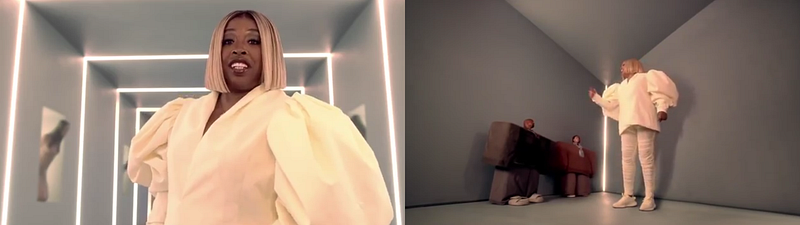
The monologue wasn’t created for I Love It specifically and rather was sampled (likely unbeknownst to Givens) by West from a stand up set Givens preformed in 1992. In the set she talks about how women can “say what the fuck [they] want and still be a lady”.
While on its face this is the strongest evidence for the “Kanye mistakenly thinking he’s an ally to sexually liberated adult performers” camp, it actually plays an important part in the video’s larger narrative.
While we as the audience can see, based on Given’s size, that the scales of power are tipped heavily in her favour, the lyrics of the song suggest that little Kanye and little Pump have a dramatically inaccurate perception of the relationship.
Among other things, I Love It a commentary on the attitudes of rappers who perform promiscuity in public but whose lives are dictated by their subservience to their significant others in private.
Lil Pump specifically is talking down to women as if they are unimportant and replaceable in his lyrics and yet both him and Kanye are following obediently behind Givens, eagerly listening and nodding along when talked to by her. This mirrors the common public narrative of men feigning concern and attentiveness to their wives who are usually depicted as nagging them.
This thread, if you’re not convinced yet, becomes increasingly obvious throughout the video.
About that hallway
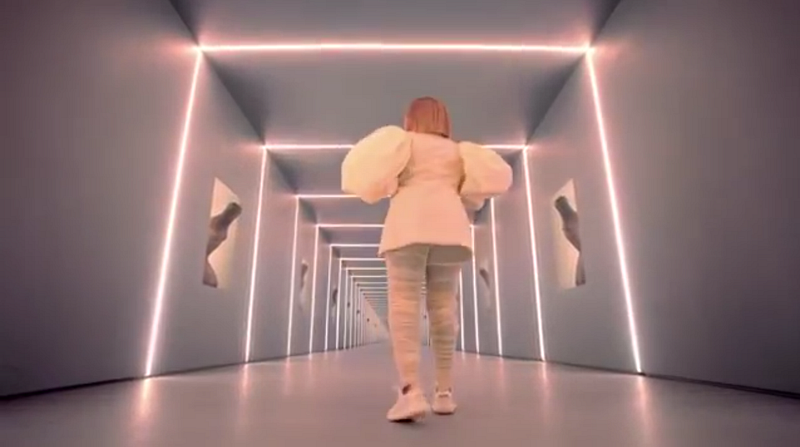
Aside from the first and lost shot, the entire video focuses on West and Pump following behind Givens as she walks down a hallway lined with naked, faceless women preserved in silicone.
There’s a lot to unpack here. But let’s start with the faceless nudes.
Firstly, and perhaps most obviously, the women are preserved as decorative trophies. This harkens back to Kanye’s own idea in Violent Crimes about seeing women as conquests rather than equals or people to be valued or admired.
The hallway is also seemingly endless which could be suggesting a number of things. The most direct is that it represents the attitude that men have to try collect as many of these trophies as possible. Another is that Pump and Kanye are chasing Givens in spite of the women already lining the walls. Meaning that either she will become one of them or that she is in fact different to them — a statement most men undoubtably make to the woman they hope to settle down with — and yet another indication that Givens represents the romantic partners of West and his peers.
Their facelessness is another layer of complexity that points to a problematic aspect of heterosexual relationships in general. By making the women faceless, West is commenting on the fact that the “hos and bitches” that rappers are referring to are an intangible, abstract idea of women — women that are mentally separate from those they know, respect, and love.
This reinforces the unfortunate reality that many men only deem women as being worthy of respect in relation to men. I.E. They should be respected only because they are somebody’s sister, wife, mother etc.
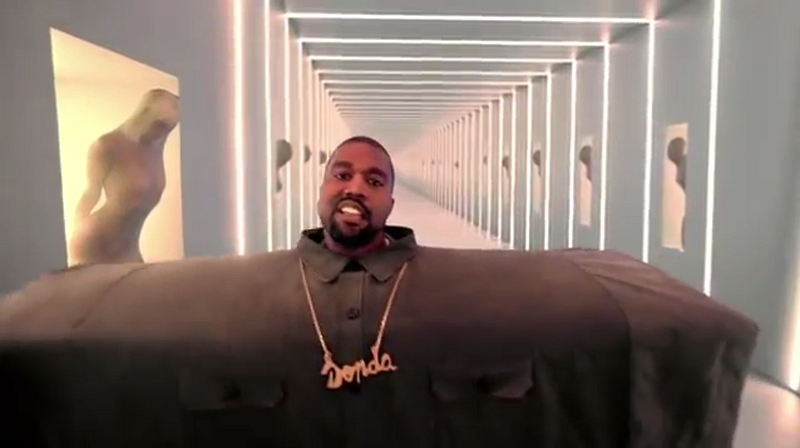
The irony of this symbolism is accentuated by the unavoidable fact that West is calling women hos and talking about his sexual appetite while wearing the name of his late mother, Donda, around his neck.
Behind the back
During the entire hallway scene we see Givens turn around only a handful of times. And how she reacts each time is extremely important.
For the most part we see Givens dancing along to the music both during Lil Pump’s verse and later during Kanye’s verse. But there are two notable exceptions.
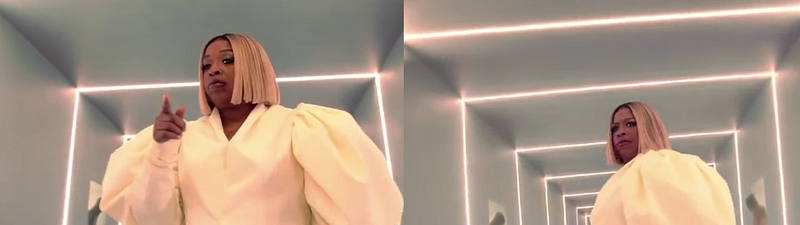
Those exceptions are once at the end of Lil Pump’s verse, when he resumes the chorus, and once at the end of Kanye West’s verse, when he says “bitch”. In both cases Givens us reacting to being called a ho and a bitch but is fine dancing along to the music when the men are talking about other women in a way that she feels is unacceptable to talk about herself.
This likely represents the conflict that many women experience when listening to rap music. Which is to say that they have to navigate a complicated middle ground between wanting to partake in and enjoy the music while at the same time opposing the way women are talked about in these songs.
Men, on the other hand, feel comfortable mischaracterizing their relationships with the women in their lives in front of other men, and even the world, but never to the faces of those women themselves.
Think that seems like a stretch? Not when you consider that the end of Kanye’s verse, where he calls Givens a “trifling ho bitch” and her reaction to being addressed as one, is almost certainly a reference to a famous Key and Peele skit with that exact premise.
Skip to 1:40 in the music video and then watch the clip below to see for yourself.
Sparkling or still?
The theme of misjudging the power dynamic of relationships re-emerges in Kayne’s bizzare monologue at the beginning of his verse:
When the first time they ask you if you want sparklin’ or still? Why you tryna act like you was drinkin’ sparklin’ water ‘fore you came out here?
This, to me, is the funniest joke in the video. This monologue a parody of the outsized importance that many rappers place on the material benefits they provide the women in their life. And in doing so act like the luxury lifestyle that they provide women makes it inconceivable that they would want to be with anybody else.
What is she supposed to do? Leave Kanye and go back to drinking still water like some sort of peasant?
This exact kind of attitude can be heard in Pusha T’s verse on Runaway, a song from West’s 2010 album My Beautiful Dark Twisted Fantasy.
24/7, 365, pussy stays on my mind I-I-I-I did it, all right, all right, I admit it Now pick your next move, you could leave or live wit’ it Ichabod Crane with that motherfucking top off Split and go where? Back to wearing knockoffs, haha Knock it off, Neiman’s, shop it off Let’s talk over mai tais, waitress, top it off
In which Pusha laughs at the idea that the woman would leave him because he can’t imagine somebody being able to give up a life of luxury to “go back to wearing knockoffs”. But Pusha gets a pass in this instance because Kanye specifically asked him to play the part of a douchebag for the song.
In the interview Pusha says that he was coached by Kanye to play the part of the douche for the song. And that West continually pushed him to be more braggadocios to get the effect he wanted.
This is important because it tells us that Kanye West has a history of using the rappers he features on his songs as bit characters rather than musical features. Which brings up another important question:
Why Lil Pump?
This, in my opinion, is the hardest piece of symbolism to solve. I have no problem rationalizing why this video appeals to Kanye but have a much harder time believing that Lil Pump joined the project because he wanted to be a part of an almost imperceptibly subtle criticism of his peers.
It could just be that Kanye genuinely really just likes the new generation of mumble rappers. That’s certainly possible. But that runs counter to the theory that Kanye was so calculated about the rest of the piece. And the content and quality of the verse itself seems to be in opposition to the fact that most rappers deliver some of their best performances ever under West’s guidance.
So the inclusion of Lil Pump must represent something. But what that something is is hard to decipher. It could be that Pump’s age and cockiness represents the exact bravado that I Love It is satirizing. It could be the hypocrisy in Pump calling women hoes while, at the same time, delivering lines like:
(I’ma fuck a bitch, tell her cousin) Your boyfriend is a dork, McLovin (dork) (McLovin; ooh, ooh, ooh) I just pulled up in a Ghost (Ghost) Fucked that bitch up out in London (up out in) Then I fucked up on her cousin Or her sister, I don’t know nothin’ (uh-uh, woo)
See also the Genius annotation of this line:
In this three line, sex-related rhyme scheme, Lil Pump claims to have had sex with a woman and then either her cousin or sister whilst out in London. Though there is nothing to back this up, it is completely possible.
My theory is that, whatever the reason, Pump wasn’t actually in on it. When you watch the video it seems fairly clear that he’s doing his best to follow Kanye’s lead. And while Kanye dances energetically during Pump’s performance, Pump does little more during Kanye’s than mouthing along to his verse.
That said it doesn’t mean that Lil Pump’s exclusion from the subtleties of the narrative was done maliciously. It only means that Kanye likely had a vision that he hid from most people, including the person singing the chorus of the song.
As we’ll discuss shortly it’s also very possible that Kanye West included Lil Pump in the song and video simply because he knew that the pairing would garner attention from the industry and the public. Or that he is featured for the reason any artist is featured on a song — in hopes that it will make the song more popular.
Why the outfits?
This has been the main focus of most articles and analysis of the video. It’s possible that West is reviving the mid-2000s video style of Missy Elliot and Ludacris. Which would make sense considering some of those iconic videos are directed by Spike Jonze, one of Kanye’s long time collaborators who directed many of the iconic videos in that era.
It’s also extremely likely that Kanye found himself agreeing with the attitude of David Byrne of the talking heads, who has said a lot of things that wouldn’t be out of place at all had they have come from Kanye himself.
But the answer could be more simple than that. The outfits give people a reason to watch and share the video. Kanye West is an iconic director who knows how to get his work shared and in the public eye. Without those outfits the video concept wouldn’t been notable at all. The satire would have either been too obvious or too obtuse for anybody to pick up. And to assume that the concept could be conceived of independent of the outfit choice is doing a disservice to the idea itself.
If nothing else Kanye is a marketing genius who knows how to get attention on his work. And by making the video for I Love It so unavoidably divisive and memeable he shows a masterful understanding of how the internet works.
The seemingly ridiculous video ensures that the song spreads far beyond the network of people who would usually take notice of his work because it’s being shared both by people who love it and are critical of it in equal measure. So the video is ubiquitous and unavoidable regardless of which side of the argument you are on.
And clearly it worked. I Love It broke the record for the most Youtube views in a single week for a hip hop video and quickly became the #1 song on the Billboard top 100 chart. The previous record holder, mind you, was Childish Gambino’s video for This Is America — a video whose social commentary was widely recognized, discussed, and praised, in a way that I Love It never will be.
Perhaps symbolism and satire are only appreciated when they perform subtlety. And the works that are genuinely subtle are doomed to be taken on face value.
The question is really whether or not Kanye, who has young children of his own, is acting irresponsibly by making a video and song that is both guaranteed to be shared widely and to be misunderstood by most of the people sharing it?
That depends on whether you believe an artist is ultimately in service of their audience or their message. But all indications are that Kanye has never cared about people understanding the statements that he’s tried to make with his art.
Do I really believe that I Love It is actually a complicated satire and not just exactly what it seems to be? I’m not sure. But it seems like there are too many coincidences for it to be entirely untrue.


