
Don’t Make Us Choose. A Missive To Adoptive Parents.
The unfair cruelty of secrecy
Exhausted, sweaty, jet-lagged, and anxious, I got off the elevator with no idea where to go so I turned left and wow, there was my mother at the end of the long, antiseptic hallway. Her tiny body — four feet, eight inches — and gleaming white hair, gripping a walker, a tall nurse walking beside her.
A day earlier my mother had emergency heart surgery. I was shocked they had her up and around. I smiled and waved even though I knew she couldn’t see me. Eighty-eight years on this earth has stolen most of her vision.
“Look at you!” I said.
It took her a moment to realize who it was.
“Oh! That’s my daughter!”
“Wow, where did you get your height from?” the nurse asked me.
The question stunned me, not because I’m unaware of our size difference, but because it’s been years since someone pointed it out. I’m five foot six and look nothing like my mother. I’m adopted.
As a child, people often asked who I looked like. Where did you get those blue eyes? I grew accustomed to the uncomfortable grip in my stomach when I lied and said, “My grandfather.”
I didn’t know where I got my blue eyes from. The other questions about my thick curly hair, height, athletic build, big boobs? No answers for those either.
When I lied, my parents didn’t intervene, correct me, reply on my behalf, “She’s adopted.” The pretending was implicit in our contract. Intended or not, their silence told me lying about my identity was acceptable, even encouraged.
No one should grow up believing who they are or where they come from isn’t worthy of proclamation. Imagine what that does to a child. The way smothering truth creates shame in an innocent body and mind.
I’ve spent my adult life undoing that shame. I found my biological family and speak openly about adoption. But in that moment, in that hospital hallway, at 54 years old, having traveled 3,000 miles to take care of my elderly mother, I felt like a child, too ashamed to answer honestly.
“It’s a mystery,” I said to the nurse. But as we inched forward, and I knew my mother couldn’t hear, I whispered, “I’m adopted. I just don’t say that in front of her.”
What?
What a bizarre thing to say. I churned with awkward regret. Even now, weeks later, I wonder what the best response would have been.
Imagine what it feels like to worry if answering a basic question about your height will hurt your mother’s feelings. Consider the pain of pretending. The charade begins the moment our records are sealed, birth certificates amended, names changed. They build every closed adoption on lies, and adoptive parents who don’t proudly celebrate their child’s differences conspire with the pretense.
So what happens when the truth comes out?
In 1999, I found my first mother, Gloria. She died in 1995 at 50 of colon cancer. I look just like her. Same height, hair, eyes, interests. When I showed my adoptive mom Gloria’s picture, she said dismissively, “You’re prettier,” and walked away.
The truth staring back at her was too painful, too threatening, and it challenged the facade she built our life upon.
In 2018, I found my first father, Hal, and his daughters, my half-sisters, Sarah and Sophie. Their blue eyes shine like mine. Hal’s face is almost identical to my son’s. My sisters and I look so much alike it’s strange we only share a father. My biological grandfather was a screenwriter, just like me.
Hal didn’t know about me. Gloria took the secret of me to her grave. She never told my father, her friends, family, or her husband of 23 years. These people whom the news of me shocked have accepted me into their lives, lovingly.
Finding my biological family has validated me in ways too deep for words and our relationships add immeasurable love to my life.
Yet my adoptive mother, my mom, the woman I love and I know loves me, keeps a “don’t ask, don’t tell” policy about them. Willful denial serves her ego and destroys mine.
In 1968, when she adopted me, social workers told my mother biology didn’t matter, to just raise me “as her own.” The sealed records of a closed adoption promised her I would never learn my first parents’ identities.
But here we are, 54 years later, and the truth is out.
It was 2019. We sat at a small outdoor table, sipping our iced teas, the clinking of ice against glass the only sound penetrating the thorny silence. A year had passed since I found Hal, Sarah, and Sophie. My mother’s refusal to speak about my father and sisters festered a wound within me.
“Mom, all that’s happened is I have more love in my life.”
“I know.”
She shifted uncomfortably. Born in the wake of the Great Depression, raised in the shadow of a World War, this conversation piqued her taciturn nature. I knew that. But I would not abide by the toxic rules of silence and denial.
“My relationship with them doesn’t threaten our relationship. What you’re doing does. I want to share this with you. You’re my mom and you’re refusing to talk about the most important thing in my life.”
She fought back tears.
“Mom, you get how fucked up this is, right? It’s like telling a gay child you accept them but not allowing their partner to come to dinner.”
“I’m afraid it makes you… regret your life.”
“They give me something you can’t, you give me something they can’t. Neither of you replaces the other.”
Our server arrived, placed our food down, and my mother changed the subject. We were done. That was the best she could do. At least she listened.
I’m not a sadist so I go along with the policy. She won’t ask, I won’t tell, and our relationship will stay limited and distant and my god that is such a shame.
Asking your child to conceal themselves, their truth, from you — the person tasked with loving and protecting them — is unbearably cruel. All it does is destroy the relationship you’re trying to protect.
How do you learn to love yourself, and be proud of who you are, if what makes you you is a source of secrecy and shame?
I spent much of my life wondering if I was good enough to love, since I wasn’t good enough to keep. For too long, I struggled with identity formation in the absence of genetic mirroring. I know I’m not alone. Adoptees are about four times more likely to attempt suicide than our non-adopted peers.
So to adoptive parents, I say this:
When you ask us to keep biological family, heritage, culture, race, ethnicity in a lockbox so it doesn’t threaten your idea of who we are — or the illusion of a type of family you’ve created — you worsen our struggle.
It’s not enough to express support or tacitly accept the existence of our first families. You must — if your adopted child wants it — welcome our first families. Adoption already split us in two, don’t make it worse.
You knowingly, willingly, raised a child born to other people, a child who may one day want to reunite with that first family. If you don’t actively support your adopted child by welcoming their first family, you are actively harming them.
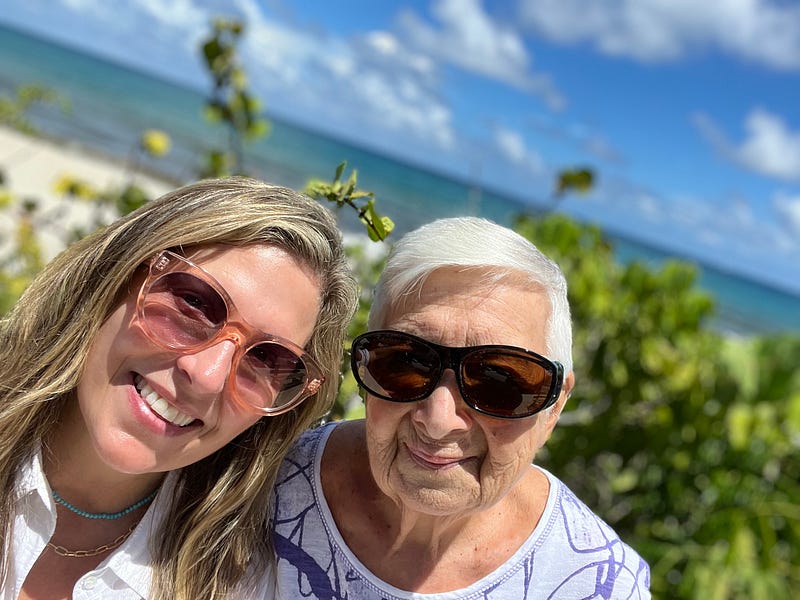
We drove north along the smooth road of AIA, the Atlantic Ocean sparkling on our right, the mansions of Palm Beach on our left. The day before, doctors released my mother from the hospital and she wanted to get out of the house, so we drove to see Mar-a-Lago. Besides Scrabble, tuna salad, hibachi restaurants, and my children, my mom and I share a disdain for Donald Trump and a love of long drives along the sea.
We paused in front of the former president’s manse, ogling at his supporters waving flags in the scorching sun. Continuing into town, I pulled over and parked so we could sit, take in some sea air.
“Come on, let’s take a selfie.”
We leaned toward each other and smiled at the camera. We sat for a few minutes, watching the tourists and deeply tanned natives on the beach. When the heat became too much, I helped her get back in the car and we continued on.
Admiring the ocean with my mother was magical. Her days are numbered and I live across the country. There won’t be many more moments like this. Moments where I forget what separates us and exist in the space that holds us together.
Maybe that’s what I’m trying to tell adoptive parents. Don’t make it so hard for your child, don’t push them away or force them to suppress who they are or ask them to choose because who they are scares you or their other family threatens you.
Love for our first family doesn’t take away our love for you, and the desire to know them doesn’t negate your parenthood. But demanding — explicitly or implicitly — a blockade, a DMZ between you and them with us in the middle erodes our relationship with you. It tells us you do not accept us in our entirety, an entirety we did not choose.
Three weeks later, I returned to Florida. This time, I found my mother prone on an ICU bed, thick tubes entering and exiting her neck like Frankenstein’s handiwork and me making her health-care decisions. This time, when she glanced at me, fear filled her eyes and she spoke through tears.
“Why am I here?”
“There was a complication.”
When the doctor entered the room, he explained to her that the clip inserted into her heart’s mitral valve opened, came loose, broke in half, and floated in her femoral vein. A surgeon cut her open to retrieve the clip and repair her vein.
“They got it all, mom. You’re okay.”
I stroked her bare shoulder, and adjusted the blood-stained hospital gown so it covered her skin.
Interminable hours turned into days before she healed enough to be out of danger. I stayed by her side, taking breaks for food and sleep and cigarettes, walks on the beach, my feet in the soft white sand, meditating to the sound of lapping waves. When she got home, I arranged for home health aides to take over her care. I had to return to my home 3,000 miles away.
She sat at her kitchen table tired, older, and sadder, drained of her typical feisty energy. I wondered if this would be the last time I would see her alive.
“Mom, I want one thing from you. Don’t leave me money or jewelry. All I want is for you to meet my biological father and sisters. Will you do a FaceTime with all of us?”
“Absolutely, I’d love to.”
Her response stunned me. Since 1999, when I found my first mother, my mom has not asked a single question about them. She never asked to see pictures or hear stories. Not when I flew to Paris to meet my first mother’s husband and best friend, not when I flew to Cape Cod to meet Hal or North Carolina to meet my sisters.
Each act of willful denial injected a poisonous irritant into our relationship. Now, unexpectedly facing the end of her life, she understood.
“Of course I’ll do that for you.”
An hour later, I sat beside my mom as the faces of my father and sisters popped up on my laptop screen. She started the conversation. Through nervous laughter and choking back tears, she said, “Thank you for creating my daughter. Thank you for giving her to me.”
Hal tearfully responded, “Thank you for raising her.”
What followed was an abundance of joy and love and laughter and stories. My mother feared a funeral, that my reuniting with biological family was the death of her place in my life. But on that phone call, she too experienced their love and instead of a funeral, we had a virtual party, a celebration of me and them and her and us. The “us” that is my family. The “us” that is me.
I awoke the next morning lighter. Magically, a burdensome weight had lifted from my soul and, just like that, decades of suffering eased and overwhelming peace filled my heart. In her ultimate act of love, my mother gifted me wholeness.
Years wasted, unfair pain incurred, my body and soul wounded. For what? For the venom of ego and fear. But now? Now I am whole and I have never loved my mother more.


