
The Unexpected Manifestation of a Wish
Many, many moons ago, media consumption for all age groups was drastically different than it was today. I grew up before the advent of YouTube, Netflix, and sundry. An innocent era where you didn’t find out in real time that the mega-rich author of one of your beloved childhood book series is a raging bigot who mouths off on Twitter instead of taking up racquetball while cruising to Tahiti on a half yacht, half Miyazaki-esque cat bus or some shit like they did when I was a twee depressed child in 1990.
And it was a deeply-cherished book series of many childhoods that turned into a major franchise, The Babysitters Club, that got a short-lived TV adaptation which only lasted one season. It’s mostly remembered by a cult following on LiveJournal and a few obscure Blogspot pages lurking betwixt the arcane depths of 90s Nostalgia Internet where you can do anything from replicate Reptar bars from Rugrats to drain your paltry retirement savings on mint condition Yikes erasers on eBay. If you bring it up to most people who were around in that time, chances are they don’t remember it.
It was a little shocking in retrospect, actually. A BSC movie didn’t arrive until 1995, and how come the show hadn’t ascended to this beloved 1990s institution like Saved By the Bell, Boy Meets World, and other live-action shows for kids who were too old for cartoons but too young for prime time TV? 1990 was when the 80s ended and the 90s began, giving viewers the most fortuitous dose possible of awkward and awesome. It turns out that the first attempt at a TV adaptation of the denizens of Stoneybrook, Connecticut had fizzled out like expired Pop Rocks for a couple reasons: network TV was uninterested and cable wasn’t as ubiquitous in 1990 as it would become later in the decade, but most interestingly, TV executives said that young girls were not a good target audience for a TV show. Their logic was that boys watched TV more than girls, who in turn read more than boys. Sure, there were girly cartoons like Strawberry Shortcake that still have dedicated shrines on Pinterest to this day, but adapting a book series aimed at young girls would equate to financial hemorrhage for the networks.
Ergo, HBO agreed to shoot one season employing fairly unknown actors with North Jersey cosplaying as Stoneybrook, Connecticut. It developed a cult following through video rental at the time and the Internet was primitive with a narrow reach back then, so the fans didn’t find each other on LiveJournal and 90s tween girl book blogosphere until the 2010s.
But as much as I adore analyzing and rambling about media I grew up with, this piece actually isn’t about the show despite referencing an episode. It was what the show manifested.
To give you a bite-size roundup of the first Babysitters Club TV adaptation prior to the Netflix series in the works at the time of writing, it was redolent with saccharine narminess that could only have been delivered when the 80s ended and the 90s began, like a diabetes-inducing dumpling made of Crinkles tucked inside a Fruit Roll-Up. Although a majority of the characters were true to the source material, the plots of the episodes were thinner than dollar store condoms and executed in a manner that made Roseanne singing the national anthem a few years later look like a night at Carnegie Hall.
But I say that with love, for there was much escape and respite to be had in this ludicrously wholesome world HBO forged in the fires of Ann M. Martin’s highly successful book series about an intrepid ensemble of tween girls with a passion for childcare. As a lonely and ostracized sufferer of child abuse, the few episodes of The Babysitters Club that I watched on the tapes my dad picked up from Blockbuster felt like this portal to a dream world I longed to enter, never to return to the hell I actually inhabited.
The girls would have arguments with classmates or neighborhood kids, but they weren’t subject to the kind of bullying leading to suicide ideation like I constantly endured. Sometimes, Stacy got into arguments with her mother and Claudia and Janine would show what diametric opposites they were, based on how the books made you think such opposing personalities couldn’t possibly be sisters even though that’s probably one of the few realistic aspects present. But Stacy didn’t come home to her mother threatening to kill herself like I frequently did, where one day she’d be like June Cleaver then the next day she’s rattling off this laundry list about how I ruin everything I touch and being hit by an 18-wheeler would be too kind for the likes of me. Claudia and Janine eventually make up, declare their sisterly love, and bake cupcakes together for the random Midsommar-esque sisterhood festival that took place for some reason. (I think the crew was bored and someone wanted to get a frosting-coated tax write-off.) She didn’t endure cruelty like having a sibling significantly old enough to know better put her fingers on the iron my mother left out for my father’s work shirts.
To say that this show forgotten in the annals of book-to-film and book-to-TV adaptations was escapism would minimize it. Games put dreams in me and provided an escape, as did the various byproducts of Hollywood that wended their way into our entertainment center. But something about The Babysitters Club hit so much closer to home and what I felt home should be. It wasn’t just my proximity to the setting when most TV took place in Hollywood or sound stages. It was this outright depiction of friends who had your back in this close-knit community that not only respected their autonomy and trusted them with their children. I longed for the show to come to life instead of the worldview that was forced upon me, an anathematic one where the constant cruelty was the point.
An episode I frequently watched was one about a sisterly feud over a stolen ring that turned out to be lost, which I cued up to the right spot.
https://youtu.be/MJ7FjBGDyhk?t=1046
One day, I was out on one of my mother’s many sojourns to off-price stores to go fill the bottomless void in her soul with more cheap tcotchkes in the name of capitalism. Bored and restless, I played hide-and-seek with my sister who who was way too old to be doing this and wound up underneath a rack of department store seconds. Amid the dust, stray tag tabs, and those plastic clips that kept garments secured to hangers, a ring peeked up at me. It was clearly not tagged merchandise and I curiously picked it up in true adventure game fashion.
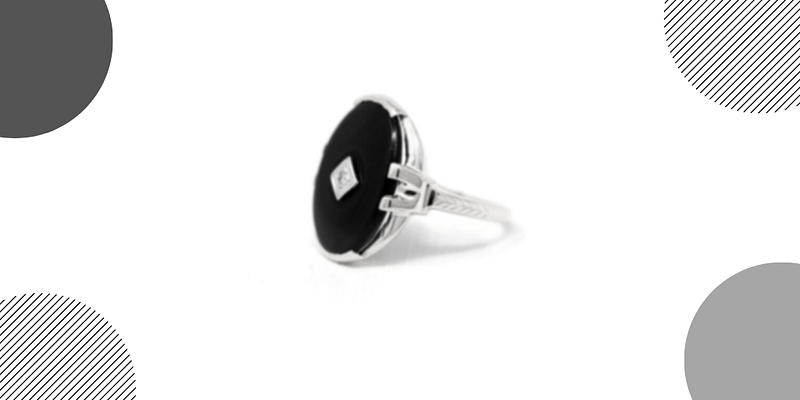
I couldn’t tell if it was precious metals or fashion jewelry, but it had a gold band, a smooth black oval stone, and what looked like a fixture for a diamond or diamond-like substitute in the middle but the stone was missing. What stunned me the most about this find was that while it wasn’t an exact replica of the ring from the TV show, it looked pretty damn close.
Was it a sign that I could make dreams come true? Not just a mere treasure found at random, but an indicator that life could be better if I kept the dream alive no matter what I had to endure?
Fast-forwarding to 2020, almost 30 years later, a quick peek on Etsy turned up rings in similar style as the one I found and the one from the show. They’re estimated to be from the 1940s-60s and sell for anywhere from $75–200. This particular Art Deco style was quite popular on the East Coast back in the 1950s, just like the jeweler on the show said.
The onyx Art Deco ring with the empty bezel became a treasure of mine just like the bracelet I received for defiantly going where I knew I belonged. I wore it to school and no one really commented on it, unlike how those little shits were otherwise obsessed with whatever I wore, did, breathed, existed, you name it. In my respite at camp though, other girls thought it was a beautiful relic I must’ve gotten from my grandmother or another older relative. I made sure that my prized possession stayed safe from pool water and would-be thieves.
It probably wasn’t worth much and I bet my parents were just happy I was easily amused with it instead of asking for a ring made of real precious stones. But the sheer actualization of hope and dreams that the ring symbolized were what made me feel like I was being protected while I wore it. I’d even make up little stories in my notebook that were half original thought and half fan fiction, speculating as to the setting stone’s origins and current whereabouts and if maybe that evil witch a few blocks away had it in her lair. That if I found the stone, I could escape that place and make a run back to the city where none of these people could hurt me again although I also wondered if my sister and I would reconcile in our adult lives like Flora and Bettina on The Babysitters Club did.
I forgot all about that ring and what it represented until I saw that this ancient series had the dust blown off the covers on Amazon and YouTube, and the scene in the jewelry store jogged my memory, opening up this floodgate of both precious memories and yet even more repressed trauma.
It wasn’t so much that I found a ring similar to the one on a short-lived TV show that was a product of its time, but rather that it was one of the first times that it felt like I willed something to happen so hard that the universe sent me a sign.
At this juncture of my life, I’ve experienced signs from the universe and complete flukes. And there’s times that we follow these signs and hold onto our dreams, but there’s forces we can’t overcome by passivity. As a child, I had no other option except to make the best of it and wait things out until I was 18. Which is a shitty way to spend one’s childhood, especially if you were lucky to have grown up in one of the last truly innocent times like the 70s, 80s, or 90s. But it’s often an unfortunate reality of abuse.
But when symbols of hope and respite appear, you go for them. You don’t have to let your dreams die just because shit is hard.
There’s only so much individual action one can take to follow their dreams: things must change systemically as well. Signs and happenstance alone cannot atone for poverty, abuse, and health conditions. But when you see a sign? You feel it in your bones that this is the universe telling you something? You go to your destiny and do your damnedest to reshape it along the way.
The most plausible supposition of how I found that ring is that countless women about 10–15 years older than my parents probably had rings just like that one, and one happened to lose hers pawing through the racks at Ross Dress For Less for factory second Ann Taylor cardigans with the same zeal as a toad burrowing in soft fresh dirt for shelter and I just so happened to find it.
Was it purely a manifestation of child’s runaway imagination? The constant state of disassociation I was in because of child abuse and bullying? Perhaps it was both. But of one thing I was certain, it felt like I willed the ring to appear. It was as if a sign had been sent that life wouldn’t be so soul-deadeningly awful and to have hope that the other worlds I saw through TV, games, and those sweet moments of respite at summer camp would soon be mine upon escaping.
It just sucks I had to wait until I was in my thirties to even realize just how much my trauma had informed my worldview and what unsafe tools it lent me to navigate the world. But while an errant piece of jewelry could accidentally give a child hope and dream fulfillment almost three decades ago, I wonder which less obscure symbols of hope to leave for younger generations.