
How to Write Better Headlines: the Ultimate Guide
How to write headlines using 15 powerful tips and tactics.

When we surf the web, we are constantly scanning and dismissing headlines.
In fact, eight out of ten people will read a headline, yet only 20% will read the rest. Why? Because almost all of them are either just so boring, way too formulaic, or stuffed with exact match keywords.
Oh sure, all the content marketing blog posts you’ve read tell you to use exciting words or a very precise keyword combination that matches your Google Analytics, and that the keywords need to fall within the first four words, and blah blah blah…(yawns) borrring!
In this article, I will give you the real deal: 15 powerful headline tactics used by some of the most influential bloggers and editors out there, period.
What’s a Headline? And Why Is It Important?
A headline is a promise. A first impression. It tells the reader why it’s worth investing their valuable and precious time reading your post when they could be doing something else.
Don’t assume you’re going to write an awesome post and slap on a basic headline, thinking it’s going to go viral.
Vice versa, it’s impossible to write a bad blog post and mask it with a great headline. You may hook readers with a compelling promise, but they’ll soon stop reading when it’s clear you’ve failed to deliver, breaking your trust before it even forms.
It’s crucial for your credibility that you keep any promises you make. Never promise a dollar and only deliver a quarter. Similarly, don’t bury a one-dollar post underneath a five-cent headline.
1. Make Your Headline Benefit-Driven for Your Target Audience
If you craft a headline without highlighting what’s in it for the reader, don’t expect them to read it. All great headlines are benefit-driven.
Whatever benefits you promised in your headline (saving time, improving productivity) make sure those benefits appeal to your target audience as well.
If the niche of your recipe site is healthy eating, your audience will be more motivated by the nutritional benefits or the calorie content of a specific recipe, rather than how to make it quickly.
And if your main focus is on how to cook like the professionals, visitors will be drawn towards a headline that promises to reveal the secret to depth of flavor or to show them how to impress their friends and family.
In other words, put yourself into the reader’s perspective and shoes because empathy is the greatest marketing skill.
2. Don’t Confuse Your Readers
Simplicity and being direct are vital. A confused mind always says no — in this case, a confused mind won’t bother clicking on a headline to continue reading if it confuses the crap outta them.
For example, “Have You Looked in the Mirror Lately?’’ is too vague. This headline can be about anything: acne, self-confidence, weight gain, dealing with wrinkles, etc. But how is a reader supposed to know what the post is about unless they click it?
Don’t leave them in a guessing game and don’t waste their time. Make sure whatever your content is about, it’s highlighted in the title.
Also, avoid using hashtags that might appear spammy, a pun that doesn’t work, or a headline that tries to be too cute. Seriously, you’re only confusing readers more.
3. Optimize Your Headlines for Both Google and Humans
If you want to get traffic from search engines, always optimize your headlines for both search engines and humans. Yet don’t beat yourself up trying to perfect your headlines for SEO alone.
Search engines have gotten smarter over the years. They can read, understand, and evaluate a web page almost as well as humans (and in some ways, better).
This means, you don’t have to use the exact keyword phrase you want to rank for in the whole headline. Plus, it restricts you from getting creative, causing your titles to appear dull to the human brain.
Today, Google puts more weight on other factors when ranking pages, including quality back-links and social shares.
Long story short, you can add your keyword phrase or keyword to your headline but don’t tailor it just for SEO and completely forget about your readers.
Keep Headlines Short And Catchy
The length of your headline is also important for SEO and user experience. Keep it short and catchy.
In search results, Google and Bing display about 63 characters of text. Yahoo! reads 72.
If you go above that, your headline will get cut at a certain point in the search results, which will look something like the image below.
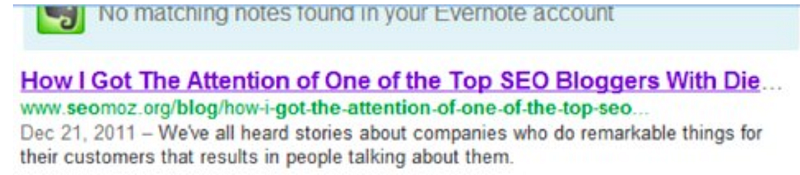
This means a reader won’t be able to read your entire headline and won’t bother clicking to read the rest.
4. Start With an Angle
To craft an irresistible headline, first you must find your angle or main focus. Many would say it’s better to write your content before creating the headline, but the other way around is always better.
Why?
Because when you start with the title, you’ll have an angle in mind that will allow you to write crisp, well-structured content with a clear mind and focus.
Vice versa, write the content first, with no clear strategy or angle in mind, and you may not be able to make a compelling promise when it’s time to write the headline.
Why?
Because the content itself is not compelling.
Examples
Let’s say you’re writing about a Zuppa Toscana recipe. Great. But what’s your angle?
- “Fast Zuppa Toscana”
- “Healthy Zuppa Toscana”
- “Cheat’s Zuppa Toscana”
- “Luxurious Zuppa Toscana”
- “Traditional Zuppa Toscana”
- “Zuppa Toscana with a modern twist”
- “The best Zuppa Toscana recipe ever”
- “Zuppa Toscana on a budget”
Once you’ve got your angle, it’s time to go deeper.
For instance, “fast” (as an angle) is vague. And vague is dull. The difference between dull writing and engaging writing comes down, in part, to concrete details. Be as specific as you can:
- Vague: “Fast Zuppa Toscana”
- Specific: “Zuppa Toscana in Under 10 Minutes”
- Vague: “Traditional Zuppa Toscana”
- Specific: “Zuppa Toscana Like Grandmother’s Old Recipe”
- Vague: “Healthy Zuppa Toscana”
- Specific: “Zuppa Toscana With Half the Calories and All the Taste”
- Vague: “Budget Zuppa Toscana”
- Specific: “Zuppa Toscana for Less than $10”
Another possible angle is the style of your post. If you’re humorous, say, promise them a lighter look at the topic in the headline:
- “How NOT to Make Zuppa Toscana”
- “My Zuppa Toscana Disasters (and How to Avoid Them)”
5. Don’t Completely Abandon Classic Formulas
Check out these fill-in-the-blank headline formulas.
- “How To _______ and ________”
- “Why ________ Isn’t ___________”
- “How I ________________”
- ‘’How to Get _____ in Half the Time”
- ‘’How You Can _____________, Too”
- “7 Ways to __________”
- “Now You Can _______ and ________”
- “The 3 Secrets of ______________”
- “Get Rid of ________ Once and for All”
- ‘’Who Else Wants to ____?’’
Yeah, yeah… I know, it’s hard to get excited over these headline formulas. They’re so overrated. And what’s the point of using them when everyone already is? Wouldn’t that make you unoriginal?
Well, not really. The reason why everyone uses these headline formulas is that they’re classic, and the reason they’re classic is because they work.
The trick to using headline formulas is to get creative and spice it up. If you fill in the blanks with uninspiring words, you’ll still end up with uninspiring headlines.
If your topic is making Zuppa Toscana and you’ve nailed down your specific angle, it becomes easier to brainstorm something interesting to add to the blanks.
Take a look at these examples
Boring: “Now You Can Make Zuppa Toscana and Be Healthy”
Better: “Now You Can Enjoy Tasty Zuppa Toscana and Not Worry About the Calories”
However, you don’t have to restrict yourself with only fill-in-the-blank headlines. Tinker with the words until you come up with something appealing:
- “Quick Zuppa Toscana: A Super-Tasty Soup in Under 10 Minutes”
- “Zuppa Toscana With a Spicy Twist (Your Grandmother Will Hate It)”
6. Don’t Dare Forget Your Adjectives
Even though a title is the same with or without an adjective, powerful adjectives make it sound more exciting and useful.
Don’t be afraid to add a punchy or emotive word to your headline. This is vital to enticing that all-important click, and it can help encourage sharing.
Examples of powerful adjectives:
- Effortless
- Painstaking
- Awesome
- Kiss-ass
- Inspire
- Powerful
- Mind-blowing
- sensational
- Free
- Incredible
- Essential
- Absolute
- Strange
- Irresistible
- Amazing
- Mouthwatering
7. Go the Negative Route
Adding negative words like No, badass, never, worse, fear, kill, bleed, war, dark, or loser in your headline pulls readers in.
The headline “5 Easy Ways To Improve Your Photography Skills’’ is OK, but add a dash of negativity to it and you’ll end up with something even better, like “For Best Results: Don’t Ever Take Pictures From This Angle.’’
When should you use or avoid negative headlines?
Negative headlines work best when used to alert and inform. Negative headlines shouldn’t, however, be used to imply a connection between the negative thing and the person reading the article. For instance:
“Stop Marketing Like a Spammer: How to Gain More Email Subscribers The Legit Way”
Reader’s reaction: “Umm, who you calling a spammer?’’
These types of headlines can leave the reader feeling attacked or dissatisfied — not the reaction you want to expect from your readers.
Using Negativity to Stimulate Curiosity
Negative headlines work well when used to engage your reader’s curiosity. Sure, we all love stories of triumph and accomplishments. However, subconsciously, we’re also drawn to the kinds of tabloid headlines that reveal a seedier, more secretive side to life.
With that being said, you can also use negativity to stir up a desire to read more.
Check out these examples
- “7 Things Your Partner Will NEVER Tell You (Unless You Know How to Ask!)”
- “10 Disturbing Secrets Every Waiter MUST Lie About to Keep Their Job”
- “10 bitchin’ tips for getting over your EX”
- “Never Write a Boring Blog Post Again”
- “How I had fun once, it was terrible”
- “When Doctors ‘Feel Rotten’ This Is What They Do”
8. Take Advantage of the Curious Human Mind
Sites like Upworthy and Distractify have gained millions of clicks by taking advantage of a psychological phenomenon known as the information gap or the curiosity gap.
Professor George Loewenstein from Carnegie Mellon University coined this term to describe the gap or space between what we know and what we want to know.
“When we notice a gap in our knowledge, it produces a feeling of deprivation. This causes us to go looking for that piece of missing information so we can stop feeling deprived.”
When you apply a curiosity gap into a headline, it creates an intriguing state that the reader wants to know about. This aching feeling to know causes them to click the headline to satisfy their curiosity and fill that gap.
The awesome formula for the curiosity gap goes a little something like this: [Rare, awesome or unique thing] + [Desirable outcome] = Curiosity gap
A few headline examples
- “A Brave Fan Asks Patrick Stewart a Question He Doesn’t Usually Get and Is Given a Beautiful Answer”
- “The Countries Where It’s Easier to Become a self-Made Billionaire”
- “Within 5 Seconds, You Won’t Like Him. By the Time He Laughs, You’ll Hate Him”
- “The Doctors Thought His Mom Would Reject Him. I Bet They Were Surprised With Her Reaction”.
- “How to Lose 20 pounds in 30 days (While Eating the Same Calories )”
All these headline examples have one thing in common: They tease the reader with a potential mystery (the gap), where they have to continue reading to solve that mystery (fill in the gap).
9. A Little Extra Something
A little extra something is quite similar to the curiosity gap. It’s a technique used by many popular blogs like Buzzfeed, ViralNova, and Smartpassiveincome. The tactic works best with list posts. The whole idea is to start with a listicle headline and then mention a particular element of one of the items.
Examples
- “12 Asian landscapes. The last one blew me away”
- “5 ‘Five-Minute Or Less’ Blogging Tips That Yield Big Results. I’m Using Tip #1 in This Title”
- “9 Things No One Tells You About Blogging. One of Them Really Sucks”
- “10 Ingredients of a Happy Marriage: Number 7 Is Impossible!”
The last part of these headlines, which I bolded, is where the little extra is, and it seems to spark up a curiosity gap, causing the reader to click to satisfy their curiosity and fill that gap.
10. Famous People Alway Spark Curiosity
People love reading posts that are inspired by famous people either because they love them or hate them.
They want to emulate the success of famous businessmen, like Bill Gates or Steve Jobs, and they want to look like beautiful celebrities, such as Beyonce or Angelina Jolie. Adding famous names to your headline can spark up some inspiration to read more.
Examples
- “Jennifer Lopez’s Secret to Getting Glowing Radiant Skin”
- “21 Life Lessons From Steve Jobs That Will Instantly Change Your Life”
- “10 Ways to Get to Oprah Winfrey’s Net Worth in Just a Year”
You can even use names from influencers in your niche:
- “The Back-Linking Strategy That Pat Flynn Used to Get Over 100,000 Email Subscribers in a Month”
11. Audience Reference
The audience reference headline highlights what type of audience the post is intended for. This headline is great because it causes the reader to immediately feel known and named. How can one possibly resist clicking to read more when it’s screaming, “that’s for me!’’
Examples
- “For the Woman Who Is Older Than She Looks”
- “For the People Who Want to Write — But Can’t Get Started”
12. Call-to-Action Headlines
Often, a call to action is found at the end of the content, but that doesn’t mean you can’t put it in your title as well.
Call-to-action headlines are best used to attract readers to sales and special promotions. This strategy is irresistible, especially when you throw in the benefit of taking the action.
A great example comes from Neil Patel’s popular marketing blog, Quicksprout. Take a look at this title for his free course:
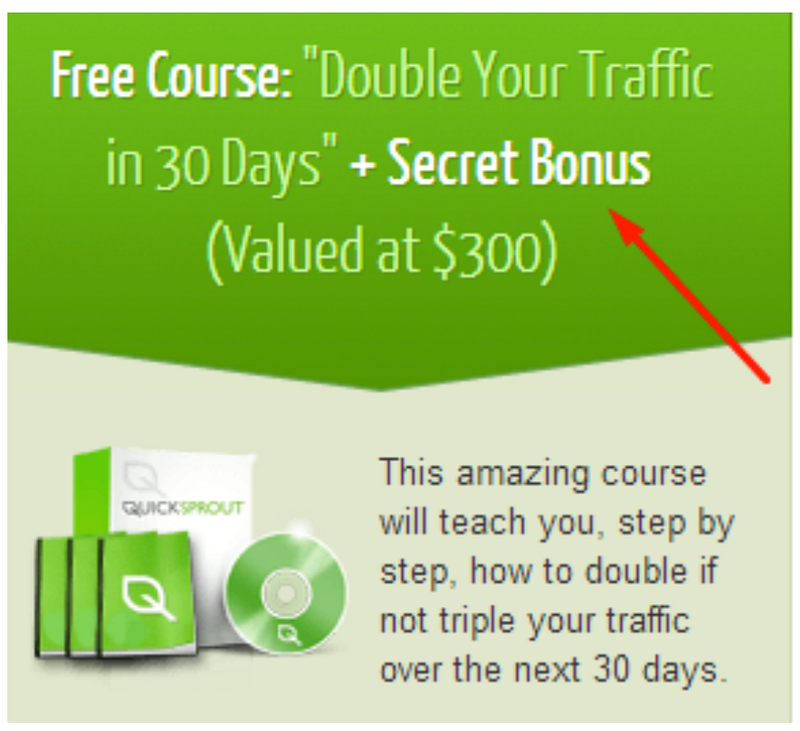
“Free” grabs the reader’s attention; I mean, it’s free! Paired with the “Valued at $300,” this creates the idea we’re getting the monetary value equivalent of $300 for free.
“Double Your Traffic in 30 Days” is the promise — 30 days is very effective because it’s realistic.
“Secret Bonus” is an ultimate buzz phrase, but it still creates that need to know in our heads.
Collectively, this is a well-crafted headline optimized for generating leads.
Adding a sense of urgency with something like “Limited Time’’ will make the headline even more tempting because it causes the reader to feel like they’ll miss this free $300 course if they don’t get it now.
13. The Jeopardy Effect
The Jeopardy effect is named after the famous Jeopardy show. This effect is perhaps part of its secret to success. The whole idea comes from the way contestants must respond to Alex Trebek on Jeopardy. Competitors lose when they get the correct answer but failed to offer it as a question. Turns out, there’s an important lesson there for marketers and writers, too.
After doing numerous experiments, Norwegian researchers found that using the Jeopardy effect in headlines has increased headline clicks and outperformed declarative headlines by 140–150%.
In one experiment, they posted separate headlines on Twitter using similar accounts.
Declarative e.g., “The Hunt for Status in the Advertising Business”
Question e.g., “Why Are Advertisers So Obsessed With Winning Prices?”
Results:
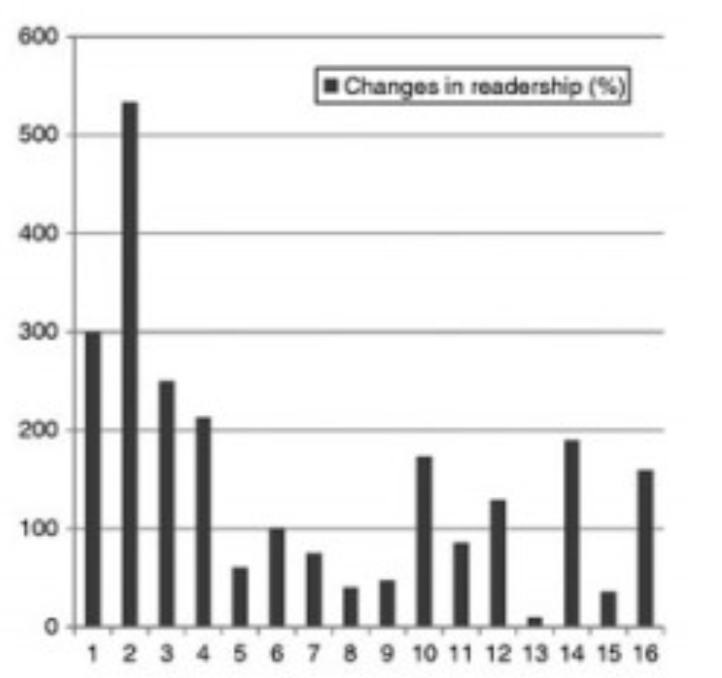
As illustrated in the graph, in every experiment, the question headlines drew more traffic and even multiplied in some cases.
Norwegian researchers found that the click rates of question headlines increased even more when the headline is self- referencing, i.e., referring to the reader.
According to the legendary copywriter Robert Bly, the question should be one that the reader can empathize with or would like to see answered. This puts them in a curious position for an answer. This causes them to continue reading to get an answer, meet the challenge, and discover the benefits.
Example
- General Question: “Are Bosses All Jerks?”
- Self-referencing: “Is Your Boss a Jerk?’’ — This one gets more clicks
Sometimes, the question can be answered with a yes or no, and that’s the end of it. This may cause some readers to feel like, “what’s the point of clicking to read the article when I’ve already answered the question?”
A powerful trick to stop a reader from having this thought is to allow them to answer the question with a yes/no but to phrase the question so the reader has to read the post to learn more.
Here is an example: “Are You Paying Too Much for Your College Tuition? How to Tell.”
The beginning of the headline can simply be answered with a yes or no, but the reader is immediately faced with how to tell. That small addition to the headline makes a huge difference because it sparks up a curiosity gap.
14. Our Brains Love Lists
Buzzfeed has proved to us that readers love listicle headlines and posts. Just as the human eye is drawn to contrasting colors, we’re also naturally drawn to the juxtaposition of digits resting beside the text. A list gives readers a clearer idea of what to expect in a post, as well as promising a quick, scan-friendly read.
Remember to always write numbers as numerals instead of spelling the numbers out.
“10 Beauty Tips Every Lazy Girl Must Know’’ draws more attention then “Ten Beauty Tips Every Lazy Girl Must Know.”
15. Convey a Sense of Urgency
Rather than taking action, humans love to procrastinate. We can’t help it. So how can you pull a reader out of that procrastinating stage and make them take the desired action?
By using the sense of urgency approach.
This technique always brings in high conversion rates when used right. It pushes someone to continue reading because they’ll start feeling like they’ll miss something really important if they pass on the article.
Keep in mind, the urgency approach doesn’t always work. A headline that urges action unnecessarily can be seen as empty hype, making it less likely to be successful.
The sense of urgency approach is more powerful when you:
- Tailor your offer to your audience
- Tailor your audience to your offer
There are several different ways to apply the sense of urgency approach.
Focus on adding urgent words
Add words like now or today to the end of your headline.
Examples
“7 Ways to Grow Your Blog Right Now’’ is far more compelling than “7 Ways to Grow Your Blog.’’
Alternatively, you could increase urgency by implying the effects of ignorance, e.g., “Are You Making These Mistakes That Almost Every Seasoned Property Investor Makes?”
When a potential property investor reads this headline, they automatically think, “Hmmm…maybe I am making some of these mistakes. I MUST read this article NOW to find out.”
Another approach is to create a deadline.
Create a deadline
Use time-sensitive language phrasing and wording such as “ends tomorrow,” “good until (date or time),” or “offer expires (date or time).”
If you don’t want to create an exact deadline date, you can still apply the same strategy using time-sensitive language in a general way, e.g., “limited-time offer.”
Create demand with scarcity
Another way to convey urgency in your readers without relying on deadlines is to emphasize or create a sense of scarcity, e.g., “Get it before it’s gone,” “Only 7 spots left,” or “While supplies last.”
Whether you’re selling tickets for a concert, or merchandise, reminding your audience that you only have a limited and rapidly dwindling supply of something can help push those fence-sitters over the edge.
Also, avoid lying about the limited supply of your product or service. If people rush to buy a so-called limited ticket only to see there are plenty more a month later, you’ll have angry customers who have lost your trust. (Trust is very important in business.)
You’ve made it to the end! Pat yourself!
I hope you enjoyed reading and found the strategies helpful. If you know someone who can benefit from this post, feel free to share it with them.
Cites and Sources
Jacob, Sherice. “Do Negative Headlines Work?” Search Engine Journal, Search Engine Journal, 25 Apr. 2010, www.searchenginejournal.com/do-negative-headlines-work/20404/#close.
Lai, Linda & Farbrot, Audun. (2013). What makes you click? The effect of question headlines on readership in computer-mediated communication. Social Influence. 9. 289–299. 10.1080/15534510.2013.847859.