

The Ultimate Guide to Money and Happiness
“ We hold these truths to be self-evident, that all men are created equal, that they are endowed by their Creator with certain unalienable Rights, that among these are Life, Liberty and the pursuit of Happiness.” — The Declaration of Independence
Those are some of the most famous words in American history, and they continue to resonate as strongly today as when they were first penned in 1776.
If you’re anything like me, you probably take life and liberty for granted and are most preoccupied with the pursuit of happiness.
You’ve also probably realized that money is somehow tied up in the pursuit of happiness in a very significant way.
Heck, even the Will Smith movie “The Pursuit of Happyness” (deliberately misspelled) was largely about the financial woes of a single dad.
You probably think that you would be happier if you had more money. I often think the same thing, so does everyone else.
What’s interesting is that we all know that there are plenty of counter-examples. Celebrities who make more than we could dream of who are deeply unhappy right up until their early passing when they “accidentally” overdose on sleeping pills.
So it should be pretty obvious that more money doesn’t always equal more happiness, yet chances are that you are convinced it will in your situation.
You might actually be right. You might be very wrong. In this article I’m going to do my best to untangle how to know which is true in your situation. I’m going to look at the relationship between money, spending, and happiness to see what we can learn about how money really relates to the pursuit of happiness.
The Fulfillment Curve
One of the key insights of the personal finance classic Your Money or Your Life by Joe Dominguez and Vicki Robin is that the relationship between spending and happiness is not linear.
Whether they know it or not, most people have this idea in their head that more money=more spending=more happiness. That’s true sometimes, but not all the time.
The model that we have in our head looks something like this:
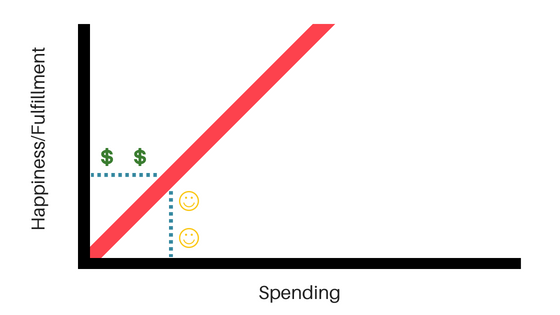
As spending goes up, happiness goes up as well. According to Dominguez and Robin, the truth looks much closer to this chart:
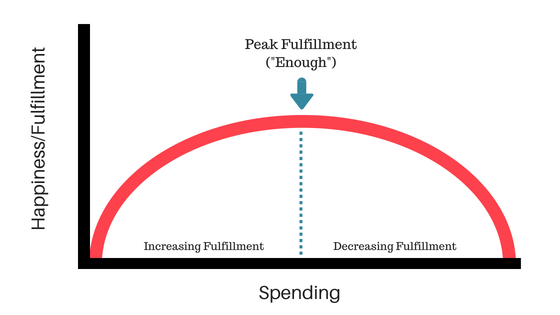
Spending does bring happiness, but it’s subject to diminishing returns. The more you spend, the less happiness you receive in return.
In fact, eventually you reach an inflection point where more spending actually makes you less happy and takes away from the fulfillment you’ve built.
This inflection point is the powerful concept of “enough.”
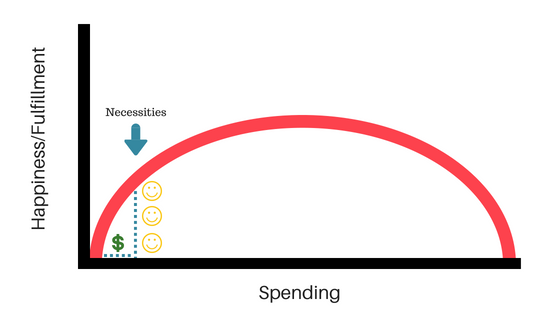
When you are struggling to cover the basics, more money=more spending=more happiness.
Life can be pretty stressful when your ability to acquire food and shelter are in doubt.
This is especially true if you have someone to take care of. Imagine being a single parent, struggling to find work. It’s easy for your whole identity to get wrapped around your ability to provide for your child, and an inability to do so is crushing.
It’s pretty hard to feel good when no one in your family has a full belly.
Chances are, if you go from dead broke to having any money, you will spend it on necessities. This will vastly improve your quality of life and bring you tremendous fulfillment.
Here’s how it looks on the fulfillment curve:
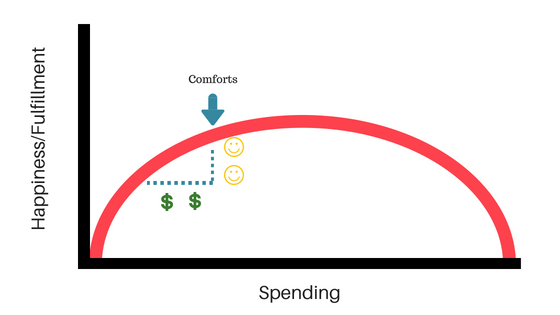
Once you have the basics, you can start moving to the adding some of the comforts of modern living. You can buy furniture and a wardrobe that’s suitable for the various situations you encounter, and even a washing machine to launder the clothes so that you don’t need to do it by hand.
Spending goes up, and so does happiness, but not nearly as much as when you were first able to put food in your belly:
The final rung on the spending ladder it to move on to luxuries. Now you can buy really nice clothes, fancy electronics, shiny cars.
You can take a nice vacation instead of a cheap staycation.
You can go out to eat and literally have people serve food to you like you’re a king (side note: if you aren’t deeply grateful for the ability to eat out and can’t see that it’s a miracle that has been unavailable to 99% of the people who have ever lived, you need to work on your gratitude muscle).
Luxuries do keep bringing you happiness, especially when you are properly grateful, but your dollar doesn’t stretch as far on this part of the curve:
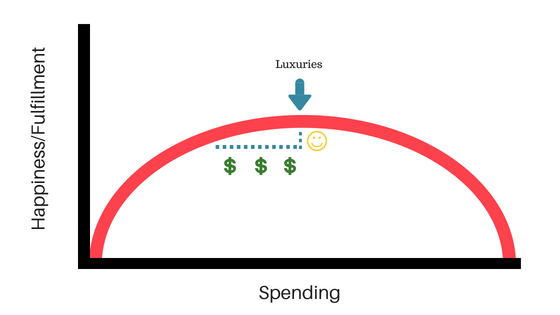
After peak fulfillment, more spending = less happiness…
This is probably a hard one to wrap your head around. How can more spending lead to less happiness?
The primary idea that Dominguez and Robin put forward is that happiness starts to decline due to the introduction of clutter.
More spending often involves more stuff and more stuff means more to take care of and to occupy your mental energy.
Let’s try a thought exercise. First, imagine a clean beautifully decorated room. Once you have that picture in your mind, imagine an ugly, messy room.
Which one had more stuff?
How did the messy room make you feel?
Clutter is an ever-present emotional burden even when we aren’t consciously aware of it.
I’d like to offer another example of spending decreasing happiness. For this example we’ll look at spending on a single item: Coca-Cola.
Now, I’ll let you in on a secret: I think sugar is evil, but I have a weakness for Coke. I still drink it on Saturday — which is my cheat day — but I used to drink as much as I could get my hands on.
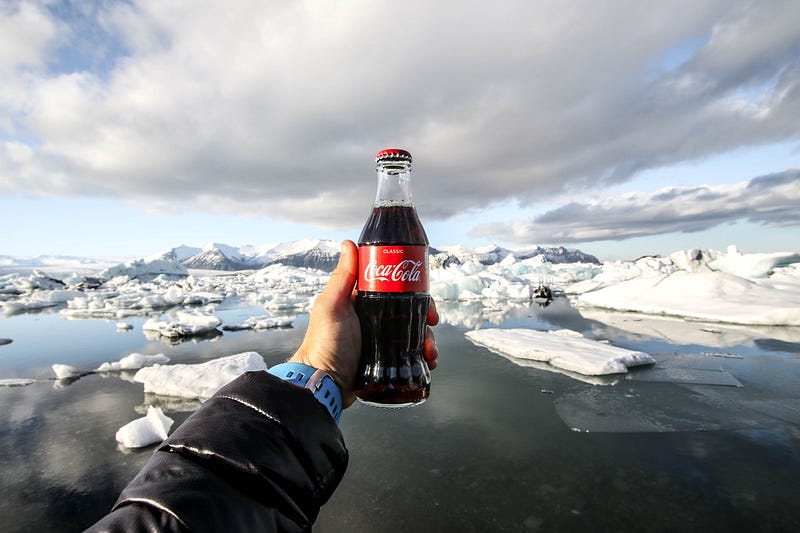
The stuff is like the nectar of the gods. It’s liquid gold (side note: my wife’s comment when reading that line was “liquid gold is what they call breast milk, but I’ll allow it”).
Surely as delicious as Coca-Cola is, the more you buy the happier you will be, right?
Well, in the beginning yes. Buying some Coke is certainly better than buying no Coke. You’ll keep getting happiness from buying more, but each additional Coke won’t bring the same satisfaction as when Coke was a rare treat.
But after a while, Coke just kind of becomes part of your routine. It no longer brings you any unique enjoyment, it just accompanies your meals in much the same way water would have.
Unlike water however, you begin to notice some disturbing trends. Your teeth are becoming yellow. Your waistline is expanding. Your blood work indicates that you are developing early signs of chronic disease. You seem to be spending more than you want to and never have as much at the end of the week as you thought you would.
Your Coke consumption has gone too far. You’re past the point of peak fulfillment and every additional Coke you buy carries the double whammy of costing you more money AND making you less happy.
The solution is simple: cut back.
You don’t need to eliminate something you truly enjoy from your life entirely, but you should carefully consider whether cutting back will make your life (and your finances) better.
For me, trying to give up Coca-Cola entirely sounds about as enjoyable as having teeth pulled. But I know there are times in my life when I was beyond peak fulfillment and needed to cut back.
The amazing thing is that if you are beyond peak fulfillment in any given area, you can cut your spending and actually get more happiness. Or, you can keep cutting further and get to the same happiness with a LOT less spending:
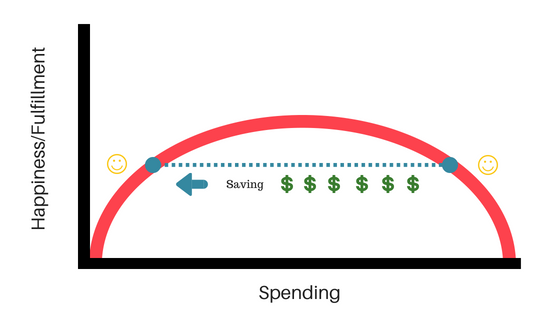
The amount of happiness that Coke is bringing me right now is probably close to what it was when I was spending way too much on it.
This concept works for anything…
I’ve used Coke as an example here, but the principles involved apply to nearly any spending that you do.
The key is to do some small-scale personal experimentation to see how cutting your spending affects your happiness in a given area.
Maybe buying the store brand instead of the name brand at the grocery store makes no difference to your happiness. Try it and find out.
Maybe eating out three times a week is just as good as eating out four times a week.
Maybe you’re just as happy with 30 channels as with 200. Or maybe you’re just as happy cutting the cord and switching to Netflix. Or maybe you’re just as happy cutting everything, buying a digital copy of How I Met Your Mother and watching that for a year. Or maybe you’re just as happy ditching TV altogether and getting books from the library.
With all these things, you don’t know until you try.
At some level, cutting your spending starts to feel too restrictive and will make you unhappy. Depending on your situation and your goals, it might make sense to make some cuts that hurt, but don’t start there.
Nearly everyone has habitual spending that they can cut down on without missing it one bit. Always look for those opportunities first.
This also means that while it’s fine to listen to other people’s frugality advice for inspiration, it should be for inspiration only. You make your own calls as to what you cut back on and why (although if you’re married and want to stay married, you should probably involve your spouse on all decisions involving money).
Increasing Your Income

Up to this point, we’ve been talking about money as if all it was good for was spending.
If that were true, then all those graphs that I showed you would be true for both spending AND income, leading us to the counter intuitive conclusion that at a certain point a bigger salary leads to less happiness.
There is something to that idea. Sometimes an increase in income involves taking on and excessive amount of stress.
But that’s not the only factor at play.
I’d like to suggest that the relationship between income and happiness looks something like this:
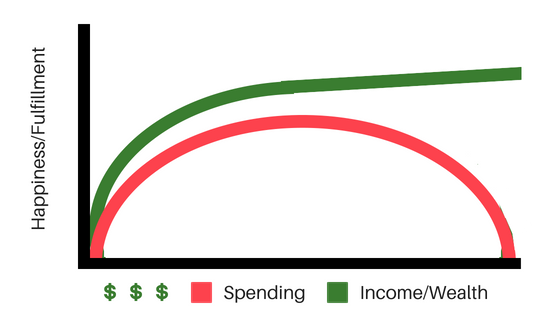
Early on, it’s tied closely to the spending curve. Since there is urgent need for necessities. most of your income gets spent.
As income goes up however, you start to get some breathing room. You also have the opportunity to do other things with your money besides spending, such as giving and saving.
I’d actually argue that the best use of money is giving. Giving makes the world a better place and makes you a better person.
If giving is the best use of your money, saving is a close second. The beautiful thing about keeping some money back for yourself instead of spending it is that your money can start making money for you if you invest it.
The reality is that if you want to build wealth, you don’t want to be the only one working for your money. There are three basic things that you can put to work on your behalf: real estate, a business, or your money.
This is the key that retirement is based on: if you want to stop working, you need someone or something else working on your behalf. Traditionally, this is the money that you have invested.
Money can buy lots of things, but the best thing that it can buy is freedom.
Most people are indentured servants to the bank, the car company, their jobs, etc. When your money is making money for you, you have true financial freedom.
In my upcoming book Personal Finance That Works For You: How to Build Wealth, Design Your Future, and Make Money While You Sleep (which is coming out in June on Amazon Kindle), I go over how to invest in a way that is nearly set it and forget it and will beat the vast majority of investors. I also go over nearly effortless ways to save money as well as ways to build passive income online so that you have more to invest.
When the book comes out, I’ll be giving it away for free for five days as a special promotion. If you want me to let you know when you can get a free copy, you can sign up below:
The Indirect Ways that Money is Involved in Happiness
Yes, spending, saving, and giving can all bring you happiness, but they aren’t the only things that can do so. In fact, they aren’t even the main things that can do so.
Consider this list of some possible things that might make you happy:
- Investing in your deepest relationships
- Spending time outside in nature
- Eating good food
- Applying yourself to a difficult task
- Engaging in creativity
- Making progress toward a worthy goal
All of these things certainly can be done without money, but there are many ways in which money might be involved in all of them. Think about it for a second:
Investing in your deepest relationships usually represents an investment of time and attention. But it might also involve some spending. The flowers I sent my wife on Valentines day weren’t free.
Spending time in nature is usually free, but sometimes you might need to pay to get into a national park or to travel to a location that will inspire awe deep within you.
Eating good food is obviously the thing on this list that most frequently costs money. Sure you can still go forage if that’s your thing, but I wouldn’t recommend it.
Applying yourself to a difficult task and Engaging in creativity are free, but the tools and resources you want to use might not be.
Making progress toward a worthy goal might not involve money, but your goal could easily be about money. I have goals regarding building an emergency fund, paying off my house, and retiring early (although I never plan to quit working).
It’s important to remember this indirect relationship between money and happiness for two reasons:
First, it helps remind you that there are plenty of opportunities to become happier without more money and…
Second, it means that happiness is the lens through which you should view your spending. Resources allocated to the categories that reliably bring happiness are well-spent.
Final Thoughts
Remember, happiness is the end game, not money.
Money is only useful to the extent that it can support your bid for happiness. Since it has lots of potential to do so, it’s an important topic to get right.
If you want to level up your personal finance game, check out my book: Personal Finance That Works For You: How to Build Wealth, Design Your Future, and Make Money While You Sleep
Get it here: https://amzn.to/2JfESW8

This story is published in The Startup, Medium’s largest entrepreneurship publication followed by 328,729+ people.
Subscribe to receive our top stories here.


