
How to Get a Better Butt: Ultimate Guide to Glute Training
A complete booty-building workout to get bigger glutes, with exercises and training strategies to get fast, noticable results
Note to readers: If you enjoy this article, check out my new Substack blog, Building Your Future. Most of my articles these days are being published there.
American society seems to go through cycles of being obsessed with one body part or another. In the 80’s it was big arms for men; in the 90’s it was pronounced busts on women. But now? Now we’re living in the era of the butt.
I get a lot of questions about glute training — what exercises to do, how many sets, how often. And the truth is, the way most people train glutes is sub-optimal.
Should you do squats? Sure, but modify them. Hip thrusts? Yes, but not the kind that most people do. Stairmaster? Not unless you’re really trying to build thigh endurance.
In truth, most people don’t have a clear picture of what the gluteal muscles even are. So to develop a good booty-building strategy, you first need to take a look at how the muscles in that area are laid out.
Anatomy of the Glutes
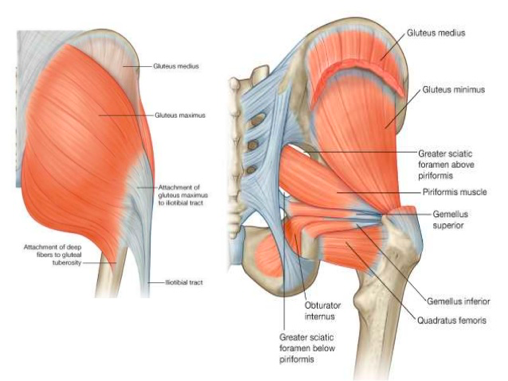
People sometimes think that gluteus maximus is synonymous with all of the muscles in the butt. There are actually a lot of muscles, as you can see here:
For well-rounded glute development, you need to train all of these muscles. That means you need to perform a variety of movements, including some that most people wouldn’t think of as butt-building movements.
Here’s a quick run-down of the major muscles of the gluteal region:
Gluteus maximus
The biggest muscle in the butt, and the most visible because it lies on top of the others.
Its main function is hip extension, i.e. kicking your leg backward — a responsibility it shares with the hamstrings. The hamstrings are stronger than the glutes when the leg is relatively straight. When the knee is bent, the hamstrings become very weak and the gluteus maximus takes over.
That means it also comes into play in squats, mainly around the bottom of the motion. The fibers at the very bottom of the gluteus maximus also contribute to hip adduction (pushing your thighs together).
The gluteus maximus is slightly slow-twitch dominant, meaning it is best worked with a slightly higher-than-average rep range or a slightly-lower-than average intensity.
Gluteus medius
This muscle lies above the gluteus maximus — as in slightly higher up the body, not on top of the gluteus maximus. It is only visible from the outside when well-developed. It wraps around to the front of the hips, and if well-developed it will make your hips look wider, and will be slightly visible from the front.
To put it another way — building the gluteus maximus will make your butt bigger from front to back, and building the gluteus medius will make your butt look bigger from side to side. This distinction between front to back vs. side to side growth rarely gets made, but it’s important to consider if your goal is to build a “bigger butt.”
The gluteus medius is responsible for rotating the hip both internally and externally, but those movements are hard to practically train — your only options are some weird cable and band exercises that don’t have good strength curves. Its main function is hip abduction — moving your legs apart — when your legs are straight, and that’s the main movement you’ll use to train it. Like the gluteus maximus, it’s slightly slow-twitch dominant.
Gluteus minimus
The gluteus minimus lies underneath the gluteus maximus and medius. It’s never visible, and as such, it is of less aesthetic concern. Building it up will make your butt look bigger, but won’t contribute to muscle definition at all.
The gluteus minimus contributes to hip extension and abduction, which means you’ll train it when you train the gluteus maximus and medius, and you don’t need to pick exercises specifically to train this muscle. Like the others, it’s slightly slow-twitch dominant.
Piriformis
A small muscle that you mostly don’t have to worry about in this context, the piriformis is mainly involved in posture and in hip adduction — pushing the thighs together.
All the other small muscles
As a group, these are all pretty insignificant from an aesthetic standpoint. They matter for athletic performance and for correcting postural issues, but if your goals are purely aesthetic, you don’t need to think about them.
There are a lot of muscles in the posterior region, but for aesthetic goals, the two you primarily need to concern yourself with are the gluteus maximus and gluteus medius.
The Four Biggest Booty-Building Mistakes
Now that you have a basic understanding of the muscular anatomy of the posterior region, you’re equipped to understand some of the big mistakes that otherwise knowledgable trainees make in trying to build a toned, muscular butt.
Mistake #1: Not working every muscle in the butt
As you saw in the previous section, the various gluteal muscles are responsible for several different movement patterns, and you need to train all of those movement patterns to build a world-class butt.
The mistake many people make is only working the gluteus maximus. Actually, it’s worse than that — they only train part of the gluteus maximus. As mentioned earlier, the bottom-most fibers of the gluteus maximus are used in hip adduction. Failure to train this movement pattern is the reason so many women have butts that mostly look good, but lack muscle tone on the bottom, where the butt meets the thighs.
The fix: better glute exercise selection
Plain and simple, you need to be doing the right exercises, and you need to be doing a variety of exercises to hit each muscle.
Exercises for the main part of the gluteus maximus: Glute-ham raises. The bottom portion of back and front squats. Hip thrusts. Glute kickbacks.
Exercises for the bottom of the gluteus maximus: Standing or seated hip adduction.
Exercises for the gluteus medius: Hip abduction, but only in a standing — not a seated — position. The cable unilateral hip abduction, for instance.
Exercises for the gluteus minimus: Same as the gluteus maximus and minimus.
Exercises for the piriformis: Standing or seated hip adduction.
Mistake #2: Emphasizing the thighs at the expense of the glutes
The glutes are mostly used in the same exercises as the muscles of the thighs. Many people focus on compound movements because they give more bang for your buck than isolation movements. While this is generally a good principle to follow, it can easily lead to under-training the glutes, because every glute exercise you do is actually a thigh exercise first and a glute exercise second.
In a sense, this is actually two different mistakes: training the quads at the expense of the glutes and training the hams at the expense of the glutes. So there are several things you need to do to fix this.
Fix #1: Use a full range of motion with squats and leg presses
Squatting is awesome, and you should definitely be doing it. But the glutes only come into action at the bottom of the squat, so you need to squat deep to really work your glutes.
Part of the reason people don’t squat deep enough is that the bottom of the squat is the hardest part — it tends to be the sticking point. What happens a lot of times is that people will subconsciously avoid this sticking point, making their squats shallower and shallower with each rep, and thus underworking the glutes. More on sticking points in a bit.
Fix #2: Bent-knee exercises
As mentioned earlier, hip extension primarily depends on the hamstrings when the leg is straight, and the glutes when the knee is bent. Failure to understand this leads many lifters to have underdeveloped glutes, despite having strong hamstrings and doing a lot of “glute exercises.” Good bent-knee exercises include hip thrusts and glute kickbacks.
The exception here is hip abduction — pushing the thighs apart. This movement is primarily an outer thigh exercise when the knee is bent, and a gluteus medius exercise when the knee is straight, so you’ll want to do it with a straight leg.
Fix #3: Isolation movements
Yes, compound movements are king, but to fully train the glutes, you’ll need to work a few isolation movements in. However, there’s a right way and a wrong way to incorporate isolation movements, which I’ll get to in a bit.
Mistake #3: Pre-fatiguing the glutes
I used to be a big proponent of pre-fatiguing. If you’re not familiar with the term, pre-fatiguing, or pre-exhaustion, is a form of superset or exercise order in which an isolation exercise is used before a compound exercise that works the same muscle — hip thrusts before squats, for instance. The idea is that the muscle will be fatigued from the isolation movement, then further exhausted in the compound movement, where other muscles will give it a boost and allow it to be worked for more volume.
The problem is, studies have shown that pre-fatiguing a muscle reduced muscle activation in the subsequent compound movement. Yes, those squats will feel like they’re blasting your glutes, but only because your glutes are weakened at that point. They’ll actually be less productive than if you hadn’t pre-exhausted your glutes. Not only that, but since the weakened glutes become a sticking point for the squat, your squats will do less to build your legs and lower back as well.
The fix: Post exhaustion
In this case, your best option is to do the exact opposite: work the glutes with compound movements, then work them more with isolation movements.
Mistake #4: Getting hung up on exercise sticking points
What do I mean by sticking points? I mean the part of the exercise that’s hardest. Most exercises have one part of the movement that’s harder than the rest, and this part is almost always the part where you hit failure.
With most pressing movements like squats and leg presses, it’s the bottom of the movement — if you squat with a full range of motion, you’ll eventually get stuck at the bottom of the squat, unable to get back up. Now, this sounds like it might be desirable for glute training — since the bottom of the movement emphasizes the glutes — but it isn’t. Most people consciously or subconsciously avoid that sticking point, either by doing fewer reps than they should or by gradually making their squats shallower as their glutes get fatigued. All of the muscles involved in the squat — even the glutes — would get trained better if the sticking point wasn’t there.
To fix this, you’ll need to match the exercise’s strength curve to its resistance curve, so that no particular point in the movement becomes a sticking point.
The fix: Accommodating resistance training
Accommodating resistance is the technical term for resistance that is lower at the hardest part of a movement and higher at easier parts of the movement. In practice, this is achieved by replacing about 20% of the barbell weight with chains or elastic bands. Since chains are heavy and not fun to carry around, you’ll probably want to use bands.
A meta-analysis showed that using accommodating resistance leads to significantly greater strength gains in the bench press and squat. And the effects were huge: one study found that adding resistance bands tripled the amount of strength and power that trained subjects gained in the squat compared to a control group.
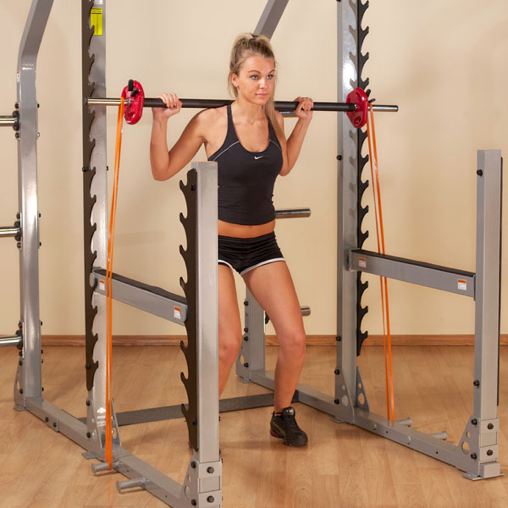
You’ll need a squat rack, which you should be using for safety anyway, and a pair of resistance bands. Note that those bands are sold individually, but you’ll need to order two. The listed resistances are the amount applied at the bottom and top of the squat, respectively. Most people should get the purple (35–100 pounds) bands.
The bands can be attached to the top or bottom of the rack, but are usually attached to the bottom since that’s easier to reach. This video shows how to attach the bands.
Optimal Glute Training Intensity, Volume & Frequency
Optimal glute training volume and frequency depend on how well-developed your glutes are. To determine that, test your strength-endurance on the barbell hip thrust.
Novice glutes: Bodyweight x 10–20 reps
Intermediate glutes: 45–105 lbs x 8–15 reps
Advanced glutes: 115–185 lbs x 8–15 reps
Elite glutes: 195+ lbs x 8–15 reps
Optimal glute-training intensity
As mentioned earlier, all of the muscles in your butt are slightly slow-twitch dominant, which means they should be worked at a slightly lower weight and higher rep range. However, “higher” is a relative term. Studies have shown that lifting heavier weights — over 65% of your one-rep max, and probably even heavier — is generally better than lifting lighter weights.
It’s common to err in either direction (too heavy or too light). Most commonly I see men going too heavy and women going too light. Some people also don’t seem to realize that, for practical purposes, isolation movements need to be done at lower intensities than compound movements.
The optimal intensity for most people is around 75–90% of one-rep max for compound movements, and 60–75% of one-rep max for isolation movements. Because women are more slow-twitch dominant than men, they tend to get the best results at slightly lower intensities than men. Now add in the fact that the glutes are slightly slow-twitch dominant, and the use of DUP, and most women training their glutes should be a little towards the lower ends of those ranges.
I should add that there is substantial inter-individual variation in optimal training intensity. While most people will fall into the range I just gave, some will do better at intensities as high as 90% for compound movements, while others may see the best results at intensities as low as 60%.
Determining your optimal intensity range is a complicated subject, however. I do that with my personal training clients, but it’s beyond the scope of this guide. Suffice to say, the range given will work for you, even if you’re in the minority of people for whom it’s not entirely optimal.
Optimal glute-training volume
Total training volume should be calculated on a per-muscle-per-week basis. Optimal training volume for all muscles goes up as you get more advanced, so advanced trainees should train a lot more than novice trainees.
Training age — whether you’re novice, intermediate, or advanced — should be considered on a per-muscle basis. There are a lot of guys who have advanced pecs and novice hamstrings, and a lot of women who have advanced glutes and novice shoulders.
Aside from training age, there are a few other considerations in determining total training volume for a muscle.
Fiber type mix should be taken into consideration. Slow-twitch dominant muscles recover faster and can tolerate a little more volume than fast-twitch dominant muscles. Remember, the glutes are slightly slow-twitch dominant, but not all that far off from average.
Gender and genetics make a difference. Women are more slow-twitch dominant than men and can tolerate somewhat higher training volume and frequency. ACE genotype also makes a difference, if you’ve had a DNA test.
But the biggest factor to consider besides training age is your stress level. Very high stress levels — and the high cortisol levels that accompany them — will impede your recovery from exercise. The difference between very high and very low stress can be as much as a twofold difference in recovery capacity.
With that said, here are some guidelines:
Novice glutes:
Low stress: 14–16 sets per week
Medium stress: 12–14 sets per week
High stress: 10–12 sets per week
Intermediate glutes:
Low stress: 18–22 sets per week
Medium stress: 16–20 sets per week
High stress: 14–18 sets per week
Advanced glutes:
Low stress: 22–26 sets per week
Medium stress: 20–24 sets per week
High stress: 18–22 sets per week
Elite glutes:
Low stress: 24–28 sets per week
Medium stress: 22–26 sets per week
High stress: 20–24 sets per week
Beyond considerations of stress and training age, you may need to do some self-experimentation to gauge your work and recovery capacities and figure out which weekly volume works best for you.
One last note about total volume is how to count it. A set of an exercise that focuses on the glutes, like the hip thrust, counts as one set. A set of an exercise that works the glutes for only part of the range of motion or only uses them secondarily, like squats, counts as half a set towards weekly glute volume.
With all of that considered, most people reading this should probably be upping their volume to get maximal results.
Optimal glute-training frequency
The optimal training frequency for a muscle mostly depends on the same factors as the optimal total training volume — training age, genetics, stress, etc. A totally untrained muscle takes 3–5 days to recover from a good workout, and should be trained only once or twice a week. On the other end of the spectrum, elite trainees can usually recover in less than 24 hours, and often benefit from twice-a-day training.
With that said, here are some rough guidelines for glute recovery times and training frequency:
Novice glutes:
- Low stress: 40–64 hours recovery time, train every 2–3 days.
- Medium stress: 56–80 hours recovery time, train every 3–4 days.
- High stress: 72–120 hours recovery time, train every 3–5 days.
Intermediate glutes:
- Low stress: 24–40 hours of recovery time, train every 1–2 days.
- Medium stress: 36–60 hours of recovery time, train every 2–3 days.
- High stress: 48–80 hours of recovery time, train every 2–4 days.
Advanced glutes:
- Low stress: 16–24 hours of recovery time, train every day.
- Medium stress: 20–36 hours of recovery time, train every 1–2 days.
- High stress: 30–48 hours of recovery time, train every 1–2 days.
Elite glutes:
- Low stress: 12–18 hours of recovery time, train once or twice a day.
- Medium stress: 16–24 hours of recovery time, train every day, occasionally twice a day.
- High stress: 24–36 hours of recovery time, train every 1–2 days.
Again, the same considerations as with volume. I hope these guidelines will drive home the importance of stress management. As you can see, keeping stress low has the equivalent effect, in terms of recovery capacity, as being one to one and a half levels of advancement higher. An intermediate trainee with low stress will recover a little bit faster than an advanced trainee with high stress.
Given that each “level” of muscular development equates to one to three years of consistent, high-quality training, this is a huge difference.
Part 4: The Best Booty-Building Exercises
Not all exercises are created equal. Many of the most popular glute exercises are sub-optimal. Here are some of the characteristics of a good exercise:
Full range of motion. A good exercise should make it possible to work the muscle through the full range of motion. This is particularly important for the glutes since many exercises only bring the glutes into play when you go deep.
A full range of motion isn’t possible with some exercises. For instance, hip thrusts need to be done from a deficit to allow a full range of motion, but it’s damn near impossible to do barbell hip thrusts from a deficit, so barbell hip thrusts are not one of your best options.
The strength curve matches the resistance curve. In other words, there’s no sticking point. It’s hard to get this perfect, but if you’re only slightly weaker at the sticking point than at other parts of the movement, that’s close enough. This is why you’ll use resistance bands when you squat.
Closed-chain, not open-chain. The technical definition of the kinetic chain is, well, pretty technical. But in practice it’s simple: Closed-chain movements are movements in which your body moves. Open-chain movements are movements where your body stays still while you push or pull a weight. Closed-chain movements are better, which is why (well, one reason why) we’ll favor squats over leg presses.
Unilateral over bilateral. I’ve already covered this one. There are some bilateral movements that are worth doing because they have no direct unilateral equivalent, but six of the nine exercises I’m about to list are unilateral.
Dynamic contraction. Exercises that involve dynamic contraction — meaning the muscle is actively contracting during both the concentric (raising) phase and the eccentric (lowering phase) — are superior to exercises that are only either concentric, eccentric, or isometric. Concentric and eccentric contractions each stimulate muscle growth in different ways, so you need both.
With that said, how many different exercises do you need to do for your glutes? As with volume and frequency, the optimal amount of variety goes up with training age, but you don’t need much. Having one or two compound and one or two isolation movements in your workout split at any given time is good enough, but a little more won’t hurt either. I’m going to give you four compound and four isolation movements (in addition to one exercise purely for pre-exhausting the hamstrings) so that you can choose the ones that work for you, or that your gym has the equipment for.
Compound movements
Back squats with elastic bands. The back squat is a mainstay of glute programs. While it’s not the best exercise for targeting the glutes per se, it does build the lower back and upper glutes. I include it in most glute programs for developing clear muscle separation between the butt and lower back.
This is your standard back squat, but with about 30–50% of the total weight replaced with elastic band resistance in the top half of the movement. Remember that resistance bands add more resistance as the weight moves up. Each band has two numbers listed, representing the amount of resistance applied at the bottom and top of the movement. It’s the higher number you want to look at.
As an example: suppose you normally back squat 150 pounds (that’s the amount you squat for your usual working sets, not your 1RM). You would want a band that applies 50–75 pounds of resistance at maximum, which means you’d want the black band from my recommended brand. If you squat at 250 pounds (again, for working sets), you’d want a band that applies 90–125 pounds, meaning you’d pick the purple band.
And remember: to target the glutes, you need to go as deep as possible. Don’t add more weight then compensate by not going deep; that’s totally counterproductive when your goal is to build a big, strong butt.
Video 2: Back squats with resistance bands
Bulgarian split squats from a deficit. The Bulgarian split squat is the best iso-lateral squatting exercise, period. It works to sculpt and defines the sides of your butt in a way that bilateral squats never could.
To get a full range of motion, you should do it from a deficit — meaning your front foot, as well as your back, is elevated, allowing your knee to drop below the level of both feet. This provides better muscle activation, and of course, lets you go deeper to target the glutes more effectively.
Video: Bulgarian split squats from a deficit
Video: How to fix the most common mistake with the split squat
Cable pull-through. This exercise isn’t well-known, but it’s one of my favorite glute exercises — particularly for guys, since it trains the same hip-thrusting movement pattern used for… fun times. Ahem.
Make sure to stand far enough away from the cable machine that there’s tension on the cable throughout the full range of motion, even when you’re bent all the way over and your hands are going slightly behind your butt. Contract the glutes with each rep and keep a loose grip — don’t turn this into a arm exercise. Your arms should move forward because your hips push them forward, not because you contract your arms.
Video 1: How to do pull-throughs
Jump lunges. I used to recommend jump squats, but I switched to jump lunges because they’re iso-lateral, and it’s also a little easier to go deep on them compared to jump squats. This is a great exercise for athletes who want to train for power. For aesthetic purposes, its main use is in post-activation potentiation supersets.
Don’t try to add dumbbells to these — you don’t want to smack yourself with them.
Video 1: Jump lunges, outdoors
Isolation movements
Unilateral hip thrust from deficit. I like this better than the barbell hip thrust because a) the deficit allows a better range of motion, and b) it’s unilateral. The downside is that you can’t easily put a barbell on your hips, only a single barbell plate. Once you get really strong, that might limit this exercise to higher-rep work. Once you can do more than twenty or so and can’t raise the weight, it’s about time to switch to kick-backs.
Video 1: Unilateral hip thrust from a deficit (note: the deficit should be bigger)
Video 2: Unilateral hip thrust from a deficit with weight (better deficit)
Cable unilateral hip abduction. This is the best exercise for specifically targeting the gluteus medius. As a reminder, the gluteus medius is involved in hip abduction, but only when the knees are straight. The more common seated hip abduction will build your outer thighs, but won’t do much for your butt. If you want to develop wider hips, this is the main exercise you would use to do that.
Glute cable kick-backs. This iso-lateral booty-building exercise is your best option for building the main part of the gluteus maximus once you reach a point where you can’t keep increasing the weight with the unilateral hip thrust.
Video 1: You’re doing it wrong — Cable kickback booty workout
Video 2: How to do cable kickbacks
Glute-ham raise. This movement works both the hamstrings and the gluteus maximus at various parts of the movement; the assistance from the hamstrings make this useful for post-exhausting the glutes after they’ve been fatigued by a compound movement. It can be done either on a glute-ham station, the seat of a cable machine, or on the floor with a partner holding your ankles. Keep your back as straight as possible; while it looks similar to a back extension, the movement here should come from flexing/extending the knees, not the back.
I prefer doing them on a machine because the contractions are more dynamic, whereas when doing them on the floor, the movement can easily become eccentric-only as you push yourself up with your hands. If you do perform them on the floor, be careful to push off with your arms only as much as you need, and no more.
Video 1: Glute-ham raise on machines
Video 2: Glute-ham raise on the floor
Unilateral lying leg curl. The leg curl is the main movement used for the isolation of the hamstrings. Whereas the glute-ham raise will be used to post-exhaust the glutes, the leg curl is going to be used to pre-fatigue the hamstrings before your main compound lifts. The lying leg curl is preferred over the seated leg curl because it produces superior levels of muscle activation and allows a slightly greater range of motion.
Video 1: Unilateral lying leg curl
Video 2: Bilateral lying leg curl with emphasized eccentric
Part 5: Glute Workouts
Now for the grand finale: the actual workouts. The following workouts incorporate everything I’ve presented to you so far: all of the exercises, advanced set and rep schemes, and principles of workout design. The whole shebang.
Like any body-part-specific workouts, they’re very short — around fifteen to twenty minutes per workout. That means you can use them in one of two ways: as stand-alone workouts, or as parts of a longer workout. If you want to use them on their own, you can do them as written.
If you wish to incorporate them into a larger workout, each workout has instructions on where to slot in other exercises to maintain optimal exercise ordering. Remember, if you want to focus on glute training, train the glutes first.
Before we get to the workouts, a few last notes:
Rest periods. In most cases, you should take about two or three minutes’ rest between sets of isolation exercises and three to five minutes between sets of compound exercises. Exceptions, such as antagonist-agonist supersets and post-activation potentiation supersets, are noted when they come up. You can also take shorter rests if you’re alternating between two muscle groups — pushups and squats, for instance — or if you’re doing a unilateral exercise and alternating each leg.
Contrary to popular belief, the research suggests does not support the common prescription of shorter rest intervals for muscular hypertrophy. Rest periods don’t need to be timed; you can wait until you subjectively feel recovered, provided this doesn’t cause your workout to drag on forever.
Number of sets per workout. These workouts include prescriptions for how many sets of each exercise you should do, but you may need to adjust those numbers up or down to match them to your target weekly training volume. The default numbers are written with intermediate trainees experiencing average stress levels in mind, so they average about six sets of glute work per workout.
As an example, suppose you’re a novice trainee with average stress levels. You’re aiming for 14 sets a week, and you’ll train glutes every four days. You want eight sets per workout, so you’ll probably want to add an extra set of each exercise per workout. That’s right — because training frequency increases slightly faster than weekly training volume, your number of sets per body part per workout often goes down as you get more advanced.
There are six workouts here, which is more than anyone needs. Pick one or two of them to use as standalone workouts, or two to four of them to incorporate into your full-body workouts. If incorporating into a full-body workout, put them at the beginning of the workout.
Workout 1: Back Squat
A1) Unilateral lying leg curl, 3 cluster sets per leg at 85/70% 1RM (DUP)
A2) Bilateral leg extension, 3 sets at 65% 1RM
B1) Back squat with resistance bands, 3 sets at 85/70% 1RM (DUP)
B2) Pushups, 3 sets to mild fatigue
C1) Glute kickbacks, 3 sets per leg at 70% 1RM
Notes
For the leg curl, alternate between each leg — performing three reps on each leg (starting with the weaker leg) before resting ten seconds, then doing the other leg. The leg curl should be taken to within one rep of failure, as the purpose is to pre-exhaust the hamstrings.
The opposite is true for the leg extension. You want to warm up the quads without fatiguing them, so stop your leg extensions several reps short of failure. To benefit from the antagonist-agonist pairing, you should move quickly from the leg curl to the leg extension, taking most of your rest after the leg extension.
The pushups are just there to fill your time while your legs are recovering; you can leave them out if your upper body is already fatigued from doing something else.
Intermediate to advanced trainees should incorporate DUP as noted, alternating between the two intensities with each workout. Novice trainees should only use the first listed intensity — 85% in this case — on every workout.
With the glute kickbacks, you can take just a minute or so of rest between sets, since you’re alternating legs.
As a standalone workout, this should take about 20–30 minutes. If you want to add other movements to make it a full-body workout, add them between circuits B and C. Adding anything between A and B will remove the benefit of pre-fatiguing the hamstrings.
Workout 2: Split Squat
A1) Bulgarian split squat, 4 sets per leg at 80% of 1RM
A2) Arnold press, 4 sets at 75% of 1RM
B1) Cable unilateral hip abduction, 2 sets per leg at 65% of 1RM
B2) Glute-ham raise, 2 sets at 70% of 1RM
Notes: As with the last workout, the Arnold press is there to make this workout more time-efficient, doesn’t need to be taken close to failure, and can be left out if you have other plans for your shoulders.
As a standalone workout, this will only take about twenty minutes, so it’s a good candidate for incorporating into other workouts. If you add more stuff, put at least some of it in between A and B to allow for more glute recovery time.
Workout 3: Pull-Through
A) Unilateral lying leg curl, 2 cluster sets at 80% 1RM
B) Cable pull-through, 4 sets at 85/70% 1RM (DUP)
C) Unilateral hip thrust from deficit, 2 sets per leg at 75% 1RM
Notes: As with the first workout, the leg curl should be taken very close to failure, and novices should just train the pull-through at 85% intensity and ignore the daily undulating periodization.
This workout is designed to be quick and simple, and can be completed in fifteen minutes. If you want to add more exercises, you could add another circuit or two between B and C. But you might also add another exercise to A, B, and C, alternating two exercises for unrelated body parts in much the same way that the previous workout alternated spit squats and Arnold presses.
Workout 4: The One-Superset Glute Workout
A1) Paused back squat with resistance bands, 5 sets at 85% intensity
A2) Jump lunges, 5 sets to fatigue
Notes: On the back squat, pause for one second at the bottom of each rep, performing an isometric hold to further fatigue the glutes. Proceed immediately from the squat to the jump lunges with no rest. On the jump lunges, keep your stride fairly long and go deep.
This workout is short but very intense. You’ll need longer-than-normal rests between circuits; rest about 4–5 minutes after each set of jump lunges. The whole thing should take 20 minutes. If you incorporate this into a longer workout, put this at the beginning, just after your warmup. But don’t add too much more exercise, even exercise that targets other body parts — seriously, this short workout will tire you out.
Workout 5: Cable Machine Only, Glutes Only
A1) Glute-ham raise, 3 sets at 70% 1RM
A2) Cable pull-through, 3 sets at 80% 1RM
B1) Cable unilateral hip abduction, 3 sets at 70% 1RM
B2) Cable glute kickback, 3 sets at 65% 1RM
Notes: The glute-ham raise should be paused 2–3 reps short of failure, while the pull-through, abduction and kickback should be taken to within one rep of failure. The glute-ham raise can be done on the seat of a cable machine.
This workout is ideal for building the glutes without growing your thighs.
Workout 6: Bodyweight Only (split squat, jump lunges, hip thrust, GH raise)
A1) Bulgarian split squat, 4 sets per leg unweighted to fatigue
A2) Jump lunges, 4 sets to fatigue
B1) Glute-ham raise, 3 sets per side unweighted to fatigue
B2) Unilateral hip thrust, 3 sets per side unweighted to fatigue
Note: This workout is meant to be done at home or while traveling. If you don’t have the equipment/partner to do the glute-ham raise, leave it out and raise the other three exercises to five sets each.
Yes, There is a Better Way to Build Bigger Glutes
Once you understand what the different gluteal muscles are and what they do, you can dramatically improve your exercise selection and program design. And once you understand the fiber mix of those muscles, and how long it really takes to recover from exercise, you can optimize your training volume, frequency, and intensity for maximal results.
Remember that, aesthetically, definition is just as important as size. Definition will come mostly from being lean — read here to learn how to lose ten pounds of fat a month. (Yes, you can do this while building muscle.)
Above all else, remember: train glutes early, train them often, and train them with variety. A well-designed glute program usually requires training 2–4 times a week with 3–6 different exercises, but your glute workouts can easily be combined with other exercises as part of a full-body workout.