The Ultimate Challenge
4 Stories That Built The Legend Of The Olympic Games
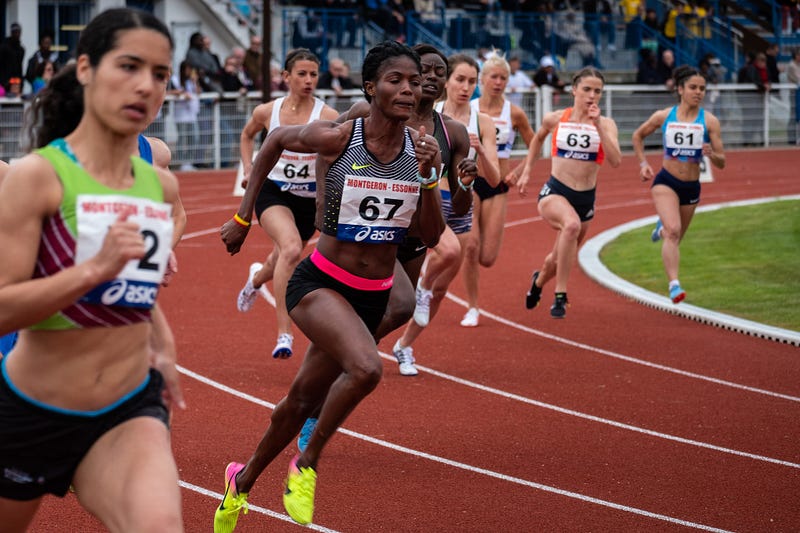
In the history of the Olympic Games, the athletes and their moments acquire an even more special dimension when they are framed by characteristics that speak directly to the mood of the fans.
Surprises, unexpected victories or defeats, challenges beyond limits, personal bets, perseverance, and stubbornness to achieve the goal, sacrifices to achieve the goal, the reminder that the sports movement should not be irrelevant with social reality, respect for the value of participation, the greatness of self-denial, the will to complete the endeavor and the universal — ultimately — recognition by the public, these are all aspects that together build the edifice of sport. I have selected 4 athletes, real “myths”, who in their own way marked the history of the Olympic Games.
Abebe Bikila — the Barefoot Emperor (1960)
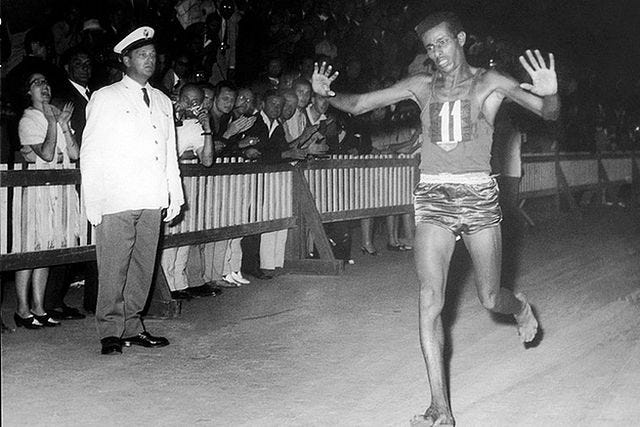
It was September 10, 1960, when marathon runners saw an almost incredible image in front of them. One of the participating athletes was running barefoot! For the runner himself, this was not unusual. The opposite in fact. Abebe Bikila from Ethiopia was the son of a shepherd and from a very young age ran in the meadows barefoot.
At one point he decided to find a job in Addis Ababa to help his family and ended up in the personal guard of the royal family. He was discovered by Onni Niskanen, a Swede of Finnish descent who worked as a young talent coach and took him with him.
Bikila started training, sometimes with and sometimes without shoes, he was used to it. He was not a member of the Olympic delegation that would travel to Rome for the 1960 Olympics. But at the last minute, Niskanen took him on a plane to replace another athlete who had fallen ill. Adidas was then the official supplier of shoes for the event, but when Bikila wanted to find a pair, there were few left, and what they gave him did not suit him. So, a few hours before the start, the Ethiopian decided to run the marathon barefoot. Niskanen informed him about the main opponents he would have in the match.
He mainly talked to him about the Moroccan Rhadi Ben Abdesselam, who would wear the number 26. But in the end, Abdesselam did not manage to receive his number in time and wore the 185, which he had used in the 10 kilometers.
The race started and Bikila, constantly passing athletes, was looking for the Moroccan with the number 26, without knowing that he had him right behind him with 185! The two got a difference from the rest and the Ethiopian made a demarcation 500 meters before the finish, which gave him a difference of about half a minute and together with the victory, the first at the Olympics for an athlete from Sub-Saharan Africa. His time, 2: 15: 16.2, was a new Olympic record.
When asked why he ran barefoot, he told reporters: “I wanted everyone to know that my country, Ethiopia, always wins with determination and heroism.” Bikila also won four years later, in Tokyo, breaking the world record and becoming the first marathon runner with two consecutive Olympic victories. The only change in the script was that he ran there wearing shoes. In 1968 in Mexico he was forced to leave after, in addition to a broken small bone in his leg before the games, he also injured his knee. A year later he became paraplegic after a car accident and finally died in 1973 at the age of just 41.
Gabriela Andersen — Beyond the Boundaries (1984)
In 1984, in Los Angeles, it was the first time that the Women’s Marathon entered the Olympic track and field program. Fifty athletes took the start and finished 44th. The winner was the then holder of the world record, American Joan Benoit, with a time of 2: 24.52. In second place was the Norwegian Grete Waitz and the podium was completed by Rosa Mota from Portugal. The people who had flooded the Olympic Stadium “Los Angeles Memorial Coliseum”, lived one of the most special moments in the history of the Olympic Games.
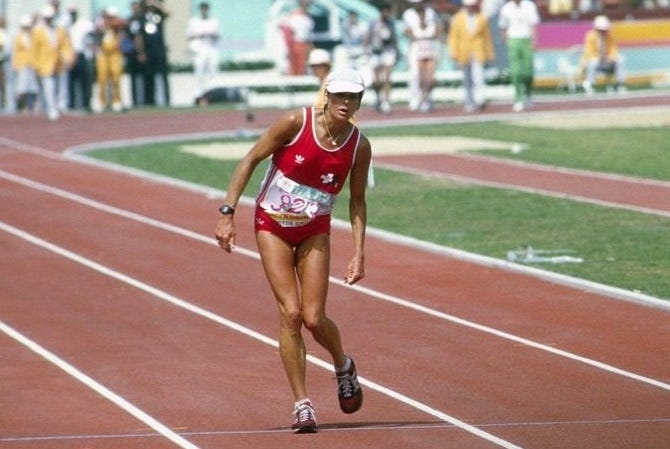
36 athletes had already finished when Gabriela Andersen entered the stadium. The Swiss athlete lived permanently in the United States, in Idaho, and worked as a ski instructor, but represented Switzerland at the games. The 39-year-old Andersen had won two marathons last year (California and Minneapolis). But her image, as soon as she entered the stadium, shocked everyone. It was not just the feeling, but the confidence that it would collapse from second to second.
Her body was folded in two, her arms seemed to be ankled and her legs were literally staggering. With all her strength left, she signaled to the doctors who approached her to leave her, knowing that if they touched her, she would be canceled. The audience shouted with all their might, trying to give her courage for the last 400 meters, while she stopped every now and then, grabbing her head.
The symptoms of complete exhaustion were evident on her, but the stage doctors who monitored her discreetly saw that she was still sweating, which meant that her body still had fluids available, so they allowed her to continue and stop. As soon as she completed the turn in the stadium (it took her almost six dramatic minutes), she collapsed and surrendered to the doctors, while thousands of people did not stop deifying her for a moment. Andersen took 37th place, but went down in Olympic history as one of the most shocking examples of willpower and determination, beyond any normal limits.
Steve Redgrave — Still paddling (2000)
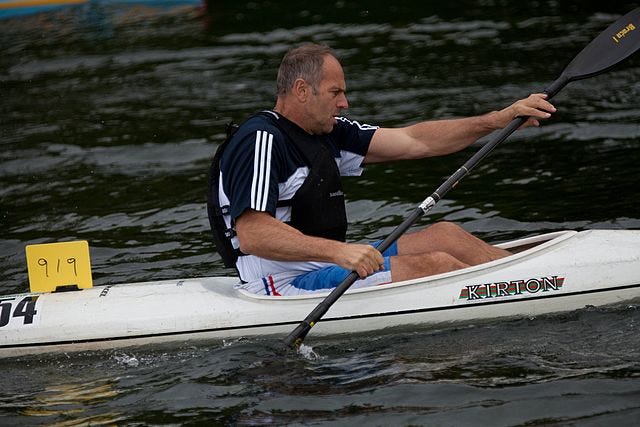
“Anyone who sees me rowing again has my permission to shoot me!” These were the words of Steve Redgrave in 1996 in Atlanta, immediately after winning his fourth gold medal in four consecutive Olympic events. The most successful rower in the history of the Olympic Games and one of the most important British athletes of all time, he did not keep his word. At the age of 34, it was obvious that the first four, one in the quadruple and three in the doubles, were not enough. He wanted to challenge himself beyond the — normal — limits.
Redgrave also had six gold medals in his collection at world championships. However, the possibility of claiming a fifth medal and even gold proved to be the perfect motivation for an athlete, who at his age, if he had not given up the action, was “doomed” to be called either a grandfather or a veteran. However, his partner in the triumphs of Barcelona and Atlanta, Matthew Pinsent, played a big role in his decision to continue. The rest was taken over by the German coach of the British, Jürgen Gröbler.
First, he ruled out the two-wheeler, deciding to return to the four-wheeler. And then he looked to find the two who would fill the crew. From there, a long period of hard preparation began, with daily long hours of training, so that the quartet could learn to work together perfectly and function as one body. In 1997, Redgrave learned that he had type 1 diabetes, but he did not give up, determined to overcome any obstacle. Reaching just before the final goal, in July 2000, in the Lucerne regatta for the World Cup, they took only fourth place. It was the first defeat not only of the quartet but also of Redgrave and Pinsent since 1992.
However, two months later, on September 23, in Sydney, in front of a large crowd that had gone to watch the grand final, the British crew did not make a mistake. James Cracknell, Tim Foster, Matthew Pinsent, and Steve Redgrave, withstood the attack of the Italians and with a titanic effort held first place for only 38 centimeters of the second. Redgrave had won the ultimate feat, winning five gold medals, while the festivities on the quadruped were at least moving among the four happy crew members.
Michael Phelps — The Hardest Medal (2008)
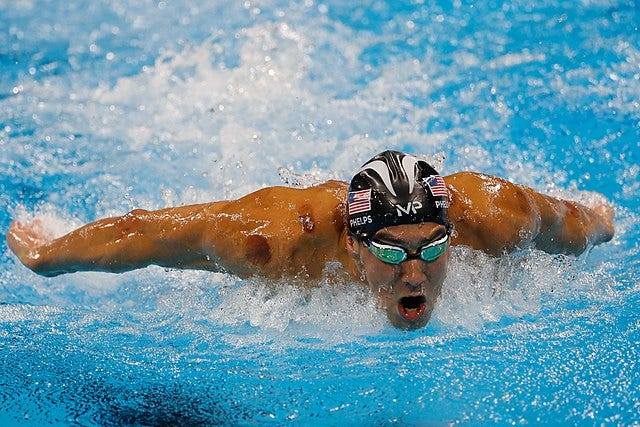
Michael Phelps’s big goal in 2008 in Beijing, was to first equal Mark Spitz’s record of seven gold medals from 1972 in Munich and if all went well, to break it, reaching eight. Four years ago, he had stopped at six golds, but there was no anxiety about the record, as Phelps’s chances had disappeared early, with the two bronze medals after the first three races. In Beijing, however, things turned out very differently, as the 23-year-old American did six out of six, with two more races left: the 100m butterfly and the mixed team relay. The first very big date for Phelps was closed on August 16th.
A possible victory would give him the seventh gold medal in the tournament and would now bring him next to Spitz. The biggest threat was the US-born Serb Milorad Cavic, who challenged Phelps before the final with his statements: “It will be good for swimming if Phelps loses. It would be nice for future historians to say that Phelps was going for eight medals, but one guy deprived him of one. I would love to be that guy.” Phelps welcomed what Cavic had to say, saying: “When I hear something like this, I get upset. They definitely give me even more motivation.”
During the race, Cavic was faster than Phelps in the first 50m. and returned first, with the American making the turn in 7th place, 0.62 ″ behind the Serb. In the second 50m., Phelps was constantly reducing the difference, and eventually, they both fell together at the finish. Cavic was late in raising his last hand, instead, Phelps miscalculated and needed half more hands, so they caught the sensor on the pool wall almost simultaneously. The electronic measurement immediately gave Phelps first a difference of one centimeter of a second (50.58 vs. 50.59). Phelps himself later admitted that he thought the extra half of his hand had cost him gold.
Immediately after the announcement of the results, the Serbian delegation lodged an objection, claiming that Cavic had touched first, but without the necessary force to activate the sensor. FINA officials viewed the frames in question at a resolution of 1 to 10,000 per second and concluded that the gold belonged to Phelps. However, the initial refusal of Omega, the official timer of the games, to release underwater photos of the finish, triggered various scenarios for the sponsorship of the company with Phelps. Finally, Omega presented in the following days all the evidence that proved his victory. The “Baltimore Sphere” took another gold after 24 hours, the eighth in total, and thus improved Spitz’s haunted record after 36 years.
Thank you for reading!