
Geopolitics & History
The Ukraine — A Quick History Lesson
A potted history of a complex country in suffering
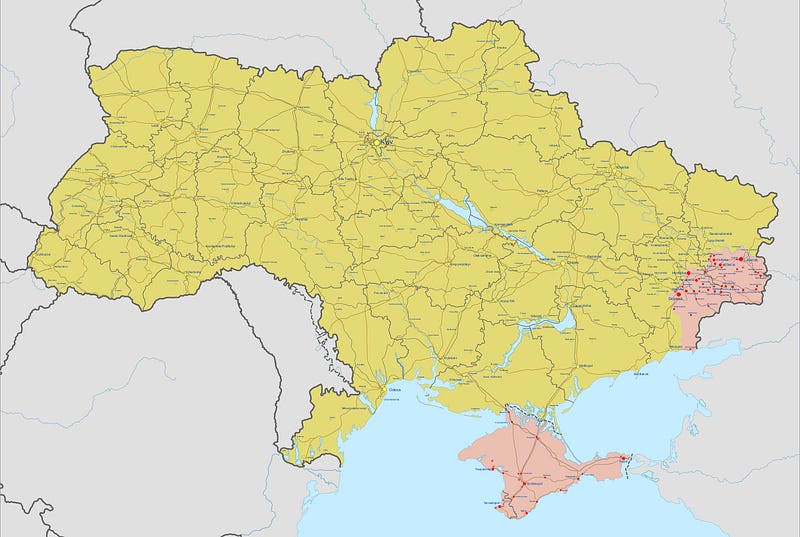
Anecdote: The first I heard of the Ukraine was when, as a boy many decades ago, I was delivering milk to Mrs Kormylio living in Bryngwyn Bach, Llanelli, a small town in West Wales. She was Welsh, but her husband was Ukrainian and had come to Wales after the Second World War.
Years later in my then capacity as a software project manager I visited Kiev and met with representatives of the government — that must have been about 1995 or so. We were trying to sell them government accounting systems.
The smattering of Russian that I’d learned while working in Moscow didn’t go down well in Kiev. Same alphabet but different language, despite Stalin’s attempts to impose uniformity across the 11 time zones of the Soviet Union.
Strangely, perhaps, I’ve also worked in Smolensk and Krasnodar, cities which tangentially form part of the Ukraine’s history.
So, the history of the Ukraine. It’s long and complex, a bit like mine.
But the geography is important too. The Black Sea region is strategically important for Ukraine because it borders the country’s only access to the sea, a critical consideration for the country.
And the Crimean peninsula also hosts major Russian (now) naval bases.
Key Events in Ukraine’s History
Ukraine’s history is a long and complicated one. It has seen many different empires come and go over the centuries, as well as various conflicts. I’ll explore some of the key events from its beginnings to present day.
The first mention of Ukraine was by the historian Herodotus in his writings, who spoke of a Scythian tribe called “Ukrainoi”.
The Ukraine has a long and rich past dating back to the ninth century and occupies an area that was once part of Russia and Poland.
Ukraine’s predecessor country, Kievan Rus’, was the first East Slavic state in Europe, from the late 9th to the mid-13th century, under the reign of the Rurik dynasty. It was founded by the Varangian prince, Oleg, who was sent to rule the territory by the Byzantine Emperor.
The territory of Kievan Rus’ varied over time and it included a number of other regions, such as Black Ruthenia, Smolensk, and Kiev (the modern capital). The gradual disintegration of Kievan Rus’ is often attributed to its geographical position; it had no natural borders like those provided by rivers or mountain ranges.
Ukraine’s Confederation with Poland
The Polish-Lithuanian Commonwealth was a union of the Kingdom of Poland and the Grand Duchy of Lithuania. The Commonwealth existed from 1569 to 1795, when its territory was partitioned among Prussia, Russia, and Austria.
The Polish-Lithuanian Commonwealth was a union of the Kingdom of Poland and the Grand Duchy of Lithuania. The Commonwealth existed from 1569 to 1795, when its territory was partitioned among Prussia, Russia, and Austria.
Cossacks and ‘Cossackdom’ in the 17th-18th centuries
In an attempt to unite with Ukraine in 1648, King John II Casimir Vasa sent an army there to establish control over Cossack territories. However he failed in this attempt as the Ukrainian Cossacks were not interested in joining their forces with Poland’s.
The Cossacks were a group of people who lived in the Southern Ukraine and the Russian Empire as far as Krasnodar on the Black Sea. Originally mix of runaway serfs, peasants and other poor people, they became fierce and capable horsemen and warriors. They settled mainly in the Southern Ukraine and protected the territory.
The Cossacks had a lot of political power because they had their own military forces which were not controlled by the Tsar of Russia. They also had their own legal and economic systems which differed from that of Russia.
The Ukraine before World War I
Leading up to the First World War, the Russian Empire and Austria-Hungary had a complicated relationship with each other. The two empires were in an alliance together, but they also often fought against each other. One of the reasons for this was because both empires wanted to control the Balkans. And the Balkans are still a problem aren’t they?
The Russians had been in control of Ukraine for more than three centuries, and Ukrainians were rebellious. The Tsarist empire treated Ukrainians as second-class citizens and seriously subjugated them. Ukrainian nationalists wanted to take back control of their country, but Russian control was absolute.
World War I and Ukrainian Independence (1914–1922)
Ukraine was the breadbasket of Europe with huge steppes producing millions of tons of grain every year. With the collapse of the Russian Empire in the revolution, Ukraine became an independent state in 1917. In 1918, after a brief but intense civil war, Ukraine’s independence was recognized by Russia.
The Ukrainian National Republic (UNR) had to defend its borders against Soviet Russia and Poland. The Western Ukrainian People’s Republic (WUNR) existed in 1920–1922 as a de facto sovereign state with limited recognition.
World War II — the Occupation of Western Ukraine (1941–1944)
The Battle of Kiev (1941) was the first major battle in which Soviet forces attempted to stop the German Army’s advance. It resulted in a huge encirclement of Soviet troops.
The occupation of Western Ukraine by Nazi Germany and its allies is a period in Ukrainian history that has been largely overlooked in historiography outside Ukraine, despite its significance for both the historical development of modern Ukraine and for understanding how World War II influenced Eastern Europe as a whole.
The Soviet era
However, the end of World War II saw the Ukraine once again firmly and severely under Russian control — this time the Soviet Union, not the Tsars.
During the Cold War, and now in the 21st Century, the Ukraine’s strategic position, particularly with the Crimea on the Black Sea is highly important in understanding the USSR’s and, now, Russia under Vladimir Putin ambitions and paranoia.
Ukrainian Nationalism in the 20th Century and beyond
Ukrainian nationalism is a part of the Ukrainian national identity that was developed in the 20th century. The main goal of Ukrainian nationalism is to create an independent, sovereign and territorially integral Ukrainian state.
The 20th century saw Ukraine’s struggle for independence from Russian and Soviet rule. It was not until 1991 that the Ukraine became an independent country following the collapse of the Soviet Union.
The Ukrainian Nationalist movement has had a significant impact on both Ukraine and Russia in the 20th century and beyond.
The Ukrainian Civil War
The Ukrainian Civil War was a political and armed conflict in Ukraine that began in February 2014 when President Viktor Yanukovych refused to sign an association agreement with the European Union (Euromaidan protests). The civil war was fought between pro-Russian separatists and Ukrainian government forces. The conflict reportedly resulted in more than 10,000 fatalities, 1 million people internally displaced, and a general deterioration of living standards.
Russia’s annexation of Crimea in 2014 and subsequent increased military presence in the region has led to a tense and escalating geopolitical situation. The UN, United States, NATO, and other Western countries have condemned Russia’s actions as illegal as they launch an invasion in February 2022.
About me: I write on a variety of topics including humor, tech and travel, together with daily news events and the minutiae of daily life on a boat. I also write techno-thrillers…and about…
…geopolitics and man’s need to conquer and subjugate
If you enjoy reading stories like these and want to support other writers and me, consider signing up to become a Medium member. It’s $5 a month, giving you unlimited access to incredible stories on Medium. If you sign up using my link below, I’ll earn a small commission at no extra cost to you.
You can follow me on Facebook Twitter @jamesmarinero . On Pinterest you will find many of my research photos from around the world. Check out my website where I occasionally have a free book on offer.


