The Truth About Your Toothbrush’s Bacteria
Covered in feces? Here’s what the microbes say
Growing up, I think one of my most disturbing “cool science facts” that I parroted around was the idea of fecal spread from flushing toilets.
I’m sure you’ve heard it in some form; when you flush a toilet, all of the… human waste, shall we say… doesn’t just get sucked down the drain to never be seen again. The energetic flush also sends micro-droplets of water into the air — and those droplets also carry tiny little bits of feces.
This phenomenon has been studied and examined, and it’s known as a “toilet plume”. Depending on the model of toilet, the power of the flush, and whether the lid is closed, this plume can spread droplets more than three feet away from the toilet.
This raises some concerning questions about the other contents of a bathroom — namely, the toothbrush. Many toothbrushes, when not in mouths, sit out on counters or next to sinks. Mine does.
How dirty is my toothbrush? When I brush my teeth, am I using the equivalent of “butt toothpaste?”
A recent study from Northwestern University decided to perform an examination of toothbrushes to answer this question. They decided to examine the microbiome, the collection of different bacteria living on the toothbrushes of volunteers, to see what bugs were present.
Notably, any area you can name will have its own associated bacteria and microbiome; the microbiome of our mouth will look different than the microbiome of our gut, which in turn will be different from the microbiome of an environment (like the inside of your sink).
It’s possible to look at a location, such as the toothbrush, and see what other microbiomes it most resembles. It’s not bad that there is a bacterial community living on the toothbrush; it matters more where those bacteria are coming from — and what they’re capable of doing.
Let’s get a brush-up on the findings.
Toothbrush Microbiomes (Mostly) Look Like Our Mouths
The first finding of this study shouldn’t be a surprise to us; the majority of bacteria found on toothbrushes are also associated with the oral microbiome (the bacteria living inside our mouths).
For those of you not familiar with the oral microbiome, it consists of all the different bacteria that live on our teeth, gums, and other areas inside our lips. It’s quite dense and diverse, and even a tactic like rinsing with alcoholic mouthwash will only briefly kill some of the bacteria before they return.
Perhaps most important to recognize is that merely having bacteria in your mouth is not a bad thing. In the world of bacteria, there are heroes and villains; while some bacteria will eat away at our enamel and cause tooth issues, others are protective and good to have around.
I like to use the analogy of a garden. You can’t have a garden of bare dirt, at least not for long — something’s gonna grow there. But while we don’t want weeds, we do want the flowers or vegetables that we plant.
So our toothbrush’s microbiome looking like the inside of our mouths is okay. In fact, it probably looks most like the inside of our mouths right after we finish brushing, and then grows more different as many of the bacteria die from no longer being in their preferred environment.
But oral-associated bacteria aren’t the only thing that researchers found on the studied toothbrushes.
What Your Toothbrush & Sponge May Have in Common
Despite what Clorox might tell you in its ads, most areas of your home are not swarming in dangerous bacteria. Yes, the dust on your shelves is made up mostly of dead skin cells. Yes, there will be bacteria feeding on those dead skin cells. But no, those bacteria aren’t going to be dangerous to you.
Remember, bacteria are evolved and suited for their particular niche and environment. Soil is full of bacteria, but most of them want nothing to do with you — because your skin, mouth, or insides aren’t anything like the soil environment that these microbes like.
But some areas in your home that receive repeated exposure to moisture can develop a semi-stable population of bacteria — think about sinks, sponges, dishwashers, or washing machines. Places that remain moist for longer are a better home for bacteria.
And that includes toothbrushes.
The toothbrush microbiome looks most like the oral microbiome — but there were also strains that are found more commonly in our environment. And again, it makes sense — the toothbrush regularly gets wet, and its bristles can retain moisture. That can help microbes from the environment, like those from a sponge or the bottom of a sink, thrive on the bristles.
Again, not necessarily a bad thing. You probably don’t want to put your sponge in your mouth, but most of the bacteria living happily on your sponge aren’t going to make you sick. They’re not evolved for living in humans, and they won’t be able to gain a foothold if you do decide to gnaw on your scrubby.
But there’s one other finding of these researchers, one that is even more concerning for our health.
Toothbrushes are Hotspots for Antimicrobial Resistance Genes
We’re not the only ones with an interest in killing bacteria. We kill them to try and keep surfaces sanitary, but bacteria have, for millions of years, waged bloodthirsty war on each other.
For bacteria, it’s all about the environment — and they want to claim that environment for themselves, like a trillion tiny Napoleons. They produce all sorts of nasty molecules and antibiotics, substances that will kill their opponents.
In order to not die of their own produced poisons, these bacteria have resistances to the antimicrobial products that they produce. Different bacteria will produce different antimicrobial substances, and thus have different resistances — but it’s ever shifting, as they all constantly strive to outdo and out-evolve each other.
It’s not just their own antimicrobials that these bacteria want to resist — they also evolve resistance to other substances, like antibiotics and cleaning products that we use. That’s why the number of different observed antimicrobial resistance genes (ARGs) is of particular importance — or concern — to scientists.
And in toothbrushes, the researchers found a lot of ARGs. Even more than we see in our own mouths.
Why would there be so much antimicrobial resistance? The researchers theorize that it could be due to the combination of the oral and environment microbiomes — the bacteria pick up ARGs from each environment and hold onto both. It could also be due to the presence of antimicrobial compounds in the soaps, toothpaste, and even the toothbrush bristles that we use.
Brushing with toothpaste that contains a bacteria-killing compound — seems like a good idea, right?
It may be backfiring on us. Because bacteria are exposed to it multiple times (every time you brush), it’s easier and easier for them to evolve resistance to the compound. And that can make these bacteria harder to treat in the future, if they overgrow and lead to disease.
So what should we do? And what about the poop on our toothbrushes?
Based on these results, there actually wasn’t much similarity between the gut microbiome and the toothbrush microbiome. Although fecal particles can end up on a toothbrush, the bacteria don’t seem to take hold and thrive there.
We may want to be concerned, however, about the rise of antimicrobial resistance genes, or ARGs, on our toothbrushes. The toothbrush could help transfer this resistance to our mouth bacteria, making it tougher for us to treat infections.
What can you do? Worry less about whether your toothbrush is in line of sight of your toilet, and focus on avoiding the use of antibiotic products, such as cleaning solutions or toothpaste. You could also cover your toothbrush or put it away when cleaning the bathroom.
…and maybe put the toilet lid down when you flush, just in case.
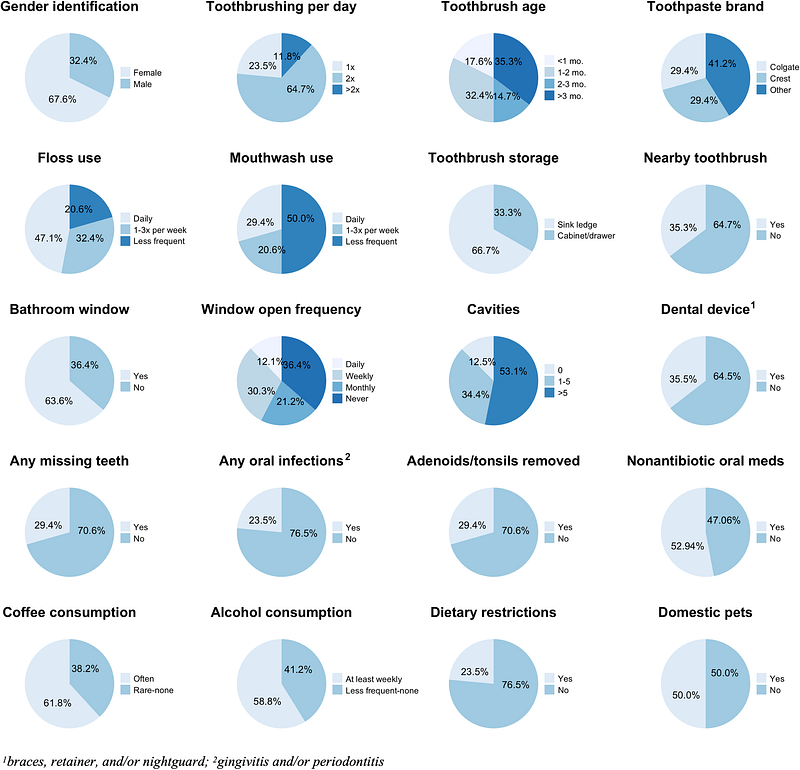
Want to check out more insights about how people handle their toothbrushes? Check out this graphic from the paper: