
SCIENCE | NOBEL PRIZE
The Truth About Marie Curie’s Life & Death
Marie Curie was the first woman to win a Nobel Prize and is the only woman to have won the Nobel Prize twice. She won it for Physics in 1903 and for Chemistry in 1911.
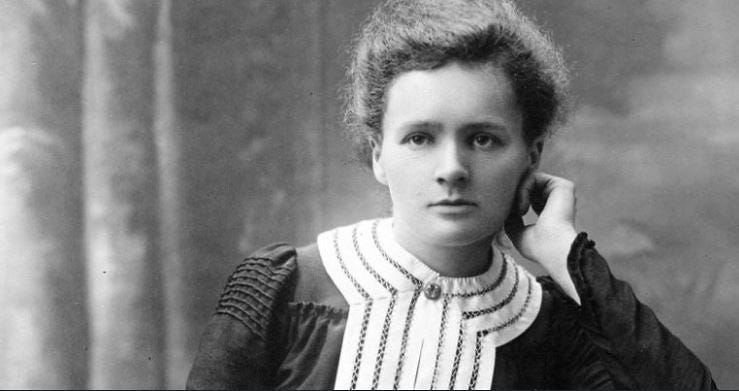
Marie Curie, the Early Years
Marie Curie, born Maria Skłodowska in Warsaw, Poland, on 7 November 1867, displayed an early passion for science.
Although born of two teachers, she was denied higher education in Poland due to her gender. Her mother died early, and her father could not afford to send her to school.
She worked as a governess and pursued clandestine studies through Physics and Math books.
In 1891, her sister offered to support her studies if she moved to Paris. There, she enrolled at the Sorbonne University, where she met Pierre Curie, a physicist, and they married in 1895. The Curies had two daughters, Irène and Ève.
Together, Marie and Pierre Curie made groundbreaking discoveries in physics and chemistry while teaching at the Paris School of Chemistry and Physics.
They conducted pioneering research on radioactivity, isolating radium and polonium.
Marie became the first woman to win a Nobel Prize and the only woman to win the award twice.
She remains an iconic figure in science, known for her tireless dedication to research and indelible contributions to our understanding of the atom.
“Life is not easy for any of us. But what of that? We must have perseverance and above all confidence in ourselves. We must believe that we are gifted for something, and that this thing must be attained.” — Marie Curie.
The Nobel Prize in Physics 1903
“In recognition of the extraordinary services they have rendered by their joint researches on the radiation phenomena discovered by Professor Henri Becquerel.”
Professor Becquerel discovered that the rays from Uranium could pass through solid matter, fog, and photo paper and that it could conduct static electricity.
The Curies and Becquerel were awarded the Nobel Prize jointly, even though their work on radioactivity was conducted separately.
Marie also passed her Doctoral Thesis in Physics in 1903.
In 1906, Pierre was struck by a horse-drawn carriage and died. Leaving Marie to raise their two daughters and continue their work.
Marie took over his Chair as Professor at the Sorbonne University and continued his lectures there.
Marie also continued their research and discovered a method to measure radioactivity, for which she won another Nobel Prize in Chemistry.
The following year, the Sorbonne University opened two new labs, one for radioactivity studies, headed by Marie Curie, and the other a biological lab for cancer research and treatment.
The Nobel Prize in Chemistry 1911
“In recognition of her services to the advancement of chemistry by the discovery of the elements radium and polonium, by the isolation of radium and the study of the nature and compounds of this remarkable element.”
Marie Curie was the Director of the Red Cross in Paris during WWI. She developed a mobile X-ray machine that could be used on the battlefield to diagnose injuries.
The first X-ray machines were called “Petits Curies” — with these and her daughter Irene at 17 set up a casualty clearing station near the frontline. They x-rayed wounded men looking for shrapnel, fractures, and bullets.
Today’s X-ray machines are similar to Petits Curies.
She toured Paris, asking for medical supplies, donations, and vehicles to convert to ambulances.
After the war, Marie and Irene continued their work. Marie won several accolades and awards, including the Ellan Richards Research Prize in 1921, the Grand Prix du Marquis d’Argenteuil in 1923, and the Cameron Prize in 1931 from Edinburgh University.
Moreover, her daughter, Irène Joliot-Curie, and son-in-law, Frédéric Joliot-Curie, also won the Nobel Prize. Bringing the total for the family to five.
The Nobel Prize in Chemistry 1935
“In recognition of their synthesis of new radioactive elements.”
Marie Curie died at 66 in the Passy, France, Sancellemoz Sanatorium. Aplastic pernicious anemia was given as the cause of her death. It is a condition developed through years of radiation exposure and poisoning.
Marie Curie literally gave her life to her work.
That’s all for today. Please engage with my article by highlighting something you found interesting and commenting. Come back soon.
Alternatively, you could subscribe to get notified of all my new stories by email.

Stephen Dalton is a retired US Army First Sergeant with a degree in journalism from the University of Maryland and a Certified US English Chicago Manual of Style Editor. Also, a Top Writer in Bitcoin, Business, Investing, Nutrition, Travel, Fiction, Transportation, VR, NFL, Design, Creativity, and Short Story.