
Writing 101
The Truth About Fanfiction
Some of the world’s best literature is fanfiction — no, really!

So you want to be a writer. Congratulations! That means you’re a writer. There’s no hard-and-fast rule about what makes a writer a writer. Maybe you write poetry, or blog posts, or novels, or infomercial scripts. Or maybe you write fanfiction.
A lot of people will tell you that fanfiction is not a legitimate form of writing. They’ll say that it’s “cheating,” because you draw inspiration from other people’s work. They’ll say it’s low class writing, because a lot of fanfiction is smutty (or, frankly, gay).
Well I’m here to tell you, fanfiction writers, that you have nothing to be ashamed of! Well, maybe you have other things to be ashamed of. But you should not be ashamed for writing fanfiction.
Fanfic is a gateway drug for many writers. It’s a way to explore ideas, practice writing, develop skills (like plotting, character development, continuity). It’s a place you can go to get instant feedback, boost your confidence, get critiques. It can help you form lasting relationships, from the beta readers to best friends.
Writing fanfiction is, for many writers, not only a stepping stone to writing original fiction (and doing well in the publishing world), but also a valuable experience and asset. Or, you know, fun.

The Myth:
Writing fanfiction is “cheating” and not “real writing.”
The truth:
Fanfiction draws on the characters, settings, or plots of other works to create new works. But so does literally every other form of literature. Every year hundreds of books are published that draw on other works for inspiration. And many of them do extremely well. Just look at George Orwell’s 1984. Did you know that it is inspired by (and it a lot of ways outright plagiarizes, but I’m not touching that with a ten foot pole) Yevgeny Zamyatin’s We? Probably not, because the fanfic (yes, I’m calling 1984 a fanfic, fight me) surpassed the original due to a lot of crazy economic, social, and political factors. But it was still based on something else.
Have you heard of Wicked, the highly successful novel and musical? That’s Wizard of Oz fanfiction right there. James Joyce’s Ulysses? Sort of based on Homer’s The Odyssey — a contemporary AU, as it were. Even Mark Twain wrote A Connecticut Yankee in King Arthur’s Court, which is the Gary Stu self-insert fanfic to end all Gary Stu self-insert fanfics. And of course there’s the The League of Extraordinary Gentlemen by Alan Moore, the ultimate crossover comic. It borrows characters from just about every “canon” piece of literature imaginable.
I have read AU (alternate universe) fanfictions that no longer resemble the work they were inspired by. Many of them are far less similar than 1984 and We. And I’m not just talking about EL James’ infamous Fifty Shades of Gray book series (which is based on Stephanie Meyer’s Twilight saga) or Cassandra Clare’s The Mortal Instruments (based on JK Rowling’s Harry Potter), either. I’m talking Coffee Shop and Office AUs of series set in outer space, Space Opera AUs of realistic fiction books and movies, and everything in between. The only things these stories have in common with their inspiration are the names of the characters and maybe their appearance/personality (although that’s not necessarily true, either). These are stories that are pretty much original fiction. They take the same effort, the same time, the same dedication to write, edit, and publish (yes, AO3 counts) as original fiction.
For a long time, the novel wasn’t considered a respected form of literature. Why? Because the genre was dominated by women. Funny how fanfiction is also a genre dominated by women (and LGBT) writers, and it is also not taken seriously. And by funny, I mean blatantly sexist (and homophobic). Fanfiction is often ridiculed as a “girl thing.” Do not let this get in your way. Just because something isn’t “critically acclaimed” doesn’t mean that it’s worthless.
Fanfiction is real writing. It takes just as much work as writing original fiction. There are fanfictions that are longer than the entire Lord of the Rings series. The time and effort devoted to those projects are just as valid as that devoted to writing original fiction. The only difference? Fanfiction writers tend to publish their work online for free, instead of pursuing selfpub or a traditional publisher for profit.
The Myth:
Fanfiction can’t make anyone money.
The Truth:
Not everyone is going to be EL James or Cassandra Clare and have our fanfic snapped up by a traditional publisher. But remember all those other works of basically-fanfiction I mentioned? Authors like George Orwell, Mark Twain, and James Joyce all managed to traditionally publish their fanfiction. It is human nature to build off of the ideas of those who came before us. In fact, for most of history, that’s all story-telling was. It’s only recently that people have become obsessed with originality. A few hundred years ago, a painter was only considered skilled if they could copy the “Great Masters.” There is nothing truly original, and if there was, it wouldn’t sell anyway.
(Also, who says people need to write for money? It can just be a fun hobby. If all you ever write is fanfic, that’s okay. We don’t tell kids in Little League not to bother because they won’t ever go pro. You’re allowed to write fanfic because you like writing fanfic and never make a cent from it. That’s a valid option!)
However, if you do want to become a “professional” (paid) writer, don’t give up on ever making money through writing just because you write fanfiction. And even if you never make any money from your fanfiction directly, the experience of having written and published fanfiction can be extremely valuable to your writing career! Which leads me to…
The Myth:
Fanfiction is useless and wastes time/creative effort.
The Truth:
Writing fanfiction taught me a lot about how to write. From fanfiction, I learned what worked and what didn’t. Writing fanfiction improved my style, my grammar, and my consistency.
Writing one-shots taught me the structure of a good short story. Writing drabbles taught me about precision and conciseness. Completing prompts/challenges taught me how to follow direction. Writing longer fic taught me about continuity, plot development, foreshadowing and following through. Writing fanfiction taught me about character development, about incorporating motivation, about avoiding OOC (out of character) words and actions — these are all important lessons for a young writer!
Everyone needs practice to build a skill, and writing is a set of very complex, difficult skills. Writing fanfiction is one of the many ways writers can hone the skills they’ll need to succeed in the publishing industry, and to see what it is exactly they need to improve on. How? Interaction. Comments. Kudos.
Fanfiction provides a platform for instant critique and feedback. It teaches you how to take criticism and turn it into growth. The first time a publisher reads your novel and gives you criticism, you’ll not only be used to reading and interpreting feedback, you’ll also not be as sensitive to it; the first time someone says “this needs improvement” can be tough, but it can be less so when you already know what to expect. Even dealing with internet trolls telling you how much “u suck” at writing (You don’t. At least, not any more than any of us “suck” when starting out.) can be an empowering moment.
Writers need to have thick skin to make it in traditional publishing, as well as confidence. New writers who haven’t had any feedback might not have confidence in their writing because they don’t know how people will react to their style or their ideas. Getting your first positive comment or kudos on a fanfic is an extremely validating experience. Knowing that someone enjoyed your work is a major confidence boost. And confidence leads to more risk taking, experimenting, and growth… which leads to better writing.

The Myth:
Fanfiction is a phase.
The Truth:
Many fanfiction writers never write original fiction. Others stop writing fanfiction once they start writing original fiction. Still others write both.
The same week my second novel was published, I posted a chapter of an ongoing Sherlock fanfiction on AO3. Just because one work was “original” and the other was fanfiction doesn’t make one more important than the other!
The truth is, many of us don’t “grow out of” writing fanfiction. It isn’t just for kids or young writers learning their craft — fanfiction is about having a passion for a story, and wanting to contribute to a community. It should come as no shock then for me to say that writing fanfiction is not always a phase, and writing fanfiction and publishing original fiction are not mutually exclusive.
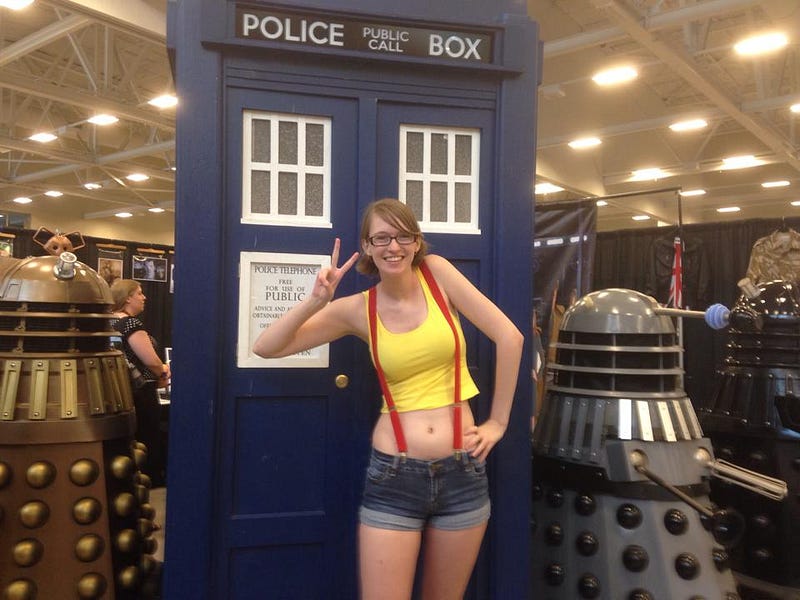
Get you a girl who can do both!
The Myth:
No one reads fanfiction.
The Truth:
Hopefully by now you’re starting to see a trend. Thousands of people write fanfiction; for starters, all of them read it too. And there are many, many more who just read fanfiction and don’t write their own. I can’t even begin to imagine the size of the Harry Potter fandom (even post-Rowling), let alone the Star Trek fandom, which has existed since the 60s. Before the Internet, fanfiction was published in zines (although they weren’t called that then) or sent between fans by mail! Fanfiction is not new. It is not a fad. It is a decades-old celebration of the things we love, of books and movies and TV shows we can’t get enough of — so we make more of it ourselves.
So many people read and write fanfiction that it is inevitable that once you join in, you’ll start making connections. You’ll meet people who want to proofread your work (called beta readers) in exchange for you proofreading theirs. You’ll meet people who want to talk about your work, their work, or canon (which here means “what is explicitly stated in the source material”). You might have fan artists asking to draw a scene from your story. You might see people prompting new works (“Someone please write ST:TOS AU where Kirk & Spock run against Trump & Pence for POTUS/VP!”).
Fandoms are gigantic, chaotic communities. They contain a multitude of people, many of whom you could form lasting relationships with. And even beyond that, many fanfiction writers gather a following. There are people who follow specific writers’ work because they like what they’ve written and want more. Having a community like that who is already familiar with the quality and style of your work can be a phenomenal asset if you venture into original fiction. Those people who read your Supernatural Destiel fic might like your upcoming novel — and fanfiction writers tend to like supporting other fanfiction writers. It’s a community of support. So you may actually end up getting readers of your original fiction from your fanfic days. Go figure!

The Myth:
Fanfiction is all porn. All of it. Gay porn everywhere!
The Truth:
When someone says they write fanfiction, that doesn’t mean they write gay erotica. I mean, they might. There’s nothing wrong with that, and “slash” is certainly a large component of a lot of many fandoms (e.g. Kirk/Spock — the slash represents a romantic or sexual relationship). But there are many other types of fanfiction, too.
Some writers like to add new romantic or sexual relationships between characters that was never explicitly in the source material. Some writers like to write backstories that are only hinted about in canon. Some writers like to continue a scene that didn’t feel finished to them. Some writers like to write about what happened after the book was over. Some writers like to extrapolate the distant futures of the characters. Some writers like to change an element of the story (e.g. what if so-and-so hadn’t died) and rewrite what happens next. Some writers like to write AUs, stories where the characters are the same but are in a new setting (what if Teen Wolf’s Stiles and Derek worked for Google together?) or have a different relationship to each other (e.g. what if Draco Malfoy and Harry Potter were half-brothers?).
There are so many types of fanfiction, it isn’t fair to lump it all together as “porn.” And even those writers who enjoy writing “porn” — who are you to say that’s not “real writing”? Erotica is a flourishing genre of literature and a multimillion dollar industry. It just so happens that most readers and writers of erotica are women.
Which once again leads us to the question: why does society love to shit all over things women like so much?!
The Myth:
Fanfiction is gay.
The Truth:
A lot of fanfiction is super gay.
There is so little positive representation for LGBT people in mainstream media, it’s no wonder so many LGBT writers decided to carve out space for themselves in fanfic. Fanfiction is a place where people can fill this void, where they can see themselves reflected in the characters they love. But there is nothing wrong with gay fanfiction.
There is nothing wrong with gay fanfiction.
Say it louder for the people in the back!
(Caveat: there has recently been some legitimate criticism of straight women who write M/M as speaking over and/or fetishizing gay men, and that can definitely be a problem. The problem, though, is not that gay fanfiction exists, but how it represents and therefore affects real LGBTQ+ people in the world.)
Some fanfiction is gay, some of it isn’t. But whether or not something contains homosexual content should not be an indicator of its value or quality.
Also, on a similar note: lots of fanfiction is also about creating representation for racial minorities, correcting racist assumptions, and exploring the lives of background characters. Nobel laureate JM Coetzee wrote Foe, a novel that uses the narrative of Robin Crusoe to explore issues of power and colonialism through the eyes of a female castaway and to give agency to Friday. Jean Rhys’ novel Wide Sargasso Sea is a prequel to Jane Eyre which explores the life of Rochester’s Creole first wife, who in Bronte’s books is depicted as the “crazy woman in the attic.” Reclaiming “the canon” and works of classic literature for underrepresented minorities is a major strain of fanfiction, and one that is important to discuss as we decolonize our curricula at every level of education.
So fanfiction can be a safe space to find oneself in the literature one enjoys, or to give another perspective to classic stories, or to increase representation, or to celebrate one’s sexuality or culture… these are all good things!!

The Myth:
Maybe I just don’t like fanfiction, okay?!
The Truth:
You probably do and don’t know it.
Do you like Lin-Manuel Miranda’s Tony award-winning musical Hamilton? That’s a historical RPF (real people fiction) AU.
Have you ever enjoyed an adaption of Sherlock Holmes? BBC’s Sherlock or CBS’s Elementary, perhaps? What about Netflix’s Enola Homes? All fanfiction based on the character created by Sir Arthur Conan Doyle, of course.
What about Jonathan Larsen’s Rent? AU fanfic of Puccini’s La Boheme (much like the movie Moulin Rouge, an AU hybrid crossover fanfic of La Boheme and La Traviata). You may also be familiar with the recent musical-about-a-musical, Tick… Tick… Boom!, starring Andrew Garfield as Larsen.
The classic 90s film Clueless is a modern retelling of Jane Austen’s Emma.
West Side Story is a modern AU of Shakespeare’s Romeo and Juliet, which is itself a retelling (fanfiction!) of an Italian poem. It’s been done multiple times, in fact; the 1999 teen drama Ten Things I Hate About You (starring Julia Stiles, Heath Ledger, and Joseph Gordon-Levitt) is a modern AU of Shakespeare’s The Taming of the Shrew, and the 2006 film She’s the Man (starring Amanda Bynes and Channing Tatum) is a modern AU of Twelfth Night.
In Alan Moore’s Watchmen, a character is reading a book based on a song from Bertold Brecht/Kurt Weill’s Three Penny Opera, itself an AU modernized retelling of The Beggar’s Opera.
These all sound too new to you? Still think fanfiction is a trend? Milton’s epic poem Paradise Lost is just Old Testament fanfiction. Dante’s the Divine Comedy is self-insert RPF fanfic. He was all like “OMG, what if Virgil and I met and became besties?!” And don’t forget Shakespeare in all this. Ol’ Billy Shakes was the King of Historical RPF fanfic. I mentioned some modern fanfic of his plays, but they were almost all based on real people and events (very loosely) or older poems in French or Italian.
Many stories are enduring in the cultural imagination. BBC’s Merlin (2008–2012) is very obviously based on Arthurian Myth. And so are like a thousand other things, from movies and TV shows to books and comics, from the thirteenth century to the present! Gawain & the Green Knight. Le Morte D’arthur. The Canterbury Tales. T.H. White’s The Once and Future King. Marion Zimmer Bradley’s Mists of Avalon. Tennyson’s masterpiece, Idylls of the King.
The Verdict
Fanfiction is awesome. A lot of “real” fiction is actually fanfiction — or at least could be interpreted that way. I could have chosen so many more examples of where fanfiction has been a financial, critical, or cultural success. People who shame fanfiction clearly don’t understand what it is, or its value.
Fanfiction can be a stepping stone for many writers. It can be a valuable learning experience. Good writing takes practice — why not practice on a platform where you can make friends, receive instant feedback, grow as a writer, and make lasting relationships? Why not take advantage of your passion for Sherlock Holmes / Game of Thrones / Star Trek / Captain America and funnel that into the enjoyable, worthwhile practice of writing fanfiction?
One thing I was sick of hearing as a fanfic writer was that I wasn’t a “real” writer. I’m here to tell you that you are a real writer, whether you publish original fiction or not. Fanfiction is real fiction. It takes skill, dedication, and passion — just like writing a novel. It is an art form. It is valid as a stepping stone to original fiction or a hobby in and of itself.
You are a real writer.
So if you want to write fanfiction, just do it! It will not be detrimental to your future career in publishing, I promise. Don’t ever feel ashamed of doing what you love. You walk among the great writers of history — what better way to get to know them, than to step into their shoes?
Thank you to my good friend W Dickerson for reminding me that this essay existed. It was published in an earlier form on Willow’s tumblog Writrs. Check out Willow’s page for stories about fandom, nerdom, and writing:
Support the author:
If you’re enjoying my content, consider showing your support by buying me a coffee. If you sign up using my referral link to get unlimited access to all of Medium, I receive a small commission.
To see more of my work, follow me on Medium or check out my personal nonfiction, nonfiction journalism and longform fiction. I do not monetize poetry or flash fiction. My novels are temporarily out of print; find out why in my article, “The Dreamspinner Press Controversy.” You can also find me on Twitter or like my public Facebook page.