
The Truth About Elon Musk vs. Bernie Sanders
How to understand billionaires, social democracy, and the financial climate of today.
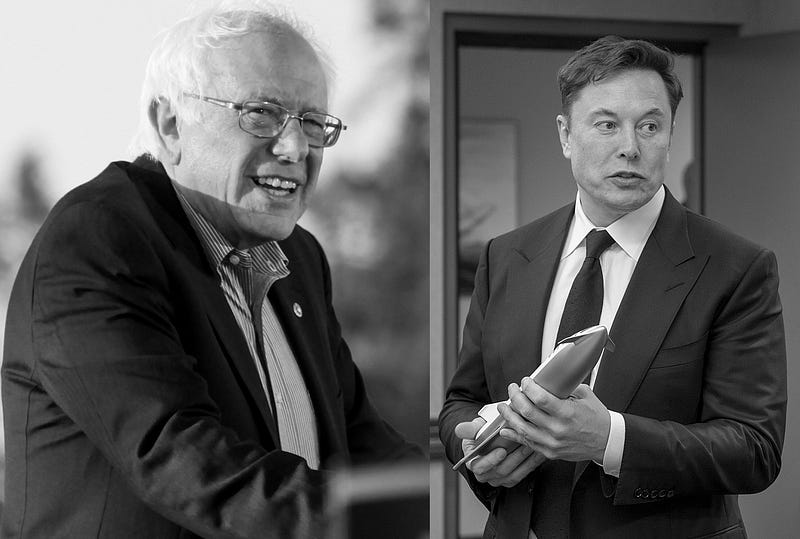
In November 2021, Senator Bernie Sanders tweeted, “We must demand that the extremely wealthy pay their fair share. Period.” Elon Musk had a few interesting responses for Sanders, including:
- “I keep forgetting that you’re still alive.”
- “Want me to sell more stock, Bernie? Just say the word.”
- “Bernie is a taker, not a maker.”
- “Ok, how much do you think is fair? Does 53% seem reasonable?”
The debate between Elon and Bernie is characteristic of the time period we live in. Massive amounts of money have become concentrated in the hands of a few techno-kings who can access more capital than ever before.
These ultra-rich include Jeff Bezos, Elon Musk, Mark Zuckerberg, the Google Guys, and new crypto wealthy like Changpeng Zao of Binance. Altogether, billionaires control more wealth than the bottom 4.6 billion people and the vast majority of online data. (Don’t click away now — this isn’t another billionaire hating article or a socialism article.)
Even 20 years ago shortly after the dotcom bust, wealth wasn’t this concentrated, right? Actually, that’s true. Bill Gates was the richest man in the world, but billionaires were more few and far between.
The concentration of wealth on a massive scale has led to a revolution in the United States that is personified by one man more than any other: Bernie Sanders. He is massively popular among young adults who feel the economy is rigged against them. However, he is massively unpopular with the ultra-wealthy — like Elon Musk — who seem to control the globe right now.
Is this new conflict a sign that we are in times never before seen? I dug into this question and found out the truth is much more interesting than either side can present.
Repeating History
Will and Arial Durant are legendary in the field of written history. Among other things, they wrote The Story of Civilization, an 11 volume, 13,000 page masterpiece that took them 40 years to write.
For this series, the Durants won the Pulitzer Prize for Nonfiction and received the Presidential Medal of Freedom. Needless to say, it was an incredible series that covered from the beginning of recorded history in the Near East to the time of Napoleon.
Most people will not take the time to read all 13,000 pages, but everyone should read their book The Lessons of History. This book takes to 102 pages of content the most important lessons from 4 decades of study and thousands of other sources.
It is a tough read, with lots of scholarly language interspersed with poetic prose, but the lessons are good enough that it would be worth its weight in gold.
Perhaps the most applicable lesson for our time is Chapter VIII: Economics and History. The basic premise presented by the Durants is that centralized accumulation of capital is natural for humans. Certain humans are born with traits that make them greedier and smarter. This allows them to gain control over others perpetually. Over time, value is concentrated in the hands of the few.
However, there is a natural cycle wherein the majority of the population periodically takes back control of most wealth, either through war or legislation. Legislation has been used in the United States following the Great Depression and during the early 1960s.
Unfortunately, the Durants died 13 days apart from each other in 1981; they never saw the capital accumulation of our day. I’m sure they would have agreed that a separation event is about to occur. So far, war has never occurred in the U.S. over redistributing capital (although the Civil War did some of that), so we must assume that political means will be used to give wealth back to the people.
Bernie Sanders, Elizabeth Warren, and Andrew Yang
The two most widely loved and respected politicians to advocate for redistribution of wealth are Sanders, Warren, and Yang. Bernie is the most widely-recognized of the three, as evidenced by the following:
- 95% of people have heard of Bernie
- YouGovAmerica lists Bernie as the fourth most popular politician
- Over 18,000,000 Twitter followers between his two accounts (more than twice as many as the next closest Congress member)
For reference, Vermont’s other senator (you don’t know his name, do you?), has a 57% recognition rating and a 132nd most popular politician rating. Bernie is clearly doing things that other politicians, especially in Congress, don’t do. Specifically, that means Bernie Sanders is approaching money in an entirely different way.
First, Bernie supports Medicare-for-all that will phase out private health providers. Second, he advocates for free college at all state colleges and universities. Third, Bernie supports Elizabeth Warren’s plan to tax extremely wealthy people:
- “2% annual tax on household net worth between $50 million and $1 billion
- 4% annual Billionaire Surtax (6% tax overall) on household net worth above $1 billion”
Warren claims this plan would have a ten-year gain of almost $4 trillion. One of Sanders’s more controversial monetary proposals is that the “federal government should pay reparations for slavery and racial discrimination”.
Right now, Sanders is actively campaigning in behalf of unions, specifically Amazon unions, and calling for Biden to punish Amazon for its mistreatment of employees. Bernie Sanders also has well-known positions as an advocate for higher minimum wage and a big opponent of Super PACs or promising rewards to major donors.
Let’s go back to Elizabeth Warren. She is goes the farthest of any politicians in her criticisms of the ultra-wealthy, but from her plan above, she doesn’t seem to have too crazy of ideas. Warren is one of only three senators considered more economically liberal than Sanders, but her plans sound very similar:
“Warren supports worker representation on corporations’ board of directors, breaking up monopolies, stiffening sentences for white-collar crime, a Medicare for All plan to provide health insurance for all Americans, and a higher minimum wage.”
Basically, the leftists senators are all united in the cause of spreading wealth to everyone. They can’t get enough support from the rest of the Democratic Party, however, to be true contenders in presidential races.
Sanders and Warren are constantly called socialists for the reforms they advocate. However, on the business-loving side of the spectrum, Andrew Yang advocates a lot of the sharing-of-wealth that Bernie is so famous for. Here’s what Yang proposed during his 2020 presidential run:
“Andrew would implement the Freedom Dividend, a universal basic income of $1,000/month, $12,000 a year, for every American adult over the age of 18. This is independent of one’s work status or any other factor.”
Obviously, there are problems, like how to fund this (maybe Sanders/Warren’s elite tax). The interesting part is that a business-focused, non-ideological politician who is fairly wealthy in his own right wants to start UBI.
The idea to spread wealth has spread across the entire political spectrum except amongst Trump and his populists. Nearly everyone recognizes that there is change on the horizon for the distribution of money.
The Billionaire Counterpoint
The main counterpoint billionaires can make is that technology is the driving point to make the world better. As an avowed futurist, I can definitely understand this point. A little though experiment shows how important technology is in quality of life:
Imagine you get a choice between being a high-ranking member of the French nobility in 1700 or a middle-class American today. Which is a better position to be in?
Most people automatically think nobility, but after a moment they recognize how hard that would be. No phone. No contact outside your local area. No modern indoor plumbing. No hospitals or medicine.
In those days, you could literally die from getting diarrhea. It was almost impossible to travel the world, and learning things was reserved for the few smartest people in each country. Sure, it would be cool to have some power and a little palace, but the equation is definitely not balanced — I’d choose today for sure.
Based on the fact that you’re reading this, I’d assume you use technology to some degree. In fact, I’d even assume you’re more technologically astute than the average person. What does that have to do with anything?
That means you understand the value provided by technology like Google’s search engine, YouTube’s easy video service, Microsoft’s Office tools, Facebook’s easy interpersonal connection, Airbnb’s localized travel, Uber’s fast carless transit, Apple’s top-quality devices, Tesla’s environmentally friendly cars, and more.
For all the negative parts of these technologies, they aren’t rejected by the broader public because they are definitely net positive.
Take Facebook/Meta for example: they mine unnecessary amounts of data, sell it to third parties, and have generally become quite controlling of their users. However, over its history Facebook has been net positive because they have helped connect people around the world in a new way.
All these companies began as small and risky startups. The founders of these companies were all obviously motivated by money to some degree, even if their larger motivation was to make a large impact on the world.
Without the money, Bill Gates wouldn’t have been staying up all night coding and Mark Zuckerberg wouldn’t have undergone all the lawsuits involved in the start of Facebook. The money provided to world-changing entrepreneurs is necessary for them to take the risk involved.
The big question to ask, though, is this: How much money is enough?
A Natural Solution
Remember how the Durants claimed that the only way for wealth to be redistributed is by war or legislation? That may not be the only way, but the new solution is possible only now.
This natural solution is Web3. No, I’m not a Bitcoin fanboy and I don’t invest in NFTs, but I see that Web3 has massive potential.
Don’t trust me though; trust former Google CEO and tech expert Eric Schmidt. He is apparently much more excited about the potential for decentralized tech than he is about crypto. Schmidt says,
“A new model [of the internet] where you as an individual [can] control your identity, and where you don’t have a centralized manager, is very powerful. It’s very seductive and it’s very decentralized. I remember that feeling when I was 25 that decentralized would be everything.”
Schmidt has $20 billion, so when he gives advice, 99.999% of the population needs to listen. He says that he would go into AI or blockchain right now if he were starting because the potential is so great.
Chris Dixon, general partner at Andreessen Horowitz and Web3 expert, claims that the major value of the internet comes from networks. That’s all the internet is, after all: a global network of computers.
However, the incredible thing about blockchain networks is that they rely on cryptography not centralized authority. No one can hack the network unless they control the majority of nodes. Getting a lot of nodes is nearly impossible because people are incentivized with tokens to create nodes.
What blockchain does is create a network of individuals who hold more power than a centralized authority could. Right now, we are only seeing Web3 as a key part of finance and a little bit in digital collectibles, but there will likely come a time when all software is run on decentralized networks.
The problem with decentralized networks is inefficiency; it’s harder to verify things through may different nodes than through a single, central authority. Luckily, there are chains like Solana that are addressing this issue, and there will be a curve of exponentially increasing blockchain processing speed.
With the advancements on the horizon, it’s not hard to imagine a world where power is concentrated in the networks we use, rather than in the network creators.
A Legal Solution
The basic legal foundation of spreading wealth evenly is through taxation and something like universal basic income. The first option to fund an equality program would be the previously mentioned plan from Elizabeth Warren to tax ultra-high net worth individuals.
The plan proposed by Andrew Yang is pretty simple: a VAT (valued-added tax) that taxes items at all steps along the retail process. PBS has a great description of how VAT would work:
“Here’s how it works: To make a T-shirt, a clothing company would buy fabric from a supplier for $5, for example. The supplier charges the clothing company the 10 percent value-added tax, or 50 cents, for a total of $5.50. The supplier then sends that 50 cents to the federal government.
Once the T-shirt is made, a clothing company sells it to a department store for $10, plus $1 in VAT, for a total of $11. The clothing company then gets a rebate from the federal government for 50 cents because it already paid 50 cents to the fabric supplier.
A customer then comes into the department store and buys the shirt for $20. The department store charges the customer the 10 percent VAT, or $2, for a grand total of $22. The department store will then get a rebate of $1 from the federal government because it paid the other $1 to the clothing company in VAT.”
If it sounds like it complicates the process of doing business, that’s because it does. Yang claims it raises enough money to spread wealth and that it will force big companies to pay reasonable taxes. There are still three big problems:
- Poorer people still pay the majority of the tax, even if it’s adjusted to put taxes most heavily on luxury items.
- The cost of everything will go up because each item is being taxed multiple times.
- It would only cover about 1/3rd the amount proposed by Yang for UBI.
In other words, there are options for legal remuneration, but there aren’t any ultra-valuable options. However, if you combine the billionaire tax with VAT and a luxury tax, there is potential for much greater income equality in the United States.
Conclusion
Here’s the bullet point rundown of this article:
- Billionaires control much of the wealth in the world today.
- Concentration of wealth is natural in human society. Periodically, wealth is redistributed.
- Several politicians, like Bernie Sanders, Elizabeth Warren, and Andrew Yang, have proposed ways to redistribute wealth.
- Tech billionaires (the main targets of anti-billionaire hate) see their wealth as a reward for undergoing major risk and creating globally useful products.
- Web3 provides a potential solution because it eliminates the centralized organization that controls data and profits.
- Legal solutions could still be used to equalize wealth in the United States while still motivating entrepreneurship.
As is clear, the economic system prevalent in the U.S. and the world today is very complex, but it’s not outside the cycles of human nature. The great thing is that we have technology that allows us to address the issues better than with war and fighting.
The best things any of us can do is avoid taking extreme positions in either direction. Billionaires aren’t the source of all evil, but taxation shouldn’t be altogether done away. The key is to look at problems from ever side to find the true solution.
Think like a scientist, not a zealot.


