
The True Meaning of Christmas Specials
“And this shall be a sign unto you:” 40% off?
Perhaps I was like Scrooge seeing Marley’s face on his door knocker, but I’m almost certain that when I watched the Charlie Brown Christmas special I heard Linus stand on stage and say:
And it came to pass in those days, that there went out a decree to render unto Caesar, and that all the world should shop and pay sales tax, and all went to be taxed, everyone into his own mall. And Joseph also went up from Shakopee, into Bloomington, unto the Mall of America, (which is called MOA) because he was an American, to shop with his wife Mary, they being great with debt. And so it was, that, while they were there, the items were purchased that needed to be delivered, and they brought forth their credit card, wrapped in promises to pay and laid it on the counter because there was no money in their checking account.
And there was in the same country stewards, abiding in their homes, keeping watch over their televisions by night. And lo, the commercials from Mammon came upon them and the glory of the goods shown round about them and they were sore afraid they would miss a good deal. And the commercial said unto them, “Fear not, for behold I bring you great tidings of a good economy, which shall be to all who do their part. For unto you is laid out this day, in a store near you, all manner of precious items, and this shall be a sign unto you: 40% off.” And suddenly there was within the commercial a multitude of friends and family praising their gifts and saying “Glory to the Giver with the highest credit card balance, and on earth peace, good will toward all, just $29.95.”
And it came to pass that I kept all these things and pondered them in my heart.
Fear not, for this is not going to be a complaint about how commercial Christmas has become. Frankly, those complaints have become as traditional and meaningless to most people as Holly and Ivy (if you don’t know what these represent, look it up). Complaining about how the true meaning of Christmas is being ignored, without actually dwelling on this meaning, is merely spiritual lip service; kind of like singing “Gloria In Excelsis Deo” without knowing what that means.
For me the issue is not that commercialism obscures the meaning of Christmas, but the cultural camouflage that diverts attention. As a case in point, let’s look at the Christmas specials we watch with our families.
Despite my parody of the Linus speech earlier, A Charlie Brown Christmas is a classic and a very “Christmas” special because it is one of the few that deals specifically with the birth of Christ. “The Little Drummer Boy” is another old (if unbiblical) one that was a favorite of mine as a kid that does this, while the Veggie Tales “The Toy That Saved Christmas” is the highlight of another generation.
Many Christmas specials purport to be about finding the true meaning of Christmas, but where is the Christ in “Rudolph the Red-nosed Reindeer,” “How the Grinch Stole Christmas,” “It’s a Wonderful Life”, or “A Christmas Story”? I love these, but if you watch them or most other shows you’ll get the message that you can be what you want to be and you should do kind things for others, and that Bumbles bounce.
Nice shows and nice sentiments all, but while Jesus would exhort us to be “nice” it isn’t why he came. Don’t forget that “for unto you is born this day in the city of Bethlehem a Savior, who is Christ the Lord.”
Enjoy the shows with your family, but if you are so inclined, look for ways to highlight Christian concepts within the programs, even if these messages appear unintentional. Teachable moments are everywhere if we are alert to them. The classic movie “Miracle on 34th Street,” for example, really focuses on the importance of faith, at one point virtually reciting Hebrews 11:1 and 11:5–6. Don’t miss the opportunity to call this to your children’s’ attention.
Similarly, I once sat open-mouthed (but not slack-jawed) watching the SpongeBob Squarepants Christmas program for the first time. The story is that SpongeBob has never heard of Santa Claus until his friend Sandy fills him in. SpongeBob gets so excited that he stands on a street corner proclaiming the good news to everyone (no one else has heard of Santa either) about how kind Santa is and about all the gifts he will bring. Soon, everyone is shouting, “We love Santa!” I turned to my daughter and said, “SpongeBob is an evangelist!”
Of course, SpongeBob is focusing on all the benefits that Santa brings. Similarly, people are exhorted to “try” Jesus for all the blessings that will be added to their lives — but if these don’t show up right away (or don’t show up in the way people expect) they get disillusioned, even bitter. This, too, happens in the SpongeBob Christmas show.
We lose sight of the fact that the first benefit of the salvation we receive from believing in Christ is not in getting what we deserve, but in avoiding what we deserve. We are in need of a savior, not a rich uncle.
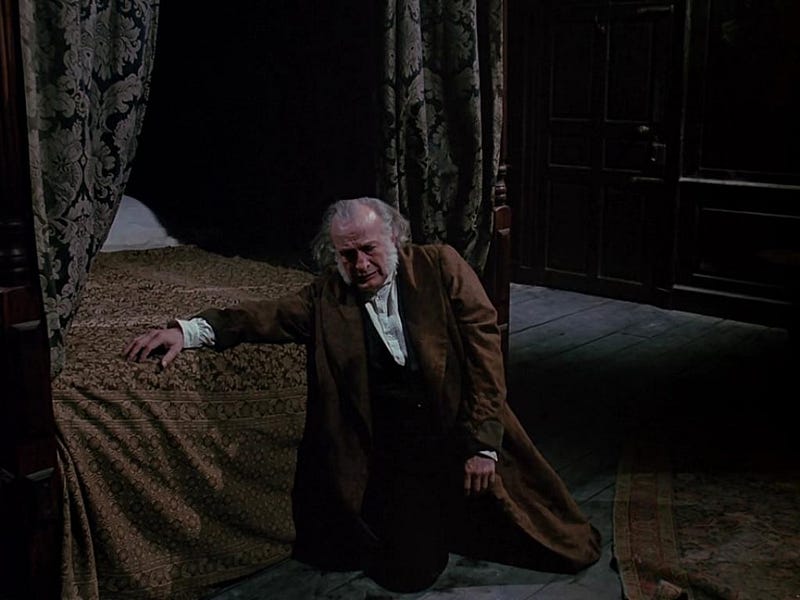
A good story for illustrating this concept can be Charles Dickens’ “A Christmas Carol”, though I don’t think the name of Jesus is ever mentioned. You may think you know the story of Ebenezer Scrooge, but look at it as a parable. Scrooge is greedy and cruel and oblivious to his iniquity. He doesn’t heed warnings to change, but because of another’s desire for him to avoid his fate, he is visited by spirits that convince and convict him of his sins, showing him all that he has missed out on, and also what is in store for him. In horror and regret he repents and asks for forgiveness, vowing to change.
He may not have been focused on the benefits of changing (as the old Scrooge would have been) but he did want to avoid a Marley-style fate, not knowing that he would also receive healing for his damaged spirit. Waking the next morning and realizing his opportunity he says “Thank you (Holy Spirit) Spirits!” and is ever after known as “a man who kept Christmas (Jesus) in his heart.” Is it a coincidence that the word “ebenezer” in Hebrew means a “stone of help” to commemorate something God has done?
By the way, I happen to think the George C. Scott “Christmas Carol” is the best, but I’ll always have a soft spot for Mr. Magoo as well.
I’m sure there are more examples in Christmas programs that I’ve left out but that have occurred to you. I’d love to hear what message or blessing you and your family get out of different Christmas shows, so feel free to leave a comment. Just don’t shoot your eye out!
Merry Christmas!