

The True Cost of Weak Leadership
Consider this scenario: You appointed a person to a leadership role in your organisation for which, not only was the individual not ready, but also was never able to “grow into that role.” Ultimately, after one or two years of the individual underperforming in the leadership role, you realised that it was a bad choice. Recognising the failure, you transferred the person to another role, hoping for a better result.
In light of the time and resources wasted, can you estimate the cost of this failure to the organisation? Many leaders cannot. But without knowing the exact costs — “direct costs” in terms of recruiting, hiring, and training, plus “hidden costs,” such as lost productivity, poor quality, and impact of low motivation on other employees working with that leader — management cannot operate an outstanding, successful, and truly profitable business.
Damage Caused by Hiring Mistakes at Any Level
Why is it still such a common practice for companies to assign leadership roles to people who are not ready or sufficiently prepared for the position and its accompanying responsibilities? If they possess the technical expertise that goes along with the job, they may seem to be the obvious and perfect choices. Yet, leadership roles require a complexity of skills and abilities that individuals may not have at present — and, in fact, may not ever possess the capacity to attain.
That said, even with hindsight and experience, in light of the eventual, inevitable, and actual failure of such individuals, many hiring leaders continue to repeat this error. But when organisations give authority and accountability to someone who does not have a comprehensive understanding of what a leadership role actually means, it is very likely that the person will not be able to handle the authority and eventually cause “collateral damage” to people, productivity, and the bottom line.
Internal and external hiring mistakes at all position levels happen more often than one likes to believe. Unfortunately, a significant percentage of hiring decisions result from the hiring manager’s “gut” feelings or perhaps intense pressure to swiftly fill a vacancy merely to get the job done. If qualified candidates are few and far between, managers must risk making a selection from a pool of individuals who may not necessarily possess behavioural or hard skills such as knowledge or hands-on experience. And, at times, HR, the line manager, or both, may find themselves fooled by a candidate’s appearance or interviewing skills, blatant close relationship to someone in management, or pressed to consider a colleague’s referral, without digging deeper to ascertain the underlying fitness for the position.
Data Proves the Need for Awareness
Many leaders fail to understand the true cost of hiring and retaining individuals who either do not have the necessary credentials, behavioural aptitude, and experience or, perhaps, are unwilling to exchange acceptable work for the salary they earn — AKA bad leaders. Such costs, often overlooked, can only lead to the organisation’s long-term detriment, risking its viability, growth potential, and success going forward.
In light of today’s competitive market, there is a critical need and urgency for board members and CEOs to understand the link between weak leadership and its true cost to all stakeholders — the management team, employee base, shareholders, clients, and customers. Part of the problem involves where corporations spend money, for example:
- Some HR programmes do little or nothing to further the true assessment and development of the individual employee. Without such forward movement, innovation and creativity stagnate, causing a drag on the quality and reliability of the company’s future potential.
- Recruiting, hiring, and training employees who do not “fit” with the organisation’s values or do not possess the requisite talent result in eventual failure or mediocracy.
An article[1] on employment costs refers to an expensive hiring mistake — the cost of a “mis-hire” — as the unconscious avoidance, denial, and/or toleration of underperforming or indifferent employees. The higher the position level, the faster the cost of a such an error increases exponentially. Brad Smart, Founder of Topgrading, Inc., cited in the article, considers the potential cost for a mis-hire as:
- 14 times salary for employees earning a base salary under US$100,000
- 28 times salary for employees earning US$100,000 to US$250,000
Besides the typical direct and indirect costs of dealing with the challenge of finding new, qualified employees (recruiting, interviewing, reference checking, lost productivity in beginning months, and so on), employers need to consider long-term opportunity costs. Such costs include substandard service; lowered employee morale and substandard performance in others due to passive resistance; missed deadlines; customer dissatisfaction with product quality, customer service, lack of innovation caused by disengagement and/or lost trust/faith in the company; and, unfortunately, missed sales opportunities.
The Long-Term Financial Implications
Imagine a business unit that has an annual revenue of US$250 million, operating at a 15% margin. Led by 12 global/regional leaders who cost, on average, US$300,000 per head, the impact of mis-hiring a single leader for the team can be truly devastating for the business unit. Two mis-hires at the leadership level will present a big problem. Three will result in long-term damage. Using this data as the base for an example calculation, the business impact becomes even more clear.
Add alt text
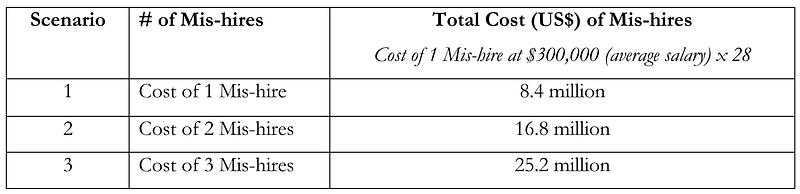
Consequently, the potential financial impact of mis-hires on a business unit with an annual revenue of US$250 million at a 15% operating margin (or, US$250,000,000 x 15% = US$37,500,000) can be as significant as a 67% reduction of the operating margin.
The hypothetical impact on the company’s operating margin is as follows, using the same three scenarios.
Add alt text
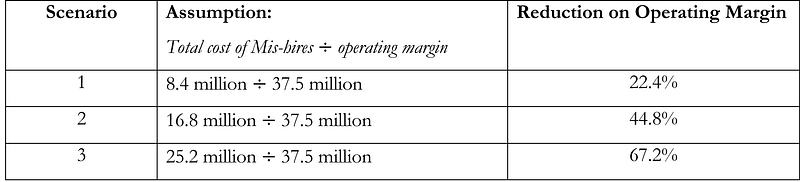
This result represents a huge impact on the organisation’s bottom line, considering the efforts and assets invested in such a business. Not only the leadership team, but shareholders as well, should be very concerned with scenarios that adversely affect profits and growth. The last thing shareholders desire is to risk the percentage of their return on their investment, which would be unacceptable. More to the point, the last thing employees desire is to find themselves, in turn, hunting for new jobs as a result of the incompetent and inefficient leadership of the entity.
A Story with an Unhappy Ending, Unless Rewritten
Put this way, in light of actual numbers, the financial impact of appointing weak leaders is a very clear, troubling, and compelling story. A serious issue faced by many organisations today involves the lack of transparency (or ignorance) with regard to actual costs or, indeed, little or no attempt to search for the true impact. This lack of transparency and understanding can trigger extensive hidden costs that take the form of wasted resources, financial expenditures, and lost time for all stakeholders, from the employee to the leadership team to shareholders. Hidden or not, these costs take a toll on all of us as we continue, over and over, to pay them.
Leadership roles are critical for developing the business and outperforming industry peers in this extremely competitive market environment. By not spending enough quality time in finding the right people and, therefore, appointing the wrong ones to these roles, many organisations defy all their stakeholders — shareholders, board members, management, employees, suppliers, clients and customers, and the community at large. Discovering, hiring, engaging, developing, and retaining only the true, strong, and capable leaders to grow your business offers the road to success.
[1] Denise Corcoran, Empowered Business.com, “Shocking Costs of Hiring Mistakes” (October 30, 2013).