
The Trope of The Farmer’s Daughter
How gender inequality was cemented by plowed agriculture
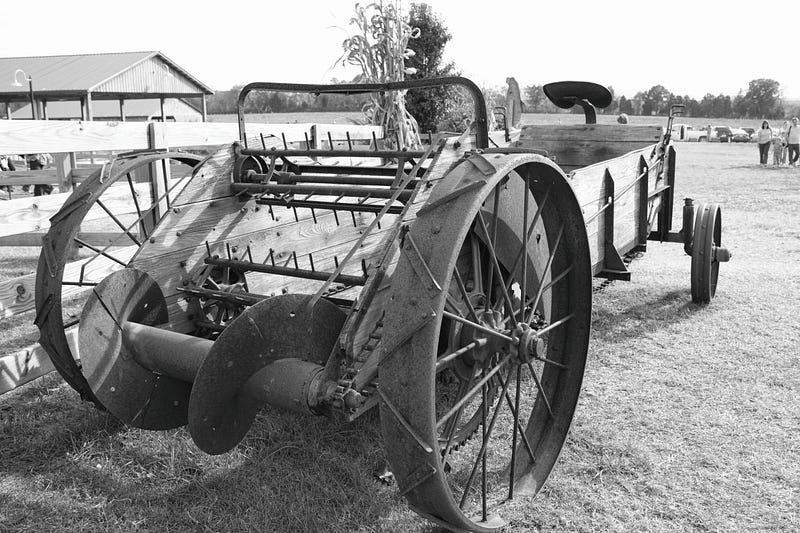
The farmer’s daughter is a standard figure of jokes and stories, a promiscuous good-time girl, always up for a roll in the hay with whatever traveling salesman or visitor to the farm happens along. She is sexually bold and indiscriminate about who she mates with and is clearly in need of the sort of control that plowed agriculture was to give men over women. Yes, you read that right — it was plowed agriculture that cemented the growing power differential between men and women that started about 6–9 thousand years ago with the invasions of the Pro-Indo-Europeans.
In 2013, a group of Harvard and UCLA economists did a unique study that established that the plow has had a great impact on our beliefs about men and women and about female freedom and autonomy. This is not only true in places that currently have plowed agriculture, but is still true in urban centers that once had it. Societies with a connection to plowed agriculture, as distinct from land worked with hoes or sticks, generations later still have markedly lower levels of female participation in politics and the labor force, and they rank high on the embrace of markedly gender-biased attitudes.
To understand why we need to consider how humans lived before the invention of the plow. There is a growing consensus among anthropologists that we evolved not as monogamous dyads but as cooperative breeders. The culturally strong image of the brave pre-historic hunter bringing home the bacon to his mate who is waiting to be provided for is really just a cultural myth. For most of human history, small bands of men and women raised young collectively, and almost certainly mated with multiple partners.
This is a lifestyle with a lot of evolutionary benefits. Multiple mating in primates establishes and continually reinforces social bonds so that there are low levels of conflict, and there is every reason to believe the same was true of our hunter-gatherer ancestors. Enhanced cooperation meant all were more likely to look after one another and their young, thus improving each individual’s reproductive fitness (the odds that their offspring would go on to produce offspring).
As Saint Louis University associate professor of anthropology Katherine C. MacKinnon told me, “We had predators. And we didn’t have claws or long, sharp teeth. But we had each other. Social cooperation, including cooperative breeding, was a social and reproductive strategy that served us well.”
Martin, Wednesday. Untrue (p. 91). Little, Brown and Company. Kindle Edition.
Meat was a very small portion of the diet of Paleolithic peoples. As such, female gatherers were central to the survival and well-being of the tribe. They weren’t sitting at home, tending the fire and the children, waiting for their one mate to provide for them. That’s a very recent and geographically specific dynamic.
Sociologist Rae Blumberg has pointed out that it is only for less than 3% of human history and in this one type of agrarian society, that women have become fundamentally dependent on men. Plowed agriculture turned on its head the prior dynamic of women as competent, self-sufficient primary producers who make their own decisions relatively autonomously.
For hunter-gatherers and in other types of agricultural economies, what women did was a huge contribution to the wellbeing of the family and the society, and they did it outdoors. In both paddy and hoe fields, female labor was vital, and a woman’s social status mirrored her indispensable contributions. Without her, no one would eat.
By contrast, a plow requires significant upper body strength, and cannot be easily set down to tend to children. Plowed agriculture meant that men worked outdoors and women became relegated to the house, and the care of the home. With land being inherited through the male line, men stayed with their families of origin and women moved to them, another factor in the diminishment of women’s status.
Simply put, a shift toward growing crops intensively for subsistence and later for profit changed everything between the sexes. Three linked beliefs — that a woman is a man’s property; that a woman’s place is in the home; and that women especially ought to be more “naturally” monogamous — are seeds that were planted in our early harvests. Stranger still, a woman’s most personal decisions were transformed into a matter of public concern and her sexual autonomy subjected to social control and legislation, owing to the ox and the horse.
Martin, Wednesday. Untrue (pp. 89–90). Little, Brown and Company. Kindle Edition.
During WWI, the British and US governments needed to replace male agricultural workers who were now off fighting, but there was a marked backlash to the sight of pants-wearing women showing up to do the much-needed work of tending and picking crops. Public outcry was so pronounced that what was essentially a propaganda campaign had to be undertaken, lest the food rot in the fields. It showed women in skirts and dresses working with hoes, so as not to offend the deeply ingrained traditions of plowed agriculture.
These beliefs about the place and role of women continue into the present day. Countries with the historical belief that women belong in the kitchen tend to have laws and customs that support unequal property and voting rights. The US typical ranks only in the middle of gender equality assessments when compared with other countries around the world. The farmer’s daughter as a stock character came into being with the world wars. She does not belong in the fields themselves, providing food for the nation. She should stay in the house, and be kept under close watch lest she get herself into trouble.
We live the plough’s unforgiving legacy every day, an inheritance that, for many of us, has come to feel logical or natural. It is not. Not only is the plough to thank or to blame for our monthly menstrual cycle; in our evolutionary prehistory, anthropologist Beverly Strassmann has found, our fat levels were lower from the constant effort of gathering, and so our cycle was more of a quarterly event. But our understanding that we “belong” to one man at a time if we are heterosexual women, or one person at a time if we are not, is something else we can pin on the plough. So are everyday realities like women being raised to sit with our legs crossed — what is between them is not ours to advertise or act upon, any more than outdoor space is our legacy or right to take up or even inhabit.
Martin, Wednesday. Untrue (p. 112). Little, Brown and Company. Kindle Edition.
The authors of the study observed that beliefs from plow-cultures were inherently “sticky” and that even years later were used as a kind of shortcut to not have to evaluate people and situations as individuals. Instead, it’s more expedient to decide that “women are not good at X.” Modern cultures that grow sorghum, tree, and root crops, ones not cultivated by the plow, have greater gender equality, more females in the labor force, and more political participation.
Far from being a universal and timeless societal dynamic, man as provider and head of a two-parent family is simply an extension of one recent and distinct type of culture made possible by certain conditions. How that incorrectly became codified as universal and scientifically enshrined is the topic of another story.
© Copyright Elle Beau 2020 Elle Beau writes on Medium about sex, life, relationships, society, anthropology, spirituality, and love. If this story is appearing anywhere other than Medium.com, it appears without my consent and has been stolen.


