
The Triangle of Belief
Tying Philosophy to Politics
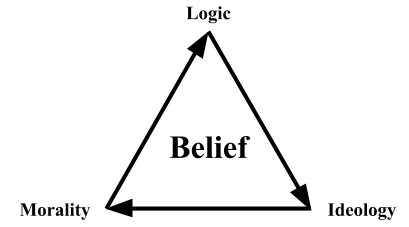
The Triangle of Belief is a method of conceptualizing the mental work necessary to form philosophical beliefs. It sorts the three stages of a belief, Morality, Logic, and Ideology, into a timeline of distinct steps while also demonstrating the looping nature of this process.
To begin the triangle, start with Morality. Like Plato’s theory of the forms, morality is an idea beyond the realistic limits of the natural world. Morality is something greater; a form of perfection that the world ought to try and imitate.
For that reason, it must be where the process of belief begins; one must first choose the most fundamental premises to start forming a belief.
For the sake of example let us use the abortion debate. Since morality is the first step, one could choose the moral position that life is infinitely valuable.
Now that the first part of the triangle is complete, move on to the second, logic. It is in this step that the consequences of the moral decision can first be seen. Logic is used as a filter, from the perfection of the form to the imperfect realm of the real; a realm based on action. Logic translates morality into action.
Beginning with the moral premise that life is infinitely valuable, the exercise of logic tells us that killing a living being would be wrong.
Step three of the triangle is ideology. Unfortunately, it seems popular nowadays to focus solely on this aspect without regard for the others. The very nature of the triangle forces these three areas to be interconnected, but without recognizing that, or by beginning the process at ideology instead of morality, it becomes very easy to produce beliefs that are inconsistent with morality, what should be regarded above all else.
The further one strays from the space of forms, of morality, and closer towards ideology, the easier it becomes to err; and only reflection on the process can reveal the mistake.
But back to the ideological step; it is here that the action dictated by logic is fully brought into the real world. Here, that logic can interact with and become real issues, politics, and beliefs. This is the testing ground; the battlefield; the reason to care about morality in the first place.
Here one could say, based on the previous steps, that they define life as starting at conception and therefore it would be wrong to abort a baby. Or perhaps one could say life starts after the child leaves the womb, which would then lead them to conclude that abortion is justifiable before birth.
Here it becomes obvious that different conclusions can be reached from the same moral starting point, hence why people who hold the same moral values can differ on philosophical beliefs.
Unlike morality, ideology is shaped by reality, by science, our best method of understanding reality, and by politics, what we do in reality. However, to say that morality is in no way shaped by reality would be false because of the very last step of the triangle; the initial morality may be changed upon learning the result of the whole process.
If ideology produces a result that doesn’t feel right, chances are you defined your morality wrong from the start. If by implementing your ideology in the real world you discover it conflicts with another moral value you hold, then perhaps you don’t really hold one of those moral values.
As well as being a process for determining belief, the triangle of belief acts as a test of one’s consistency; determining if there are errors in one’s beliefs and correcting them at the same time.
The purpose of outlining this process isn’t to detail a new theory of how philosophy ought to be conducted; rather it is to demonstrate the method already used, often subconsciously, to come to philosophical conclusions.
By walking through it, I hope to more consciously understand my own thought process in order to more easily recognize inconsistencies in my beliefs; and perhaps this visualization will help others to the same effect.
A problem with a lot of modern debates is the acceptance of shallow, or single step, conclusions, without challenge from the other steps; arguments based solely on ideology. One way to encourage deeper and more relevant arguments is to ask where our beliefs come from in the first place.


