
NOVELLA
The Trial Of Summary James — Chapter Six
A great African nation has risen in North America. But something is… wrong: Chapter 6 of 20 in the novella.
Check out the links at the end of this story under “Notes” for additional chapters.
Chapter Six
Again, I felt strange. I looked in the mirror and patted down the vestment with the understanding that there was nothing normal with this attempt to mingle with clerics. When I looked up “His Eminence Philippe Alon” on the Net, I saw that he was considered an aloof man of extended Haitian heritage, one whose family had arrived in Florida several generations ago but never mingled with other nationalities or races. He believed in the purity and sanctity of his kind, although by all accounts he was not an ethno-nationalist. He and his ancestors simply believed in their culture so deeply, the stories said, that they kept all their marriages “in-house.”
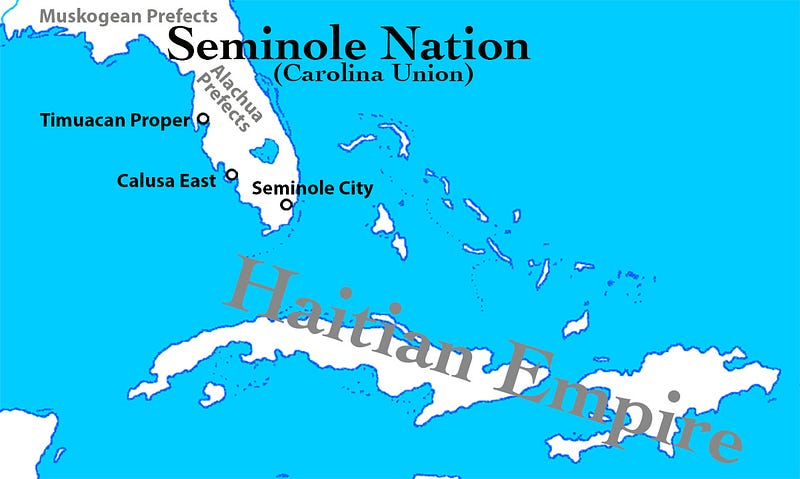
As for the Seminole Caribbean Protestant Voudoo Congregation itself, there were no alarm bells. There was no enforced ethnic policy. Its constituents were mostly Seminole and Caribbean, but that was a function of geography, not policy. Voodoo, or voudou as spelled within the congregation’s formal title, was a minor adjunct to a devout Christian flavor armored by reverence for the Virgin Mary. According to various sources on the Net, voodoo was used medicinally as a part of faith healing services in the dozen or so churches of the congregation.
There wasn’t much public information about their business interests, but Sonoma Holmes’s baseball bats were mentioned, as were baseball gloves, some equestrian equipment such as saddles, plus a few hotels on some islands in the Haitian Republic, which encouraged congregational investments, especially out of the Seminole Nation. The congregation was registered with the Synod, which meant that their payroll should have been publicly available. As far as we could tell, it was not.
Curiously, the congregation also offered accounting services to other congregations, including, surprisingly, Navasota. I looked in the mirror, thinking I should have played a congregational financier instead. It would have been easier than wearing this goofy uniform.
I took a rideshare to the congregational headquarters, which was a long three-story structure with yellow, red, and blue wood façades and steep turret roofs centered at the top of each of its three wings. The building was surrounded by a dense mixture of palms and wide-leaf tropical plants, and each façade was draped in a wide, mossy vine. When I exited the rideshare and reached the entrance, I was greeted by a friendly-looking man in a derby hat, a finely pressed blue silk robe, and white trousers. He opened the door for me with a slight bow, and I nodded.
The interior smelled a little moldy and was darker than I would have expected a public entrance. On one wall was a line of lit fat candles leading to a dark hallway. On the other wall was a series of three-foot square electric red, blue, and yellow flat LED lights embedded into wood paneling. They produced dim lighting that glazed the room with an eerie dark golden hue.
A long, curved wood structure resembling a wet bar revealed itself just beyond the entrance. A woman dressed in a floor-length white skirt gathered at the waist was entering something into a keyboard as I approached the counter. Her skirt was tightened with a wide patchwork stripe ruffled from the knee downward. Her skin was a stunning reddish-brown highlighted by a beige long-sleeved blouse decorated with yellow and blue diamond patches. A small cape trimmed at its edges by a line of small fat feathers was attached to the back of the short blouse, which barely covered her chest and left much of her midriff exposed above the line of her skirt. She looked up, smiled at me, then asked politely if I needed help.
I explained that in honor of the tradition of congregational calling, I was making a call upon His Eminence. After I showed her my credentials, she politely nodded in understanding before leading me to the dark hallway, which lit up as we approached to reveal a long series of doorways and a wide double door at its end. When we reached the end, the doors opened slowly and silently by themselves. She paused, tapping something into the com bracelet on her wrist, then whispering something into it.
We entered an expansive, circular room. When I looked up, I could see I had missed this architectural feature as I approached from outside, as its high ceiling was capped by a dome beautifully painted inside with a mural featuring angels and women, all of them naked. She motioned for me to sit at a massive walnut square table surrounded by tall wooden chairs upholstered with what to an eye uneducated in the arts like mine looked like ink drawings of various battles. Each chair had its own distinctive battle that I thought one could spend hours looking at, they were so finely drawn and detailed.
She must have noticed my admiration because she said in a surprisingly deep voice, almost a different octave than the one she had greeted me with, “These are the battles of the great revolution. Each representing a victory at the birth of the Haitian Empire.” I touched the drawing between my legs as I sat, thinking that the ink looked so pure and fresh that it should smear as I swiped my finger across it, but of course, that did not happen.
She smiled at me again and said, “Everyone loves the art of these chairs. I think they are at least one hundred and fifty years old, but, in truth, nobody knows where they originated.”
“I’m surprised you let people sit in them,” I replied. “They’re like museum pieces.”
“Some say that their durability is sourced in magic,” she said, to which I nodded politely. The chairs had such tall backs that my head was barely over the top. Each chair was framed with its own distinctive ornate curvatures.
A long, thin drone rolled in and offered me tea or coffee in a muffled, artificial-sounding voice. I chose coffee. A cube-shaped smaller drone no higher than the woman’s knees appeared instantly. The first drone reached over as the second drone opened its top like a flat lid to reveal a pitcher from which the first drone poured a cup. It then placed it in front of me. “Thanks,” I said to everybody involved, but especially the young lady, who was quite attentive and pleasant.
She bowed slightly and said, “His eminence will be here shortly. He says he is honored and looking forward to meeting with you.”
I nodded graciously, and she walked out. As soon as the doors shut behind her, two large panels in the room opened to reveal long flat screens, each of which was probably at least four yards wide. Only one of them turned on. A video of two jungle cats fighting. I was taken aback by such an odd form of waiting room entertainment for a visiting cleric. The video was rather gruesome, with one of the cats actually winning — these things normally resulted in one running away, at least in nature programs I had seen on television. But this one concluded with one of them sinking its teeth into the throat of the other and looking around afterward, guarding its kill.
As I was watching, His Eminence, Philippe Alon, must have walked in because I heard a voice standing not quite directly behind me about 15 feet say, “Life is about struggle, is it not, reverend?”
When I looked over my shoulder, I noticed that the man was nearly eye-to-eye with me even though I was seated. He had a high-pitched but dull voice that was difficult to understand with his French accent. He wore a very simple white tunic tied around the middle, almost like a bathrobe. “The struggle never ends, unless by our own complacency, in which case, it is our end, given to us by our opponents, who are happy enough to strike our throats and end our days.”
The tiny Haitian sat down across from me. The back of his chair towered over him. “What brings you to our fine congregational home?”
I couldn’t think of a place I had ever wanted to leave sooner, so I got to the point.
“Frankly, I think we have a shared problem.”
The little man had a strange face. It was somehow simultaneously round and long. I had to study it for a moment to truly understand its geometry. He was mostly bald but for a small lock of hair cut in a perfect square at the peak of his head. His forehead began nearly square but quickly rounded out at the temple and was girded underneath by wide, round cheeks. Long shark’s tooth earrings hung by thin strands resembling fishing line dangled from his earlobes. When he had smiled faintly at me while speaking his spooky words, he revealed yellowing teeth with hints of longer-than-normal canines.
He nodded as if he seemed to understand, but, of course, I knew he couldn’t. “Go on,” he said politely enough.
“May I sync with your monitor?”
He nodded, then gave me the portal and code. I sent the image of Luemba to his monitor. We both looked at it as I told him that the man had been found snooping around the Navasota congregational headquarters.
“I must admit I do know this man. He is an integral part, as a matter of fact, of everything we do here.” He then got up and walked away, just like that, the doors closing behind him. The image of Horse Luemba went dark. And so did I.
End of Chapter Six
You can purchase the full novella for 99 cents here:
Table of Contents (links will appear as additional chapters are published daily on Medium):
Chapter 1 Chapter 2 Chapter 3 Chapter 4 Chapter 5 Chapter 6 Chapter 7 Chapter 8 Chapter 9 Chapter 10 Chapter 11 Chapter 12 Chapter 13 Chapter 14 Chapter 15 Chapter 16 Chapter 17 Chapter 18 Chapter 19 Chapter 20
NOTES
This short novella was unplanned. I wrote it under my legal name way back in 2021. Side note: The pen name Charles Bastille originated after the publisher of MagicLand convinced me my name would not be SEO-friendly — I’m no longer convinced that matters and haven’t decided yet if I should publish additional works under the Bastille pen name.
The novella takes place in an alternative North America that celebrates diversity, avoided genocide, and corrected the mistakes of slavery as a side-effect of a failed Revolutionary War. As such, although no human endeavor can avoid tragic error, it takes place on a much less dystopian continent than our current experience.
The world represented here is much larger than can be conveyed in such a short book. This world is more fully represented in a trilogy called Restive Souls, which begins in the late 18th century. It is still in final edits.
But the main character of this novella, Longman Jones, told me he wasn’t willing to wait for me to finish that novel. Maybe that is in part because he makes no appearance at all in the larger work.
But he is a restive soul, and he needed to get out of my head. So I took a couple weeks off from the main novel way back in 2021, and wrote this, in hopes he’d shut up. I never really promoted it, but I’m starting to now a bit.
If you enjoy this novella, please let your friends know that for 99 cents they can spend a couple hours with Longman in a more egalitarian world than what they may be used to. It will make him very happy if you do.
For updates on the Restive Souls series, visit https://medium.com/restive-souls. Or subscribe to my newsletter fiction here (takes you to a site off the Medium platform).
Consider this short novella a teaser for the broader work. And if enough people like it, I suspect Longman Jones will also make another appearance or three.
Thanks for reading!

This story was written by a human, not by AI or Grammarly GO (More Info).
Copyright © 2020–2023 Charles White
All rights reserved
The characters and events portrayed in this book are fictitious. Any similarity to real persons, living or dead, is coincidental and not intended by the author.
No part of this book may be reproduced, or stored in a retrieval system, or transmitted in any form or by any means, electronic, mechanical, photocopying, recording, or otherwise, without express written permission of the publisher.
Cover design by: Charles White; cover image licensed from Adobe Stock
Published in the United States of America